


On January 15, 2026, the United States Senate delivered a rare moment of legislative clarity in an otherwise grinding appropriations season. With an overwhelming vote of 82 to 15, senators approved a three‑bill “minibus” funding package for fiscal year 2026 that now heads to President Donald Trump’s desk for his signature.
This package is composed of the Interior‑Environment, Commerce‑Justice‑Science, and Energy‑Water appropriations bills. It is designed to keep a significant portion of the federal government funded through the end of the fiscal year on September 30, 2026, supplanting the continuing resolution that currently sustains federal agencies and expires on January 30.
The House of Representatives had already approved this same package on January 8 by a 397‑28 vote, striking a rare chord of bipartisan agreement in a divided Congress.
From NASA missions and weather satellites to public lands and water infrastructure, the minibus touches agencies that carry out everyday but essential functions of government. The resounding bipartisan support reflected more than just collegiality; it signaled a broad legislative consensus that long‑standing federal programs should not be held hostage to political brinkmanship. However, it is important to note that this minibus is focused on the least controversial agencies.
Want to Know Your Rights?
Download a free digital copy of the U.S. Constitution, the same document Trump is trying to bulldoze. Learn exactly what he’s breaking, and how to fight back.
100,000+ strong — and counting.
This winter of our discontent, become a paid subscriber for just $1 a week and help us keep the truth alive.
Join The Coffman Chronicle — $1/Week
What Congress Actually Did on Funding
It is important to be precise about what this minibus accomplishes. Despite some headlines suggesting a “boost” in funding, the enacted numbers are not dramatic increases over prior years’ appropriations. Rather, these bills preserve relatively stable funding for the covered agencies and, in many cases, avert the deep cuts the White House proposed in its FY 2026 budget request.
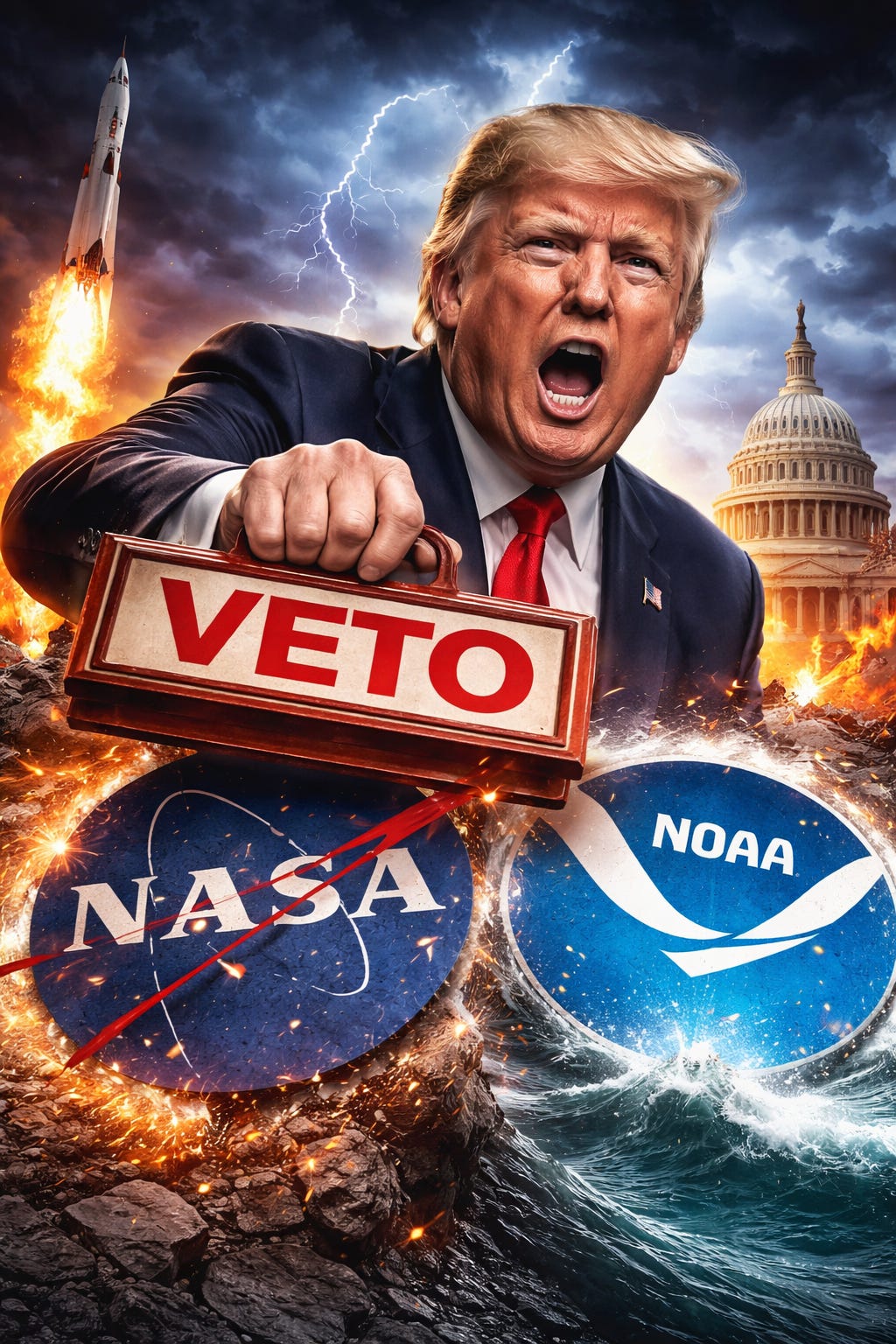
The Trump administration had sought steep reductions to science and data agencies, including proposed cuts to NASA, the National Science Foundation (NSF), the National Oceanic and Atmospheric Administration (NOAA), and other parts of the Department of Commerce and Energy. The appropriations text approved by Congress rejects those deep cuts, instead opting for funding levels that keep these agencies operating near their recent historical baselines.
For example, NASA’s budget under this bill is set at about $24.4 billion, slightly below the FY 2025 enacted level but significantly higher than the White House’s requested figure, which had called for a 47% reduction. The National Science Foundation likewise receives funding that, while modestly below its last enacted level, far exceeds the administration’s budget blueprint of a 57% cut.
“Today, we sent funding bills to the president’s desk that reject the steep cuts he wanted and protect investments that families across America depend on every day… This package saves a key program to save families on their energy bills, sustains our investments in scientific research, and protects essential funding for our public lands and Tribes, among so much else. Passing these bills reasserts Congress’ power of the purse and will prevent this administration from having the legal authority to decide for itself how to spend these taxpayer funds again. Democrats will keep fighting to protect investments in the American people—and I look forward to getting the rest of our bills across the finish line.”
Senator Patty Murray (D-WA), Vice Chair of the Senate Appropriations Committee and Ranking Member of the Energy and Water Development Subcommittee.
By maintaining funding close to normal levels at these agencies, Congress effectively defied the Trump budget request without resorting to dramatic spending increases. That distinction matters because it frames the bill not as a splurge but as a defense of existing public services and core governmental functions.
The Looming Question: Will Trump Sign It?
The bill now sits on President Trump’s desk. At this moment, his decision on whether to sign it is a central political question. On the one hand, the breadth of bipartisan support in both chambers suggests that the bill should be a straightforward signature for a president seeking to avoid a government shutdown.
On the other hand, Trump’s recent record on vetoes suggests that he may be willing to reject even broadly supported measures. In late December 2025, he issued his first two vetoes of his second term on bills that had passed both chambers of Congress by wide margins. One concerned the Finish the Arkansas Valley Conduit Act, and the other dealt with expanding the reserved area of the Miccosukee Tribe in Florida. Both had passed nearly unanimously, yet when Trump vetoed them, congressional attempts to override the vetoes failed to reach the two‑thirds threshold required in the House of Representatives. Those override votes fell far short despite the bills’ earlier showings of broad support.
See our reporting here:
When Loyalty Becomes Law
·The strongest definitive sign yet of intraparty conflict of Donald Trump’s second term didn’t come in a rally speech or a social media post. It came on December 30, 2025, in a veto pen, aimed not at Democrats, but at his own party. With a stroke of his Sharpie, Trump ki…


That episode is a reminder that overwhelming initial votes do not always translate into override majorities once a president has signaled a veto. Members often retreat from supporting overrides when faced with a direct presidential rebuke.
A veto of this minibus would be a different kind of act, however. The bills that Trump rejected last year were discrete, relatively narrow measures. This minibus encompasses extensive and routine government funding that is generally uncontroversial outside of internal budget politics. To veto a package that both parties have overwhelmingly approved would be a clear break from the customary deference presidents pay to bipartisan spending agreements.
Appropriations Beyond the Minibus: The Hard Work Still Ahead
That reality becomes even sharper when one looks at the broader appropriations landscape. Although passage of this three‑bill minibus clears one hurdle, Congress still has not completed all twelve regular appropriations bills for FY 2026. Funding for the Department of Homeland Security (DHS), Defense, Labor‑HHS‑Education, Transportation‑HUD, and several other areas remains unresolved, with some measures still stalled in committee or facing deep partisan divisions.
Funding for DHS in particular has become a flashpoint, complicated by partisan divisions over immigration enforcement and oversight of agencies such as Immigration and Customs Enforcement. The DHS appropriations bill, originally expected to be folded into another minibus, was removed amid political pushback and now stands as a stand-alone obstacle that could complicate other funding negotiations.
That imbalance — one bipartisan package finished and sent to the president, others unfinished and fraught — lays bare the narrow path remaining for Congress to avert a shutdown when the continuing resolution expires at the end of January.
We covered the origins and timeline of this process in depth in our earlier article on the minibus negotiations. That piece charts how months of behind‑the‑scenes bargaining led to this moment.
Read that article here:
Snarkitorial: It’s Budget Blitz Month... Again
·As the frigid wind blows through Washington, D.C., the dust has just settled on the last extended shutdown. Naturally, that means it’s Budget Blitz Month, baby!

What Happens If Trump Vetoes This Bill
If President Trump were to veto this minibus, the political responsibility for any resulting government shutdown would be unmistakably his.
The remaining appropriations bills are mired in deep disputes that make their timely passage uncertain, even if the House and Senate are determined to act before the January 30 deadline. Without this already‑passed package in place, the government would begin to experience funding lapses for key departments and programs, and the narrative of a shutdown would shift away from Capitol Hill dysfunction to a president rejecting a bipartisan agreement that most of his own party supported.
That scenario strips away claims that Democrats are to blame. The evidence would show that Congress did act, passing a broadly supported funding bill, and that the veto, not legislative gridlock, was the proximate cause of the funding lapse. In that event, Trump’s attempt to paint a shutdown as the fault of the opposing party would ring hollow.
While it remains to be seen what decision he will make, it is clear that a veto of this bipartisan bill would be a striking escalation in a year already defined by political battles over budgets, immigration, and the reach of federal programs. What happens next will shape the narrative around the looming funding deadline and the politics of governance itself in 2026 as the midterms approach.
Like what you're reading?
Subscribe to get clear, grounded reporting on the real stakes behind Washington's power plays. No spin — just what’s happening, why it matters, and who’s responsible.
Sources:
“U.S. Senate passes bill to boost federal science spending after White House sought major cuts” — Reuters, January 15, 2026
“Senate Passes Three‑Bill Funding Package in 82‑15 Vote” — U.S. Senate Appropriations Committee release, January 15, 2026
“Senate passes funding for NOAA, NASA and NSF; bill goes to president’s desk” — University Times, January 15, 2026
“Congress Passes Appropriations Package to Sustain Funding for NASA, NOAA, Fisheries, and More” — IFPTE, January 16, 2026
“Congress Set to Finalize Science Budgets Rejecting Trump Cuts” — American Institute of Physics (FYI), January 9, 2026
“Trump vetoes the first 2 bills of this term” — CBS News, updated January 1, 2026
“House rejects effort to override presidential veto for Colorado water project” — Colorado Politics, January 8, 2026
“House falls short of overriding 2 Trump vetoes of bipartisan bills” — ABC News, January 8, 2026
“Trump vs. Every Member of Congress” — Wake Up To Politics, January 8, 2026
“FY26 Appropriations Update: Congressional Appropriators Release Minibus Spending Bill…” — Consortium for School Networking/CRA blog, January 7, 2026
“House Passes Minibus Including Strong Funding for NSF” — FABBS, January 14, 2026
Start pressure to override the inevitable veto. Make it count!