


Welcome back to Truth or Satire?, the game where knowing a lot about current events mostly means knowing that absolutely nothing can be dismissed on vibes anymore.
Five headlines. Some are true. Some are not. Some have been through the internet’s industrial context-removal machine. Make your picks, then see whether your instincts still work in modern society.
SCORE YOURSELF
4–5/5: Congratulations. You can still distinguish reality from whatever this is. Please remain available for consultation.
2–3/5: Respectable. Your internal fact-checker is functioning, but the warning lights are on.
0–1/5: Honestly, just start clicking “I Accept” on everything. The terms and conditions have already won.
Let’s play……
This Community Is Powered by You
We cover the chaos, corruption, propaganda, and policies shaping the country, plus the occasional descent into the surreal.
Follow for sharp political commentary, honest media analysis, and weekly reminders that reality is now competing directly with parody.
THE WEST WING, WET AND WILD
THE VIRAL HEADLINE
Trump proposed replacing the White House Press Room with a pool.
THE BACKGROUND
The relationship between Donald Trump and the White House press corps has never exactly been a Hallmark movie, but during his second administration, the fight moved beyond insults and into the mechanics of who gets access to the president. In February 2025, the White House took control of the presidential press pool away from the White House Correspondents’ Association, breaking with a system under which journalists had largely determined the rotating group allowed into spaces too small to accommodate the entire press corps. Trump summarized the change rather efficiently: “We’re going to be now calling the shots.”
That change followed a fight with the Associated Press, which the administration restricted from some presidential events after the news organization declined to adopt Trump’s preferred name, “Gulf of America,” for the Gulf of Mexico. A federal judge subsequently ruled that the government could not punish the AP for its editorial choices, but the administration redesigned the pool system anyway, retaining day-to-day discretion over its composition. By September 2026, CNN, MS NOW, and Politico were fighting their own White House access restrictions in federal court, while television networks temporarily suspended pool-camera coverage in protest.
The term “press pool,” incidentally, is not metaphorical journalism jargon invented specifically to make this story ridiculous. Because only a limited number of reporters can physically accompany the president into certain events, a rotating pool attends and distributes its reporting to the rest of the press corps. Pools travel in motorcades, aboard Air Force One, and into cramped presidential appearances where several hundred credentialed journalists would otherwise have to settle matters through trial by combat.
However, the White House also has another, considerably wetter connection to the word. Franklin Roosevelt had an indoor swimming pool built inside the White House in 1933 for exercise and therapy for the effects of polio. Richard Nixon later had a floor constructed over the pool to create additional workspace for reporters, and the modern briefing room eventually occupied the space. The old swimming pool was not filled in or demolished. It remains beneath the White House press area because American democracy has been sitting directly on top of the punchline for more than half a century.
THE REALITY
On Sunday, September 27th, Trump supplied the source material himself. In a Truth Social post, he shared side-by-side images of the James S. Brady Press Briefing Room and an ornate indoor swimming pool. The briefing room was labeled “Fake News — Before.” The other image, labeled “FDR Pool — After,” depicted a gilded restoration of the swimming pool that once occupied the space beneath the press area.
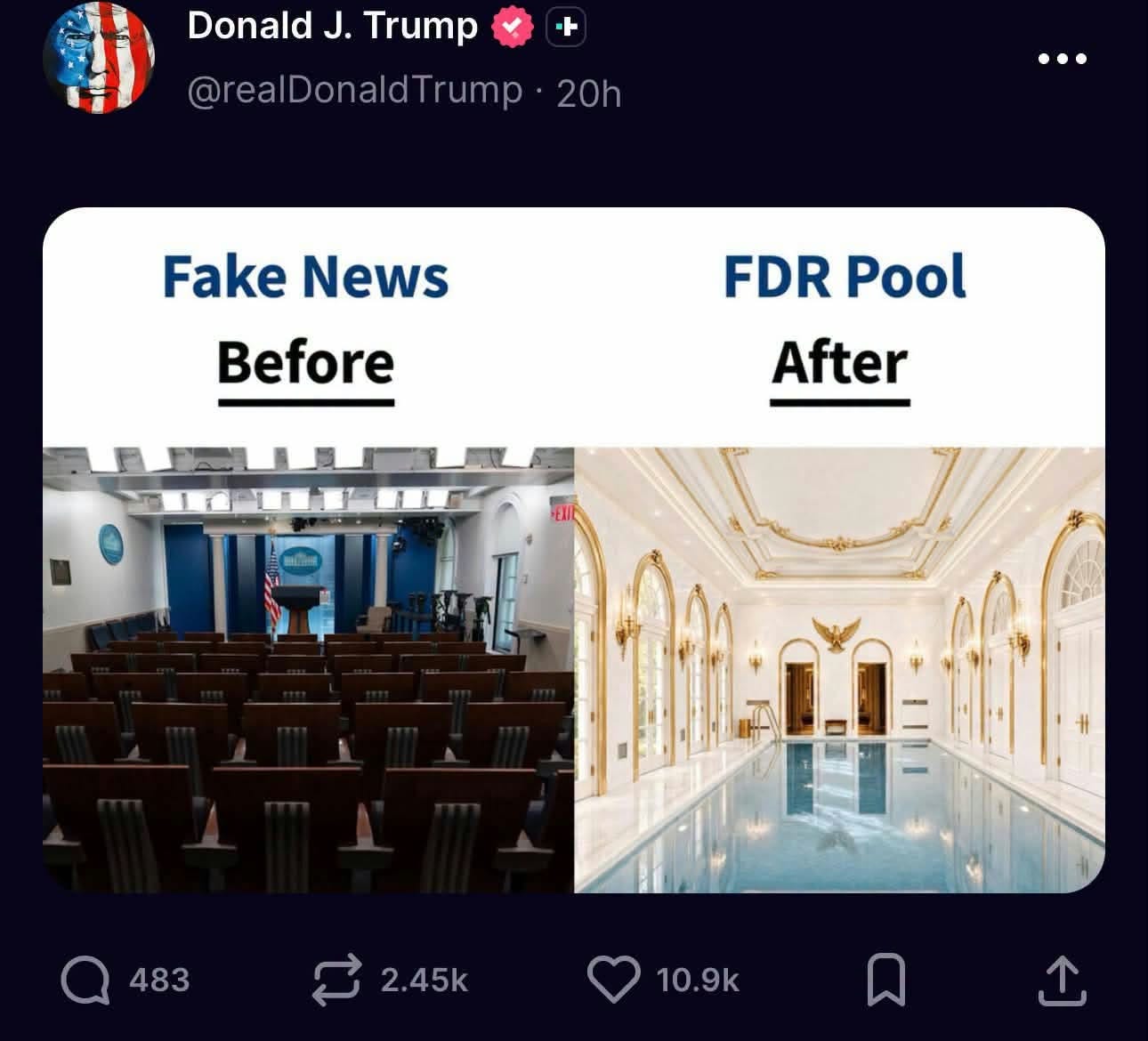
So, yes, Trump publicly floated replacing the press room with a swimming pool. What remains unclear is how far beyond the social-media post the idea had traveled. The White House did not announce a construction project, release architectural plans, provide a timetable or budget, or otherwise indicate that work on restoring the pool had begun, but there have been other projects that have emerged seemingly “fully formed” (yes, those quotation marks are satirical) after the first whiff was treated as a joke.
When People sought comment about the idea, the White House declined. Whether that was the start of another White House construction project or an elaborate way of trolling reporters remains, for now, somewhere beneath the surface.
THE VERDICT
TRUE WITH A FLOATIE-SIZED CAVEAT
Washington has finally found a bipartisan infrastructure project: putting reporters underwater.
Also, we refuse to believe that he put together the press pool pun and the historic use of the space himself. At best, this is a coincidence or a regurgitated trope. However, we will not be wagering on the likelihood of this eventually happening because gestures vaguely.
THERE WILL BE BLOOD
THE VIRAL HEADLINE
Menstrual blood is a source for stem cells.
THE BACKGROUND
Modern medicine has an awkward history with the female body, particularly when pregnancy or reproduction might complicate the experiment. In 1977, FDA guidance recommended excluding women of childbearing potential from early phases of drug trials, a category broad enough to include women using contraception, unmarried women, and women whose husbands had undergone vasectomies. The policy was reversed in 1993, the same year Congress directed the National Institutes of Health to ensure that women were included in NIH-funded clinical research.
Menstruation has occupied an especially strange corner of that neglect. In 2023, researchers trying to improve the measurement of heavy menstrual bleeding reported what they described as the first comparison of modern menstrual-product capacity using human blood products rather than water or saline. They tested 21 products with expired packed red blood cells. Even that was only an approximation: menstrual fluid is not simply blood but a mixture that also includes endometrial cells, vaginal secretions, and other biological material, making the substance menstrual products are designed to absorb considerably more complicated than red-colored water.
Sometimes the blind spots are anatomical. The rete ovarii, a structure associated with the ovary, appeared in early editions of Gray’s Anatomy before largely disappearing from modern textbooks after being dismissed as a functionless remnant. Researchers recently took another look. A 2025 eLife study in mice found three distinct regions persisting into adulthood, fluid moving through part of the structure toward the ovary, secreted proteins potentially relevant to ovarian function, and connections with blood vessels, immune cells, and nerves. Its exact function, particularly in humans, remains unresolved. The structure apparently spent more than a century progressing from “we found a thing” to “probably nothing” to “perhaps somebody should have kept studying the thing.”
Meanwhile, few areas of biomedical research have carried more cultural baggage than stem cells. Much of the American political fight centered on embryonic stem-cell research and therefore became entangled with abortion, embryo research, IVF, and questions about when human life begins. But “stem cell” describes a much broader category of cells, and medically useful or scientifically interesting stem and progenitor cells can come from sources including bone marrow, peripheral blood, umbilical-cord blood, and other tissues. In other words, decades of political argument have trained Americans to hear “stem cells” and immediately picture embryos, while decades of medical history gave researchers plenty of opportunities to overlook what female reproductive tissue might be doing right in front of them.
THE REALITY
Scientists can obtain stem/stromal cells from menstrual fluid. Researchers commonly call them menstrual blood-derived stem/stromal cells, or MenSCs, and the scientific literature describing them now stretches back years, but the story just hit the algorithm this week. A 2018 review even called human menstrual blood a “renewable and sustainable source of stem cells,” while later reviews have examined their properties and possible applications in regenerative medicine.
That does not mean menstrual blood is stem cells, or that it is some sort of monthly bag of embryonic stem cells waiting to be harvested. Menstrual fluid contains blood along with cells and material shed from the endometrium and other reproductive-tract secretions. Researchers isolate and culture particular cell populations from that material. Researchers have also identified cells with mesenchymal stem/stromal characteristics in the endometrium itself, including the functional layer shed during menstruation, which helps explain why they can appear in menstrual effluent.
Even the terminology comes with an asterisk. Scientists use both “mesenchymal stem cells” and “mesenchymal stromal cells,” and a 2021 review cautioned that the identity of MenSCs had sometimes been too loosely defined, with continuing disagreement over their markers and differentiation potential. Researchers have reported rapid proliferation, immunomodulatory properties, and the ability of cultured MenSCs to differentiate along multiple cell lineages, but those laboratory characteristics should not be confused with proof that every cell collected during menstruation is a stem cell.
The existence and now more widely known knowledge of these cells, however, does not mean that menstrual-derived stem-cell treatments are already routine medicine. Much of the therapeutic work remains experimental, involving laboratory studies, animal models, and limited clinical research.
THE VERDICT
TRUE
Thousands of years of menstruation, and science is still going through the lost-and-found box. If development continues at the same pace as most aspects of women’s health, we are likely to see the outcome of uncontrolled climate change long before significant therapies are available.
THANK YOU FOR YOUR SERVICE AGREEMENT
THE VIRAL HEADLINE
ICE agents attracted by huge bonuses are being fired before the end of their probationary periods and forced to repay bonuses.
THE BACKGROUND
ICE spent the past year attempting one of the fastest law-enforcement expansions in modern federal government. Congress poured tens of billions of dollars into immigration enforcement, and the agency launched a nationwide recruiting campaign intended to dramatically expand its workforce. By January 2026, ICE said it had hired roughly 12,000 new officers in less than a year. The recruiting campaign attracted more than 220,000 applications and advertised signing incentives reaching tens of thousands of dollars.
Moving that many applicants through a federal law-enforcement hiring system created another problem: federal agents normally require rather more vetting than the assistant manager at Chili’s. A whistleblower who supervised background investigations warned the Department of Homeland Security inspector general that ICE’s overwhelmed hiring operation was making final offers before some applicants had completed basic preliminary checks, including fingerprinting, identity verification, and credit screening. The official described the situation as an “unprecedented lowering of standards” that created risks of misconduct, infiltration, and insider threats. ICE has said that required vetting remained in place and that some applicants could begin training in temporary status while full investigations continued.
Another wrinkle is familiar to anyone who has ever discovered that the exciting number at the top of a job advertisement has several paragraphs of conditions underneath it. Federal recruitment incentives can be tied to written service agreements. Congress specifically authorized ICE signing bonuses for new agents, officers, and attorneys who commit to five years of service, and required written agreements spelling out the amount, the service period, the circumstances under which the agreement can end early, and what happens if it does. A “signing bonus,” in other words, is not necessarily free money delivered by T-shirt cannon on orientation day.
Probationary employment adds yet another layer. New federal employees generally have fewer procedural protections against removal than established career employees, giving agencies greater latitude to determine during an initial period whether someone is suitable for continued federal service. Put that together with an unprecedented hiring sprint, unfinished background investigations, five-year service commitments, and recruitment incentives governed by contractual fine print, and ICE managed to create the federal-employment equivalent of clicking “I agree” without reading the terms and conditions—except the terms involve badges, guns, immigration enforcement, and potentially a great deal of money.
THE REALITY
The firing part is real. On September 15, 2026, The Washington Post reported that ICE had begun quietly dismissing some people brought in during its enormous hiring push after subsequent investigations uncovered problems in their backgrounds or supervisors found them unsuitable for the work. One profiled recruit was Joseph Moore, a 38-year-old Marine reservist hired as a deportation officer in the fall of 2025 despite a complicated employment history that included previous firings from law-enforcement jobs. ICE moved to terminate him while he was still a relatively new employee.
Moore’s case ended tragically. After an August 21, 2026 crash in an ICE vehicle left him injured, he was told days later that the agency intended to fire him. On August 28th, he went to ICE’s Philadelphia field office, where Philadelphia police said he died from a self-inflicted gunshot wound after officers attempted to de-escalate the situation. His family has disputed aspects of the official account. The broader Post investigation documented other recruits being removed as ICE revisited personnel decisions made during the hiring rush.
The bonus portion is where things get murkier. ICE undeniably advertised signing bonuses of up to $50,000, and those incentives weren't simply unconditional gifts. Recruitment incentives can be governed by service agreements with consequences if the agreed service isn’t completed. However, the widely advertised $50,000 was a maximum incentive, not proof that every recruit received $50,000 in cash upon hiring. More importantly, after reviewing reporting on the recent firings, we could not find a named fired ICE recruit who produced a repayment demand, collection notice, or other documentation showing that ICE ordered that person to return a signing bonus.
That missing link is also important for the viral add-on claiming fired recruits received only the after-tax portion of a bonus but are now being required to repay its full gross value. Such a scenario can arise under some employment bonus agreements, and tax withholding can make repayment considerably more complicated than simply handing back the amount that reached someone’s bank account. However, possibility is not evidence that it has happened to these ICE recruits. The available reporting establishes the bonuses, the service commitments and the probationary firings. It does not, at least yet, establish the final and most delicious part of the viral story: that those fired recruits are actually being handed bills for the bonuses that attracted them there in the first place.
THE VERDICT
UNPROVEN, FOR NOW
Nothing says “Welcome to federal service” quite like wondering whether HR would like its money back. Perhaps in the future, both sides will take greater care when vetting their prospects.
THE SPY WHO CAME IN FROM THE OPEN BAR
THE VIRAL HEADLINE
FBI Director Kash Patel spotted partying with Russian spy.
THE BACKGROUND
Russia has spent much of the past decade making otherwise ludicrous American political headlines considerably harder to dismiss. U.S. intelligence agencies concluded that Russia conducted a multifaceted influence campaign surrounding the 2016 presidential election, including cyber operations and efforts to manipulate political discourse. A bipartisan Senate Intelligence Committee later concluded that the assessment was supported by the intelligence and documented a much broader Russian social-media operation intended to sow division and influence Americans. Investigators found no evidence that Russia changed vote tallies, but the influence campaign itself was very real.
The techniques have evolved. In 2024, the Justice Department seized 32 domains allegedly used in a Russian government-directed operation known as Doppelganger. Prosecutors said the campaign mimicked legitimate news organizations, created fake American personas, purchased social-media advertising, used artificial intelligence, and recruited influencers to push messages while concealing the Russian government’s involvement. In a separate case announced the same day, prosecutors charged two employees of the Russian state-controlled network RT with secretly funneling nearly $10 million to a Tennessee media company that published thousands of videos aimed at American audiences.
The FBI sits at the center of that world. Counterintelligence is one of the bureau’s core responsibilities, encompassing espionage, foreign intelligence operations, covert influence, and foreign governments' attempts to cultivate people inside the United States. That work frequently depends on confidential human sources and informants operating inside complicated networks, where law enforcement, organized crime, international business, politics, and foreign governments can overlap in uncomfortable ways.
Russia adds another particularly tangled layer. Russian oligarchs, businesspeople, athletes, political figures, and expatriates have extensive international relationships, while the Kremlin has repeatedly been accused by Western governments of using seemingly ordinary commercial, cultural, and personal relationships as avenues for intelligence gathering and influence. For American counterintelligence agencies, determining where ordinary association ends and foreign intelligence activity begins is quite literally part of the job.
THE REALITY
The photograph is real, but first we need to identify the people in it. On the weekend of September 26th, FBI Director Kash Patel attended the New York wedding of former acting U.S. Attorney Alina Habba and Turkish businessman Turhan Mildon. On September 27th, Nevada federal prosecutor Sigal Chattah posted a group photograph from the festivities. From left to right, the image shows MMA manager Ali Abdelaziz, Mildon, Chattah, Habba and Patel. Abdelaziz and Patel are therefore in the same photograph, but on opposite ends of the group.
That is worth spelling out because one version of the story circulating on social media creates an easy visual misunderstanding. The Raw Story social media post says Patel was seen “partying alongside Ali Abdelaziz,” but the large photograph accompanying the post prominently shows Patel walking arm-in-arm with a woman, not Abdelaziz. The text identifies Abdelaziz correctly; the person visually foregrounded beside Patel is simply not the person the headline refers to.
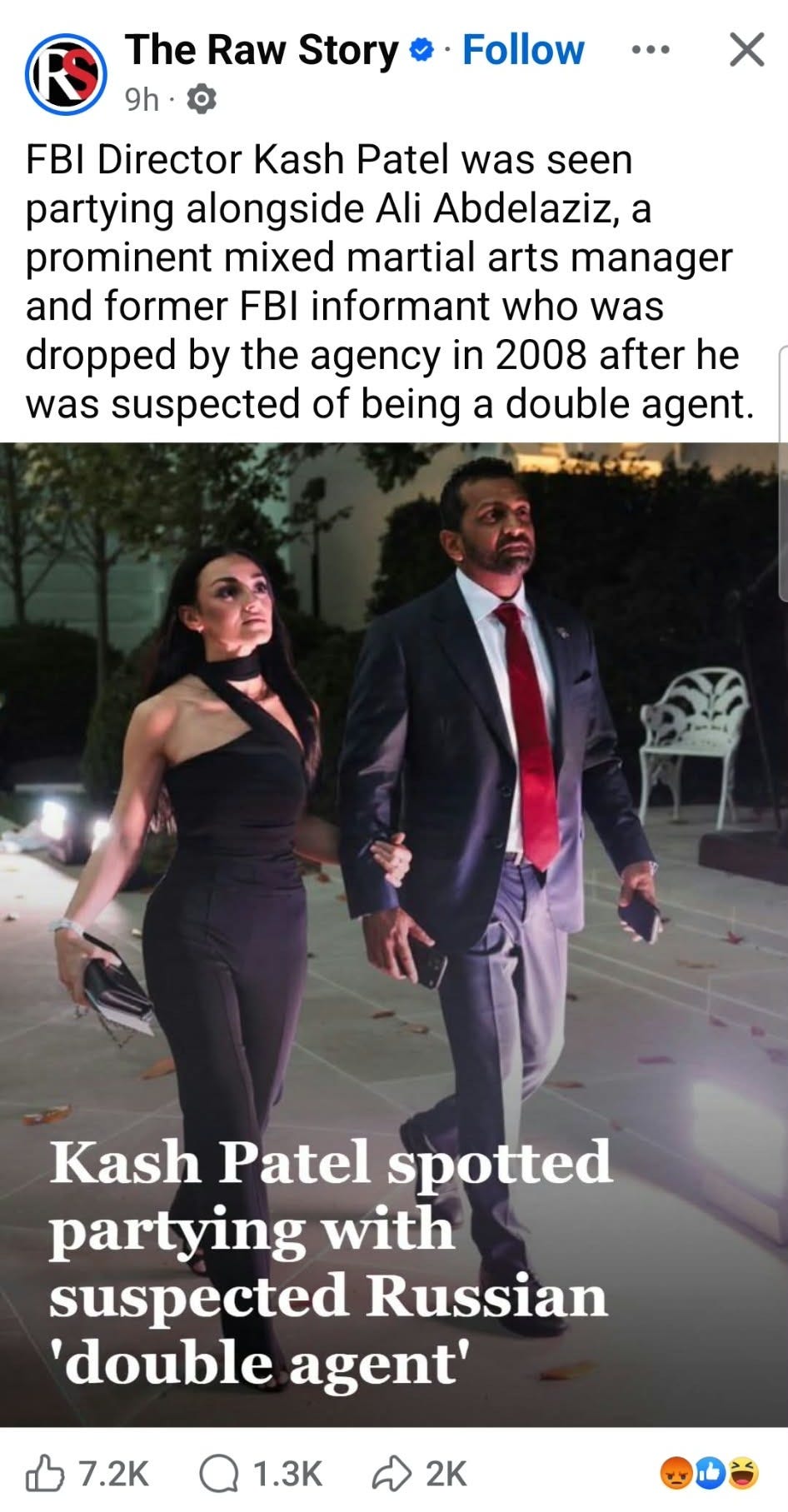
Abdelaziz does, however, have a genuinely extraordinary law-enforcement history. According to reporting based on the 2013 book Enemies Within, he was recruited while incarcerated in Colorado in 2002 to work undercover for the NYPD against Muslims of America and later became an FBI confidential informant. The FBI eventually became suspicious that he was operating as a double agent, severed its relationship with him, and unsuccessfully sought his deportation. That history was reported years before Patel became FBI director; The Washington Post, for example, described it in 2018 while covering Conor McGregor’s public attacks on Abdelaziz.
The underlying reporting establishes that Abdelaziz was an American law-enforcement informant who was later suspected of acting as a double agent. Recent coverage has additionally pointed to his professional relationships with Russian, Belarusian, and Chechen MMA fighters, including fighters connected to Chechen leader Ramzan Kadyrov. However, suspicion of double-dealing, professional connections to people from Russia and the former Soviet sphere, and an established finding that someone was a Russian intelligence operative are three different things. The wedding photograph shows Patel and Abdelaziz at the same event, posing in the same group photo. It does not, by itself, establish their relationship, and the available sources do not establish Abdelaziz as a proven “Russian spy.”
THE VERDICT
MISLEADING
Apparently even counterintelligence gets complicated once somebody starts assigning tables. To be fair, though, we used to conduct spycraft with more subtlety.
OUR AMERICAN COUSIN
THE VIRAL HEADLINE
Aides are floating a plan to attach Trump’s name to Ford’s Theatre.
THE BACKGROUND
Washington is full of buildings that function as both public institutions and national memorials, so their names carry more political weight than the average municipal recreation center. The Kennedy Center is one of the clearest examples: Congress designated it as a living memorial to President John F. Kennedy, while also creating a major national performing-arts institution. During Trump’s second term, control of the center became a political battleground as he remade its leadership, programming, physical plans, and public identity. More recently, attempts to attach Trump’s name to the institution became the subject of litigation, with courts blocking parts of the effort.
That fight is part of a broader transformation of official Washington. Trump has pursued extensive changes to the White House and surrounding capital landscape, including a massive ballroom project, alterations to the Rose Garden, changes around the Lincoln Memorial Reflecting Pool, and plans for a monumental triumphal arch near Arlington National Cemetery. Preservation groups have challenged some projects in court, while lawmakers have argued over how much authority a president has to alter buildings and memorials whose identities Congress established or protected.
Ford’s Theatre occupies an unusually delicate place in that landscape. John Wilkes Booth shot Abraham Lincoln there on April 14, 1865, making it the site of the first assassination of an American president. The government eventually acquired the building; after decades serving other purposes, it was restored and reopened as a working theater in 1968. Two years later, Congress combined the theater, the neighboring Star Saloon, and the Petersen House—where Lincoln died—into Ford’s Theatre National Historic Site. Today it operates as both a theater and a memorial and educational site devoted to Lincoln and the assassination.
Ford’s Theatre also carries a peculiar history of government intervention in what the building could be and what it could be called. After Lincoln’s assassination, authorities closed the theater and John T. Ford attempted to reopen it later that year, only to have the government prevent performances from resuming. Congress subsequently authorized the building’s purchase, and for decades it served decidedly less theatrical federal purposes—including offices and storage—before its restoration as a theater and historic site.
That leaves Washington with an institution bearing the name of a nineteenth-century theater owner primarily because it became inseparable from one of the most consequential nights in American history. Ford’s Theatre is simultaneously a functioning performance venue, a National Park Service historic site, a presidential-assassination site, and part of a larger memorial landscape devoted to Abraham Lincoln. In a capital currently arguing over who gets commemorated, whose names belong on public institutions, and how much a sitting president can remake the city around himself, even the marquee can become political territory.
THE REALITY
Unlike the White House pool, this one begins with an anonymously sourced report, not a presidential announcement. On September 23rd, MS NOW reported that Trump administration officials were circulating a list of government properties that could have the president’s name attached to them in some fashion. According to people familiar with the effort, Ford’s Theatre had emerged in those discussions. One administration official told the outlet that the idea had been discussed but said they did not know where it stood, and the report itself said it was unclear how seriously the theater was being considered or even how Trump’s name might be attached to it.
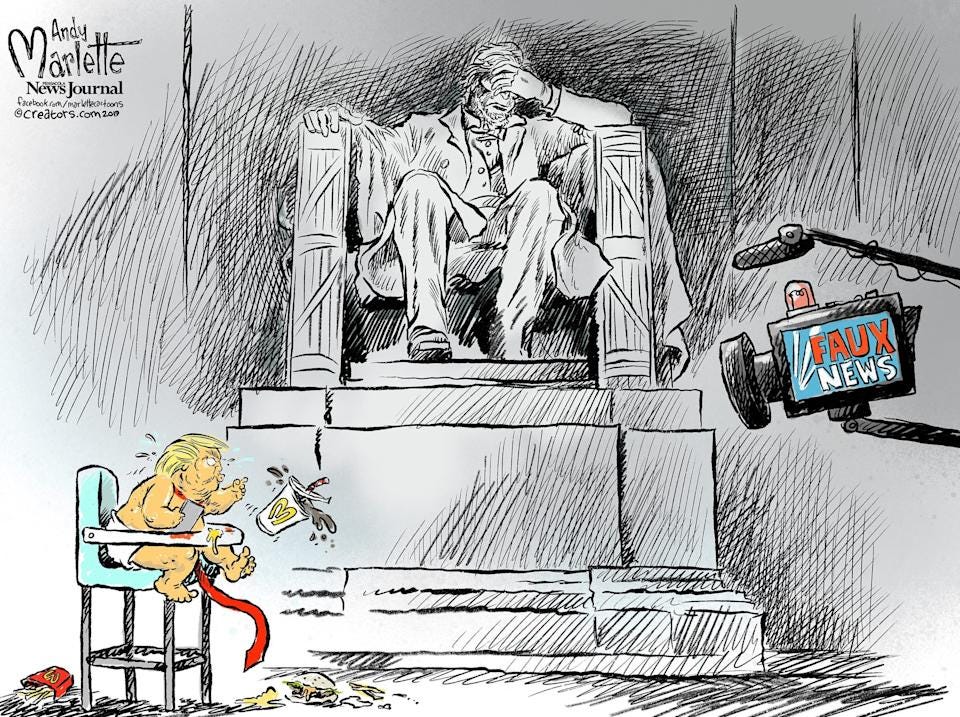
The report did not say Trump had ordered Ford’s Theatre renamed, approved a proposal, or personally requested the idea, only that administration officials had discussed it as aides considered federal properties that could carry his name. In other words, the viral headline’s unusually cautious phrase “aides are floating a plan” is much closer to the original reporting than more dramatic versions suggesting Trump himself decided to rename the theater.
The administration flatly denied the report. The Interior Department, which oversees the National Park Service site, said it was “not true.” White House spokesman Davis Ingle also rejected the story, and Trump subsequently denounced it on Truth Social as “FAKE NEWS,” arguing that he would not want his name attached to the place where Lincoln was assassinated. What we have is a familiar but unresolved journalistic collision: MS NOW says multiple people familiar with the effort described internal discussions; the administration says those discussions did not happen.
A large gap also exists between discussing a name and successfully changing one. Ford’s Theatre is part of a congressionally established national historic site, so an internal White House discussion would not, by itself, rename the institution. The Kennedy Center, alas, would like to have a word.
THE VERDICT
REPORTED AND DENIED
Washington has reached the point where even the theater marquee needs legal counsel.
That’s five more headlines successfully escorted through the narrow passage between “that cannot possibly be real” and “apparently we need to check.”
Until next time, stay skeptical, read past the screenshot, and remember: reality is under no contractual obligation to sound plausible.
If this game gets any harder, we’ll need constitutional scholars, trauma counselors, and three Onion editors on retainer just to sort the headlines.
Follow for the next round of Truth or Satire, where America dares parody to catch up. Or tune in for our regularly scheduled analysis and commentary, when the meds kick in, and we can take the headlines seriously.
Sources:
“Trump Floats Removing White House Briefing Room to Revive Hidden ‘FDR Pool’ After Barring CNN from Air Force One,” People, September 28, 2026.
“White House takes control of the press pool covering Trump,” Reuters, February 25, 2025.
“The White House is starting a new media policy that restricts wire services’ access to the president,” The Associated Press, April 16, 2025.
“White House Swimming Pool,” White House Historical Association, undated.
“History of Women’s Participation in Clinical Research,” NIH Office of Research on Women’s Health, undated.
“Absorbency of contemporary menstrual products: considerations for assessment of heavy menstrual bleeding,” BMJ Sexual & Reproductive Health, August 7, 2023.
“Rediscovering the rete ovarii, a secreting auxiliary structure to the ovary,” eLife, March 19, 2025.
“Human menstrual blood: a renewable and sustainable source of stem cells for regenerative medicine,” Stem Cell Research & Therapy, November 21, 2018.
“Menstrual blood-derived stem cells: toward therapeutic mechanisms, novel strategies, and future perspectives in the treatment of diseases,” Stem Cell Research & Therapy, December 21, 2019.
“Understanding menstrual blood-derived stromal/stem cells: Definition and properties. Are we rushing into their therapeutic applications?” iScience / PubMed, November 22, 2021.
“ICE is quietly firing new hires. For one recruit, it was devastating,” The Washington Post, September 15, 2026.
“Congressional Record — Senate, S3872,” U.S. Government Publishing Office, June 28, 2025.
“Criminal Investigator,” USAJOBS / U.S. Immigration and Customs Enforcement, current recruitment listings.
“Kash Patel spotted partying with suspected Russian ‘double agent,’” Raw Story, September 28, 2026.
“Ex-Trump official Alina Habba weds Turkish billionaire at posh NYC hotel before star-packed crowd,” New York Post, September 26, 2026.
“Conor McGregor accuses Khabib Nurmagomedov’s manager of being a terrorist,” The Washington Post, October 5, 2018.
“Assessing Russian Activities and Intentions in Recent U.S. Elections,” Office of the Director of National Intelligence / Senate Select Committee on Intelligence, January 6, 2017.
“Committee Findings on the 2017 Intelligence Community Assessment,” Senate Select Committee on Intelligence, July 3, 2018.
“Justice Department Disrupts Covert Russian Government-Sponsored Foreign Malign Influence Operation Targeting Audiences in the United States and Elsewhere,” U.S. Department of Justice, September 4, 2024.
“Two RT Employees Indicted for Covertly Funding and Directing U.S. Company that Published Thousands of Videos in Furtherance of Russian Interests,” U.S. Department of Justice, September 4, 2024.
“Trump aides explore attaching president’s name to Ford’s Theatre,” MS NOW, September 23, 2026.
“Sources: WH aides explore attaching Trump’s name to Ford’s Theatre where Lincoln was shot,” MS NOW, September 23, 2026.
“Ford’s Theatre Reportedly Eyed in Trump Naming Push,” BroadwayWorld, September 23, 2026.
“Trump Denies He Considered Renaming Theater Where Abraham Lincoln Was Assassinated After Himself,” People, September 24, 2026.
“Ford’s Theatre National Historic Site: Foundation Document,” National Park Service, 2016.