


There was a time when determining whether something happened required reading a newspaper. Today, it requires three browser tabs, a court filing, an academic paper, and occasionally someone willing to explain why a government spokesperson just said that with a straight face.
The internet has become astonishingly efficient at stripping away every ounce of context before launching a headline into the algorithmic void. By the time it reaches your feed, all that’s left is the part most likely to make you yell, “No way.”
Sometimes you’re right. Increasingly... you’re not.
Welcome back to Truth or Satire? The only game where common sense is a useful starting point, but an absolutely terrible finishing strategy.
Score Yourself
4–5/5 — Reality’s Last Fact-Checker
You can still separate journalism from fever dreams. We genuinely don’t know whether to congratulate you or recommend you spend less time online.
2–3/5 — Respectably Confused
Not bad. Reality got a few past you, but to be fair, reality has recently hired a team of professional misdirection artists.
0–1/5 — Algorithmically Optimized
Don’t feel bad. Somewhere, a viral Facebook page is already turning this week’s edition into twelve misleading memes and an AI-generated image with six fingers.
Let’s play.
This Community Is Powered by You
We cover the chaos, the corruption, the propaganda, and the policies shaping the country, plus the occasional descent into the surreal.
Follow for sharp political commentary, brutal media analysis, and weekly reminders that reality is now competing directly with parody.
DEAD MAN’S PARTY
THE VIRAL HEADLINE
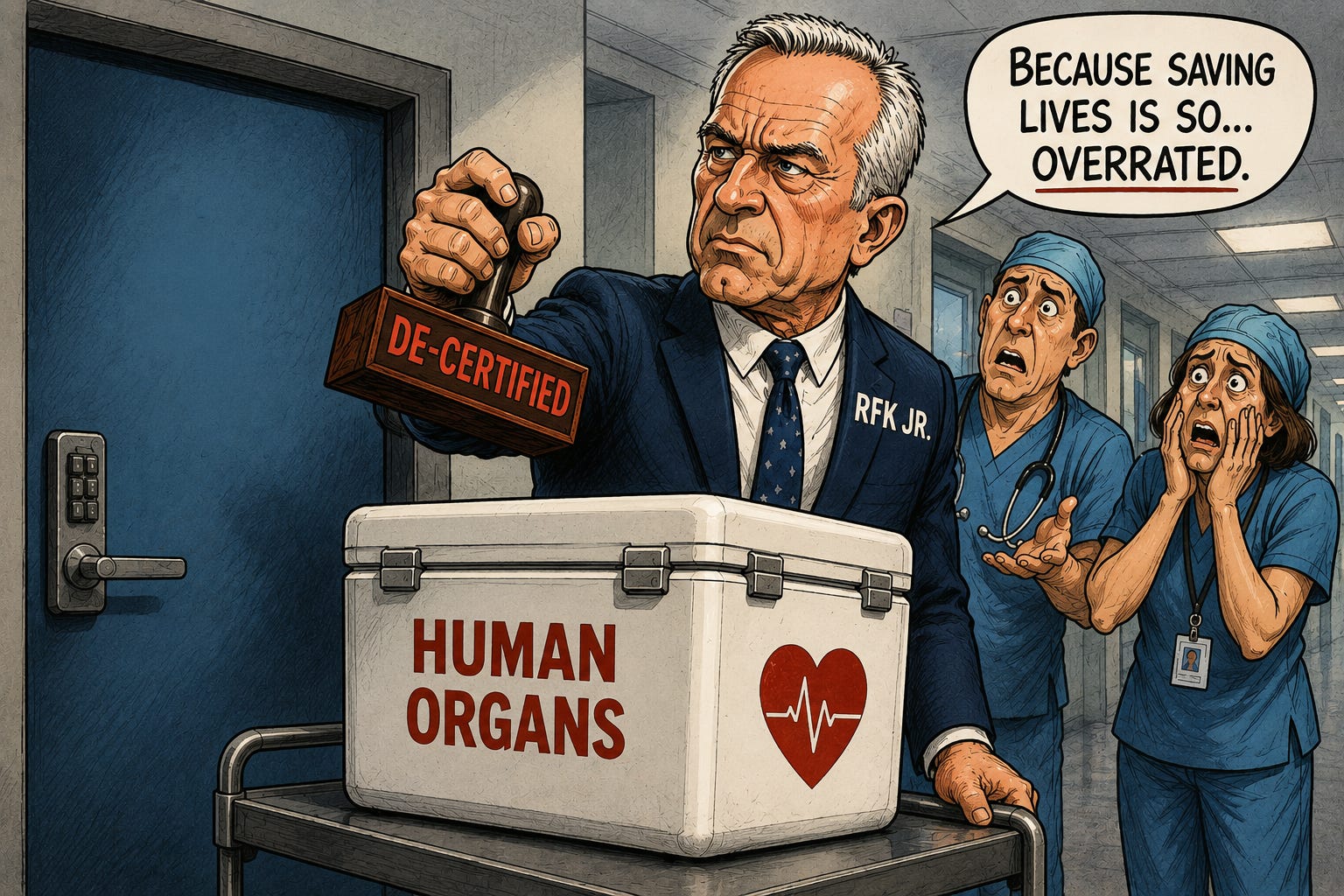
HHS is decertifying organ donation group, the Network for Hope.
THE BACKGROUND
Organ donation in the United States depends on a surprisingly complicated system operating between hospitals, transplant centers, federal regulators, and nonprofit organ procurement organizations (OPOs). OPOs step in after a physician has declared death to coordinate consent, evaluate potential donors, recover organs, and help get them to patients waiting for transplants. There are roughly 55 federally designated OPOs operating across the country.
The stakes are enormous. More than 100,000 Americans are currently waiting for an organ transplant, most of them for kidneys. More than 49,000 transplants were performed in the United States last year. The basic math means the system is under constant pressure to identify usable organs quickly without compromising the medical and ethical safeguards surrounding death and consent.
One increasingly important source of organs is donation after circulatory death, commonly called DCD. Unlike traditional donation after brain death, these cases can involve patients with catastrophic injuries who do not meet neurological criteria for brain death but whose families have decided to withdraw life-sustaining treatment. Once circulation permanently stops and death is declared, organ recovery may begin. Because timing matters enormously for organ viability, DCD requires particularly careful coordination among hospitals and procurement organizations.
Network for Hope itself is relatively new in its current form. It was created in October 2024 through the merger of Kentucky Organ Donor Affiliates and the Cincinnati-based LifeCenter Organ Donor Network. The combined organization became responsible for a large territory covering Kentucky and portions of Ohio, Indiana, and West Virginia. Federal regulators approved the merger, while the Organ Procurement and Transplantation Network adjusted its administrative regions to accommodate it.
THE REALITY
On August 5th, Health and Human Services Secretary Robert F. Kennedy Jr. announced that the federal government had begun the process of decertifying Network for Hope. Kennedy called the organization a “bad apple” and accused it of persistent patient-safety failures. The action does not mean the organization instantly ceased operating that afternoon. Decertification is an administrative process, and Network for Hope has said it will appeal.
The decision comes after a federal investigation that was considerably less whimsical than the average RFK Jr. headline. The Health Resources and Services Administration reviewed 351 cases from 2021 through 2024 in which organ donation had been authorized, but organs were ultimately not recovered. Investigators flagged 103 cases as having concerning features. Seventy-three involved patients showing neurological signs that regulators said were incompatible with proceeding toward donation, while at least 28 cases raised questions about whether patients had actually died before portions of the procurement process began.
The case that helped trigger wider scrutiny involved Anthony “TJ” Hoover II, a Kentucky man hospitalized following a drug overdose in 2021. Plans were made for donation after circulatory death, but according to subsequent investigations and testimony, Hoover showed signs of consciousness as preparations continued. The organ recovery was eventually stopped, and Hoover survived. Federal investigators later identified broader concerns involving neurological assessments, communication between procurement personnel and medical teams, consent procedures, and documentation.
There is an important distinction buried under the horror-movie framing circulating online. Network for Hope and its predecessor were not declaring living people dead so their organs could be removed. OPOs have no legal authority to declare death. The allegations concern what happened during the donation process after hospitals and medical teams had begun moving toward withdrawal of support or organ recovery. Network for Hope strongly disputes the government’s characterization, says it complies with federal requirements, and has implemented additional safeguards. However, after previously ordering corrective action and threatening decertification in 2025, HHS has now escalated from warning to enforcement.
THE VERDICT
True, with the bureaucratically important caveat that “decertifying” currently means HHS has begun the process, not that somebody unplugged the building Wednesday afternoon.
For once, the sentence involving RFK Jr. and questionable medical practices has him standing on the regulator side of the table. The broken clock has apparently requested a federal inspection.
THEY/THEM’S THE BREAKS
THE VIRAL HEADLINE
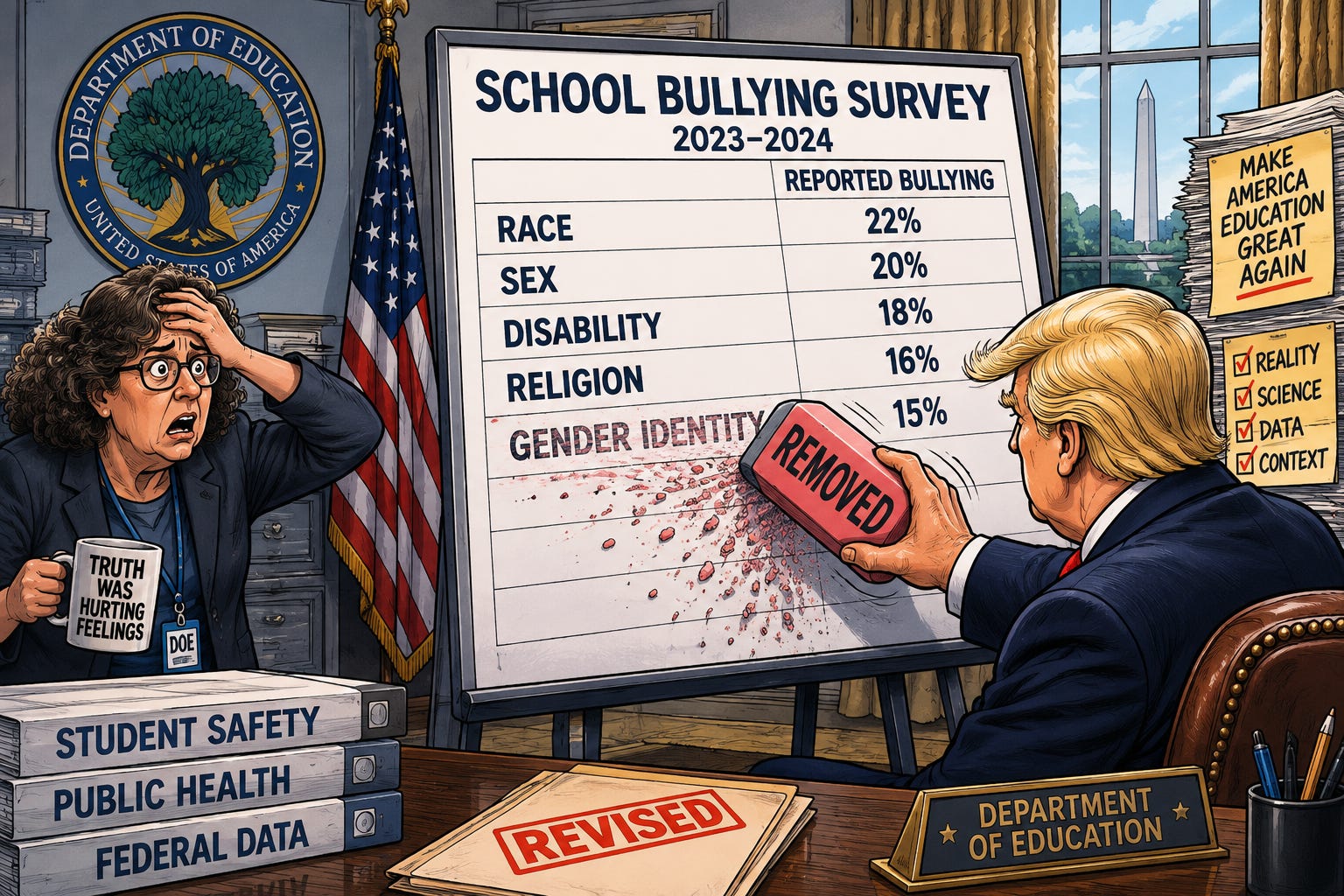
The Department of Education has removed transgender kids from its bullying survey.
THE BACKGROUND
For nearly six decades, the U.S. Department of Education has collected civil rights data from public schools through what is known as the Civil Rights Data Collection, or CRDC. Conducted every two years, the survey gathers information from roughly 17,000 school districts serving around 50 million students. Schools report everything from enrollment and advanced coursework to discipline, restraint, harassment, and bullying. The resulting database has become one of the federal government’s primary tools for identifying disparities in educational opportunities and school climate.
Bullying has long been one of the survey’s major focuses. Schools report incidents involving harassment based on race, color, national origin, sex, disability, and religion, among other protected characteristics. Researchers, advocacy groups, school districts, and federal officials use the information to identify patterns, enforce civil rights laws, and shape education policy. While individual students are never identified, the aggregate data can reveal which groups experience disproportionate levels of harassment.
Questions surrounding transgender students have become one of the country’s most contentious education issues. Over the past several years, states have adopted sharply different policies governing bathroom access, athletic participation, pronouns, curriculum, and parental notification. At the federal level, presidential administrations have likewise shifted their interpretation of Title IX, alternately expanding and narrowing protections based on gender identity through executive actions, agency guidance, and litigation.
The Civil Rights Data Collection has evolved repeatedly alongside those policy changes. Questions have been added, modified, or removed over the years to reflect new legal requirements, emerging educational priorities, or changes in federal enforcement. While the survey is often viewed as a simple statistical exercise, decisions about what information is collected can shape what problems policymakers are able—or willing—to measure.
THE REALITY
This one is essentially true, although the viral wording skips over an important distinction. The Department of Education did not literally remove transgender students from schools or from the survey itself. Rather, it eliminated questions and reporting categories that specifically tracked students based on gender identity.
The revised Civil Rights Data Collection removes references to gender identity throughout the survey and no longer asks schools to report bullying, harassment, discipline, or other outcomes affecting transgender and nonbinary students as distinct categories. Instead, schools will continue reporting broader harassment data without identifying those students separately. The department also removed questions relating to gender identity from several other sections of the collection.
The changes align with the Trump administration’s broader policy of recognizing only biological sex in federal programs. Education officials argued the revisions reduce regulatory burden and bring the survey into compliance with the administration’s interpretation of federal law. Civil rights organizations, researchers, and education groups countered that eliminating the categories will make it substantially harder to identify discrimination against transgender students because the federal government will no longer collect nationwide data measuring those experiences.
The viral headline captures the practical effect more than the literal action. Transgender students obviously still attend schools that complete the survey. What disappeared was the government’s ability to measure, at a national level, whether those students experience bullying at different rates than other children. Whether that represents streamlining, ideology, or deliberate statistical blindness depends largely on whom you ask.
THE VERDICT
Mostly true. The students didn’t disappear, but the spreadsheet did.
Apparently, if you stop collecting statistics, the statistics become much less inconvenient.
FIGHT CLUB: EXECUTIVE ORDER
THE VIRAL HEADLINE
The UFC lost $30 million hosting Trump’s birthday fight event.
THE BACKGROUND
Mixed martial arts has spent the last three decades evolving from a niche spectacle into one of the world’s largest combat sports. The Ultimate Fighting Championship (UFC) now stages dozens of events annually across multiple continents, generating revenue through live gates, sponsorships, broadcast rights, merchandise, and pay-per-view sales. Since Endeavor acquired the company in 2016, the UFC has increasingly operated as part of a publicly traded entertainment conglomerate expected to deliver predictable financial returns rather than simply produce memorable fights.
That corporate structure changed again in 2023 when the UFC merged with World Wrestling Entertainment to form TKO Group Holdings. The combined company reports quarterly earnings to shareholders, files financial disclosures with the Securities and Exchange Commission, and routinely discusses the profitability—or lack thereof—of major events during investor conference calls. Unlike promotional hype before a fight card, these disclosures carry legal obligations because investors rely on them when evaluating the company’s performance.
Donald Trump has maintained an unusually close relationship with the UFC dating back more than two decades. During the promotion’s early years, when many casinos and arenas refused to host mixed martial arts, Trump allowed UFC events at the Trump Taj Mahal in Atlantic City. UFC President Dana White has frequently credited Trump with helping legitimize the organization during its formative years, while Trump has remained a regular presence cageside and has appeared at numerous high-profile UFC events throughout his political career.
This year, that relationship reached a new level. As part of America’s 250th anniversary celebrations, the administration announced plans for a UFC card on the White House grounds. The event was marketed as both a sporting spectacle and a patriotic celebration, combining one of the country’s fastest-growing sports with one of its most recognizable political figures. Staging a major pay-per-view event on federal property, however, presented logistical and security challenges unlike anything the UFC had attempted before.

THE REALITY
This one is true. During TKO Group’s quarterly earnings call, company executives disclosed that the White House event generated an operating loss of roughly $30 million after accounting for sponsorship revenue. The figure was presented directly to investors during discussion of the company’s financial performance rather than emerging through anonymous leaks or media speculation.
The unusually high cost reflected the unprecedented nature of the event. Building a temporary arena on White House grounds required substantial investments in infrastructure, security coordination, broadcasting equipment, staging, transportation, and production. Unlike a normal UFC venue, there was no existing arena with permanent seating, lighting, locker rooms, or television facilities waiting to be rented for the weekend.
Despite the financial loss, executives emphasized that they viewed the event as a strategic success rather than a business failure. TKO argued that the extraordinary global publicity, media exposure, and long-term branding value justified the expense. In other words, the company portrayed the event less as a profitable fight card than as a massive advertising campaign whose benefits could not be measured solely through ticket sales or pay-per-view revenue.
The viral headline, then, is accurate but missing the company’s own explanation. Investors really were told the event lost approximately $30 million. What tends to disappear online is the second half of the sentence: management openly acknowledged the loss while insisting it was intentional and worthwhile because of the worldwide attention generated by hosting a UFC event at the White House.
THE VERDICT
True, and we couldn’t be happier for them.
Turns out building an octagon on one of the most secure pieces of real estate on Earth is slightly more expensive than renting the MGM Grand. Who could have predicted that “location, location, location” applies to federal monuments?
FREE WILLY: JACKASS EDITION
THE VIRAL HEADLINE
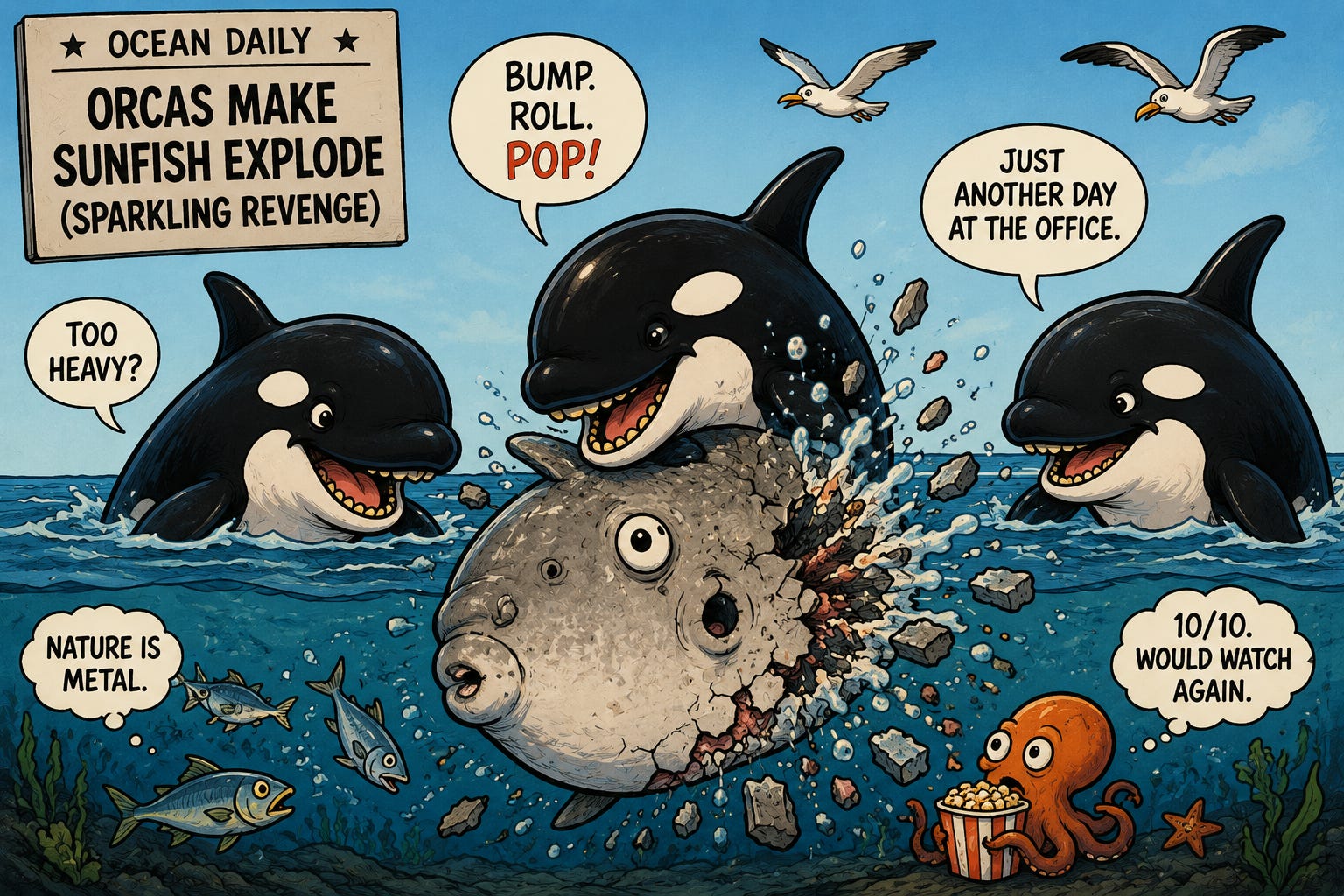
Orca whales have been spotted exploding sunfish for fun.
THE BACKGROUND
Orcas are among the most behaviorally flexible predators on the planet. Different populations specialize in different prey, and many of those techniques are learned socially rather than hardwired. Some hunt seals by generating waves that wash them off ice floes. Others cooperate to attack whales, herd fish, or target sharks. Researchers increasingly describe orca behavior in terms of culture because hunting strategies, vocalizations, and even temporary fads can spread through social groups.
They are also notorious for interacting with prey in ways that do not always look strictly utilitarian. Orcas have been documented tossing seals, manipulating carcasses, carrying objects, and engaging in what researchers interpret as play. In some populations, unusual behaviors appear briefly, spread socially, and then disappear. The famous “salmon hat” trend among Pacific Northwest orcas, in which whales carried dead salmon on their heads, is one of the stranger examples of this apparently fad-like behavior.
Sunfish are strange animals in their own right. The sharptail sunfish, Masturus lanceolatus, can grow more than three meters long and weigh up to about 2,000 kilograms. Despite their size, sunfish are relatively slow-moving and often spend time near the surface, where they warm themselves, seek parasite removal, or move between feeding depths. In the Gulf of California, they are among the prey species regularly encountered by orcas.
The Gulf of California is also an important place for studying orca behavior because the whales there do not fit neatly into the familiar resident, transient, and offshore ecotypes used to describe many North Pacific populations. Researchers are still documenting their diets, social structure, and hunting traditions, which means novel behaviors can emerge from observations that would otherwise look like oceanic chaos caught on somebody’s GoPro.
THE REALITY
The exploding part is very real. In a paper published July 23rd in Frontiers in Ethology, researchers documented a previously undescribed behavior in which one orca held a dead sharptail sunfish in place while another accelerated toward it and slammed into the carcass at high speed. The impact caused the sunfish’s body to fragment into thousands of pieces. Researchers observed the behavior in separate encounters in 2024 and 2025, after an earlier similar event had been witnessed in 2021.
The “for fun” part is where the viral headline gets ahead of the science. The researchers explicitly floated play as one possible explanation, but they did not conclude that entertainment was the motive. Lead author Kathryn Ayres said the behavior may help younger orcas feed more easily by breaking the sunfish into manageable pieces, or it “could also just be for fun.”
There is evidence supporting the feeding explanation. In the documented encounters, the sunfish were already dead when the high-impact ramming occurred, and juveniles were seen feeding on fragments afterward. Sunfish have tough, rubbery tissue that can be difficult for younger whales to tear apart. Pulverizing the carcass could therefore function as an extremely dramatic form of food processing: one whale holds dinner still while another turns itself into a marine battering ram.
So the viral headline combines a documented event with an unproven motive. Orcas really are coordinating attacks powerful enough to make giant sunfish burst apart. Scientists really have suggested that play may be part of the explanation. They just cannot yet tell whether this is a hunting technique, food preparation, social learning, recreation, or some combination thereof. Apparently even marine biology now requires us to distinguish between “violent feeding behavior” and “the whales thought it would be hilarious.”
THE VERDICT
Mostly true. The sunfish exploded. The orcas’ Yelp review of the experience remains unavailable.
Scientists have not established that they are doing it for fun, but somewhere in the Gulf of California, two orcas have absolutely invented a piñata between attacks on billionaire boats. Our new favorite animal?
FAHRENHEIT 372
THE VIRAL HEADLINE
Courts ruled in favor of allowing librarians to be arrested over books.
THE BACKGROUND
Book challenges have become one of the most sustained fronts in America’s culture wars. Public and school libraries have faced growing pressure over books involving sexuality, LGBTQ+ identities, race, religion, and other contested subjects, while state lawmakers have increasingly moved beyond local challenge procedures and written restrictions directly into law. Supporters describe those measures as protections against obscene material. Librarians, publishers, and civil-liberties groups argue that many of the laws are broad enough to sweep in constitutionally protected books and encourage institutions to remove anything remotely controversial.
Arkansas entered that fight in 2023 with Act 372, signed by Governor Sarah Huckabee Sanders. Among other provisions, the law created a new offense called “furnishing a harmful item to a minor.” The prohibition was not limited to pornography shops or explicitly obscene material sold to children. Its language applied to anyone who made qualifying material available to a minor, potentially including librarians and booksellers. A violation would be a Class A misdemeanor, carrying the possibility of up to one year in jail.
The law also changed the way library-book challenges could be handled. Another provision required libraries to establish procedures for reviewing material considered “inappropriate” and allowed decisions to move beyond librarians or library boards to local elected officials. Critics argued that this could transform ordinary collection decisions into political battles while pressuring libraries to move disputed books into adults-only sections or remove them altogether rather than risk litigation or prosecution.
Arkansas was hardly alone. Similar battles have unfolded across Florida, Iowa, Texas, and other states, while federal courts have reached different conclusions about how much constitutional protection applies when governments decide what belongs on public or school library shelves. In 2025, for example, the Fifth Circuit sided with Llano County, Texas, in litigation over the removal of 17 books, and the Supreme Court later declined to hear the residents’ appeal. That ruling applies only within the Fifth Circuit, but it illustrated how unsettled the law surrounding library collections has become.

THE REALITY
This one is substantially true, but the phrase “courts ruled in favor of allowing librarians to be arrested” compresses several years of litigation into one ominous sentence. A federal district judge originally went the other way. Judge Timothy Brooks blocked the challenged portions of Act 372 before they could take effect and, in December 2024, permanently ruled Sections 1 and 5 unconstitutional. His decision concluded that the criminal provision was overly broad and that the library-challenge process created serious First Amendment problems.
Arkansas appealed. In June 2026, a three-judge panel of the Eighth U.S. Circuit Court of Appeals heard arguments over whether those provisions could be enforced. The state maintained that the plaintiffs’ fears of prosecution were too speculative and that the statute could constitutionally regulate material deemed harmful to minors. The challengers argued that librarians and booksellers would have to either restrict lawful books or risk criminal liability simply for making them available.
The appeals court has now reversed the lower court’s injunction, allowing Act 372 to take effect while the litigation proceeds. That means the criminal provision the district court had blocked is no longer being held back by that ruling. Librarians, booksellers, and potentially others who furnish material meeting Arkansas’ statutory definition of “harmful to minors” can therefore face prosecution under the law. Library Journal summarized the result plainly: after previously being declared unconstitutional by the district court, Act 372 is now allowed to take effect.
The nuance is that the appellate court did not order police to start rounding up librarians, nor has a court ruled that librarians should be arrested simply because someone dislikes a book. Criminal liability depends on the statutory definition of material “harmful to minors,” prosecutors would still have to bring individual cases, and defendants would retain their constitutional defenses. The litigation may also continue through rehearing or further appeal. Unfortunately, however, the viral claim is not inventing the central fact: a law exposing librarians and booksellers to possible jail time over the materials they make available was blocked as unconstitutional, and a higher court has now removed that protection.
THE VERDICT
True, with a large procedural asterisk. No court ordered the arrest of librarians. It just restored the law that makes arrest possible.
Apparently the overdue-book fine has received a felony-adjacent software update. What a time to be alive. sigh
Congratulations! You’ve survived another round of Truth or Satire?, the game where “that’s obviously fake” has become less of an opinion and more of an opening statement before reading Reuters.
If you aced it, congratulations on maintaining a functioning internal fact-checker despite overwhelming environmental conditions.
If you didn’t... honestly, neither did half the internet.
We’ll be back next time with five more headlines that somehow slipped past every editor, every screenwriter, and occasionally, common sense itself. Until then, keep asking questions, keep checking sources, and remember: Reality is still undefeated... unfortunately.
If this game gets any harder, we’re going to need constitutional scholars, trauma counselors, and three Onion editors on retainer just to sort the headlines.
Follow for the next round of Truth or Satire, where every week America dares parody to catch up. Or tune in for our regularly scheduled analysis and commentary, when the meds kick in, and we can take the headlines seriously.
Sources:
“Appeals Court Reverses Lower Court Injunction, Allows Arkansas Act 372 to Take Effect,” Library Journal, August 5, 2026.
“Federal court hears oral arguments in appeal of Arkansas’ library obscenity law,” Arkansas Advocate, June 11, 2026.
“Federal Court Strikes Down Unconstitutional Provisions of Arkansas’s Censorship Law,” ACLU of Arkansas, December 23, 2024.
“Judge rules Arkansas law allowing criminal charges against librarians is unconstitutional,” Associated Press, December 23, 2024.
“Fayetteville Public Library v. Crawford County,” ACLU of Arkansas, case page, updated 2026.
“Fragmentation of sharp-tail sunfish (Masturus lanceolatus) caused by high-impact ramming behavior in orcas (Orcinus orca),” Frontiers in Ethology, July 23, 2026.
“Orcas filmed ramming one of the world’s heaviest fish so hard it explodes, possibly for fun,” Frontiers, July 23, 2026.
“One orca held a sunfish by the tail. Another smashed it to smithereens.,” National Geographic, July 23, 2026.
“Watch orcas ram a sunfish so hard it explodes,” Ars Technica, July 23, 2026.
“Video: Scientists watch orcas ram a sunfish so hard it explodes,” Georgia Public Broadcasting / NPR, July 24, 2026.
“US moves to shut a Kentucky organ donation group, citing safety failures,” Associated Press, August 5, 2026.
“US begins organ-transplant reform as ‘signs of life’ found before some retrievals,” Reuters, July 21, 2025.
“OPTN Executive Committee Approves Changes to Two Regions,” Health Resources and Services Administration, October 24, 2024.
“House panel examines organ retrieval missteps ‘fit for a horror movie,’” The Washington Post, July 21, 2025.
“HRSA Corrective Action Plan and OPTN Directive,” Health Resources and Services Administration, May 28, 2025.
“2025–26 Civil Rights Data Collection (CRDC),” U.S. Department of Education, July 22, 2026.
“Department of Education will no longer track the bullying of trans & non-binary kids,” K-12 Dive, August 5, 2026.
“The Trump administration is deleting government data. From infant deaths to hunger, here are five ways it’s hurting Americans,” The Guardian, May 7, 2026.
“Trump Administration Is Scrubbing LGBTQ+ Questions From Federal Surveys. Here’s Why It Matters,” People, March 11, 2026.
“Civil Rights Data Collection (CRDC),” U.S. Department of Education.
“UFC owners reveal how much money was ultimately lost staging UFC White House card in June,” MMA Fighting, August 3, 2026.
“TKO to Announce Second Quarter 2026 Results,” TKO Group Holdings, July 8, 2026.
“Inside Dana White’s $60 Million Plan To Stage UFC Freedom 250 At The White House,” Forbes, June 5, 2026.
“White: UFC to pay for entire White House card; no taxpayer funds being sought,” Sports Business Journal, January 26, 2026.
Ya know I figured out why this is easy.. what we call satire is Trump’s reality. Well, I got a feeling… Trump’s reality is coming to an end.