


Once upon a time, environmental news meant recycling campaigns and maybe a concerned celebrity hugging a tree. These days, the news is bleaker.
With the Atlantic hurricane season beginning soon, a particularly long tornado season winding down, and weather forecasters raising the possibility that 2026 could be a mega El Niño year, it appears that Mother Nature is expressing her displeasure with recent viral headlines. And honestly, who can blame her? Current policy rhetoric and actions have our blood pressure rising as high as carbon dioxide levels.
This edition of Truth or Satire asks a simple question: Is this an environmental policy update, or the opening monologue of a dystopian science fiction film?
Score yourself:
5/5 → You are fully adapted to eco-collapse information warfare.
3–4/5 → You still possess trace amounts of hope.
0–2/5 → Your brain has rejected the premise of modern headlines entirely.
Let’s play.
This Community Is Powered by You
We cover the chaos, the corruption, the propaganda, and the policies shaping the country, plus the occasional descent into the surreal.
Follow for sharp political commentary, brutal media analysis, and weekly reminders that reality is now competing directly with parody.
Thank you for being here. It means everything.
Bees Swarm White House. Apocalyptic Checklist Continues
The Viral Claim
A massive swarm of bees descended on reporters gathered on the North Lawn of the White House.
The Political Backdrop
While the current White House increasingly resembles a Wes Anderson remake of Veep, the administration has continued to maintain the official beehives the Obama administration installed on the South Lawn in 2009 as part of broader gardening and sustainability efforts.
What changed this spring was the branding. In April 2026, First Lady Melania Trump unveiled a new, larger ceremonial hive installation, including a decorative hive modeled after the White House itself. The rollout was tied to broader messaging about conservation, pollinators, and White House honey production.

AP
At the same time, spring is peak swarm season for honeybees. When colonies become overcrowded, queens often leave with part of the hive to establish new colonies elsewhere. Beekeepers expect swarming.
White House press corps members generally do not.
The Reality
On May 15, reporters on the North Lawn described what several outlets called a “bee tornado” near the White House press area known as Pebble Beach. Videos showed large swarms circling the lawn before clustering into nearby trees. Reuters photographers captured images of bees covering equipment near the briefing area.

Fox News
No major injuries were reported, and experts emphasized that swarming bees are usually more interested in relocation than aggression. The White House already maintained multiple active hives producing honey for state functions, gifts, and charitable donations. The new hive expansion appears to have further increased the colony's capacity.
So yes, the White House did publicly expand its beekeeping efforts shortly before journalists were treated to an unscheduled live demonstration of pollinator mobility.
Satire or Truth?
Truth. Nature briefly requested hard-press credentials.
Apparently, even the bees wanted clarification on administration policy.
Bees are In. Other Wildlife? Not So Much
The Viral Claim
Federal officials are bringing cyanide “bombs” back onto public lands.
The Political Backdrop
This headline immediately sounds like one of those fake stories people share alongside grainy wolf photos and conspiracy hashtags. Unfortunately, the underlying devices are real, and they have existed for decades.
The devices in question are M-44 sodium cyanide ejectors, spring-loaded predator-control tools used primarily against coyotes and other canids accused of threatening livestock. When an animal bites or pulls the baited device, it ejects sodium cyanide powder into the animal’s mouth.
The Biden administration moved in 2024 to discontinue use of M-44 devices on Bureau of Land Management lands after years of environmental criticism, accidental poisonings, and growing concern over non-target impacts involving pets and wildlife. That followed years of controversy surrounding a 2017 Idaho incident in which an M-44 device poisoned a teenager and killed his dog.
At the same time, the Trump administration has increasingly framed public-land management through the lens of extractive use, ranching interests, and deregulation, while environmental advocates have warned that predator-control policy is quietly becoming more aggressive again.
The Reality
Reporting this month indicates that an April 2026 memorandum involving BLM and USDA Wildlife Services may reopen the door to M-44 use on BLM-managed lands through case-by-case approvals, effectively reversing the prior discontinuation policy.
Importantly, the administration has not announced some sweeping “cyanide bombs everywhere” national program. The reporting, instead, points to a regulatory and administrative pathway that allows renewed use with specific approvals.
Still, environmental groups reacted strongly because M-44 devices have long been criticized as indiscriminate poison tools capable of killing pets and non-target wildlife alongside intended predators.
And yes, the phrase “cyanide bombs on public lands” is technically sensationalized. The underlying policy shift, however, appears very real.
Satire or Truth?
True, but with enough regulatory fine print to poison a coyote lawyer.
Nothing says “preserving the wilderness” quite like hidden cyanide ejectors scattered across federal land.
Mercury and Arsenic: Coming to a Tap Near You
The Viral Claim
The Trump administration is rolling back rules that prevented coal plants from releasing mercury, arsenic, and other toxic pollutants into waterways connected to drinking-water supplies.
The Political Backdrop
The administration has spent months aggressively repositioning environmental regulation as an obstacle to economic growth, energy production, and electricity demand in the AI era.
Since returning to office, Trump officials have repeatedly emphasized “energy dominance,” accelerated fossil-fuel approvals, softened enforcement priorities, and argued that Biden-era environmental regulations threatened grid reliability and industrial expansion.
At the same time, electricity demand projections have surged due to growth in AI infrastructure, data center construction, and industrial reshoring. Coal and natural-gas operators have increasingly argued that stricter wastewater and emissions rules could force older plants offline precisely when energy demand is rising fastest.
Therefore, when EPA Administrator Lee Zeldin says toxic-pollution controls are “unduly costly,” it sounds horrifying, but not especially surprising.
The Reality
In May 2026, Trump’s EPA moved to weaken portions of Biden-era wastewater regulations governing coal-fired power plants. The rules address wastewater and leachate streams associated with coal ash and other plant waste that may contain arsenic, mercury, selenium, lead, and other toxic contaminants.
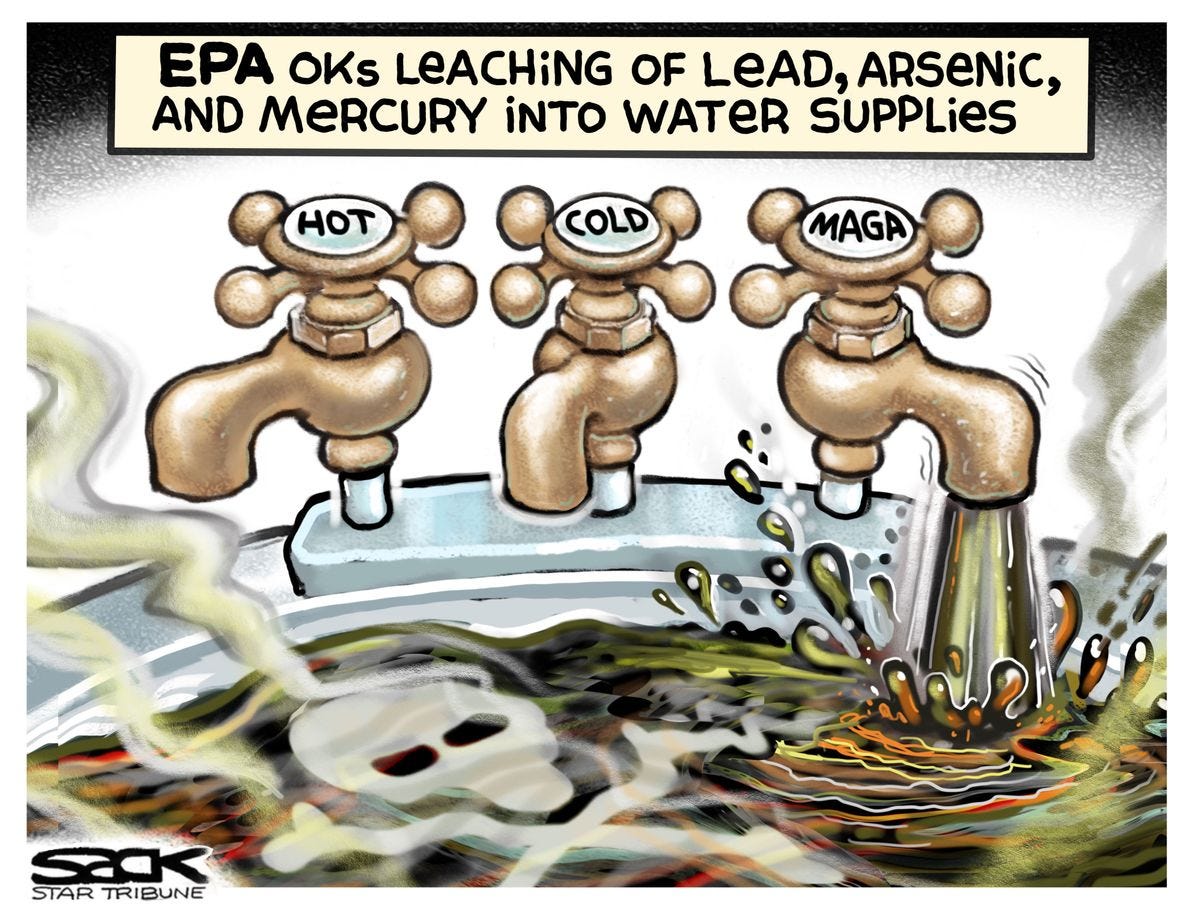
The administration argues the 2024 standards imposed excessive compliance costs on utilities and risked undermining energy reliability during rising electricity demand. EPA estimates the rollback could save the power industry hundreds of millions to more than a billion dollars annually.
Environmental groups, however, argue that the move increases the risk of toxic contamination reaching rivers, lakes, groundwater, and downstream drinking-water systems.
The important nuance is that the administration is not literally announcing “power plants may now dump mercury directly into your tap water.” The rollback instead weakens treatment and discharge requirements that environmental advocates believe help prevent exactly that contamination pathway.
Satire or Truth?
Mostly true, with America once again debating whether poisoning waterways is economically efficient.
Apparently, the free market has entered its “mercury is a cost-saving measure” phase.
Double the Wattage to Data. Who Gets the Bill Remains to be Seen.
The Viral Claim
A proposed Utah AI data-center campus would use more electricity than the current average consumption of the entire state while releasing “23 atomic bombs’ worth of heat” into the environment every day.
The Political Backdrop
The AI boom has quietly become one of the largest infrastructure and energy stories in the country. Every week now seems to bring another hyperscale data center proposal, another local water dispute, another power grid concern, or another rural community discovering that artificial intelligence apparently requires its own industrial civilization.
At the same time, political leaders from both parties increasingly treat AI expansion as a national security and economic race imperative. That means local environmental concerns often collide directly with promises of technological dominance, jobs, and investment.
And because modern headlines are no longer satisfied with moderation, the internet has now entered the era of “data centers compared to atomic bombs.”
The Reality
The project is real. The proposed Stratos or Wonder Valley AI campus in Box Elder County, Utah, associated with investor Kevin O’Leary, could reportedly require up to 9 gigawatts of electricity at full build-out.
For context, Utah’s average statewide electricity consumption currently stands at roughly 4 gigawatts per year, meaning the facility’s projected demand would indeed exceed twice the state’s average annual usage.
The viral “23 atomic bombs of heat” comparison comes from a preliminary analysis by Utah State University physicist Rob Davies, who estimated combined waste heat from the facility and associated power generation could approach the equivalent energy release of roughly 23 Hiroshima-scale bombs per day.
Importantly, the comparison is thermodynamic, not explosive. Nobody is suggesting literal bomb-like detonations. The claim instead attempts to communicate the staggering scale of continuous industrial heat release associated with a massive AI and power-generation complex.
Still, the fact that this sentence required clarification at all probably says something about where society currently is.
Satire or Truth?
Truth, but explained using the language of a History Channel apocalypse documentary.
Your chatbot now requires the energy budget of a small civilization.
Musk v. Memphis Turns to Mississippi For Help
The Viral Claim
xAI has installed dozens of methane gas turbines in Mississippi to power its Memphis-area AI operations while facing allegations that the turbines are operating without proper air permits.
The Political Backdrop
This story sounds fake because it resembles the kind of cyberpunk satire people wrote about late-stage capitalism around 2014. Unfortunately, the AI buildout has become so power-hungry that tech companies are increasingly colliding with the physical limits of grids, permitting systems, water access, and environmental regulation.
Earlier this year, Memphis officials faced mounting criticism over temporary methane gas turbines associated with xAI’s Colossus data-center operations. Environmental and civil rights groups raised concerns about the impacts of air pollution on nearby communities already burdened by industrial emissions.
At the same time, AI companies across the country have been scrambling to secure enough electricity to support rapidly expanding compute demand. In practice, “temporary” fossil-fuel infrastructure has increasingly begun looking suspiciously permanent.
Then came Southaven, Mississippi, just across the Tennessee border.
The Reality
In recent weeks, reporting revealed that xAI now reportedly operates or has installed approximately 46 methane gas turbines at a Southaven facility connected to its Memphis-area AI expansion. Earlier reporting had focused on 18 to 27 turbines. Environmental groups say the number has continued growing.
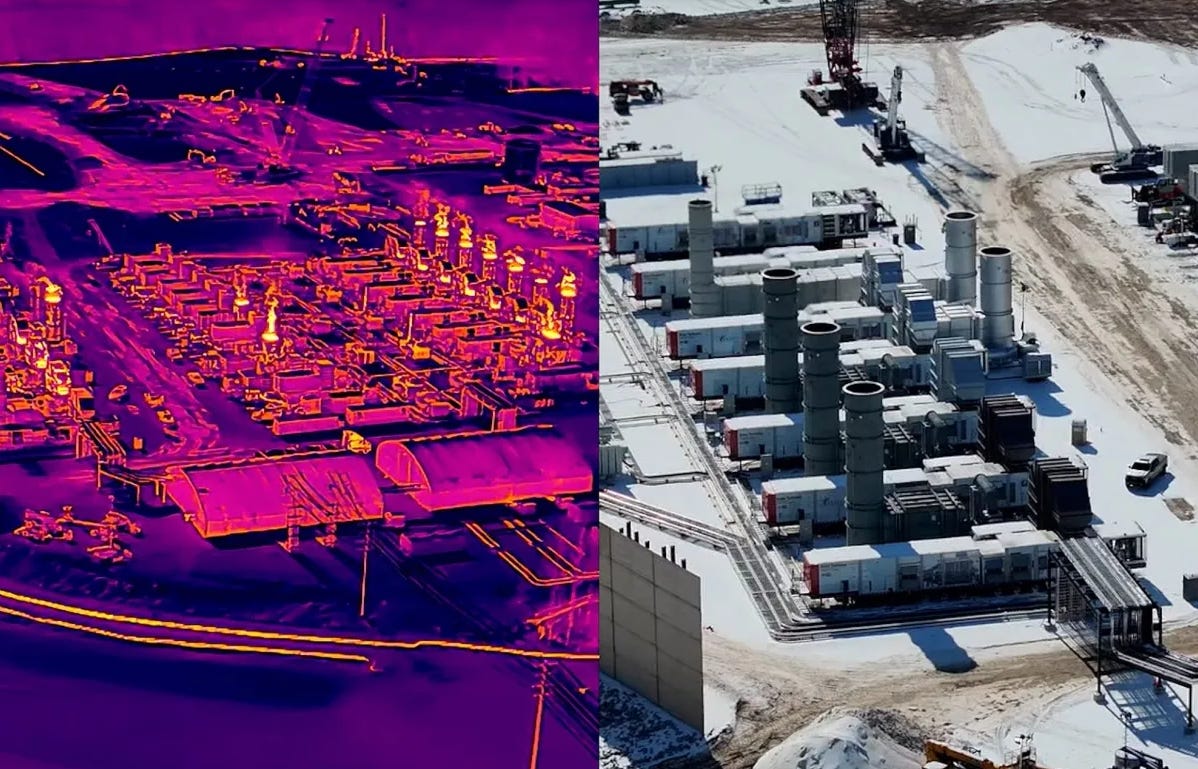
Photo by Evan Simon, Floodlight
Earthjustice and the Southern Environmental Law Center are now involved in litigation tied to allegations that the turbines are operating without required Clean Air Act permits. Mississippi regulators reportedly treated the turbines as temporary mobile equipment, while critics argue that the scale and duration of operations require more stringent oversight.
The emissions concerns include nitrogen oxides, particulate matter, carbon monoxide, and formaldehyde, all pollutants associated with gas combustion and air-quality impacts.
While no one has publicly proven xAI intentionally crossed into Mississippi specifically to evade Tennessee oversight, critics increasingly argue the situation resembles a form of regulatory arbitrage in which jurisdictional fragmentation allows major industrial infrastructure to expand faster than environmental enforcement can respond.
Which, to be honest, is an extremely 2026 sentence.
Satire or Truth?
Truth. The AI future apparently runs on portable fossil-fuel power plants and permitting technicalities.
Nothing says “building tomorrow” like quietly constructing a cross-border methane grid behind a chatbot.
When the Future Starts Looking Industrial Again
Five stories. All sound like satire, but this time, all are mostly true. Because of course they are.
For years, the future was marketed as sleek, digital, clean, and frictionless. Instead, it increasingly looks like smokestacks, turbines, water fights, industrial heat, chemical runoff, and billionaires discovering that the cloud is actually a giant physical machine plugged directly into the Earth.
Until next time, please remember that “temporary infrastructure” is one of the most permanent phrases in the English language.
And Mother Nature? She’s entering her Crone period and DNGAF about economic competition, strategic advantage, or rich white guys’ portfolios.
If this game gets any harder, we’re going to need constitutional scholars, trauma counselors, and three Onion editors on retainer just to sort the headlines.
Follow for the next round of Truth or Satire, where every week America dares parody to catch up. Or tune in for our regularly scheduled analysis and commentary, when the meds kick in, and we can take the headlines seriously.
Sources:
AP News, “What’s all the buzz about? Melania Trump is growing the White House honey program with a new beehive,” April 24, 2026.
Fox News, “White House gets an unexpected buzz as thousands of bees swarm the executive mansion’s North Lawn,” May 15, 2026.
The Daily Beast, “Swarm of Angry Bees Sparks Chaos on White House Lawn,” May 15, 2026.
Public Domain, “Trump Admin Opens Door to Resumed ‘Cyanide Bomb’ Use on BLM Land,” May 6, 2026.
E&E News, “BLM, USDA agree to renew use of ‘cyanide bombs,’” May 8, 2026.
BLM, “Discontinuing the use of M-44 Devices that Deliver Sodium Cyanide from BLM-managed Public Lands,” February 24, 2024.
AP News, “Trump administration aims to roll back limits on toxic wastewater from coal-fired power plants,” May 14, 2026.
Earthjustice, “Trump’s EPA Moves to Ax Requirement that Coal Plants Treat Toxic Wastewater Seeping into Lakes and Rivers,” May 14, 2026.
EPA, “Steam Electric Power Generating Effluent Guidelines — 2024 Final Rule,” 2024.
The Guardian, “‘Irresponsible’: backlash as Utah approves datacenter twice the size of Manhattan,” May 13, 2026.
Grow the Flow, “Analysis Finds Box Elder Data Center Could Release as Much Heat as 23 Atomic Bombs Per Day,” May 7, 2026.
FOX 13 Utah, “Data center could release ‘23 atomic bombs’ of heat per day,” May 7, 2026.
Mississippi Today, “xAI now has 46 gas turbines without air permits. State officials are ‘evaluating the situation,’” May 11, 2026.
WIRED, “xAI Adds 19 New Gas Turbines Despite Ongoing Lawsuit,” May 13, 2026.
Reuters, “NAACP sues Musk’s xAI, alleging illegal operation of gas turbines,” April 14, 2026.
Gizmodo, “xAI Got Sued Over Its Gas Turbines, so It Naturally Added More of Them,” May 14, 2026.
Very helpful bad news! I'm involved with Food & Water Action, which opposes the uncontrolled explosion of data centers. I'm forwarding this satirical real story to them. As one of the fairy royals remarked on the ignorant folks in *A Midsummer Night's Dream*, "What fools these mortals be!"
Amazing to see how complicated everything is when you just read the headlines and don't realize, understand, OR, take the time to read all that is under it! YOU provide so many explanations....very depressing about how much WORK it takes to stay "informed." Thank you for all the help you continue to provide but what ELSE are "we, the people" missing every hour of every day. Truly, depressing, sadly.