


By now, you’ve probably heard about the Trump-branded passport, the workaround to put Trump’s signature on U.S. currency, and the attempts to attach his name to institutions like the Kennedy Center and the Institute of Peace.
Today, we’re not asking whether this sounds fake. After all, everything in this timeline sounds fake and mildly apocalyptic.
We’re asking something slightly more useful: Who proposed it, who set it in motion, and how far has it gone?
This Community Is Powered by You
What started as a small circle has grown into something much bigger, and it’s all because of readers like you.
Every time you forward this email, post it on socials, or bring someone new into the fold, you’re helping build one of the most passionate, independent political communities out there.
Want to keep the momentum going?
Share this newsletter with someone who should be part of this conversation.
Thank you for being here. It means everything.
A $250 bill with Trump’s face on it
Reality Check: Real — proposed.
Representative Joe Wilson introduced the Donald J. Trump $250 Bill Act, which would direct the Bureau of Engraving and Printing to create a $250 bill bearing Trump’s image. His office said the bill would also create an exemption to the rule barring living people from appearing on U.S. currency.
Apparently, after finding a workaround to get Trump’s signature on money, the next logical pivot was if we can’t put his face on any existing bills, then let’s invent new money. The irony is that his average supporters are unlikely to ever hold that kind of cash, thanks in part to his policies.
Trump on Mount Rushmore
Reality Check: Real — proposed.
Representative Anna Paulina Luna (because of course) introduced legislation directing the Interior Department to arrange for Trump’s figure to be carved into Mount Rushmore.
Because nothing says “small government” like federally ordering a mountain to make room for your guy. The obvious question is, does any mountain contain enough space to house his ego?
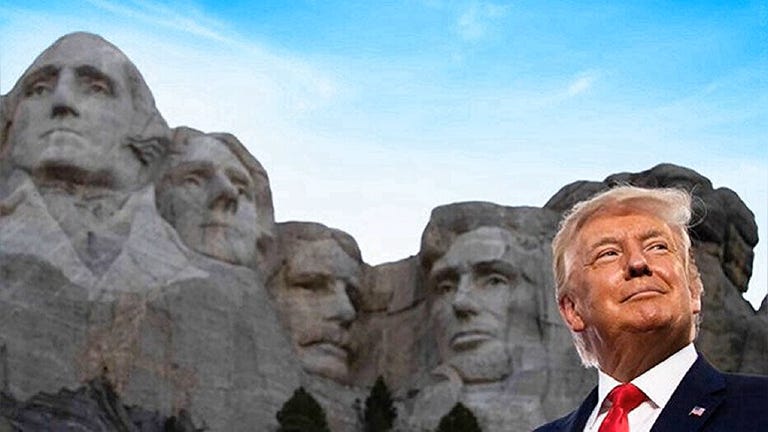
Yes, he posted this AI photo on Truth Social.
Trump-class battleships
Reality Check: Real — in motion.
The Navy’s planned Trump-class battleship program has already drawn industry attention and budget scrutiny, with recent reporting putting the first ship’s projected cost above $17 billion.
So yes, the branding has moved from money and monuments to military hardware. There’s no money for healthcare, but a vanity battleship? Always.
Trump-branded savings: kids and retirement
Reality Check: Real — partly enacted / partly launched by executive action.
Treasury has promoted Trump accounts, savings accounts for minors, as part of a broader financial literacy push.
More recently, Trump signed an executive order establishing TrumpIRA.gov, a federal site meant to help workers compare private-sector retirement options.
Save for the kids. Save for retirement. Just make sure the branding survives compound interest. Naturally, we should all trust the financial advice and programs of the guy whose companies have filed for bankruptcy six times.
TrumpRx
Reality Check: Real — launched.
The White House launched TrumpRx.gov as a government prescription-drug pricing platform in February 2026.
Apparently, even prescription drugs needed a campaign logo. Just ignore his creative math and big pharma donors.
Trump on the National Parks pass
Reality Check: Real — challenged in court.
A lawsuit challenged the use of Trump’s headshot on the 2026 America the Beautiful National Parks pass.
This one lands differently after everything we’ve already reported about staffing cuts, service disruptions, and pressure on the parks system.
The branding is getting bigger. The parks themselves, not so much.
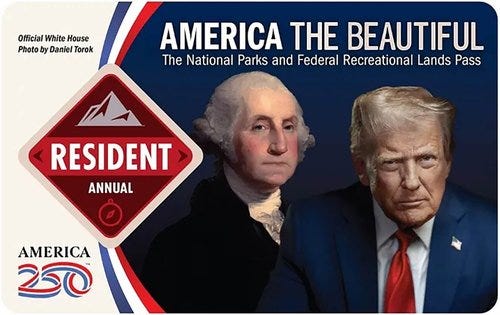
Proposed National Park Pass
The Trump Route for International Peace and Prosperity
Reality Check: Real — ordered by presidential determination (yes, that’s a thing)
A Federal Register notice directed the Secretary of State to establish a working group for the Trump Route for International Peace and Prosperity (TRIPP), which is tied to Armenia-Azerbaijan regional connectivity.
At this point, the question is not whether Trump’s name can be attached to money, medicine, mountains, military ships, retirement accounts, public lands, and foreign policy. The question is what’s left.
(We are tired. Insert your own TRIPP joke in the comments.)
Closing turn
The joke, of course, is that none of this sounds real. The problem is that all of it is in some form. There are, of course, quite a few more proposals, including airports, stadiums, rail stations, and roads.
Taken together, it is starting to look less like vanity and more like a governing style: personalize the institution, brand the public good, and turn the machinery of government into one more surface for political marketing.
We used to call it colonialism or empire-building. Today, we just call it whatever the hell this is. (gestures wildly)
Reality check complete. Unfortunately.
Sources:
“Trump goes on dead-of-night posting bender of bonkers AI pics — including Trump on Mt. Rushmore,” Mediaite via MSN, May 2, 2026.
“Wilson Introduces Legislation to Put President Trump on New $250 Bill,” Rep. Joe Wilson Press Release, February 27, 2026.
“Rep. Luna Introduces Legislation to Carve President Trump on Mount Rushmore,” Rep. Anna Paulina Luna Press Release, January 28, 2025.
“Trump Announces New Class of Battleship,” U.S. Department of Defense / War Department, December 22, 2025.
“Trump Accounts,” Internal Revenue Service, 2026.
“Promoting Retirement Savings Access for American Workers by Establishing TrumpIRA.gov,” The White House, April 30, 2026.
“Fact Sheet: President Donald J. Trump Launches TrumpRx.gov to Bring Lower Drug Prices to American Patients,” The White House, February 2026.
“Lawsuit Challenges Trump Use of Headshot on National Parks Pass,” Center for Biological Diversity, December 10, 2025.
“Establishing a Trump Route for International Peace and Prosperity Working Group,” Federal Register, August 15, 2025.
“U.S. to Issue Limited-Edition Passport Featuring Trump for 250th Anniversary,” Associated Press, April 28, 2026.
“Treasury Announces New Currency Design Featuring Trump Signature,” U.S. Department of the Treasury, March 26, 2026.
“Kennedy Center Labor Dispute Raises Questions About Governance and Naming,” The Washington Post, May 4, 2026.
“Trump Administration Renames U.S. Institute of Peace Building,” Associated Press, December 5, 2025.
“Trump Proposes Renaming Penn Station and Dulles Airport,” Punchbowl News, February 5, 2026.
“Trump Wants Commanders Stadium Named After Him,” ESPN, November 8, 2025.
“Trump Gold Card Immigration Program Announced,” The White House, September 19, 2025.
“U.S. Mint Reviews 250th Anniversary Coin Designs,” U.S. Mint, 2026.
“Commission Reviews Gold Coin Design Featuring Trump,” U.S. Commission of Fine Arts, March 26, 2026.
“Trump’s Image Appears on Federal Buildings Across Washington,” Axios, September 17, 2025.
If President Trump’s narcissism has possibly been intensified by a neurological event such as a stroke, the risks extend far beyond personal or partisan concerns—they touch the core of American democracy and the well-being of its citizens. Neurologically driven changes in empathy, impulse control, and self-awareness can fundamentally alter a leader’s capacity for sound judgment, collaboration, and self-restraint. When such tendencies are amplified in the highest office, the consequences may include:
- Erosion of Institutional Checks: A leader less able or willing to consult advisors or heed institutional boundaries may further centralize power, weakening the very foundations that safeguard democracy.
- Escalation of Rhetorical and Policy Extremes: Heightened impulsivity and diminished empathy can fuel more aggressive, divisive rhetoric and policy decisions, deepening polarization and putting vulnerable communities at risk.
- Undermining Public Trust: Visible behavioral changes and inconsistent communication can generate confusion and suspicion, eroding the public’s faith in government transparency and the rule of law.
- Global and Domestic Instability: Erratic decision-making at the executive level can ripple outward, impacting international relations, economic stability, and domestic safety.
Ultimately, the intersection of medical vulnerability and concentrated power demands vigilance from all branches of government, the media, and the public. Recognizing and understanding the clinical dimensions of leadership behavior is not merely a matter of political strategy; it is essential to safeguard democratic norms, protect institutional integrity, and ensure the safety and security of all Americans. The stakes are collective—and so too must be the response.
Would I participate in anything that has Trump’s name on it? absolutely 150% No! it’s not his ego he’s enhancing, its his pocketbook. You can be certain any of his schemes have a way he will profit from it. Mt Rushmore? He’s probably going to insist on a large portion of the admission fees for his own pocket. And the other honored men on Mt Rushmore would climb down the mountain before his likeness was completed.