


Welcome back to Truth or Satire?, the game where we present five things the internet insists happened, and you attempt to determine whether you are reading journalism, satire, misinformation, or the frantic notes of someone experiencing a carbon monoxide leak.
Once upon a time, this was easier. Satire exaggerated reality until it became ridiculous. Reality stayed politely on its side of the line. Everyone understood the arrangement.
That arrangement has been terminated without notice. These days, common sense is less a useful tool than an active impediment. The fake stories sound plausible, the real stories sound like rejected 30 Rock subplots, and somewhere, at this very moment, a journalist is reluctantly typing the phrase “officials confirmed” into a sentence that would have gotten them escorted from the newsroom ten years ago.
So trust your instincts. Distrust your instincts. Stare suspiciously at all five headlines until one of them confesses. Whatever.
Score yourself:
4–5/5: Congratulations. You remain capable of distinguishing reality from fiction despite reality’s increasingly hostile efforts to prevent this.
2–3/5: Perfectly respectable. Your pattern recognition still works; unfortunately, the patterns no longer do.
0–1/5: You believed in a rational universe, and frankly, that seems like the healthier mistake.
No Googling. No cheating. No assuming anything is too stupid to be true.
Let’s play… Truth or Satire?
This Community Is Powered by You
We cover the chaos, the corruption, the propaganda, and the policies shaping the country, plus the occasional descent into the surreal.
Follow for sharp political commentary, brutal media analysis, and weekly reminders that reality is now competing directly with parody.
BRASS TACKS
THE VIRAL HEADLINE
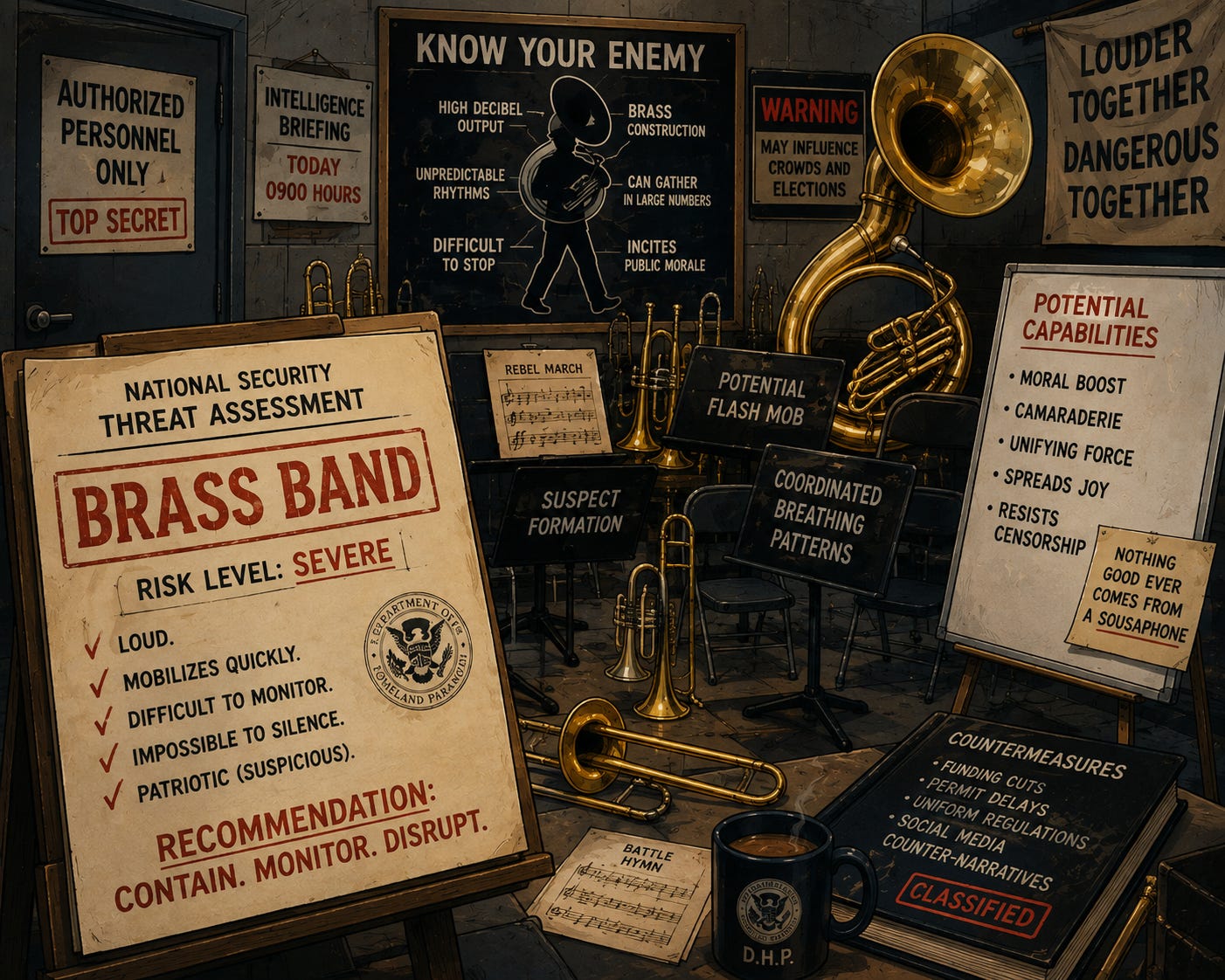
The Trump Administration has declared brass instruments a national security threat.
THE BACKGROUND
“National security” once conjured a fairly predictable collection of subjects: armies, intelligence agencies, nuclear weapons, foreign adversaries, and whatever was happening behind the door marked CLASSIFIED. Increasingly, however, Washington has treated national security as something much broader, one that can encompass factories, supply chains, energy infrastructure, telecommunications networks, computer chips, pharmaceuticals, and whether the United States can manufacture essential goods without relying on another country.
That shift has accelerated as competition with China has intensified. Both Democratic and Republican administrations have argued that America’s dependence on foreign manufacturing can become a strategic vulnerability, particularly when critical products or materials are concentrated overseas. Semiconductors, rare-earth minerals, batteries, pharmaceuticals, steel, aluminum, and copper have all become subjects not merely of economic policy but of arguments about military readiness and America’s ability to function during war, shortages, or disruptions to global trade.
Donald Trump’s second administration has embraced that connection especially aggressively. Its economic agenda has repeatedly treated domestic manufacturing capacity as a component of national power, while pushing companies to move production back to the United States and attempting to reduce American dependence on foreign suppliers. The administration has also shown a willingness to use presidential authority expansively when it believes imports or overseas production weaken strategically important American industries.
That can produce some strange collisions between the language of the Pentagon and the contents of an ordinary shopping cart. Modern supply chains are enormous, complicated things, and materials considered strategically important eventually find their way into products whose connection to national defense is considerably less obvious.
Which means that, apparently, in Washington anything can become a matter of national security if you follow the supply chain long enough. Which brings us, somehow, to the band room.
THE REALITY
The Department of Commerce did not issue an intelligence bulletin warning Americans about radicalized trombones. It issued a tariff proposal. Nobody at the White House appears to have received an intelligence briefing warning that the trombone section was massing along the Canadian border, but the viral headline is built around a real and remarkably literal piece of federal trade policy.
The Commerce Department has proposed adding brass-wind musical instruments and their parts to products covered by Section 232 tariffs involving copper and other metals. The relevant customs classification, HTS 9205.10.00, covers brass-wind instruments—the bureaucratic category containing the trumpets, trombones, tubas and French horns now caught up in a trade mechanism whose statutory justification is national security. The proposal could subject covered imports to an additional tariff of roughly 25%.
There is an important distinction between that and what the headline says. The administration did not formally determine that a trumpet itself poses a threat to national security. Rather, the government is considering brass instruments as derivative products within tariffs designed to protect domestic supplies and production of metals that the administration considers important to national security. In other words, the concern is the industrial supply chain, not the possibility that Yamaha has weaponized the B-flat scale.
And there is an especially strange wrinkle behind how we got here. The United Auto Workers had actually asked the administration to do this. In a May 14th letter to Commerce Secretary Howard Lutnick, the union urged the department to immediately add brass musical instruments to the copper Section 232 tariffs following the announced closure of Conn Selmer’s Eastlake factory. The UAW specifically identified the same tariff codes for brass instruments and their parts and argued that higher tariffs could protect domestic production.
That factory story makes the policy considerably messier. Conn Selmer’s Eastlake plant employed about 150 workers making instruments ranging from school-band horns to professional equipment. Its owner planned to move most production to China despite Chinese-made brass instruments already facing an effective tariff of about 20.4%. Reuters reported that keeping the Ohio operation running would have required roughly $13 million in savings. Conn Selmer’s ultimate owner, meanwhile, is billionaire investor John Paulson, a major Trump supporter who hosted a 2024 fundraiser for Trump that raised about $50.5 million and publicly criticized American companies for moving manufacturing overseas.
So no, the Commerce Department has not concluded that your child’s trumpet is an instrument of foreign sabotage, but yes, the Trump administration has placed brass instruments inside a proposed tariff action conducted under a law explicitly intended to address threats to American national security.
The National Association of Music Merchants has launched a rebuke, urging educators and businesses to submit comments by the deadline. They are also scheduling meetings with Congressional staff, arguing that this unfairly raises costs for schools, families, and those who provide instruments to them.
Band nerds! Unite!
THE VERDICT
Mostly true, with a very important change of key.
The brass section has been identified. Please remain calm and do not make any sudden embouchures. Homeland Security would like to remind everyone that the piccolo remains armed and extremely shrill. Your neighbors, however, absolutely support declaring all brass instruments as weapons of torture.
AIR FORCE DONE
THE VIRAL HEADLINE
Trump was secreted off Air Force One onto another aircraft via an airport catering.
THE BACKGROUND
“Air Force One” is not technically a particular airplane. It is the radio call sign used by any U.S. Air Force aircraft carrying the president. The familiar blue-and-white Boeing 747s are specially modified VC-25As, equipped to function as flying command centers with secure communications, defensive systems, medical capabilities, aerial refueling capacity, and other classified protections intended to keep the president functioning during emergencies.
Moving a president overseas is therefore considerably more complicated than putting him on an airplane and closing the door. The Secret Service works with the military, diplomatic personnel, host governments, intelligence agencies, and advance teams to secure airports, motorcade routes, accommodations, and alternate transportation. Details of presidential movements can be withheld or deliberately altered when officials believe revealing them could expose the president to attack.
There is precedent for taking that secrecy considerably further. Presidents have made covert trips into dangerous areas using undisclosed schedules, unusual aircraft, communications blackouts, and deliberate misdirection. Bill Clinton secretly flew into Pakistan aboard an unmarked executive jet in 2000 while another aircraft followed a different route as a decoy. George W. Bush’s 2003 Thanksgiving trip to Baghdad was concealed until he arrived. Barack Obama made an unannounced trip to Afghanistan in 2014, and Joe Biden traveled secretly by train into wartime Ukraine in 2023. Presidential security occasionally requires making the most recognizable person on Earth temporarily very difficult to find.
Donald Trump also faces a longstanding threat from Iran. U.S. officials have tracked Iranian plots against Trump and members of his administration following the 2020 American drone strike that killed Iranian General Qasem Soleimani. Those concerns have persisted into Trump’s second term and become considerably more acute amid direct military conflict between the United States and Iran. Trump himself has repeatedly said that he considers himself a leading Iranian assassination target.
Presidential travel is already part diplomacy, part military operation, and part extremely expensive traveling circus. Sometimes the circus apparently needs a trapdoor?
THE REALITY
This one is somehow substantially true.
During Trump’s July trip to a NATO summit in Ankara, Turkey, the public departure initially looked perfectly normal. Trump had arrived aboard his newly retrofitted, Qatar-donated Boeing 747, but announced before leaving that he would travel to Britain aboard one of the older blue-and-white presidential 747s “for old time’s sake.” Television cameras watched him climb aboard the legacy Air Force One. Reporters and White House personnel boarded as well. The plane prepared to leave, except Trump wasn’t on it anymore.
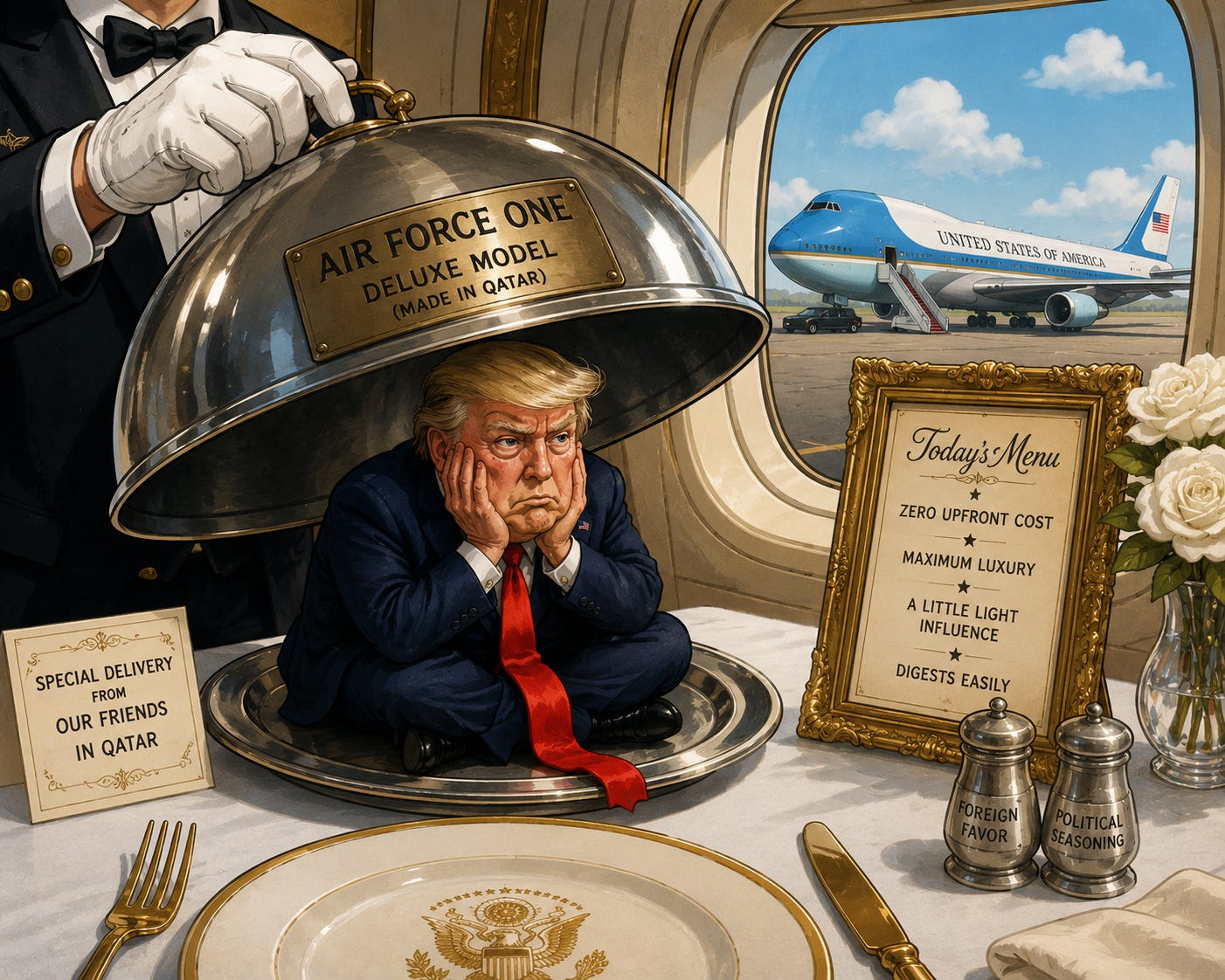
According to reporting first published by The Washington Post and subsequently detailed by Reuters and the Associated Press, Trump and several aides crossed to the opposite side of the aircraft, where a catering vehicle—the sort normally used to raise food and supplies to an airplane door—was hydraulically lifted into position. They entered the catering vehicle out of public view, descended to the tarmac, and were quietly transported to a smaller Air Force C-32A. Trump then flew aboard that aircraft to RAF Mildenhall in Britain.
Meanwhile, the old Air Force One departed Turkey with journalists, security personnel, support staff, and some White House officials aboard, many of whom reportedly believed the president was still somewhere in the plane. Reporters were instructed to keep their window shades closed. The presidential C-32A flew separately and arrived in Britain shortly before the decoy aircraft. Trump was then returned to the presidential travel operation without the press realizing what had happened. The full maneuver remained secret for about a month.
The reason was not presidential eccentricity, at least, not entirely. The Post reported that U.S. officials were responding to a credible Iranian threat against Trump or his aircraft amid renewed hostilities with Iran. At the time of the trip, Trump publicly acknowledged that Iran wanted him dead but denied that security concerns explained the unusual aircraft arrangements. When reporters later asked why they had been ordered to close their shades during the flight, Trump told them it was probably because they were on a “dangerous flight,” before adding: “But if I go, you go. Right?”
There was just one fairly important detail missing from that reassurance. He had already gone. Maybe it was TACO Tuesday.
THE VERDICT
True. Somehow, extremely true.
Somewhere, the Secret Service is furious that Home Alone 2 was the least complicated Trump airport plot, and we are all left frantically waiting for leaked images of the CIC on all fours under a hotel-style cart or under a serving dome.
ROOMBA: FIRST BLOOD
THE VIRAL HEADLINE
Roombas now banned by the administration.
THE BACKGROUND
The average American home has quietly accumulated an impressive collection of computers pretending to be appliances. Televisions connect to the internet. Doorbells contain cameras and microphones. Refrigerators run software. Thermostats learn household routines. Toys connect to cloud servers. The conveniences vary, but the underlying bargain is increasingly familiar: ordinary objects collect information about their surroundings and communicate with networks far beyond the home.
That has created an equally strange national-security problem. Intelligence and cybersecurity officials have spent years warning that connected consumer devices can become avenues for surveillance, data collection, cyberattacks, or access to larger networks. Researchers have found vulnerabilities in everything from security cameras and baby monitors to smart speakers and home appliances. The concern is not necessarily that someone in Beijing desperately wants to know when you preheat the oven, but that millions of insecure networked devices can collectively create valuable access points and enormous quantities of data.
Washington’s anxiety has been particularly intense when those devices are manufactured by companies with ties to China. The United States has restricted equipment from Chinese telecommunications giants Huawei and ZTE, targeted surveillance-camera manufacturers Hikvision and Dahua, and repeatedly scrutinized Chinese-made drones from DJI. Under both Democratic and Republican administrations, policymakers have increasingly treated the security of communications equipment, software, sensors, and connected devices as part of the country’s larger strategic competition with China.
The Trump administration has pushed that philosophy further, arguing that America’s dependence on foreign technology can create vulnerabilities extending well beyond traditional telecommunications. That concern increasingly encompasses artificial intelligence, autonomous systems, drones, industrial equipment, semiconductors, communications infrastructure, and machines capable of gathering information about the physical world around them.
Which raises an uncomfortable question about the modern American home: How many things in there are watching you back?
THE REALITY
Your existing Roomba has not become contraband, and federal agents are not coming to confiscate it from beneath the couch, but on July 28, the FCC added foreign-produced “advanced robotic devices” to its Covered List after a White House-convened group of national-security agencies determined that such machines posed “unacceptable risks” to U.S. national security or public safety. Officials warned that foreign-made robots could collect information useful for surveillance and intelligence operations, introduce supply-chain vulnerabilities, or potentially be remotely manipulated.
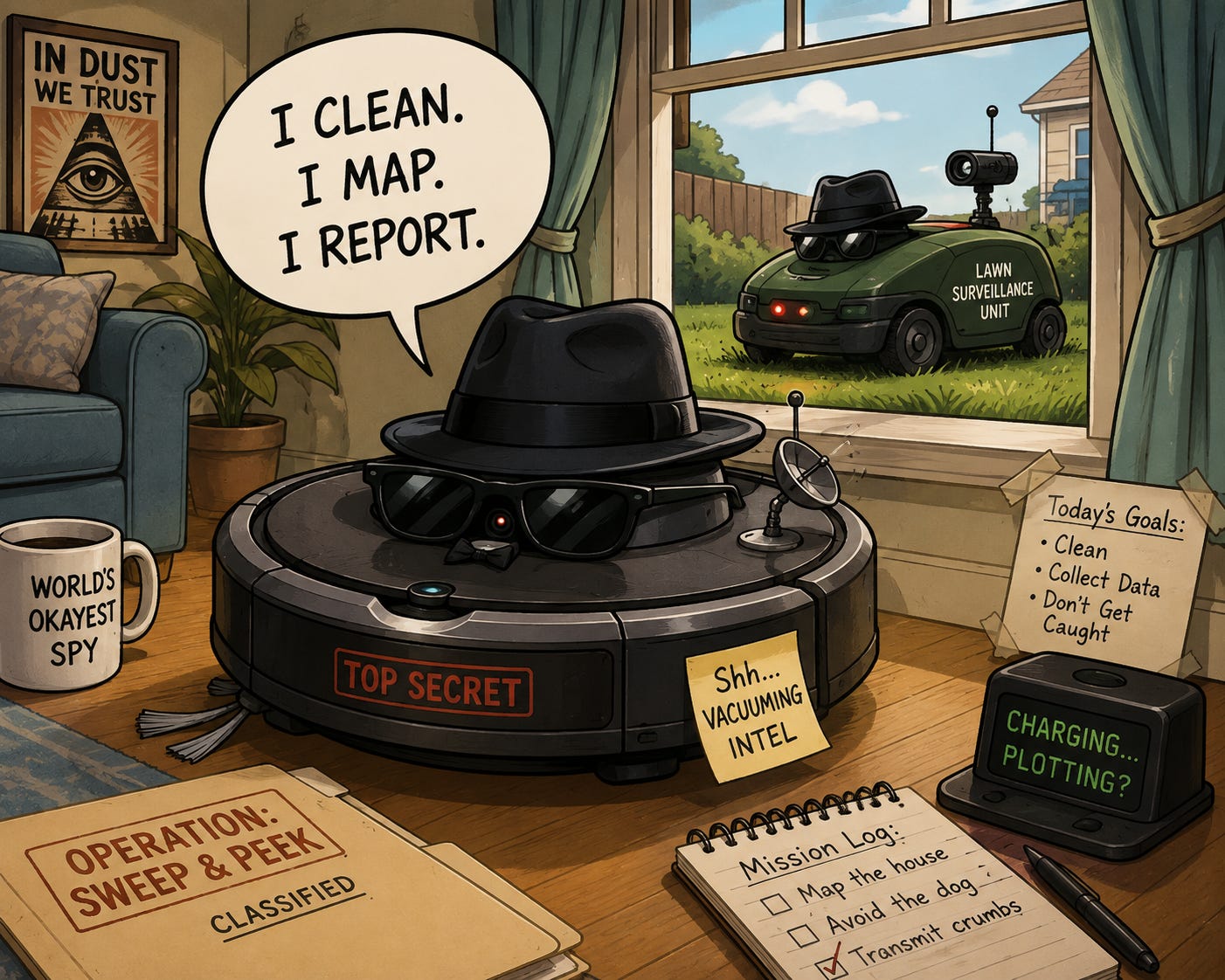
The announcement initially focused attention on considerably more futuristic machines such as humanoid robots, four-legged robotic dogs, and other autonomous mobile systems. Then came the important question: What exactly counts as an advanced robotic device? The government’s definition reaches autonomous ground machines that can navigate or move remotely, perceive their surroundings through sensors, communicate wirelessly, run software controlling their movement, and—with their docking equipment—weigh more than 4.4 pounds. The FCC subsequently confirmed that ordinary robot vacuum cleaners qualify. Robot lawnmowers and other autonomous household machines can fall within the definition as well.
There is, however, a major qualifier hiding inside “banned.” The government did not remotely brick the robot vacuum currently eating your phone charger. Models that already received FCC authorization can continue to be sold, imported, owned, and used. The restriction primarily prevents new foreign-produced models from receiving the FCC authorization necessary to enter the American market, although manufacturers may pursue exemptions or conditional approval. Despite much of the political discussion focusing on China, the rule is based on foreign production, not exclusively Chinese ownership.
That is especially consequential because the robot-vacuum business is overwhelmingly international. Chinese companies including Roborock, Ecovacs, Dreame, Xiaomi, and Narwal are major players, and even Roomba’s creator, iRobot, is now under Chinese ownership. The policy therefore does not amount to an immediate nationwide prohibition on Roombas, but it really does use federal national-security authority to block future foreign-made robot vacuums meeting the government’s definition unless they clear an exception.
THE VERDICT
Mostly true, but your current floor employee has been grandfathered in.
The machines have learned our floor plans, our schedules, and exactly where we dropped the Cheerio. Frankly, they’ve seen too much. They might weaponize the dust bunnies next.
To recap: your smart mower or vacuum knowing your house or lawn intimately? Questionable. Brass instruments? Problematic. Flock cameras on every corner? Patriotic.
THE SECRET LIFE OF PETS
THE VIRAL HEADLINE
Scientists create OnlyFans account to fund research.
THE BACKGROUND
Some of the most valuable scientific experiments are not really experiments at all. They are exercises in patience. Long-term ecological studies follow the same species, populations, and environments across decades, allowing researchers to detect changes that would be invisible during a conventional two- or three-year project. Questions involving climate, lifespan, reproduction, social behavior, population decline, and evolutionary change often require scientists to keep collecting the same kinds of data year after year.
That makes continuity unusually important. Once a decades-long study stops, researchers cannot simply recreate the missing years later. A lost field season can permanently interrupt a dataset built across generations of animals, while the disappearance of trained staff, established monitoring systems, or institutional knowledge can make restarting considerably harder. Some ecological research projects have consequently become scientific institutions in their own right, surviving generations of graduate students and occasionally the researchers who started them.
Much of that work depends on federal funding. The National Science Foundation has historically been one of America’s principal supporters of basic research, including ecology, evolution, environmental science, and other fields where the immediate commercial payoff may be difficult to identify. That is partly the point. Governments fund fundamental science because private companies generally have little incentive to spend decades answering questions that may be scientifically important without producing an obvious product to sell.
That system has been under extraordinary pressure during Trump’s second administration. Thousands of federal research grants have been canceled or disrupted, scientists have reported delays and uncertainty surrounding future awards, and universities have scrambled to preserve projects and personnel whose funding disappeared. By February 2026, The Guardian reported that nearly 8,000 grants had been canceled across the NIH and National Science Foundation alone, contributing to warnings that the upheaval could damage American research for years.
For scientists whose research requires uninterrupted observations across decades, “we’ll try again when the funding comes back” isn’t necessarily an option.
Desperate times call for increasingly creative grant proposals.
THE REALITY
The marmots are, in fact, on OnlyFans. UCLA professor Daniel Blumstein and his research team created an account called OnlyMarms featuring yellow-bellied marmots from their long-running field research in Colorado. The material is entirely safe for work (unless your workplace has unusually strict policies concerning large ground squirrels) and the researchers are using the platform to attract attention and raise money for continued research. UCLA itself highlighted coverage of the project in July.
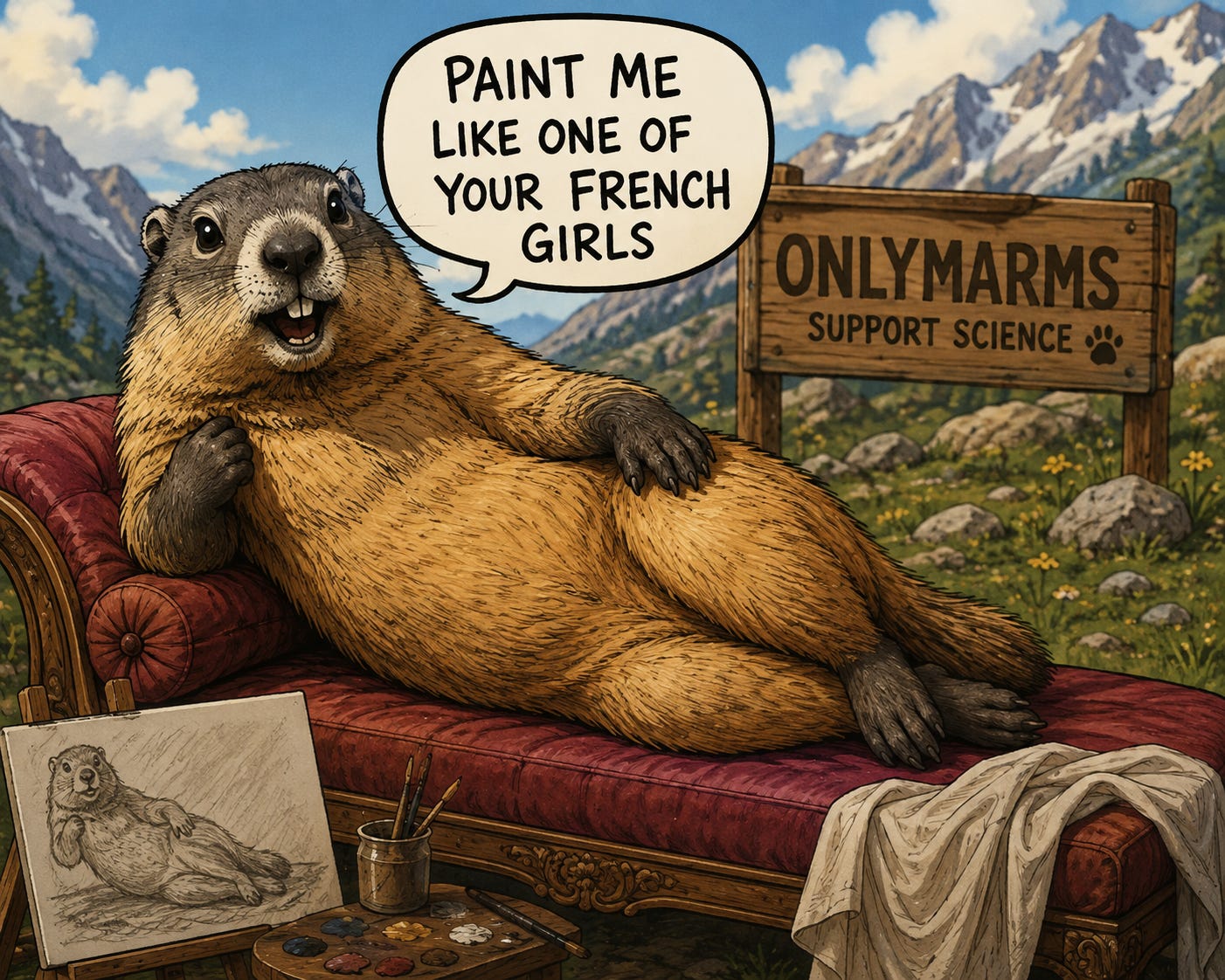
This is not a newly invented study built around an extremely good social-media joke. Yellow-bellied marmots around the Rocky Mountain Biological Laboratory near Crested Butte, Colorado, have been studied continuously since 1962, making the project a rare multigenerational record of wild mammals. Researchers identify and repeatedly observe individual animals, producing data that allow scientists to investigate survival, reproduction, social relationships, personality, responses to predators, and how environmental conditions affect marmot lives over time. Blumstein’s own work with the population stretches back decades.
The team’s research is considerably more serious than its new marketing department. One recent study drew on more than 24,000 hours of observations to examine whether marmots that gave alarm calls more frequently faced different survival outcomes. Other work using the population has explored social behavior, aging, climate, and the consequences of changing environmental conditions. The extraordinary value comes from being able to compare animals alive today with generations observed using related methods years or decades earlier.
OnlyMarms emerged as researchers searched for ways to keep that work funded amid the broader upheaval in federal science support. Rather than quietly watching an irreplaceable longitudinal project become another casualty of disappearing research dollars, the scientists decided to try something unconventional enough to attract public attention. Man, to have been at that brainstorming sess….
So yes: professional wildlife researchers responsible for a scientific dataset stretching back to the Kennedy administration have reached the year 2026 and concluded that one possible path toward keeping it alive involves putting marmots on OnlyFans.
No nudity is involved. Although, technically, none of the marmots are wearing pants.
THE VERDICT
True. Science has entered its influencer era.
Please subscribe responsibly. The marmots have already started describing themselves as “content creators,” and frankly, the fame has changed them.
Bonus: now you can somewhat legitimately say you only visit OnlyFans to support science. Up next, TrunksAndJunk.com and BlueFootBooby.net. (We encourage you NOT to Google either of those, or do so at your own peril.)
28 DAYS LATER
THE VIRAL HEADLINE
AI created more than a dozen viruses not found in nature.
THE BACKGROUND
Generative artificial intelligence is no longer limited to writing paragraphs, producing the exact same flyer for every event, or generating suspiciously enthusiastic customer-service emails. Researchers have increasingly adapted the same basic idea to biology: train models on enormous collections of genetic information, allow them to learn patterns encoded in DNA and proteins, and then use those models to predict or design biological sequences that do not already exist in the training data.
One prominent example is Evo, a family of genomic language models developed by researchers including scientists at Stanford. Instead of learning relationships between words, these models learn patterns across DNA, RNA, and proteins. The original Evo was trained on millions of microbial and bacteriophage genomes encompassing hundreds of billions of genetic “letters,” allowing researchers to ask biological questions in a way that increasingly resembles how people prompt conventional generative AI.
That possibility has obvious medical and industrial appeal. AI-assisted biological design could help scientists identify new proteins, improve gene-editing tools, engineer microorganisms, or develop treatments for infections that have become resistant to conventional drugs. Bacteriophages — viruses that infect bacteria — are of particular interest because researchers have explored using them to kill dangerous bacteria when antibiotics stop working.
It also creates a problem that ChatGPT does not encounter when it writes a bad poem. DNA can become physical. Genetic sequences proposed on a computer can, under the right circumstances, be synthesized in laboratories. Researchers and governments have therefore spent years debating how to screen DNA orders, restrict dangerous biological information, secure powerful models, and prevent useful advances in synthetic biology from becoming tools for creating pathogens. Evo’s developers, for example, deliberately exclude known viruses that infect humans and some other organisms from portions of its training data because of precisely those concerns.
Artificial intelligence has gotten very good at answering the question, “What could come next?” Biologists are increasingly confronted with the follow-up: What could go wrong?
THE REALITY
Scientists have now crossed a significant threshold: AI-designed viral genomes have been turned into functioning viruses in the laboratory.
A team led by Stanford researcher Brian Hie used genomic language models Evo 1 and Evo 2 to design complete bacteriophage genomes. The models generated thousands of candidate genetic sequences. Researchers selected nearly 300, had the DNA synthesized, introduced those sequences into bacterial cells, and waited to see whether the artificial instructions could actually produce working viruses.
Sixteen did. Those 16 viable bacteriophages were not simply copies of viruses scientists had pulled from nature. They were newly generated genomic designs produced by the AI models and then physically created in the laboratory. Some were sufficiently functional that combinations of the AI-designed phages successfully killed strains of E. coli, including bacteria that had developed resistance to naturally occurring bacteriophages.
Now for the extremely important sentence preventing this edition from ending with everyone digging a bunker. Ready? These were bacteriophages, not human viruses. They infect bacteria. The researchers intentionally excluded genetic sequences from viruses known to infect humans, animals, and plants while preparing the models for this work. Even the researchers’ experimental target was E. coli, and the immediate scientific goal is potentially beneficial.
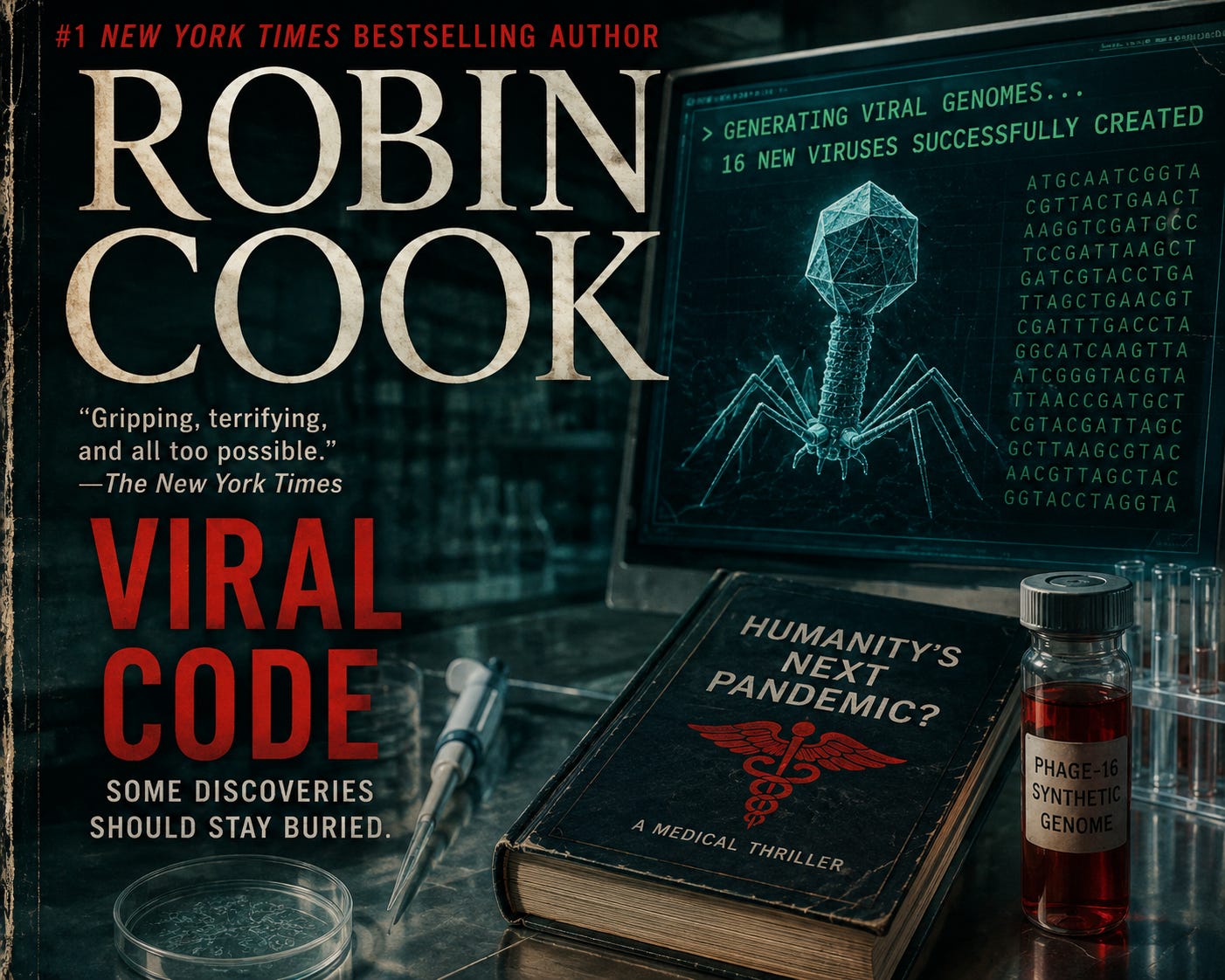
However, the biosecurity concern is not merely something the internet added afterward for dramatic effect after reading the complete works of Robin Cook. The researchers themselves warned that whole-genome generative design raises important biosafety and security questions. In commentary accompanying the work, experts at the Johns Hopkins Center for Health Security argued that the ability to compose viable viral genomes with generative AI now exists while the systems for governing that capability have not kept pace. Other scientists caution that these bacteriophages have tiny, comparatively simple genomes and that designing substantially more complex viruses remains a much harder problem.
So the headline omits perhaps the most comforting word in the English language right now—bacteriophages—but it does not invent the milestone.
THE VERDICT
True, with a massive, bacteria-sized asterisk.
We taught the autocomplete to biology. Surely nothing narratively significant will follow. Right? In the meantime, perhaps now would be a great time to gather up all of your COVID-era masks and send them through a sanitize cycle just in case.
So, how’d you do?
If you got all five right, congratulations. You have successfully adapted to an information environment in which disbelief is no longer skepticism but merely the first stage of fact-checking.
If you bombed, take comfort in knowing that your primary mistake was apparently expecting events to proceed according to recognizable rules of human behavior. There are worse character flaws.
Anyway, that’s enough reality for one edition.
Go outside. Drink some water. Look at a tree. Experience something that does not require three independent sources and a federal filing to establish whether it exists. Maybe wear a mask in public….
We’ll be back soon, assuming the distinction between truth and satire continues to matter. At this point, that feels increasingly like an administrative technicality.
If this game gets any harder, we’re going to need constitutional scholars, trauma counselors, and three Onion editors on retainer just to sort the headlines.
Follow for the next round of Truth or Satire, where every week America dares parody to catch up. Or tune in for our regularly scheduled analysis and commentary, when the meds kick in, and we can take the headlines seriously.
Sources:,
“A Trump pledge is falling flat as Ohio musical instrument plant closes,” Reuters, April 17, 2026.
“May 14, 2026 Letter on Conn-Selmer,” United Auto Workers, May 14, 2026.
“Tariffs Explained,” National Association of Music Merchants (NAMM), updated 2026.
“Trump boarded secret Turkey flight via catering truck due to Iran threat, reports say,” Reuters, August 11, 2026.
“Why the elaborate ruse Trump used in Turkey isn’t like other secret presidential trips,” Associated Press, August 11, 2026.
“Trump used elaborate ruse to fly out of Turkey following summit because of Iran threat, report says,” Associated Press, August 11, 2026.
“Trump flies partway home from Turkey in an old Air Force One, not the new Qatari-gifted jet,” Associated Press via The Washington Post, July 8, 2026.
“Fact Sheet: FCC Updates Covered List to Include Foreign-produced Advanced Robotic Devices and Power Inverters,” Federal Communications Commission, July 28, 2026.
“FCC bans foreign humanoid robots, expanding campaign against Chinese tech,” The Washington Post, July 28, 2026.
“The US government just banned Roombas,” The Verge, July 29, 2026.
“FCC Adds Foreign-Produced Power Inverters and Advanced Robotic Devices to Covered List,” Mayer Brown, July 29, 2026
“Russia’s ‘human safari’, Disney-TikTok deal and SpaceX lockup,” Reuters, August 6, 2026.
“Scientists create OnlyFans account for marmots to fund research – video,” The Guardian, August 7, 2026.
“‘OnlyMarms’: Marmots are on OnlyFans to raise money for research — and more UCLA media,” UCLA Newsroom, July 27, 2026.
“Projects,” Blumstein Lab, UCLA, accessed August 11, 2026.
“Safety fears as scientists make first viruses designed by AI,” The Guardian, August 6, 2026.
“How AI is Transforming Scientific Discovery While Keeping Humans at the Center,” Stanford Institute for Human-Centered Artificial Intelligence, 2026.
“Welcome Evo, generative AI for the genome,” Stanford Engineering, December 4, 2024.
“Sequence modeling and design from molecular to genome scale with Evo,” Science, November 15, 2024.
“World’s first AI-designed viruses a step towards AI-generated life,” Nature, September 18, 2025.
Well 4/5 ain’t bad but the brass instrument one had me stumped until you explained it involved lobbyists!