


Against all reasonable expectations, another week has occurred. Unfortunately, things happened during it. Some were important. Some were stupid. An alarming number were both, and several would have been rejected from a writers’ room for being a little too on the nose.
Which means it’s time once again for Truth or Satire, the game where reality and parody fight in an alley while the rest of us stand around trying to remember which one used to have standards.
Five claims. You decide what actually happened.
“Oh, come on” remains a valid response, but not a source.
Score Yourself
0–1: You still expect events to behave. Adorable. You approached this exercise believing that somewhere there remained a natural boundary between “plausible news report” and “thing somebody made up after three margaritas.” Pinches your cheeks
2–3: Functional, but concerning. You can still distinguish reality from nonsense roughly as often as a coin can. This is now considered a marketable skill.
4–5: You have been assimilated. Congratulations. Your brain has successfully evolved to survive the modern information environment. Unfortunately, this means you can now read an insane sentence, stare silently into the middle distance, and think, Sure, why not? then doing a bit more searching before hitting repost.
Let’s play… Truth? or Satire?
Today’s Five Minutes in America
The Extra F
One fallen letter is all it takes for Coffman’s Landing to start telling itself a story.
Today’s five-minute episode is ready. Come spend a few minutes in Coffman’s Landing with Tony Michaels.
YOU MUST BE THIS RAW TO RIDE
The Viral Claim
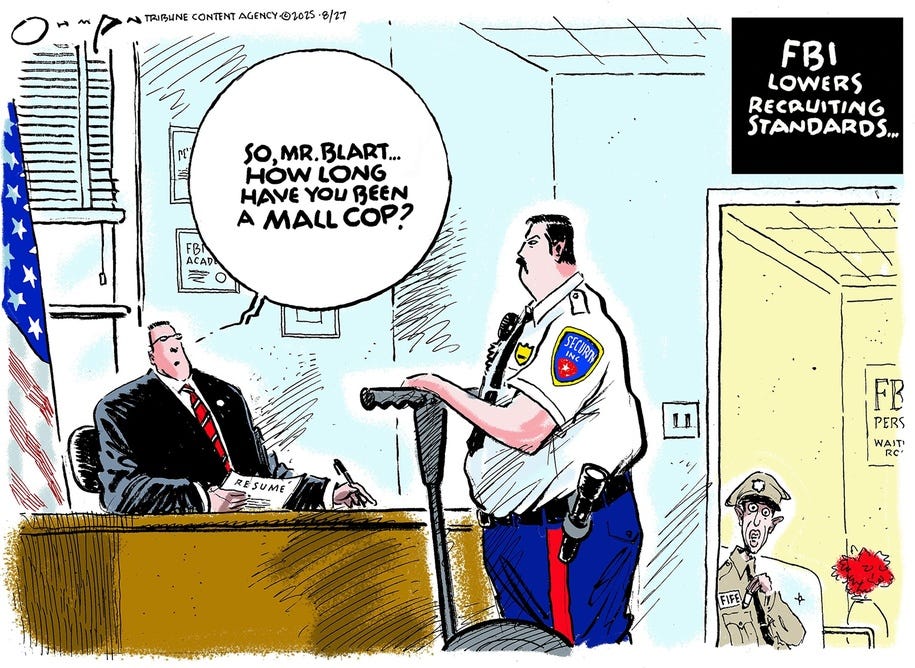
The FBI has removed bestiality and hiring prostitutes, among other conditions, from standards for new hires.
Background
Getting a job with the FBI has traditionally required considerably more than submitting a résumé and hoping nobody checks your Facebook page. Applicants undergo extensive background investigations that can include interviews with employers, coworkers, friends, and neighbors; reviews of financial and criminal records; drug screening; and, for many positions, a polygraph examination.
The scrutiny is warranted. FBI employees may handle classified information, criminal investigations, and other extremely sensitive material. A background investigation isn’t concerned only with whether someone has been convicted of a crime. Investigators also look for dishonesty, questionable judgment, and circumstances that could make an employee vulnerable to coercion or blackmail.
Some conduct, therefore, has historically resulted in automatic disqualification rather than simply becoming another factor for investigators to consider. The Bureau also maintains specific eligibility requirements involving felony convictions, drug use, and other conduct.
Those standards aren’t immutable. Hiring policies have changed over the years as laws, social norms, and the Bureau’s recruiting needs have changed.
The Reality
On June 16th, the FBI circulated new guidance to personnel involved in applicant background checks. According to reporting by CBS News, several behaviors that once automatically ended an application can now, under certain circumstances, be evaluated as part of the applicant’s broader history instead.
Hiring sex workers is among them. An applicant may avoid automatic disqualification if the conduct occurred more than ten years ago and happened fewer than three times, subject to additional restrictions involving whether the applicant held certain positions of trust. Theft from an employer may also no longer result in automatic rejection if it occurred more than three years ago.
Then there is the sentence nobody expected to encounter in an FBI employment story. Conduct involving bestiality or animal cruelty may no longer be an automatic disqualifier if it occurred before the applicant turned 18. CBS reported that the new eligibility language itself does not distinguish between voluntary and coerced conduct. The FBI has said the flexibility is intended in part to account for unusual circumstances, including cases involving childhood sexual abuse.
None of this means that admitting to one of these things earns somebody an FBI windbreaker. Removing an automatic disqualification means an applicant can continue through the Bureau’s extensive suitability and background process, where the conduct can still be considered, and employment can still be denied.
Verdict:
“Not automatically rejected” and “welcome aboard” are doing very different amounts of work here.
Still, it has been a rough week for anyone who thought certain behaviors were safely tucked away in the unwritten portion of the employee handbook. Perhaps the applicant pool was getting a bit… shallow. Drain the swamp indeed.
This Community Is Powered by You
We cover the chaos, the corruption, the propaganda, and the policies shaping the country, plus the occasional descent into the surreal.
Follow for sharp political commentary, brutal media analysis, and weekly reminders that reality is now competing directly with parody.
KENNEDY CENTER: EXTREME MAKEOVER
The Viral Claim
Donald Trump had the Kennedy Center’s historic weeping willow trees cut down and plans to replace them with trees he prefers.
Background
The John F. Kennedy Center for the Performing Arts has spent much of the last year making news for things other than the performing arts. The building and its grounds have become the center of an extraordinary fight over renovations, historic preservation, and presidential authority. Changes to the exterior have generated lawsuits and protests, while disputes over signage—including the addition and subsequent court-ordered removal of Trump’s name—have made the building itself part of the political spectacle. Tarp-gate continues to rage, and whistleblowers have made startling claims.
The turmoil has continued beyond lettering on the facade. Artwork has been removed from the grounds, renovation plans have included substantial changes to the building and its interiors, and the Center’s future has become entangled in arguments over a proposed extended closure, preservation requirements, and warnings about the complex's deteriorating condition.

The Reality
The photographs are real. The willows are gone. However, they were also gone months before the current round of Kennedy Center renovations became the story attached to them.
The trees were removed in October 2025. At the time, a Kennedy Center spokesperson said the willows had become a safety hazard. That explanation later acquired considerably stronger support in federal court.
During an April 2026 hearing in a historic-preservation lawsuit, Kennedy Center Executive Director Matthew Floca testified about the landscaping. A May federal court opinion summarizing that testimony states that most of the weeping willows included in the Center’s original design had already been felled because of decay.
A real preservation dispute exists here, however. The willows were considered important contributors to the Kennedy Center’s eligibility for the National Register of Historic Places, and Floca said he thought weeping cherry trees would make suitable replacements. He also testified that he and Trump had not specifically discussed the willows or their replacement. This is a more credible statement than most because Floca has made many other claims that do not spare the administration.
Verdict:
Sometimes the photograph is authentic, and the caption is where the fan fiction begins.
The trees were rotten, which, admittedly, does nothing to narrow down the suspects in Washington.
YOU’RE NOT YOU WHEN YOU HALLUCINATE
The Viral Claim
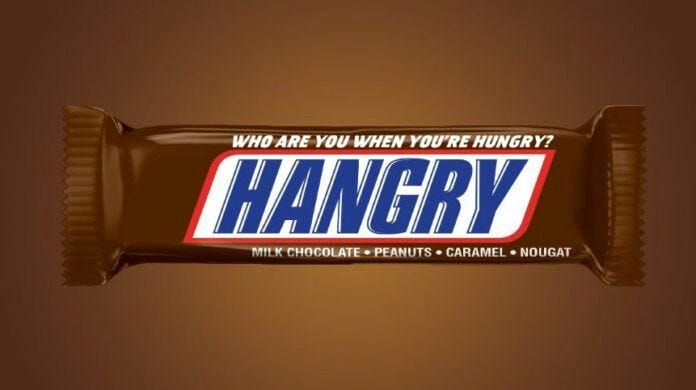
Snickers has created a digital candy bar that users can feed to ChatGPT when the AI starts giving bad answers.
Background
In 2010, Snickers launched the advertising campaign built around the phrase “You’re Not You When You’re Hungry.” The premise has survived remarkably well. Hunger makes otherwise recognizable people irrational, irritable, or inexplicably turn into Betty White until somebody hands them a candy bar. Hangriness is real, y’all.
Artificial intelligence has developed some personality problems of its own. Large language models can produce incorrect information, become excessively agreeable, wander away from the question, or confidently provide an answer that bears only a passing acquaintance with reality. Longtime readers may recall the questionable citations in RFK’s Make America Healthy Again push a few months ago.
How a user prompts an AI can also affect what happens next. Asking a model to reconsider an answer, check assumptions, or approach a problem differently can sometimes produce a better response. Like most technology, output quality often directly correlates with input quality, and knowing the tips and tricks is always a good idea.
The Reality
Snickers launched Hungr.AI on August 31st and describes it as the world’s first digital candy bar made for AI. Yes, really. That’s where we are, folx.
When ChatGPT starts producing answers that seem incorrect, overly flattering, or otherwise “off,” users can visit the Snickers site, copy the digital Snickers, and paste it into the chat. The candy bar is, disappointingly but predictably, not chocolate. Snickers’ own terms describe it as a short code snippet or prompt-instruction block designed to change how the AI responds.
The promotion takes the metaphor considerably further than necessary. The AI gets its imaginary Snickers while participating humans can claim one of 3,000 actual Snickers bars through DoorDash while supplies last. The promotion runs through September 20th or until the candy is gone.
Should feeding your chatbot a digital candy bar fail to make it stop confidently inventing nonsense, the Snickers FAQ has an answer for that, too. Snickers supplied the digital tool, the language model supplied the response, and users should fact-check it. That’s the capitalism equivalent of that’s on you, bro. We find threatening the albeit imaginary motherboard to be quite effective. Pro tip.
Verdict:
Apparently even artificial intelligence can be fixed with something from the vending machine. Capitalism at its finest, right?
Humanity spent billions teaching machines to think and has now reached the “have you tried giving it a Snickers?” phase. To be fair, we too can be motivated to work better with the promise of chocolate.
CLEANUP ON AISLE EVERYWHERE
The Viral Claim
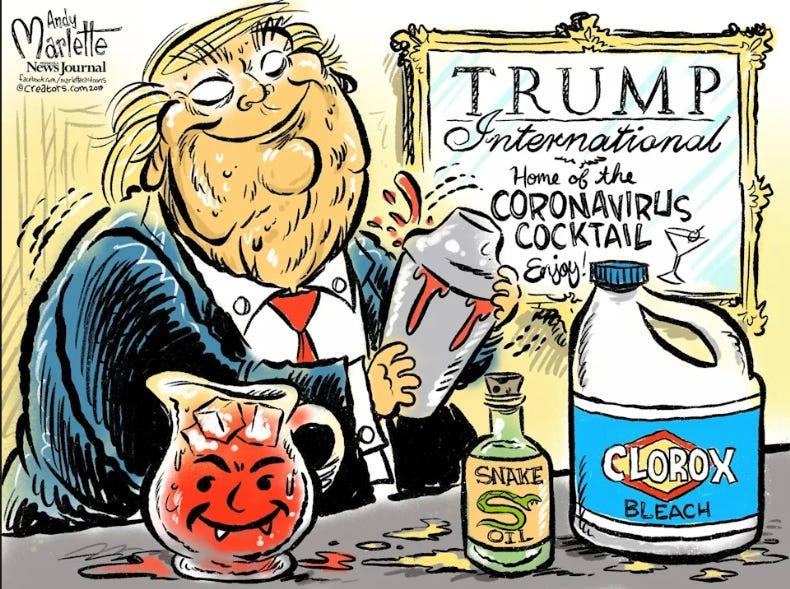
Clorox has recalled more than 6 million bottles because they may contain dangerous bacteria.
Background
If it seems as though everything you own has been recalled lately, you may simply be paying attention. Product recalls have become such a regular feature of American life that the Consumer Product Safety Commission maintains an entire searchable database devoted to things we bought before somebody discovered they could burn us, poison us, strangle us, or occasionally launch a small child across the room. True story.
Food isn’t doing much better. Recent recalls and outbreak investigations have involved everything from undeclared allergens to bacterial contamination, including a current multistate outbreak involving alfalfa sprouts linked to both E. coli and Salmonella. Double the yum. At this point, opening the refrigerator is less meal preparation than risk assessment.
Clorox, meanwhile, has been part of American cupboards for more than a century. The company began selling commercial liquid bleach in 1913. Few household brands are as closely associated with a single product as Clorox. Its name has become so synonymous with bleach in everyday speech that “Clorox” is sometimes used generically for the product itself, sort of like Kleenex, Band-Aid, or Kool-Aid.
The Reality
On September 3rd, the Consumer Product Safety Commission announced the recall of approximately 6.3 million bottles manufactured by Clorox Manufacturing Company of Puerto Rico.
The products are scented Mistolin Dilutable Cleaners and Lestoil Heavy Duty Multi-Purpose Cleaners. The recall applies only to specified products sold in Puerto Rico and the U.S. Virgin Islands, including particular scents and production date codes manufactured between April 2025 and June 2026.
The reason really is bacteria. The affected cleaners may contain Pseudomonas aeruginosa, an organism commonly found in soil and water. Healthy people are usually unaffected, but exposure can cause serious infections in people with weakened immune systems or those with certain medical devices.
Consumers with affected bottles are instructed to stop using them, submit identifying information and photographs to obtain a refund, and dispose of the cleaner in its container with household trash.
If the word “Clorox” made you picture bleach, you aren’t alone, and if you immediately began questioning your science and sanitation knowledge, fear not. Sodium hypochlorite—the active ingredient in ordinary household bleach—is itself effective against P. aeruginosa at proper concentration. However, neither of these recalled cleaners contains bleach, hence the risk.
Verdict:
Check your bottle before checking your will, and unless you live in very specific places, your cleaner is not trying to kill you, at least not with bacteria.
Your bleach is innocent. Put it back under the sink and apologize.
PRINT THIS BEFORE YOU LEAVE
The Viral Claim
MapQuest refused to rename Lake Ontario “Lake America” and promptly became the #1 app in the App Store.
Background
For anyone who came of age before a calm electronic voice began judging every missed turn, there was MapQuest. Launched on the web in 1996, MapQuest helped turn online mapping into an ordinary household activity. You typed in two addresses, printed several pages of turn-by-turn directions, and placed them somewhere in the passenger seat where they would inevitably slide onto the floor at the exact moment you needed Step 17.
No friendly voice announced that it was recalculating. There was no little blue dot assuring you that civilization remained nearby. If you missed a turn, you pulled into a gas station, unfolded your increasingly crumpled directions, and attempted to determine where your relationship with MapQuest had gone wrong.
The service was once so dominant that AOL acquired its parent company in 2000 in a deal worth roughly $1 billion. Google Maps, smartphones, and GPS navigation eventually shoved it out of the cultural spotlight. MapQuest changed hands several times, kept operating, and quietly survived while an entire generation mostly assumed it had gone wherever Ask Jeeves went.
The Reality
On August 27th, Trump issued an executive order directing the federal government to use “Lake America” instead of Lake Ontario. His penance for renaming things randomly is no longer effective fodder for Truth or Satire, however. Private mapping companies weren’t required to follow suit, but many did.
Google Maps adopted the new federal name for U.S. users. Apple Maps eventually did the same, allegedly under personal pressure from the Bully-in-Chief. MapQuest responded considerably more succinctly.
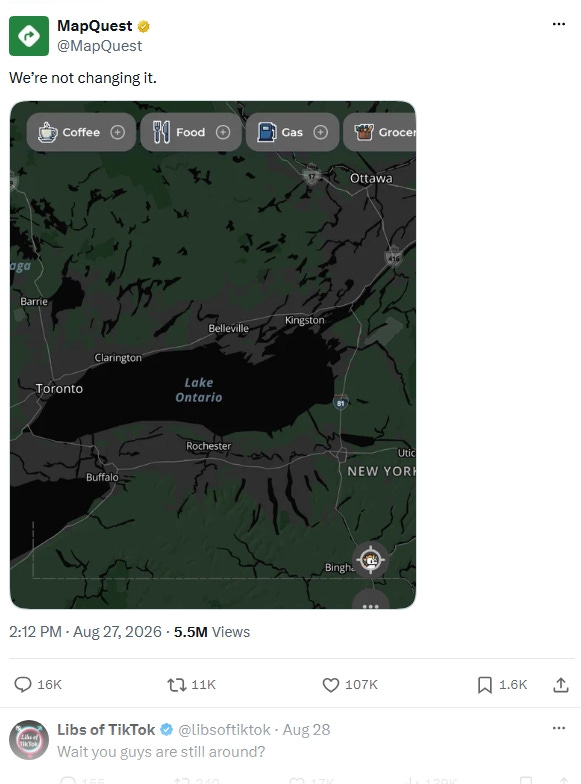
Undaunted by the taunts about their surprising continued existence, the elderly millennial website—or honorary Gen-X technology, depending on how strictly we are checking IDs—began enjoying itself, proving once again that those of us of a certain age are not here to play. MapQuest promoted a tool that let users give the lake their own ridiculous names and used its social accounts to needle the considerably larger technology companies that had changed theirs. After Google changed the lake’s name and Apple followed, MapQuest posted a GIF from Snow White showing the poisoned apple rolling from Snow White’s hand. The caption consisted of two words: “Them too.”
It turns out MapQuest did evolve (but perhaps not matured) with technology, and people started downloading MapQuest. A lot. Within days, the formerly forgotten navigation service climbed to the top of Apple’s U.S. App Store. MapQuest’s general manager later said the surge produced more than 1.5 million U.S. and Canadian installs in less than a week, an outcome he described as completely shocking.
Verdict:
Thirty years of being mocked by people who couldn’t find a wedding reception without printing six pages of directions apparently leaves a mark, but Donnie’s Sharpie sure won’t.
MapQuest didn’t die. It was resting, and now it’s pissed. Ah, menopause plus Gen X are really such a beautiful, feral, violent combination. It gives us hope and a tiny taste for vengeance.
That’s it for another round of Truth or Satire, the game that becomes less sporting every time reality discovers a new hobby. How’d you do? Alas, there are no prizes, only vigilance and whatever MapQuest is doing.
Come back next time and try again. Until then, remember: skepticism is healthy, context is expensive, and “there’s no way that happened” is no longer admissible evidence. Stay hydrated, consume literature and art, and treat yourself to a snack. You matter just as much as AI, baby. kiss
If this game gets any harder, we’re going to need constitutional scholars, trauma counselors, and three Onion editors on retainer just to sort the headlines.
Follow for the next round of Truth or Satire, where every week America dares parody to catch up. Or tune in for our regularly scheduled analysis and commentary, when the meds kick in, and we can take the headlines seriously.
Sources:
“At the FBI, a history of hiring prostitutes or stealing from employer may no longer be a barrier to being hired,” CBS News, August 28, 2026.
“FBI no longer treating an applicant’s experience with prostitution as automatic bar against hiring,” Associated Press, August 28, 2026.
“DC Preservation League et al. v. Board of Trustees of the John F. Kennedy Center for the Performing Arts — Memorandum Opinion,” U.S. District Court for the District of Columbia, May 29, 2026.
“Claim Trump cut down weeping willow trees outside Kennedy Center debunked,” Newsweek, September 1, 2026.
“Kennedy Center removes ‘Blue’ sculpture as Trump presses on with Washington makeover,” Reuters, September 2, 2026.
“SNICKERS® Launches the World’s First Digital Candy Bar for when AI Acts ‘Hungry’,” Mars, Incorporated, August 31, 2026.
“SNICKERS® HUNGR.AI | Even AI Can Get Hungry,” Snickers, accessed September 5, 2026.
“HungrAI Q&A,” Snickers, accessed September 5, 2026.
“Clorox Puerto Rico Recalls 6 Million Scented Mistolin and Lestoil Multi-Purpose Cleaners Due to Risk of Exposure to Bacteria,” U.S. Consumer Product Safety Commission, September 3, 2026.
“CPSC Posts Product Recalls and Product Safety Warnings to its Web Site,” U.S. Consumer Product Safety Commission, September 3, 2026.
“Apple changes Lake Ontario name to ‘Lake America’ for US users of its Maps, following Trump’s order,” Associated Press, September 2, 2026.
“Apple Maps changes name of Lake Ontario to ‘Lake America’,” Reuters, September 1, 2026.
“Apple follows Google in adopting Trump’s ‘Lake America’ name,” TechCrunch, September 1, 2026.
“MapQuest is now the No. 1 US app after bucking Trump’s ‘Lake America’ renaming,” TechCrunch, September 2, 2026.
Thank you for your service! And poo on those companies who change entire mapping systems because the occupant of the White House has a hissy fit. Good Lord, who gives him the right to be listened to when any right thinking person would NOT do such an infantile thing. As a former president's wife would say: "Just Say No!"