


There was a time when reality had the decency to be implausible only occasionally. We do not live in those times. Instead, we have… (gestures wildly) this.
The news cycle has given us enough bizarre headlines to make satire file a workplace grievance, so once again we’ve assembled five viral claims that escaped into the internet. Some may be exactly as ridiculous as advertised. Others... well, you’ll see.
As always, read the headline first, make your call, then see how reality decided to complicate everyone’s day.
Score yourself as you go:
4–5/5: Congratulations. You’re becoming alarmingly difficult to fool.
2–3/5: Entirely respectable. Reality has been freelancing lately.
0–1/5: Don’t feel bad. The timeline has been acting unsupervised for quite some time now.
Let’s play Truth or Satire!
This Community Is Powered by You
We cover the chaos, the corruption, the propaganda, and the policies shaping the country, plus the occasional descent into the surreal.
Follow for sharp political commentary, brutal media analysis, and weekly reminders that reality is now competing directly with parody.
The Viral Claim:
A hiker walked 10 miles down a mountain impaled on a pole to avoid a costly helicopter evacuation.
Background:
For many hikers, trekking poles are as indispensable as sturdy boots or a reliable backpack. Modern poles help transfer weight away from knees during steep descents, improve balance on uneven terrain, reduce fatigue over long distances, and provide extra stability when crossing streams, snowfields, or loose rock. Lightweight aluminum or carbon-fiber shafts are typically fitted with hardened carbide or steel tips designed to bite into the ground, giving hikers a more secure footing in difficult conditions.
Ironically, those same features can become dangerous during a fall. Fortunately, such injuries are the exception rather than the rule. Most wilderness rescues involve far more familiar problems: dehydration, exhaustion, heat illness, sprained ankles, falls, altitude sickness, or hikers who simply underestimated the demands of the trail. Grand Canyon National Park alone recorded 848 emergency medical incidents and 232 search-and-rescue operations in 2025, while Yosemite National Park responded to 194 search-and-rescue incidents and 663 medical assists in 2024. Against the backdrop of hundreds of millions of annual visits to America’s national parks, those numbers illustrate that serious emergencies remain relatively uncommon, but far from rare.
The Reality:
On July 20, 2026, 32-year-old Billings nurse David Cifaldi was climbing Granite Peak, Montana’s highest mountain, with friends Jesse Ross and Brad Reich. While crossing the aptly named Froze-to-Death Plateau, Cifaldi slipped on loose rock. One of his steel-tipped trekking poles drove beneath his left arm and exited through his lower back, narrowly missing his lungs, heart, and major blood vessels.
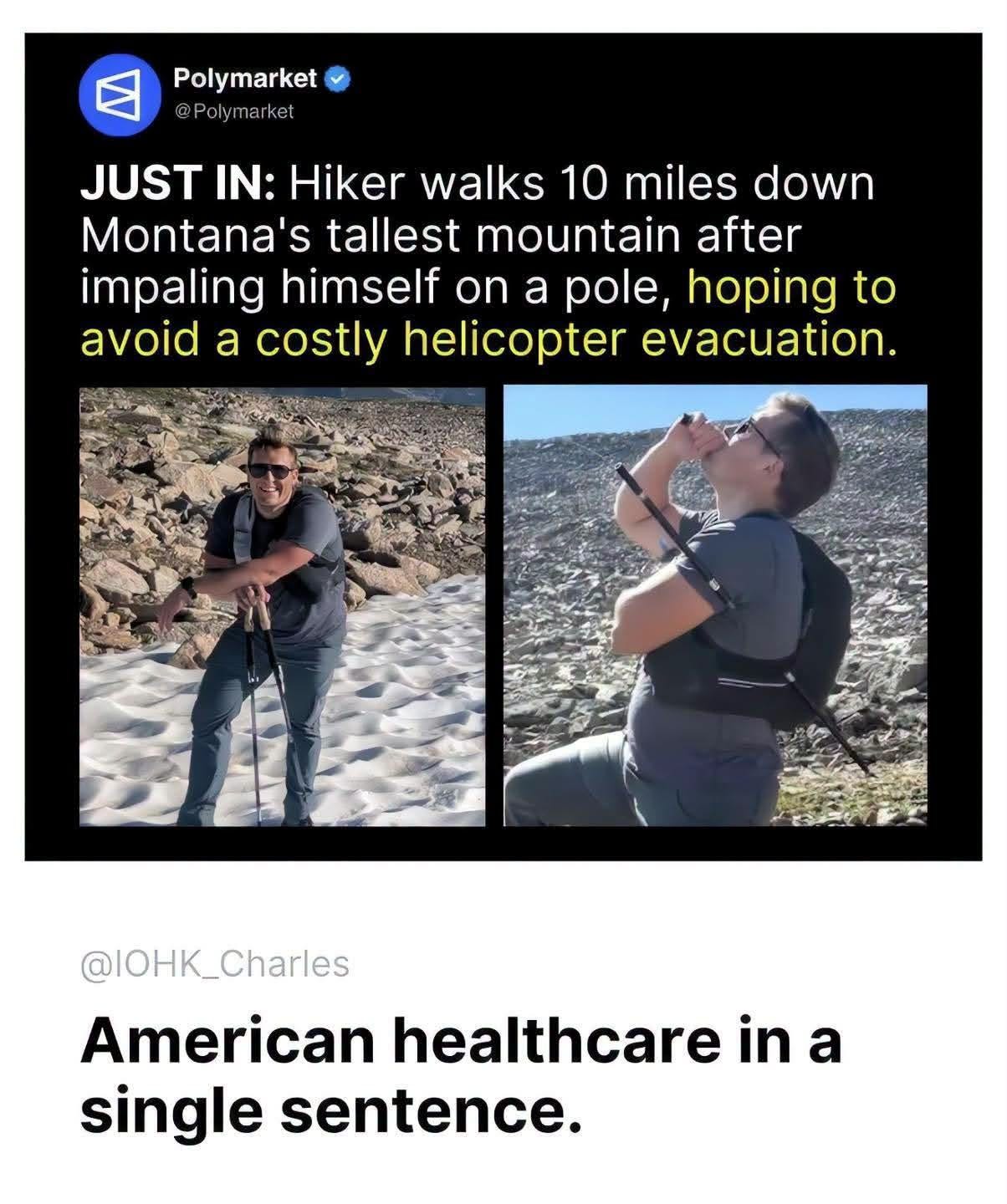
The injury was as dramatic as the viral photographs suggested. Remarkably, however, Cifaldi remained conscious, could breathe normally, and retained movement in all four limbs. Drawing on his nursing experience, he performed a rapid self-assessment, concluded the pole appeared to have passed primarily through soft tissue, and made the critical decision to leave it in place rather than risk catastrophic bleeding by removing it on the mountain. His companions helped stabilize the protruding pole with clothing and pack straps before the group began planning their descent.
Contrary to some online accounts, the group did not simply disappear into the wilderness and hope for the best. Using a Garmin inReach satellite communicator, they contacted emergency authorities and remained in communication with search-and-rescue personnel. Because Cifaldi was alert, ambulatory, medically knowledgeable, accompanied by experienced partners, and able to continue descending, rescuers monitored the situation while keeping additional rescue options available should his condition worsen.
Over the next six hours, Cifaldi descended approximately ten miles and nearly 5,000 vertical feet through rugged alpine terrain. After reaching their vehicle, the group drove toward medical care before Cifaldi was transferred to St. Vincent Regional Hospital in Billings. Surgeons successfully removed the pole, confirming that it had narrowly missed vital organs. He survived without major permanent injury and has since said he intends to return and finish climbing Granite Peak.
The viral claim also contains an important kernel of truth. Cifaldi has openly acknowledged that the potential cost of a helicopter evacuation influenced his decision. However, the internet compressed a complex medical and logistical assessment into a single motivation. His nursing background, his stable condition, his ability to walk, the presence of two capable companions, continuous communication with rescuers, and the availability of additional rescue resources all factored into the decision. Cost was part of the equation, but it was not the entire equation.
The Verdict:
The Internet Took the Shortcut.
Granite Peak came within inches of winning. Somewhere, every wilderness first-aid instructor just updated the definition of “composure under pressure” with a picture of a nurse. If anyone knows how to navigate the American healthcare nightmare, it is a medical professional.
The X-Files: Special Collections
The Viral Claim:
An explosive Smithsonian Report alleging inaccurate exhibits was authored by a fake historian.
Background:
The Trump administration’s confrontation with the Smithsonian emerged from a broader effort to reshape how the federal government presents American history in schools, national parks, museums, monuments, libraries, and other publicly funded institutions.
On January 29, 2025, President Trump signed Executive Order 14190, “Ending Radical Indoctrination in K–12 Schooling.” The order directed federal agencies to develop a strategy for preventing federal funds from supporting what it called “discriminatory equity ideology” and “gender ideology” in elementary and secondary education. It also revived the 1776 Commission, a first-term initiative intended to promote what the administration described as patriotic education.
Two months later, on March 27, 2025, Trump signed Executive Order 14253, “Restoring Truth and Sanity to American History.” The order declared that federal historical sites should serve as “solemn and uplifting public monuments” and accused museums and other institutions of replacing objective history with narratives centered on racism, sexism, oppression, and other perceived national failings. It specifically directed Vice President JD Vance, in his capacity as a member of the Smithsonian’s Board of Regents, to seek the removal of what the administration called “improper ideology” from Smithsonian museums, education programs, and research centers.
The same order reached beyond the Smithsonian, instructing the Interior Department to review federal monuments, memorials, statues, markers, and historical displays for material that “inappropriately disparages Americans” or emphasized subjects inconsistent with the administration’s preferred presentation of the country’s history.
Interior Secretary Doug Burgum formalized that effort on May 20, 2025, through Secretarial Order 3431, also titled “Restoring Truth and Sanity to American History.” The order required bureaus including the National Park Service to inventory monuments and interpretive materials, identify content considered improperly negative or partisan, and review displays for possible removal or revision. The department also installed signs and QR codes inviting visitors to report material they considered inaccurate or ideologically objectionable.
That review led to disputes over signs and exhibits discussing slavery, Indigenous history, climate change, and the treatment of marginalized communities. A federal judge later ordered the government to restore some removed materials while litigation over the policy continued.
Meanwhile, the Smithsonian was already being pulled into a series of public controversies. In July 2025, the National Museum of American History removed references to Trump’s two impeachments from a display titled “Limits of Presidential Power.” The museum said the temporary wording had been added in 2021, that the section was under review, and that an updated exhibit would eventually include every presidential impeachment. Nevertheless, the removal intensified suspicions that the Smithsonian was yielding to political pressure after Trump returned to office.
The White House continued pressing the institution over exhibits it considered excessively negative, ideological, or insufficiently patriotic. Because the Smithsonian is not an ordinary executive-branch agency and the president does not simply control the contents of its museums, the administration increasingly relied on funding pressure, appointments, public criticism, and federal property surrounding the museums.
That became especially visible on July 24, 2026, when Trump issued “Restoring Trust in the Smithsonian Institution.” The order directed the Interior Department and National Park Service to place signs on federally controlled sidewalks outside the National Museum of American History warning visitors that some material inside was inaccurate and directing them toward sources approved by the administration. It also called for a temporary alternative exhibition responding to displays criticized by the White House.
The Reality:
On July 4, 2026, the White House released a 162-page report titled Saving America’s Story: How Ideological Capture at the Smithsonian Institution’s National Museum of American History Erases Our Heritage. The report was published by the White House Domestic Policy Council pursuant to Executive Order 14253, Restoring Truth and Sanity to American History, which President Trump signed four months earlier. Unlike many federal reports, however, the document does not identify individual authors. Its cover attributes the publication to the White House and the Domestic Policy Council, and the report contains no byline, list of contributors, acknowledgments, or named historians responsible for its research or conclusions. In other words, the official record tells readers what the administration concluded, but not who actually wrote those conclusions.
That omission quickly became part of the story. Within hours of the report’s publication, journalists and social media users began pointing to David Barton, a conservative activist and author long associated with Christian nationalist interpretations of American history. The speculation did not emerge out of thin air. Barton has publicly acknowledged advising Trump administration officials on historical issues, and investigative reporting subsequently described him as playing a significant role in the administration’s broader effort to reshape federal historical interpretation. Observers also noted that portions of the report echoed themes Barton has promoted for years regarding the nation’s religious founding, the Constitution, and what he considers progressive distortions of American history.
As of this writing, the White House has not identified the report’s principal author or authors, Barton has not publicly claimed to have written it, and no documentary evidence has emerged showing that he drafted the text or served as its lead author. It is therefore entirely possible that Barton advised the project, reviewed drafts, contributed research, or influenced its conclusions without being the report’s author.
The phrase “fake historian” also deserves closer examination. Barton is a real author, lecturer, and political activist whose books have sold widely within conservative circles. He does not hold an academic degree in history, and numerous professional historians, including some conservative and evangelical scholars, have sharply criticized his scholarship. In 2012, Thomas Nelson withdrew The Jefferson Lies after historians challenged its factual accuracy, although Barton later republished the book through another publisher. His supporters argue that he has corrected longstanding biases in academic history, while his critics contend that he routinely misquotes sources, omits contradictory evidence, and advances conclusions unsupported by the historical record.
Taken together, the available evidence paints a more nuanced picture than the viral headline. There is substantial reporting connecting Barton to the administration’s broader historical agenda, and there is no shortage of criticism from the historical profession regarding his work. What has not been publicly established is that he authored the Smithsonian report itself.
The Verdict:
Citation Needed.
The report spent 162 pages criticizing historical documentation without documenting who wrote it. Somewhere, an English teacher just circled the cover page in red ink and developed a migraine.
The Greatest Show on Earth
The Viral Claim:
The largest drag show ever recorded just took place in North America.
Background:
Despite often being portrayed as a recent cultural phenomenon, drag has existed in one form or another for centuries. Long before women were permitted on many stages, male actors routinely played female roles in theater. By the late nineteenth and early twentieth centuries, female impersonators had become popular attractions in vaudeville, while drag balls in cities such as New York and Washington, D.C., offered LGBTQ communities rare spaces to gather during periods when simply wearing clothing associated with another gender could result in arrest.
Over the following century, drag evolved into a diverse performance tradition encompassing comedy, dance, lip-syncing, pageantry, celebrity impersonation, and political satire. It also became closely intertwined with ballroom culture, particularly within Black and Latino LGBTQ communities, where “houses” provided both artistic competition and chosen families for people often excluded from mainstream society. Although performers such as Divine and RuPaul helped bring drag to wider audiences, the art form remained largely confined to clubs, theaters, and LGBTQ venues for much of the twentieth century.
That changed dramatically during the 2000s and 2010s. Television programs such as RuPaul’s Drag Race introduced drag to millions of viewers worldwide, while performers increasingly appeared at festivals, universities, libraries, Pride celebrations, and community events. As drag became more visible, however, it also became more politically controversial.
In recent years, drag has become one of the most contested issues in America’s broader debate over gender, sexuality, and public expression. Several states have considered or enacted laws restricting certain drag performances, particularly those involving minors, while courts continue to weigh questions involving free speech, obscenity, and equal protection. Supporters argue that drag is simply another form of theatrical performance whose appropriateness depends on the venue and audience. Critics contend that many performances are inherently sexual and unsuitable for children or publicly funded spaces.
Whether viewed as entertainment, art, activism, or all three at once, drag now occupies a far more prominent place in American culture than it did a generation ago. That increased visibility has also meant that unusually large drag events are no longer simply entertainment news. They have become cultural and political statements in their own right.
The Reality:
On July 11, 2026, during the annual Cowboys Music Festival in Calgary, Alberta, organizers staged Drag Me to Cowboys, an 18-and-over event headlined by RuPaul and featuring performers including Sasha Colby, Sasha Velour, Roxxxy Andrews, and Calgary’s own Nearah Nuff. The event took place during the Calgary Stampede, one of Canada’s largest annual festivals, and organizers had announced beforehand that they intended to attempt a Guinness World Records title.

When attendance was officially counted, 7,423 people had entered the venue, enough for Guinness World Records to certify the event as the largest attendance at a drag artist stage show. Guinness formally recognized the record on July 11, identifying the Cowboys Music Festival as the record holder and noting that the attempt commemorated the festival’s 30th anniversary.
That is where the viral headline begins to blur. Many posts simply declared that Calgary had hosted the “largest drag show ever.” While not entirely inaccurate, that wording leaves out the category Guinness actually certified. The organization maintains separate records for largest attendance at a drag artist stage show, largest drag artist stage show by number of performers, and longest drag artist stage show, among many others. Calgary did not set every drag-related record. It set one very specific—and very impressive—attendance record.
The distinction may sound technical, but it exists for the same reason Guinness maintains separate records for the tallest building, the tallest freestanding structure, and the tallest observation tower. Without carefully defined categories, almost every world record would devolve into an argument over what exactly was being measured.
Guinness maintains separate records for largest attendance at a drag artist stage show, largest drag artist stage show by number of performers, and longest drag artist stage show, among many others. Calgary did not set every drag-related record. It set one very specific—and very impressive—attendance record. Yaz, Queens!
The Verdict:
Superlative With Fine Print.
Every world record eventually comes with two things: a certificate and someone arguing about the adjective. For one glorious evening, thousands of people gathered to prove that, contrary to popular belief, size does matter… at least when you’re filling out a Guinness application.
Raiders of the Lost Archive
Viral Claim:
Two National Archive facilities are closing and will be inaccessible to the public.
Background:
For most Americans, the National Archives is synonymous with the Declaration of Independence, the Constitution, and the Bill of Rights. Those iconic documents reside in Washington, D.C., but they represent only a tiny fraction of what the National Archives actually preserves.
The National Archives and Records Administration (NARA) is responsible for safeguarding billions of pages of federal records created by Congress, the courts, the military, federal agencies, and the presidency. Its collections include military service records, immigration files, census schedules, naturalization papers, treaties, maps, photographs, engineering drawings, audio recordings, motion pictures, and countless other documents chronicling the day-to-day workings of the federal government. While many records have been digitized, millions remain accessible only in their original physical form.
To make those records more accessible, NARA operates a network of archives, records centers, and presidential libraries across the United States. Researchers, attorneys, historians, journalists, students, and amateur genealogists routinely travel to regional facilities to examine records that may exist nowhere else. For many family historians, a single military pension file, immigration record, or land patent can answer questions that have remained unresolved for generations.
That work has become both easier and harder in recent decades. Advances in digitization have made millions of documents searchable from home, dramatically expanding public access to historical records. At the same time, preserving and providing access to an ever-growing collection has become increasingly expensive. Archives, libraries, and museums across the country have struggled with aging facilities, deferred maintenance, staffing shortages, cybersecurity demands, and the long-term costs of digitization. Institutions face the paradox of serving more users than ever while maintaining physical collections that cannot simply be uploaded to the internet.
Those financial pressures have increasingly collided with political ones. Federal cultural institutions have spent recent years navigating budget uncertainty, debates over public spending, workforce reductions, and shifting priorities regarding which services should remain local and which can be consolidated. For researchers whose work depends on physical records, even administrative changes can have outsized consequences.
The Reality:
On June 23, 2026, National Archives and Records Administration Chief Operating Officer Jay Trainer informed employees that NARA planned to close its regional archives and Federal Records Center operations in Chicago, Illinois, and San Bruno, California, over the next several years. The San Bruno site is officially known as the National Archives at San Francisco, despite being located several miles south of the city. NARA also plans to remove temporary federal records from its Seattle records center, although Seattle’s permanent archival holdings are expected to remain until the agency identifies a replacement facility.
The Chicago and San Bruno announcements involve more than administrative offices or warehouses closed to casual visitors. Both sites contain public research rooms and permanent federal records used by genealogists, historians, journalists, attorneys, tribal researchers, and members of the communities documented in the collections. NARA says the facilities will close “in the next few years,” with record relocations beginning within months and the broader transition expected to take several years.
The National Archives at Chicago holds more than 140,000 cubic feet of historical records, dating from 1800 into the early twenty-first century, from federal courts and roughly 85 agencies operating in Illinois, Indiana, Michigan, Minnesota, Ohio, and Wisconsin. Frequently requested collections include naturalization and federal court records, Bureau of Indian Affairs materials, maritime records, and Chinese Exclusion Act case files created in Chicago and St. Paul.
The National Archives at San Francisco holds more than 75,000 cubic feet of records dating from the 1850s through the 1980s. Its geographic reach includes northern and central California, most of Nevada, Hawaii, Guam, American Samoa, and former U.S.-administered Pacific territories. Among its heavily used materials are federal court files, Alcatraz inmate records, Native American records, military materials, Chinese immigration files, and Alien Files containing photographs, correspondence, vital records, interview transcripts, and visa documents that can be extraordinarily valuable to family historians.
NARA has said that accessioned permanent records from Chicago and San Bruno will be transferred to other archival locations, while temporary agency records will move elsewhere within the Federal Records Center system. Trainer described the closures as a way to preserve the agency’s core functions while improving efficiency, reducing real-estate costs, and protecting the long-term financial health of the records-center program. As of the announcement, however, NARA had not publicly identified the final destination of every permanent collection or provided a detailed schedule showing when particular records would again become available for in-person research.
That makes the phrase “closed to the public” substantially accurate as a description of the facilities’ future. Once the buildings close, researchers will no longer be able to visit those regional research rooms or consult the records there. It does not mean NARA plans to destroy the collections or permanently withdraw them from public access; the stated plan is to relocate them and continue reference services elsewhere. NARA’s San Francisco page currently says onsite and offsite services are continuing during the transition.
The distinction offers limited comfort to researchers who depend on proximity. Moving a record from San Bruno to Seattle, Southern California, or another region may preserve its legal status as a public record while placing it hundreds or thousands of miles farther from the people most likely to use it. Archival organizations and community groups have also warned that relocation could disperse experienced staff, interrupt access during lengthy moves, and separate records from the geographic communities whose histories they document.
So yes, two regional National Archives facilities used extensively by genealogists really are slated to close and become inaccessible to visitors. Their records are not scheduled to vanish, but where they will go, how long particular collections may be unavailable, and how practical future public access will remain are still unresolved.
The Verdict:
Access Sold Separately.
Historians call this provenance. Airlines call it connecting flights. Local history is becoming a much more flexible concept.
Deal or No Deal
The Viral Claim:
European soccer nations have unanimously voted to boycott the World Cup in protest of a FIFA decision.
Background:
The World Cup may look like a sporting event, but behind the matches sits one of the most complicated governing systems in international athletics. FIFA oversees global soccer and organizes competitions including the men’s and women’s World Cups, youth tournaments, and the Club World Cup. Its membership extends across 211 national associations, each of which also belongs to one of six regional confederations.
Europe’s confederation, UEFA, represents 55 national associations and includes many of the sport’s wealthiest leagues, most recognizable national teams, and largest television markets. FIFA governs the global game, but a World Cup without European countries such as France, Germany, England, Spain, Italy, and the Netherlands would lose many of its strongest teams, biggest audiences, and most valuable commercial relationships.
That imbalance has produced a long and frequently hostile relationship between FIFA and European soccer officials. The two organizations have clashed over tournament calendars, player workloads, governance, revenue, club competitions, voting power, and the distribution of money throughout the sport. FIFA argues that its global mission requires resources to support soccer in countries with smaller leagues and fewer commercial opportunities. UEFA and its member associations have often accused FIFA of making major decisions without meaningful consultation while relying heavily on the players, clubs, broadcasters, and sponsors concentrated in Europe.
Boycott threats are therefore unusually powerful but also unusually difficult to carry out. National teams do not simply decide independently that they will skip a tournament without consequences. Players may face conflicts with clubs and sponsors, associations may lose revenue or encounter disciplinary action, and governments sometimes become involved when sporting disputes overlap with foreign policy or human-rights concerns. Even when officials use the word “boycott,” the declaration may describe a warning, a conditional commitment, or an attempt to force negotiations rather than an immediate withdrawal.
The timing made the latest claim especially combustible. The expanded 2026 World Cup had concluded in the United States, Canada, and Mexico only weeks earlier, after drawing enormous audiences and renewed scrutiny of FIFA’s leadership, commercial ambitions, tournament management, and relationships with political figures. Against that backdrop, reports that every European soccer nation had agreed to boycott the World Cup sounded less like an isolated administrative dispute and more like a possible rupture at the center of the global game.
The Reality:
On July 28, 2026, FIFA announced plans to establish a new subsidiary called FIFA Forward Enterprise, or FFE, to oversee the commercial and event operations of the World Cup and FIFA’s other competitions. FIFA valued the proposed company at approximately $20 billion and said it would seek up to $4.2 billion from external investors in exchange for minority, non-controlling stakes of up to 20%.
The proposal came from FIFA president Gianni Infantino, who presented it as a way to unlock new investment and substantially increase the money distributed throughout international soccer. FIFA said the company would remain under its control and insisted that outside investors would not be purchasing the World Cup itself or gaining authority over sporting decisions. Thrive Eternal, an investment fund associated with Jared Kushner’s Thrive Capital, was expected to lead the proposed investor group.
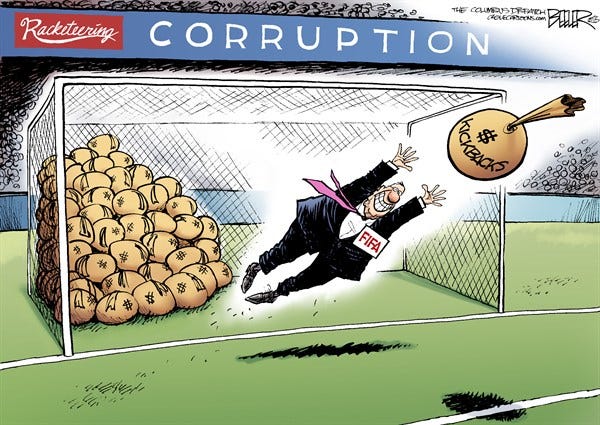
Infantino also offered FIFA’s 211 member associations a considerable financial incentive to approve the plan. Under the proposed distribution package, each association could receive as much as $40 million, with funding scheduled to become available beginning January 1, 2027, if members accepted the proposal by September 19, 2026. FIFA described the arrangement as a proposal rather than an obligation and said its members would be free to accept, reject, or modify it.
The announcement produced an immediate backlash. UEFA accused FIFA of attempting to transfer part of the ownership and financial value of the World Cup and its other competitions to private investors without adequate consultation. Officials also objected to the compressed timetable, the financial incentives offered to national associations, and the possibility that investors seeking returns could eventually exert pressure over tournament schedules, formats, host selections, broadcasting arrangements, or other decisions that FIFA characterized as purely sporting matters. UEFA summarized its position by declaring that the “soul and governance of football” were not assets to be traded.
On July 30th, representatives of UEFA’s 55 national associations met virtually in an emergency session. Following that meeting, UEFA announced that all 55 had unanimously and unequivocally rejected the proposal and agreed to boycott FIFA competitions if FIFA proceeded with transferring ownership interests to outside investors. The commitment covered not only the men’s World Cup, but FIFA competitions generally, including women’s and youth tournaments.
The threat carries unusual weight. UEFA’s membership includes England, France, Germany, Italy, the Netherlands, reigning world champion Spain, and dozens of other national teams central to FIFA’s tournaments and broadcasting business. Spain and Portugal are also scheduled to serve as principal hosts of the 2030 men’s World Cup, alongside Morocco, making a European withdrawal especially difficult to reconcile with the tournament already being planned.
However, European nations have not yet withdrawn from a World Cup. The vote established a collective, conditional position: they will boycott if FIFA carries out the proposed investment arrangement. FIFA can still abandon the plan, change its terms, extend consultations, or fail to secure enough support from its members. As of the vote, no European association had forfeited qualification, withdrawn a team, or announced that it would independently refuse to participate regardless of what FIFA does next.
The viral claim therefore contains two genuine bombshells—a unanimous European vote and a threatened World Cup boycott—but leaves the hinge connecting them off the page. Europe did not vote to punish FIFA for something that happened during the recently completed tournament. It voted to boycott future FIFA competitions if the organization proceeds with a plan to sell private investors a stake in the business operating them.
The Verdict:
Terms and Conditions Apply.
Contracts have always been written in fine print. Apparently so are viral headlines. Somewhere, a copy editor just circled the missing “if” and prevented an international incident.
And that’s it for another edition of Truth or Satire. How did you do? Does it even matter anymore? Does anything?
Reality continues to insist that every week contain at least one sentence nobody expected to read before breakfast. We remain grateful for its commitment to keeping both journalists and satirists gainfully employed, but would appreciate free mental healthcare or even just virtual therapy for the trauma.
Until next time, stay curious, be kind to your local archivist, nurse, librarian, and English teacher, and if the timeline starts making perfect sense... check your pulse. AI is busy enough generating proof-of-life images lately.
If this game gets any harder, we’re going to need constitutional scholars, trauma counselors, and three Onion editors on retainer just to sort the headlines.
Follow for the next round of Truth or Satire, where every week America dares parody to catch up. Or tune in for our regularly scheduled analysis and commentary, when the meds kick in, and we can take the headlines seriously.
Sources:
“Montana Man Hikes Out of the Mountains to Get Help After He Was Impaled by a Trekking Pole” — Associated Press, July 30, 2026.
“Montana Man Hikes 10 Miles to Safety After Falling on Trekking Pole” — The Guardian, July 27, 2026.
“Hiker Impaled by Pole Treks Ten Miles to Avoid Helicopter Fee” — The Times, July 31, 2026.
“Hiker, 32, Impales Himself on a Trekking Pole in Freak Accident, Walks More Than 10 Miles Down Mountain for Help” — People, July 27, 2026.
“Park Statistics” — Grand Canyon National Park, National Park Service, 2025 statistics, accessed July 31, 2026.
“Park Statistics” — Yosemite National Park, National Park Service, updated November 18, 2025.
“Saving America’s Story: How Ideological Capture at the Smithsonian Institution’s National Museum of American History Erases Our Heritage” — White House Domestic Policy Council, July 4, 2026.
“Restoring Truth and Sanity to American History” — The White House, March 27, 2025.
“Restoring Trust in the Smithsonian Institution” — The White House, July 24, 2026.
“Trump Orders Signs Outside Smithsonian History Museum to Correct What He Calls ‘Inaccurate Information’” — Reuters, July 24, 2026.
“Trump Orders New Signs Outside Smithsonian Saying Some Exhibits Are Inaccurate” — Associated Press, July 24, 2026.
“The Fake Historian Advising Trump’s Anti-Smithsonian Campaign” — Popular Information, July 29, 2026.
“Founding Fathers, Inc.” — Global Project Against Hate and Extremism, June 15, 2026.
“Largest Attendance at a Drag Artist Stage Show” — Guinness World Records, July 11, 2026.
“Cowboys Music Festival Is Giving Calgary a Chance to Help Break a Guinness World Records Title” — Curiocity Calgary, July 8, 2026.
“The First Self-Proclaimed Drag Queen Was a Formerly Enslaved Man” — Smithsonian Magazine, June 9, 2023.
“As Drag Shows Go ‘Mainstream,’ Some Red States Look to Restrict Them” — Stateline, April 1, 2024.
“Restrictions on Drag Performances” — Movement Advancement Project, data current through July 26, 2026.
“Know Your Rights: S.B. 12 Drag Ban” — ACLU of Texas, February 25, 2026.
“National Archives to Transition Out of Three Federal Records Centers” — Federal News Network, June 25, 2026.
“National Archives by the Numbers” — National Archives and Records Administration, updated June 30, 2026.
“About the National Archives of the United States” — National Archives and Records Administration, updated December 30, 2024.
“National Archives Expands Joint Digitization Effort With Ancestry” — National Archives and Records Administration, May 9, 2024.
“National Archives Catalog Guide for Genealogists and Family Historians” — National Archives and Records Administration, updated January 4, 2024.
“Densho Opposes Plans to Close National Archives Facilities in Chicago and San Bruno” — Densho, 2026.
“UEFA Countries to Boycott World Cup Over FIFA Proposals” — Reuters, July 30, 2026.
“UEFA to Boycott World Cup and FIFA Tournaments Over Stake-Sale Plans” — Reuters, July 30, 2026.
“European Nations Vow FIFA World Cup Boycott Over Infantino Private-Equity Plan as Opposition Spreads” — Associated Press, July 30, 2026.
“FIFA’s Private-Equity Push Opens New Front in Decades-Old Power Struggle With Europe” — Reuters, July 29, 2026.
“How World Soccer Is Governed: FIFA, UEFA and the Balance of Power” — Reuters, July 29, 2026.
“Member Associations” — FIFA, accessed July 31, 2026.
“National Associations” — UEFA, accessed July 31, 2026.
Thanks, and it's funny because in Europe this story was solely focused on his claim: "No helicopter because its gone ruin me".
"The phrase “fake historian” also deserves closer examination"
Yeah. Is the expertise in history fake? Or is the expertise in fake history real?