


Welcome back to Truth or Satire, where every day we ask whether the internet has finally broken reality or if reality simply got there first.
The World Cup is in North America, and after several weeks of doomscrolling, we can now confirm that the international community has discovered three things: our stadiums, our fast food, and our alarming commitment to unlimited refills.
Keep score at home:
4–5 correct: You could survive a pub in Glasgow.
2–3 correct: You know soccer has offsides, but not why.
0–1 correct: You still call it soccer in front of Europeans.
Let’s play the internet’s favorite game, where even a perfect score may be an indictment, Truth or Satire!!
This Community Is Powered by You
We cover the chaos, the corruption, the propaganda, and the policies shaping the country, plus the occasional descent into the surreal.
Follow for sharp political commentary, brutal media analysis, and weekly reminders that reality is now competing directly with parody.
The Universal Language of Sport: Arguing in Public
Viral Claim
Argentine and Algerian soccer fans got into a fistfight in Times Square during the World Cup.
Background
The FIFA World Cup is one of the largest sporting events on Earth, drawing supporters from dozens of countries to host cities and fan zones. While the matches themselves take place in stadiums across North America, many fans gather in major cities simply to celebrate, watch matches, and soak in the atmosphere.
New York City has become one of the tournament’s unofficial gathering points. Times Square, already one of the world’s busiest public spaces, has hosted large crowds of supporters waving flags, singing songs, and celebrating victories.
Both Argentina and Algeria are known for passionate football cultures. Argentine supporters are among the most recognizable in the world, while Algerian fans have built a reputation for energetic celebrations and massive turnouts wherever their teams compete.
Large sporting events often produce memorable displays of camaraderie. They also occasionally produce moments where enthusiasm exceeds good judgment. So did sports fans resort to the American tradition of fistacuffs?
The Reality
On June 15, 2026, that enthusiasm briefly turned physical in Times Square.
Videos circulating online showed a confrontation involving supporters carrying Argentine and Algerian flags. What began as an argument escalated into a fistfight in the middle of one of the world’s most recognizable tourist destinations. New York police quickly intervened, and reports indicated that at least one individual was taken into custody or issued a summons.
Fortunately, the incident appears to have been relatively isolated. There were no widespread reports of major injuries, large-scale disturbances, or organized clashes between supporter groups. The overwhelming majority of fans continued celebrating peacefully throughout the city.
In other words, the viral posts were based on a real event, but not necessarily the international incident some corners of the internet portrayed. The fight happened. The World Cup did not descend into chaos. New Yorkers largely responded the same way they respond to everything else in Times Square: by continuing to walk around it.
Verdict
SOMEHOW, YES
The World Cup’s first international exchange program apparently required police supervision. New Yorkers barely noticed.
The Tartan Army Came, Saw, and Coned
Viral Claim
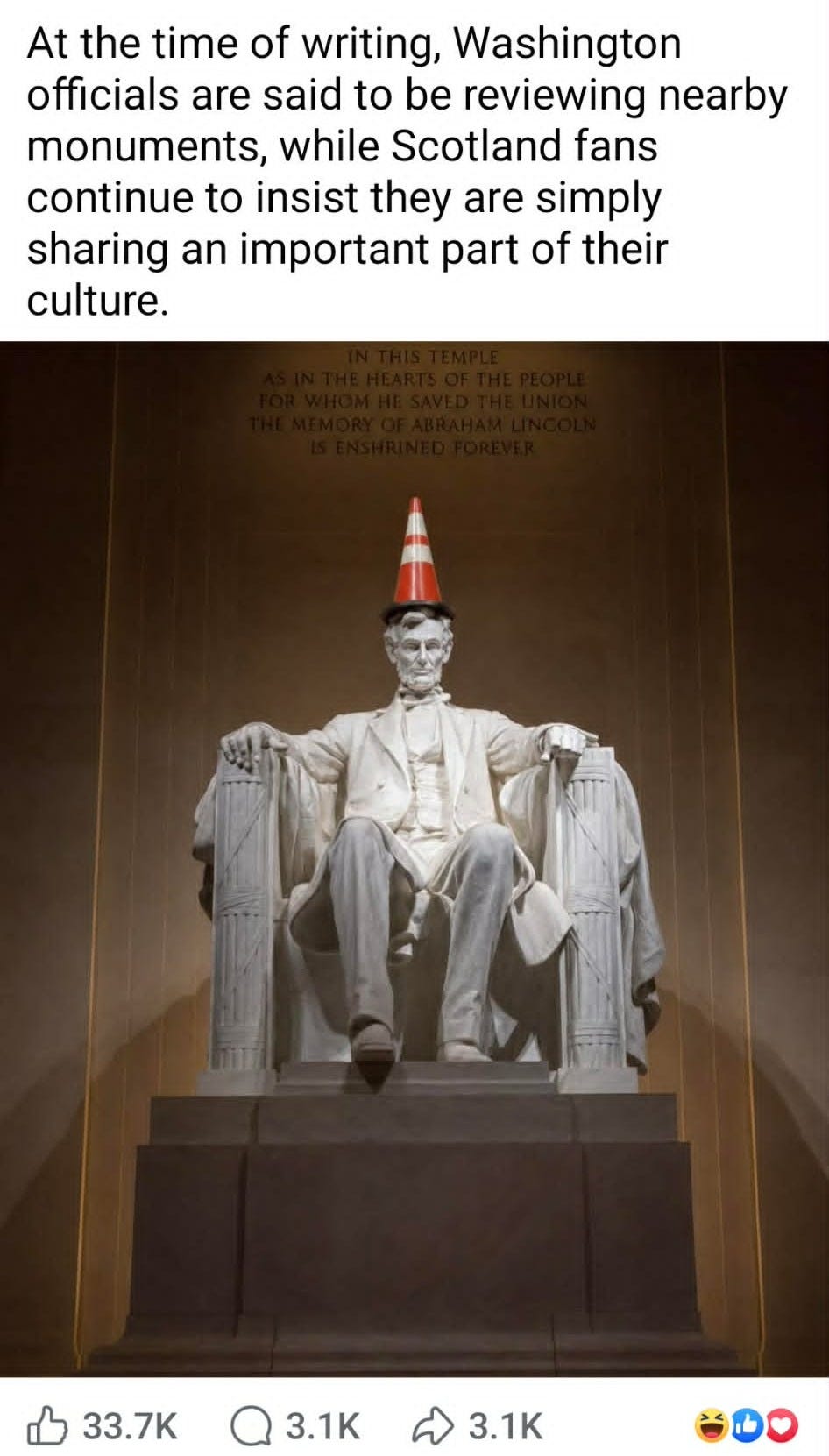
Scottish World Cup fans placed a traffic cone on Abraham Lincoln at the Lincoln Memorial.
Background
Scotland’s men’s national team qualified for the 2026 FIFA World Cup, marking the country’s first appearance at the tournament in 28 years. For many Scottish supporters, the trip to North America represented a once-in-a-generation opportunity to follow their team on the world’s biggest stage.
The Scottish fan base, known as the Tartan Army, has developed an international reputation for passionate support, elaborate singing, and generally good-natured behavior. Over the years, the group has also become known for charitable fundraising efforts and positive interactions with host communities.
Another Scottish tradition is somewhat more unusual. In Glasgow, placing traffic cones on statues has become a long-running cultural phenomenon. The most famous example involves the statue of the Duke of Wellington, which has spent decades wearing an orange traffic cone despite repeated efforts to remove it.
With more than 20,000 Scottish supporters reportedly converging on the Boston area for matches at Gillette Stadium, local officials, business owners, and statues alike suddenly found themselves exposed to Scottish culture.
The Reality
We found no evidence that Scottish supporters placed a traffic cone on Abraham Lincoln at the Lincoln Memorial. The image appears to have originated with Scottish Banter, a Scottish humor page on social media. As far as we can tell, Abraham Lincoln survived the World Cup without acquiring new headwear.
The problem is that reality was not interested in being outdone.
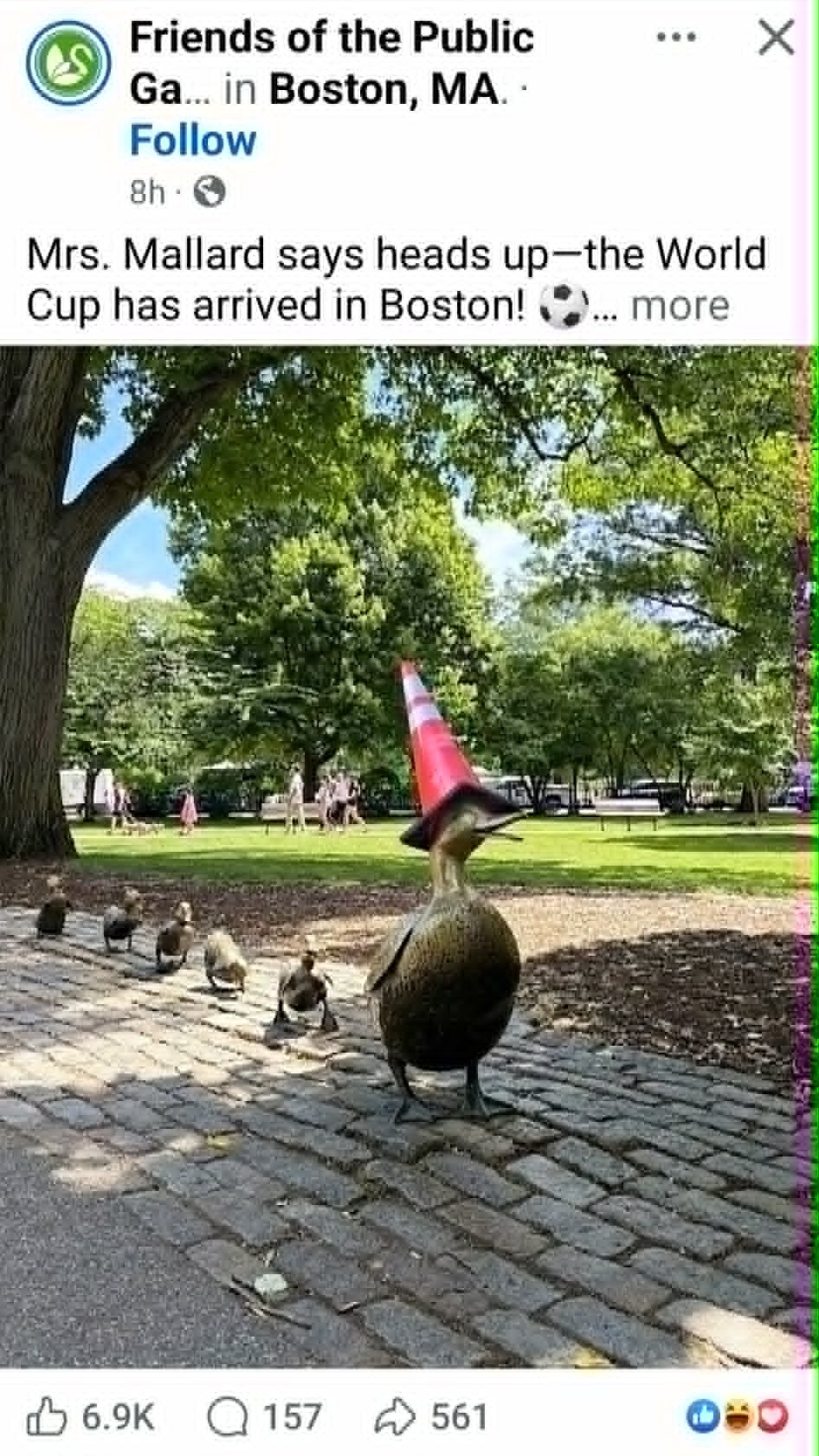
While Lincoln appears to have been spared, Scottish supporters absolutely brought the ancient and noble art of coning to Boston. Friends of the Public Garden posted photos showing Mrs. Mallard wearing a traffic cone, while local social media accounts and news outlets documented multiple Boston-area statues receiving similar treatment. South Coast Spotlight alone compiled a gallery of seven coned statues. Apparently, the Tartan Army looked at centuries of American history and thought, “You know what this needs? More traffic infrastructure.”
The cones were only the beginning.
As Scotland prepared for its first men’s World Cup appearance in nearly three decades, Boston bars experienced a surge unlike anything many had seen before. Reuters reported that some establishments required emergency beer deliveries to keep up with demand from Scottish supporters. WEEI’s The Lead reported beer sales reaching roughly three times St. Patrick’s Day levels. Social media posts circulating from local businesses claimed that Sam Adams’ downtown taproom sold approximately four times its normal Fourth of July volume and temporarily ran out of beer altogether.
The Tartan Army also managed to transform a local liquor store into a tourist attraction. Jobi Liquors, a neighborhood store in Boston, became an unlikely pilgrimage site as Scottish fans began taking selfies in front of the business. For reasons that remain unclear, the store became one of the unofficial landmarks of Scotland’s World Cup experience. Historians may one day study this phenomenon. They will likely remain confused.
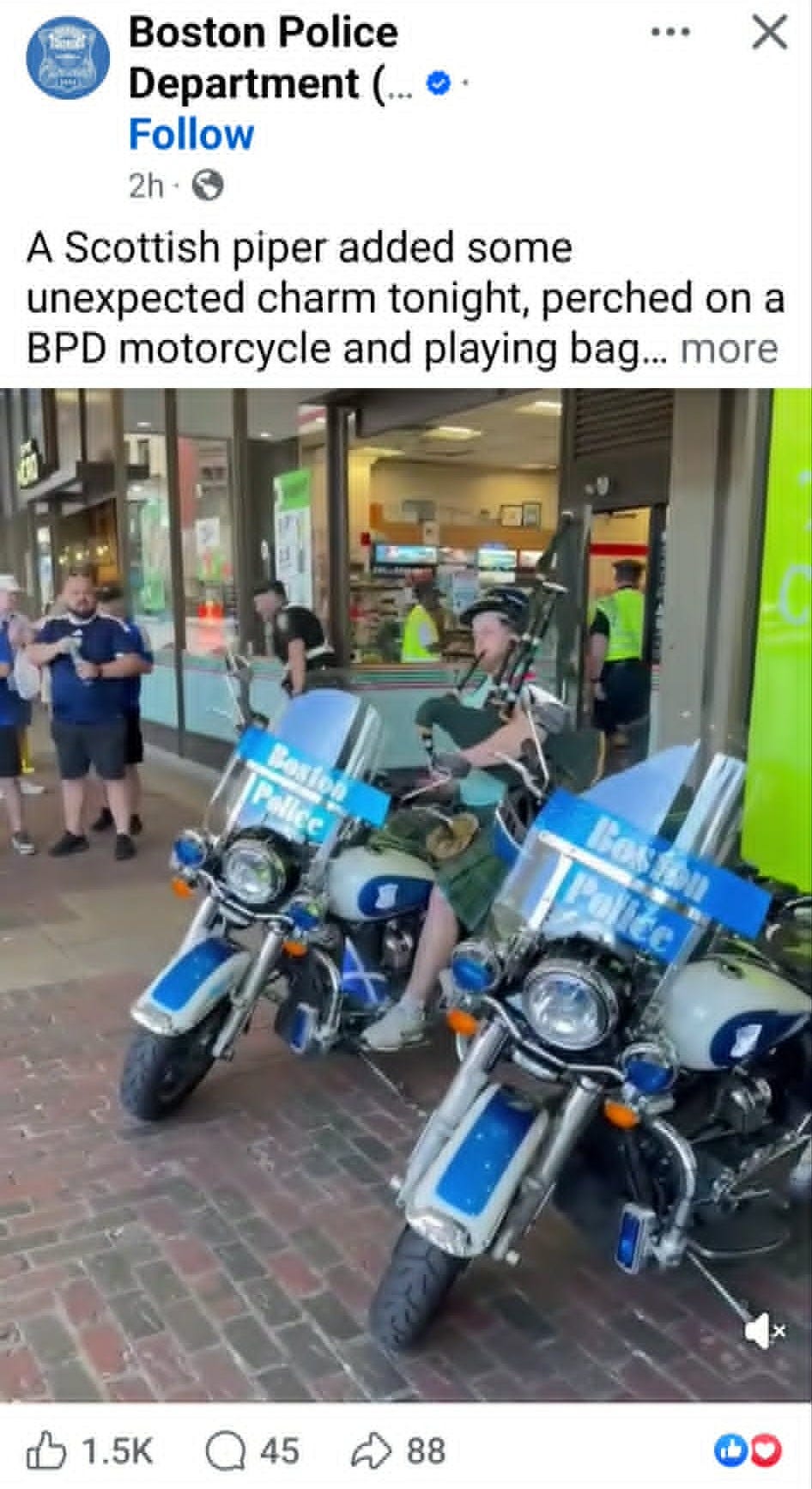
Meanwhile, Scottish supporters spread throughout the city. Fans packed bars, attended Red Sox games, marched through downtown streets, and filled social media with videos of singing, chanting, and bagpipes. The Boston Police Department even shared a photo of a Scottish bagpiper sitting atop a police motorcycle—a sentence that feels increasingly normal the longer you spend reading about this story.
The Tartan Army’s reputation for good behavior also made an appearance. Multiple reports highlighted supporters helping clean up trash after celebrations and making charitable donations while in Boston. One widely shared story involved Scottish supporters contributing to a local children’s charity. Another involved a fan staying with the Sisters of the Carmelite of the Aged and Infirm, creating what may be the most unexpectedly wholesome lodging arrangement in World Cup history.
By the end of the week, the city had witnessed beer shortages, bagpipes, coned statues, charity donations, baseball crossovers, and enough Scottish accents to convince some residents they had accidentally been relocated to Glasgow.
The Lincoln Memorial story may have been internet banter. Everything else was somehow real. Historians were relieved to discover this was one of the friendlier British Isles incursions into New England.
Verdict
THE INTERNET GOT CARRIED AWAY, YET SOMEHOW MISSED THE REAL CHAOS
The only thing Scottish fans apparently didn’t cone was Abraham Lincoln. Meanwhile, business has never been better in Boston, and everyone is sporting a new iconic accent.
Having survived one British invasion, North America immediately received another.
The Special Relationship Runs on Beer
Viral Claim
English fans drank 5,000 beers, ran up a $40,000 tab, and got kicked out of a Dallas-area pub.
Background
England has one of the largest and most recognizable traveling supporter bases in international soccer. Wherever the Three Lions play, thousands of fans often follow, creating massive gatherings at pubs, fan zones, and watch parties.
The Dallas-Fort Worth area has become one of the major hubs of the 2026 World Cup, hosting matches, serving as the media center, and attracting supporters from around the globe. Local businesses have spent months preparing for an influx of international visitors.
The Reality
Unlike many viral stories, this one appears to be rooted in numbers that are almost too specific to have been invented.
The Londoner in Arlington, a British-style pub, became a focal point for England supporters during the tournament. The venue held a soft opening timed to coincide with England’s World Cup festivities.
According to reports citing The Londoner, England supporters purchased more than 5,000 beers during the venue’s World Cup celebrations. The pub reportedly sold 2,352 bottles of beer alone, while total sales exceeded £30,000, roughly $40,000 for Americans who prefer their currency conversions served with freedom units.
The enormous turnout coincided with England’s opening World Cup festivities and quickly transformed the pub into one of the tournament’s most talked-about gathering spots. Videos posted online showed packed crowds, overflowing patios, and supporters singing football chants that could probably be heard from low Earth orbit.
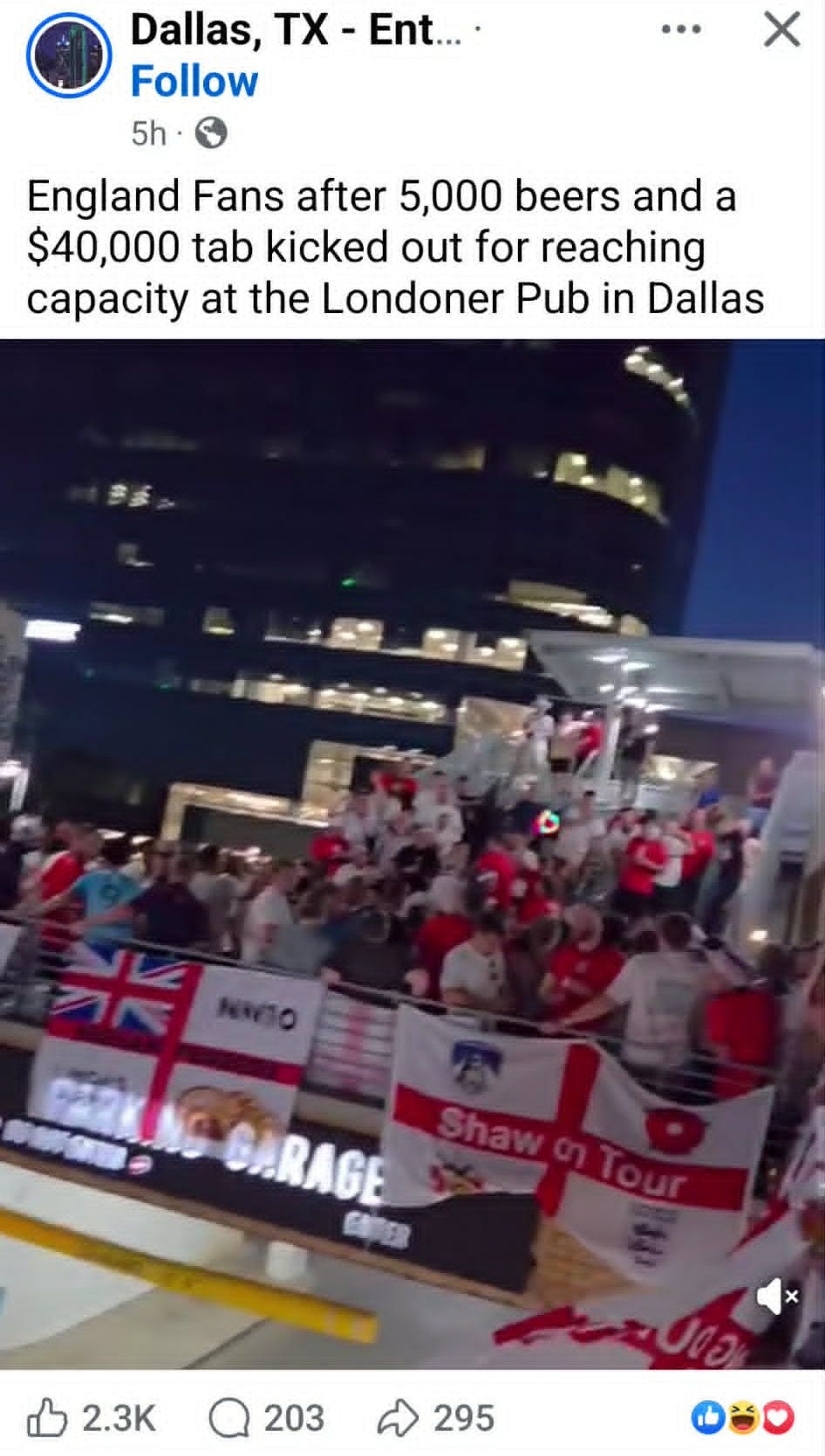
Importantly, reports indicate that fans were not removed for refusing to pay their tabs or for the establishment descending into chaos. Instead, authorities reportedly helped clear the venue because it had reached capacity. In other words, the problem was not that England supporters drank too much beer. The problem was that too many England supporters showed up to drink beer in the same place at the same time.
By World Cup standards, that’s practically a success story.
The Londoner has since become something of a pilgrimage site for England supporters in Texas, with fans treating the venue as a temporary embassy of football culture. The pub gets business. The fans get beer. Everybody wins, except perhaps the fire marshal.
Verdict
THE INTERNET DID NOT INVENT THIS
Historians call this the first successful British occupation of Texas.
Australians: America’s Cousins With Less Filter
Viral Claim
Ten thousand Australian soccer fans marched through Vancouver, chanting about Donald Trump.
Background
Australia’s men’s national soccer team, nicknamed the Socceroos, has developed a reputation for attracting passionate supporters willing to travel enormous distances to follow the team. Given Australia’s geographic isolation, international tournaments often become major cultural events for fans.
Supporter marches are a longstanding football tradition. Before major matches, thousands of fans frequently gather to sing, wave flags, and walk together toward stadiums or fan zones. These marches often generate some of the most memorable images of any tournament.
Vancouver has emerged as one of the World Cup’s busiest host cities, attracting supporters from around the world. The city’s downtown core has become a regular gathering place for fan celebrations, parades, and pre-match festivities.
Australian sports culture is also famously irreverent. Whether discussing opponents, politicians, or each other, Australian supporters have rarely been accused of being overly reserved.
The Reality
The march itself is very real.
Local Vancouver reporting documented thousands of Australian supporters flooding downtown streets as the Socceroos prepared for World Cup action. Videos showed large crowds dressed in green and gold, waving flags, singing songs, and transforming sections of the city into what looked like a temporary Australian neighborhood.
The viral portion of the story involves chants about Donald Trump. Videos circulating widely on social media appear to show Australian supporters singing an anti-Trump chant while marching through Vancouver. The clips spread rapidly across platforms and generated significant online discussion.
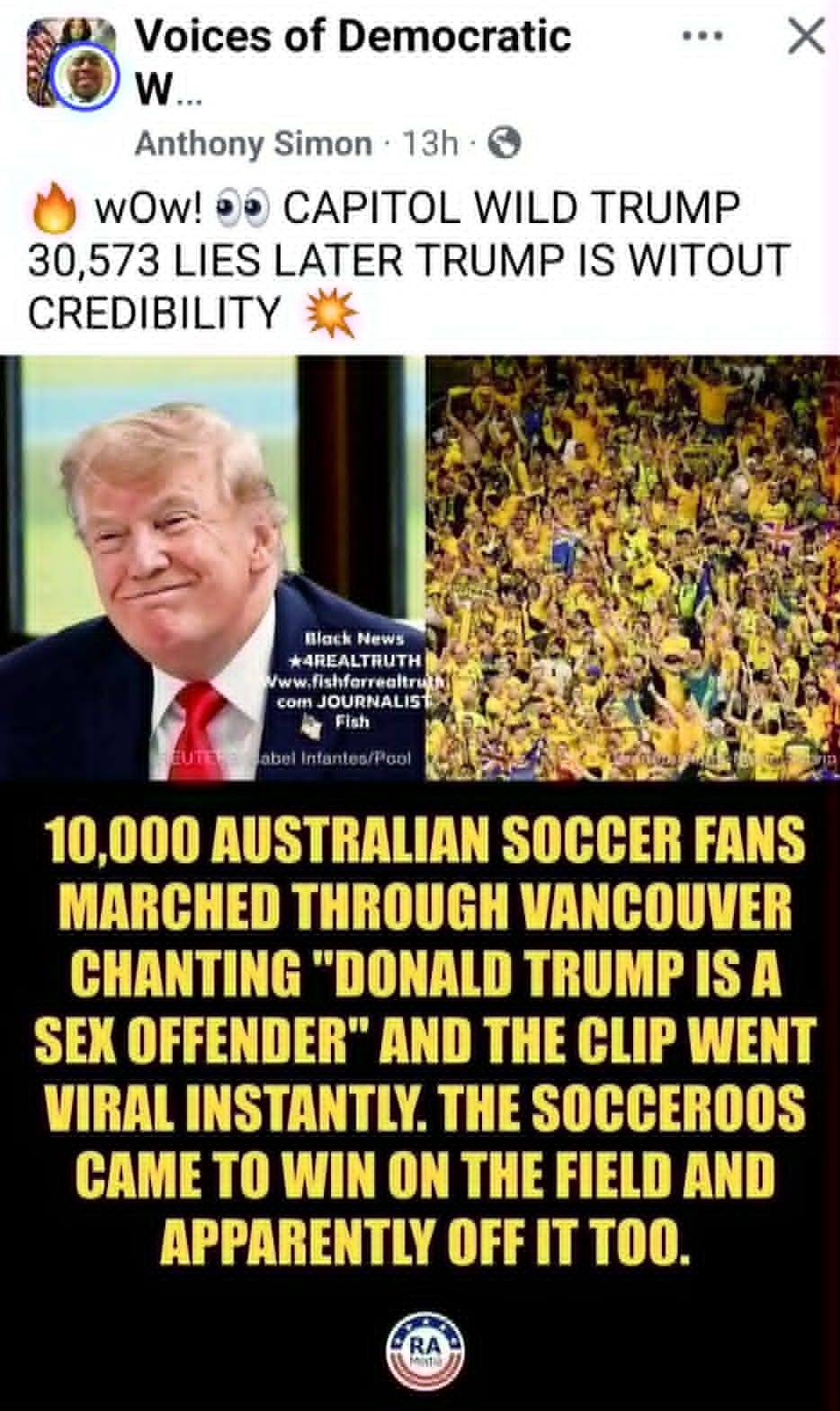
Where things become less certain is scale. While viral posts frequently cited figures of around 10,000 participants, local reporting focused more on the march’s existence and spectacle than on verifying every number or lyric that later circulated online.
In other words, we can confidently say the march happened. We can reasonably say the chant appears authentic. We cannot confidently say every viral retelling captured the exact size, wording, or context of what occurred.
Honestly, this is often how internet stories work. A real event happens. The internet arrives. The event becomes larger than life. For Australians, this process appears to happen slightly faster than normal. Even without firm confirmation of the chant, however, we feel confident that our favorite international uncle, who always gets a seat at the kids’ table, absolutely made it epic.
Verdict
INTERNET, YOUR HONOR
Australia remains Britain’s most successful “What if we put the loud people over there?” experiment.
The World Came for Soccer and Found Waffle House
Viral Claim
International World Cup visitors have become obsessed with American food, gas stations, and complimentary tortilla chips.
Background
The 2026 FIFA World Cup is the largest in tournament history, with matches spread across the United States, Canada, and Mexico. Millions of visitors are expected to travel throughout North America during the competition, many experiencing parts of the continent for the first time.
The United States has a food culture that is often misunderstood abroad. While international perceptions often focus on fast-food chains, the country also boasts dozens of distinct regional food traditions, from Texas barbecue and Southern comfort food to New England seafood and Southwestern cuisine.
Major sporting events often become cultural exchanges that extend far beyond the competition itself. Visitors attend games, but they also explore cities, try local restaurants, and inevitably document their experiences online.
In the age of social media, those discoveries can spread around the world almost instantly. Sometimes that means highlighting world-famous landmarks. Sometimes it means discovering that a gas station has a larger footprint than some European villages.
The Reality
This story is not only true—it may be one of the most wholesome developments of the entire tournament. Honestly, it is the only thing keeping our editor sane right now.
As World Cup supporters have traveled across North America, social media has been filled with posts documenting first encounters with uniquely American foods. Yahoo News and other outlets have highlighted the growing trend, while countless fan videos and posts have racked up millions of views.
One of the most widely shared stories involved a Japanese visitor dining at a Mexican restaurant in the United States. According to a viral post, he was served complimentary chips and salsa before his meal. Unfamiliar with the custom and reluctant to refuse what he perceived as a generous gift, he reportedly ate three baskets before realizing they were not the main course. By the time his actual dinner arrived, he had no room left to eat it.
The World Cup has also produced a steady stream of visitors discovering regional American specialties. Fans traveling through Texas have documented their first encounters with Texas barbecue, often reacting to portion sizes with a mixture of awe and concern. Brisket, smoked ribs, and giant platters of meat have become recurring stars of World Cup social media.
Then there is Buc-ee’s.
For those unfamiliar, Buc-ee’s is a Texas-based travel center chain that combines the functionality of a gas station with the scale of a small civilization. International visitors have posted videos marveling at the size of the stores, the walls of beef jerky, the endless snack selections, and the sheer number of fuel pumps. Many appear to have entered expecting a convenience store and emerged questioning everything they thought they knew about convenience stores.
Other recurring discoveries include first visits to Waffle House, Raising Cane’s, Chick-fil-A, Taco Bell, and various regional chains. Fans have documented reactions to sweet tea, free refills, giant drink sizes, ranch dressing, late-night diner culture, and the realization that Americans treat side dishes as a competitive sport. Honestly, if you are not following German fan Freddy in particular, what are you even doing with your life??


Verdict
TRUTH WEIRDER THAN FICTION
The true winner of the World Cup may be complimentary tortilla chips. Thank goodness nearly every other nation in the world has universal healthcare. They will need it after their gut-busting North American tour.
And with that, our doomscrolling comes to an end.
We regret to inform you that reality remains stranger than satire, international diplomacy may be conducted through sports bars, and the true winner of the World Cup may be American chain restaurants.
The British spent centuries exporting their culture around the world. America apparently chose to respond with brisket, ranch dressing, and unlimited refills.
Until next time, wave to the traveling soccer fans, take a break from doomscrolling for some food scrolling (search Facebook for “soccer fans discover”), and remember: not every monument needs a traffic cone.
If this game gets any harder, we’re going to need constitutional scholars, trauma counselors, and three Onion editors on retainer just to sort the headlines.
Follow for the next round of Truth or Satire, where every week America dares parody to catch up. Or tune in for our regularly scheduled analysis and commentary, when the meds kick in, and we can take the headlines seriously.
Sources:
New York Post, “Brawl erupts between mob of Argentinian and Algerian soccer fans in Times Square ahead of World Cup showdown”, June 16, 2026
talkSPORT, “Mass brawl breaks out in Times Square between rival World Cup fans in shocking scenes”, June 17, 2026
Reuters, “Unquenchable Scottish thirst for World Cup beer pushes Boston bars to the limit”, June 17, 2026
People, “Scottish Soccer Fans Are Drinking Boston’s Bars Out of Beer: ‘Never Seen Anything Like It’”, June 17, 2026
The Guardian, “Tartan Army toast Scotland’s World Cup return: ‘It’s a once-in-a-lifetime opportunity’”, June 12, 2026
Boston.com, “‘Thousands’ of Scottish fans are taking pictures in front of Jobi Liquors”, June 17, 2026
The Independent, “England fans ignore police pleas to leave Dallas pub after drinking over 5,000 beers”, June 17, 2026
The Irish News, “England fans defy distances as hundreds gather on eve of World Cup opener”, June 17, 2026
Daily Hive Vancouver, “Australian fans take over Downtown Vancouver before FIFA World Cup match”, June 13, 2026
The Guardian, “Socceroos fans feel right at home in Vancouver: ‘Like a hilly Melbourne’”, June 13, 2026
Yahoo News, “World Cup visitors are discovering America — one Waffle House and side of ranch dressing at a time”, June 17, 2026
Houston Chronicle, “World Cup tourists take social media by storm, get recommendations from J.J. Watt”, June 11, 2026
Houston Chronicle, “A World Cup tourist got hundreds of Houston breakfast ideas. He chose Shipley Do-nuts.”, June 17, 2026
Quartz, “World Cup visitors are losing their minds over these American foods”, June 15, 2026
Waaaay more positive stories than usual, and equally unexpected wholesomeness from soccer fans