


On November 18, 2025, the U.S. House of Representatives did something almost unthinkable in this age of gridlock: it voted — nearly unanimously — to release the Epstein files. That moment, driven by a rare discharge petition, marked a long-overdue step toward transparency and justice for survivors.
While headlines blared about the Epstein vote, another major development took place in the House. It didn’t go viral. There were no prime-time cable debates, no bombshell hashtags, but it could affect the lives of millions of Americans who keep our government running.
Just the day before, another discharge petition — the same rarely used legislative tool that brought the Epstein files vote to the floor — quietly reached the required 218 signatures. This time, it was to force a vote on the Protect America’s Workforce Act, a bill that would reverse one of the most consequential and underreported decisions of the Trump administration: the systematic dismantling of federal workers’ collective bargaining rights.
This legislation, introduced by Rep. Jared Golden (D-Maine) and Rep. Brian Fitzpatrick (R-Pa.), has been quietly gathering bipartisan support. With 218 members now backing its advancement, it is guaranteed a floor vote in the House, potentially in the coming days.
The implications are profound.
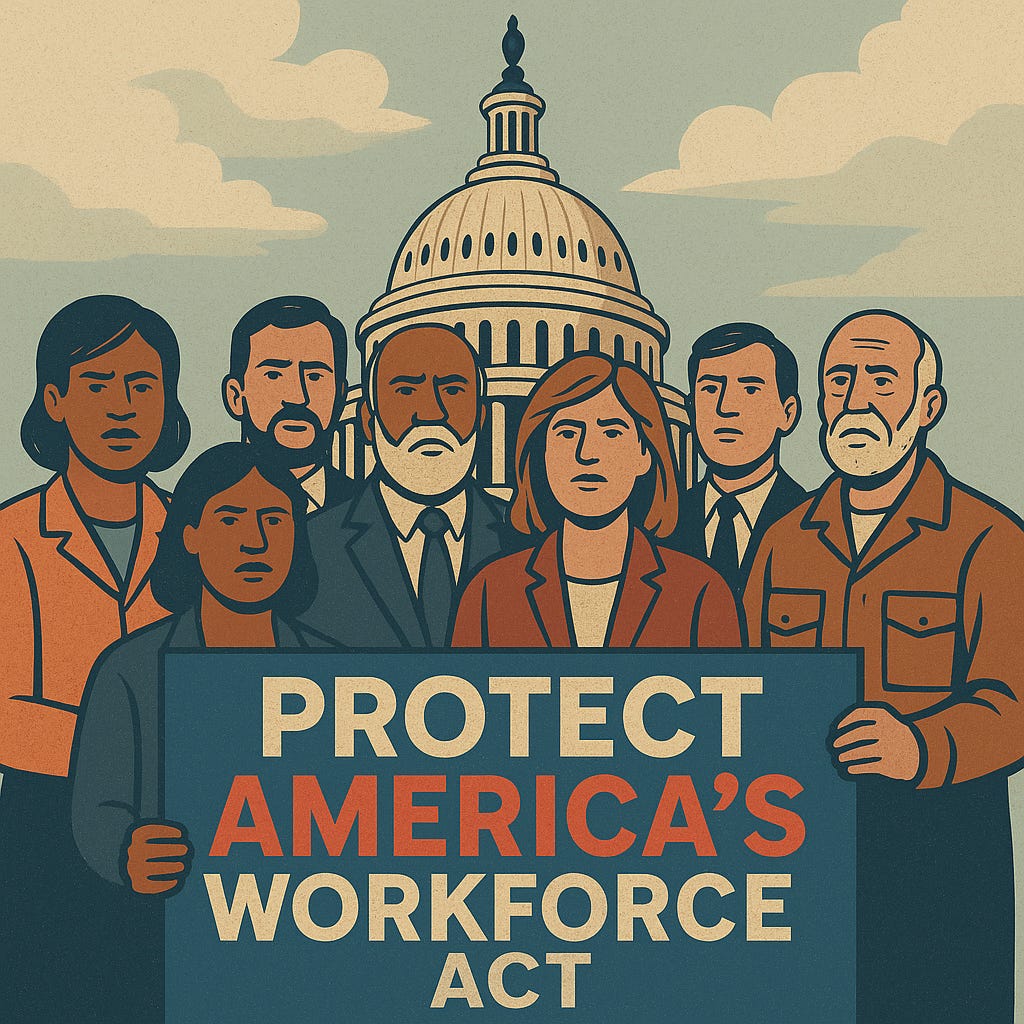
Want to Know Your Rights?
Download a free digital copy of the U.S. Constitution—the same document Trump is trying to bulldoze. Learn exactly what he’s breaking… and how to fight back.
50,000 strong — and counting.
This Early Black Friday, become a paid subscriber for just $1 a week and help us keep the truth alive.
Join The Coffman Chronicle — $1/Week Early Access
Undoing Trump’s Executive Assault on Federal Workers
The Executive Orders
In the early months of his return to the White House, President Trump wasted no time reviving his long-standing goals of weakening the federal workforce’s ability to organize and collectively bargain.
On March 27, 2025, he signed an executive order that excluded agencies with “national security functions” from the collective bargaining protections of the Civil Service Reform Act of 1978. The move stripped union rights from tens of thousands of employees across more than 30 federal agencies, including the Departments of Defense, State, Justice, Veterans Affairs, and Energy. These exclusions represented a sweeping rollback of workplace rights for civil servants on the frontlines of diplomacy, national security, public health, and more.
Then, in August 2025, the administration issued a follow-up order that further expanded the list of affected agencies. By designating additional departments as exempt from bargaining obligations, the White House effectively neutralized the role of unions across a majority of the federal workforce.
The Impact
In all, an estimated 67 percent of federal workers lost their right to negotiate working conditions, grievance procedures, and basic protections.
Union representatives were removed from agency offices, and contract negotiations were suspended or nullified. Workers were left with no real avenue to challenge arbitrary management decisions. All of it was done through executive authority, without Congressional input or public debate.
A Long Road to 218
The Protect America’s Workforce Act wasn’t an overnight maneuver. The bill was introduced early in 2025, but the effort to force a vote began quietly in June with the launch of a discharge petition.
The signatures didn’t flood in. Through July and August, momentum stalled. Congress went into recess. Party leaders discouraged signatories. Even many Democrats hesitated, wary of drawing internal fire or triggering floor fights during a volatile election year.
Then came the shutdown. On October 1, 2025, the federal government ground to a halt, and with it, so did nearly all floor activity.
Then something shifted.
In early November, just days after the House crossed 218 signatures to force a vote on releasing the Epstein files, support for the workers’ petition suddenly picked up. On November 17, two moderate Republicans — Nick LaLota and Mike Lawler — signed on, pushing the total over the finish line.
This wasn’t a scheduling win. It was a signal. The climate had changed. The political will that didn’t exist in July had finally arrived, shaped by new public pressure, shifting loyalties, and a growing desire to reclaim some power from a president whose legal and ethical burdens now cast a longer shadow over his party.
The Legislation
The Protect America’s Workforce Act directly confronts Trump’s executive orders. The bill would reverse both 2025 executive actions, restore collective bargaining rights for affected workers, and codify protections to prevent future administrations from repeating the same unilateral moves.
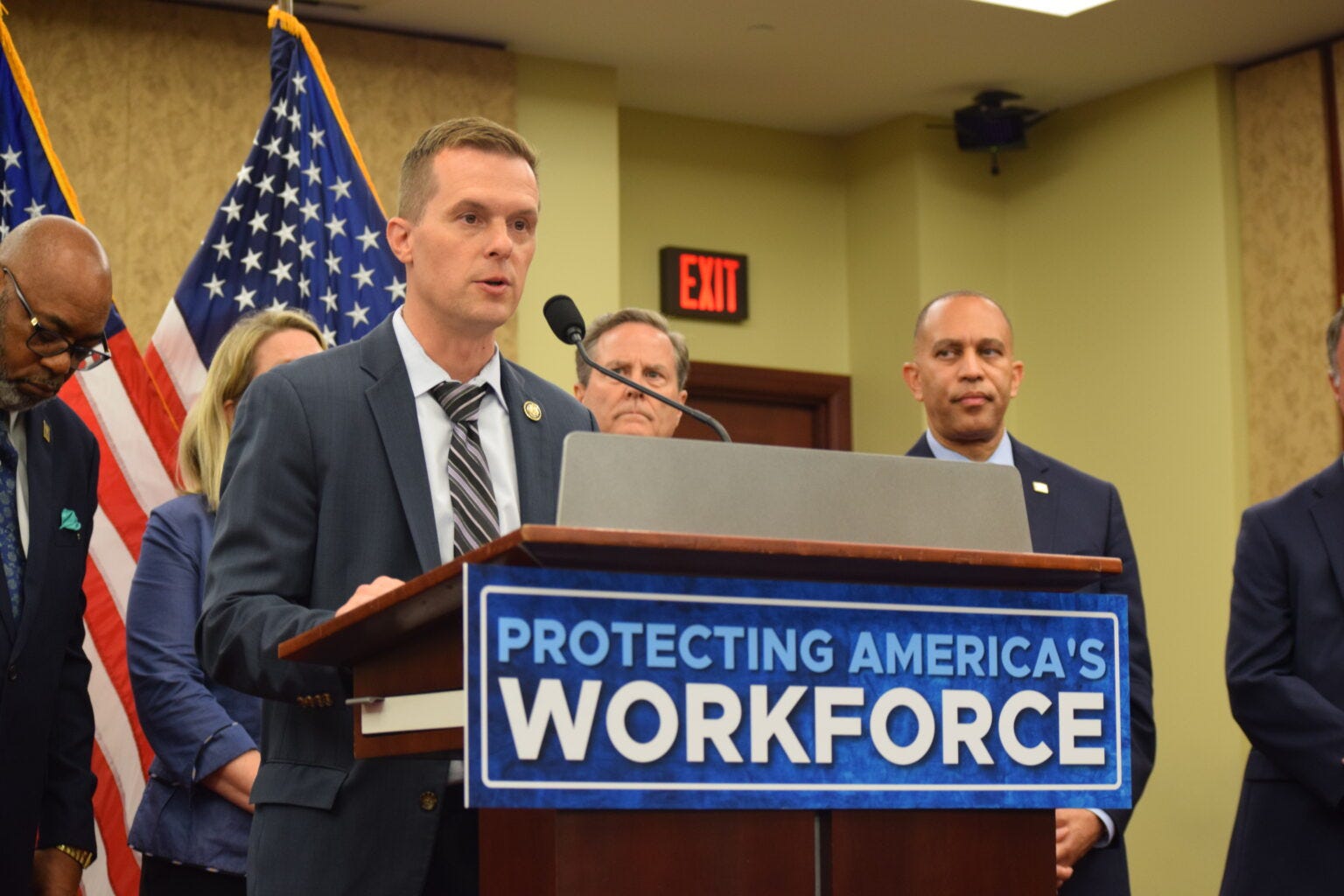
(Photo via Rep. Jared Golden)
This isn’t just a labor fight. It’s a fight for basic democratic governance, to decide whether the rights of millions of federal employees can be erased with the stroke of an executive pen.
Voices From the Frontlines: Union Leaders React
The Protect America’s Workforce Act isn’t just a legislative maneuver. For the people whose rights were stripped away by executive order, it’s a fight for survival, stability, and respect. Labor leaders and federal unions have responded to the bill and the successful discharge petition with clarity and urgency.
Everett Kelley, president of the American Federation of Government Employees (AFGE), called the March executive order “the single most aggressive action taken by the federal government against organized labor in U.S. history,” warning that it “dwarfs any previous action against public or private sector working Americans.”
Liz Shuler, president of the AFL-CIO, praised the discharge petition’s success as a model of worker-led power. She said, “The labor movement fought back against the largest act of union-busting in American history by doing what we do best: organizing. Working people built a bipartisan coalition to restore union rights to federal workers… Speaker Johnson has run out of excuses to delay a vote on this legislation.”
Lee Saunders, president of AFSCME, emphasized the broader implications. “When federal workers have the freedom to collectively bargain for safe working conditions and strong public services, we all benefit. The billionaires running this administration are hell-bent on rigging our government to line their own pockets — and silencing federal workers is how they plan to do it.”
These leaders see the bill not only as a restoration of legal rights but as a necessary defense against political retaliation and structural power grabs. The reaction has been one of urgency but also of hope.
The Ongoing Legal Fight
Litigation is also underway. After the March 2025 executive order, the NTEU, AFGE, and other union federations filed lawsuits. In April, a judge blocked implementation at dozens of agencies, though that block was overturned on appeal in mid‑May. Some agencies have since moved ahead with terminating collective bargaining agreements. The legal battle underscores that restoring rights isn’t just a political question. It’s being fought in court right now.
A Test of Congress’s Will & of the GOP’s Future
In a year marked by partisan infighting, the use of two successful discharge petitions in the same month — one for the Epstein files, and now this — signals something more than procedural savvy. It may represent a shift, a small but meaningful reassertion of Congressional power in an era dominated by executive overreach.
That makes the upcoming federal workers’ vote more than just a labor issue. It’s a test.
It’s a test of whether Congress can do more than chase headlines and actually legislate for the public good.
It’s a test of whether Republicans, sensing that Donald Trump’s legal and political liabilities are becoming too much to bear, are willing to start separating themselves, not just in rhetoric, but in action.
The Epstein vote may have been a moment of moral clarity for the House. However, it also offered something else: political cover. For Republicans who have long feared Trump’s wrath, this nearly unanimous vote provided a safe outlet to say, “enough.” If the Epstein files prove to be his political iceberg, then this is their chance to jump ship and show voters that they are still capable of governing.
Here, with the federal workers bill, they have an opportunity to do just that.
Democrats Should Seize the Moment
For Democrats, the path forward is clear: press the advantage. Make the case that undoing Trump’s executive power grabs is not just a partisan fight, but rather a constitutional one. Make every Republican choose: are you still enabling him, or are you ready to start fixing what he broke?
This isn’t just about restoring labor rights. It’s about restoring balance, Congressional authority, and a sense of responsibility in how we govern.
The Protect America’s Workforce Act is a chance to do something rare in today’s politics: to act, together, in the interest of millions of Americans who won’t get a headline, but who make this country work every day.
Two Petitions. Two Chances. One Path Forward.
Let’s be clear: the Epstein vote was important. It was necessary. It was just.
But justice comes in many forms.
Justice is holding predators accountable, and it’s also standing up for workers who’ve been silenced. It’s calling out corruption and rebuilding the institutions that serve us all. It’s exposing what’s been hidden and repairing what’s been damaged.
If Congress truly wants to reclaim its voice — and if Republicans truly want to demonstrate they are more than just Trump’s cleanup crew — this is their moment.
Will they take it?
Don’t let the bastards sneak anything past you. Subscribe and get your daily dose of rage and receipts delivered fresh, before the spin doctors can scrub it.
Sources:
“House majority forces vote on bill to restore collective bargaining for most federal employees,” Federal News Network (November 17, 2025)
“Golden’s bill to restore federal workers’ union rights clears threshold to force House action,” Rep. Jared Golden – Official Press Release (November 17, 2025)
“Discharge Petition for the Protect America’s Workforce Act reaches 218 signatures, triggering House consideration,” National Federation of Federal Employees (November 18, 2025)
“Trump signs executive order to exclude national security agencies from collective bargaining protections,” Economic Policy Institute (March 27, 2025)
“Judge blocks Trump administration from nixing collective bargaining for most federal employees,” Associated Press (April 25, 2025)
“Court lifts block on Trump order to strip federal workers of union rights,” Washington Post (May 17, 2025)
Read here“Congress inches closer to vote to overturn Trump’s union-busting orders,” American Federation of Government Employees (September 22, 2025)
“Union leaders applaud Senate bill to restore collective bargaining rights for federal workers,” People’s World (September 19, 2025)
“Labor movement forces vote to restore federal workers’ union rights,” Common Dreams (November 17, 2025)
And what if the DOJ doesn't release anything because there is an ongoing investigation against Democrats?