


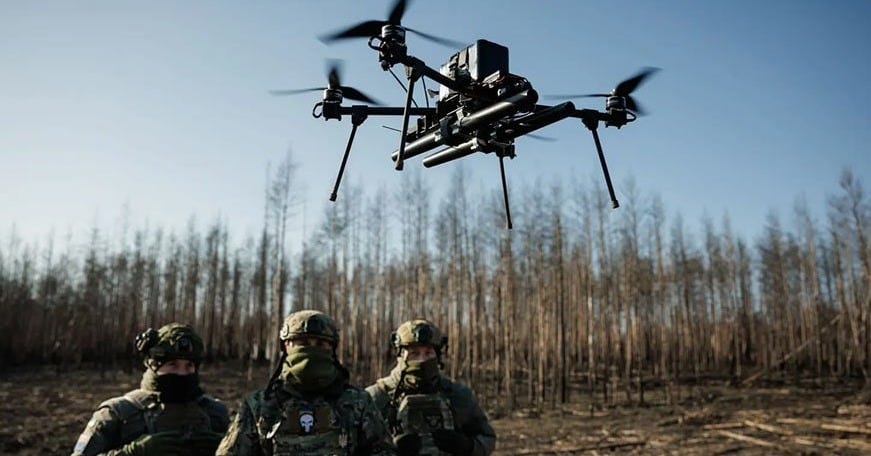
Ukraine’s front line is being reshaped by a new battlefield reality: a drone-saturated “kill zone” where soldiers, vehicles, medics and supply crews can be spotted and attacked far beyond the trench line.
The shift is drawing fresh attention online from military analysts and defense-focused communities because it points to a larger question: whether Ukraine is showing the world what future wars will look like.
Reporting from AP News found that high-tech drones have made parts of Ukraine’s front line deadly for soldiers and difficult for evacuation teams. Reuters separately reported that Ukraine’s drone-heavy front has slowed Russian advances and changed how both sides move through the battlefield.
The social media reaction has focused less on politics and more on military consequences. Analysts on X have highlighted how FPV (First Person View) drones can create area-denial zones, where troops entering open ground may be seen and targeted quickly. Defense communities on Reddit have also debated the limits of FPV drones, including whether they can replace artillery or simply add another deadly layer to the battlefield.
That distinction matters. Drones have not made artillery, infantry, armor or logistics irrelevant. But they have shortened the time between detection and attack.
Subscribe free for daily political analysis they won’t broadcast. Join 110K+ readers →
For soldiers near the front, visibility can now be fatal. A vehicle moving supplies, a medic trying to reach the wounded or a small assault team crossing exposed ground may be seen from above before they reach cover.
The broader consequence reaches NATO and the U.S. military. NATO has said it is working to apply lessons from Ukraine’s drone war, including through the NATO-Ukraine Joint Analysis, Training and Education Centre in Poland.
The U.S. Army has also pointed to Ukraine as a reason counter-drone training must become more adaptable and immediate, noting that FPV drones can overwhelm traditional defenses.
The plain-English consequence is this: Ukraine’s war is no longer only a contest of trenches, artillery and tanks. It is also a contest over who can see first, jam first, strike first and survive long enough to move.
For Ukraine, the drone kill zone can slow Russian advances. But it also makes holding ground, rotating troops and evacuating the wounded more dangerous.
For NATO, the lesson is urgent. Future wars may be shaped not only by fighter jets and armored columns, but by cheap drones flying just above the battlefield.
Subscribe free for daily political analysis they won’t broadcast. Join 110K+ readers →