


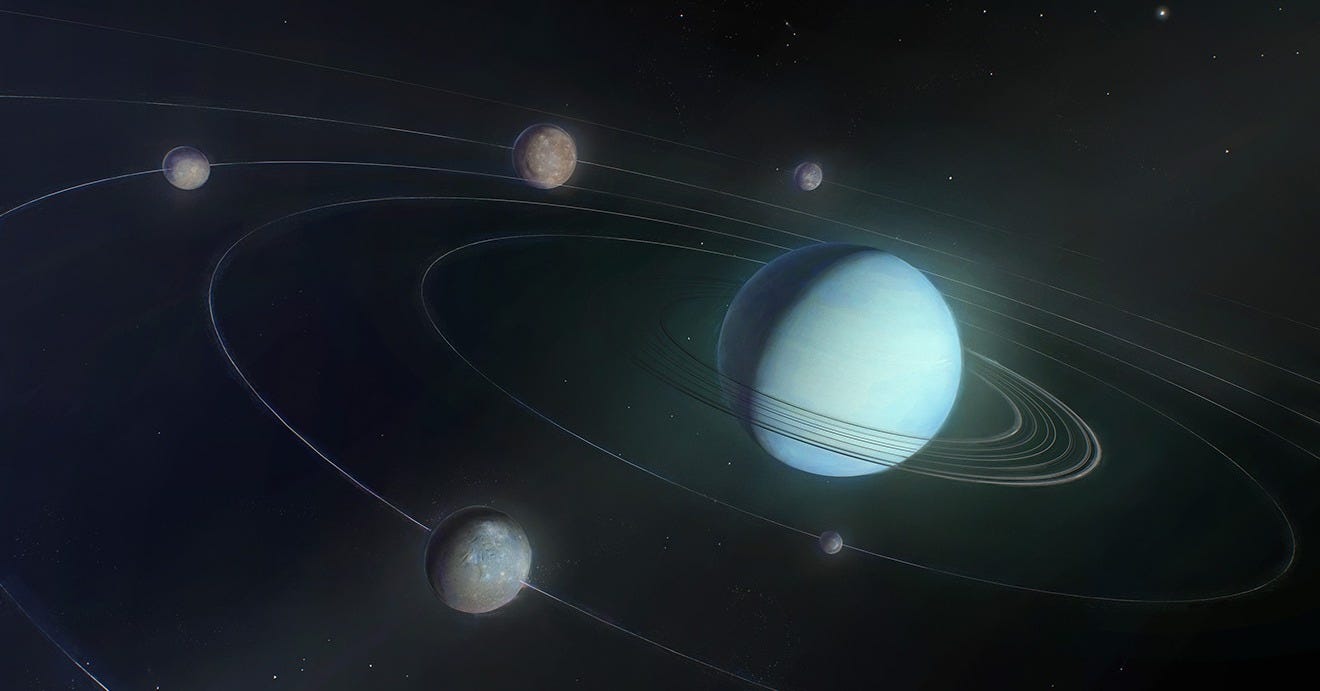
Scientists investigating the origins of the solar system say Uranus’ moons may contain clues pointing to a dramatic chapter in planetary history, one that could have included giant planets that no longer exist.
New research discussed in the journal Icarus examined 122 possible scenarios for a period of instability believed to have occurred after the solar system formed. During that era, the giant planets are thought to have shifted positions through a series of gravitational encounters that reshaped the outer solar system.
Researchers found that Uranus’ moon system was destroyed in the vast majority of simulations. The configurations that most closely resembled the present-day system often involved one or more additional giant planets that were eventually ejected into interstellar space.
The findings add weight to long-running theories that the early solar system may have contained a fifth giant planet beyond the four giant worlds seen today. Scientists have proposed such scenarios before because they help explain several unusual features of the outer solar system, including planetary orbits and the distribution of smaller bodies.
Subscribe free for daily political analysis they won’t broadcast. Join 110K+ readers →
One of the study’s most intriguing targets is Miranda, Uranus’ smallest major moon. Researchers believe its unusual appearance may reflect a history of destruction and reassembly, potentially preserving evidence of ancient gravitational upheaval.
Reaction among astronomy enthusiasts and science-focused communities has centered on the possibility that a long-lost giant planet once helped shape the solar system before being thrown into deep space. The concept has become one of the most discussed aspects of the new research.
While the simulations do not prove a missing planet existed, they suggest Uranus and its moons could provide one of the best opportunities to test the idea. Scientists have argued that a dedicated mission to Uranus could help answer some of the biggest remaining questions about the formation of the solar system.
Subscribe free for daily political analysis they won’t broadcast. Join 110K+ readers →