


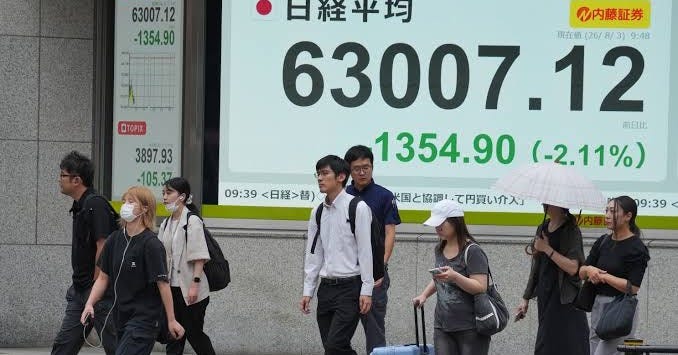
The U.S. dollar weakened sharply against the Japanese yen after Washington and Tokyo confirmed a rare coordinated effort to support the Japanese currency.
The yen rose to about 155.20 per dollar following the announcement, its strongest level since early May, before giving back part of the advance. It had traded near 164 in July, around its weakest level in four decades.
President Donald Trump and Japanese Finance Minister Satsuki Katayama confirmed that both governments had intervened. Katayama said authorities would not hesitate to coordinate again if necessary. Preliminary Bank of Japan data suggested Tokyo may have spent as much as $36.58 billion during the latest operation, although the final amount has not been published.
The action matters beyond currency trading. Japan has large holdings of U.S. government debt, and selling foreign assets to finance yen purchases can put pressure on Treasury markets. Reports indicated the U.S. side used euros in its yen purchases, a structure analysts interpreted as an effort to support Japan without directly signaling a broader campaign against the dollar.
Subscribe free for daily political analysis they won’t broadcast. Join 110K+ readers →
Visible market reaction has focused on whether intervention can produce more than temporary relief. Some financial commentators described U.S. participation as an unusually strong warning to traders. Others argued that intervention can slow a currency move but cannot reverse the underlying trend while Japan maintains lower interest rates and expansionary fiscal policies.
The debate also extends to the yen carry trade, in which investors borrow cheaply in yen and purchase higher-yielding assets elsewhere. A sudden unwinding could increase volatility in bonds and technology stocks.
The next test is whether traders rebuild positions against the yen. Further intervention remains possible, but a sustained recovery may require higher Japanese interest rates, tighter fiscal policy or increased repatriation of overseas investments.
Subscribe free for daily political analysis they won’t broadcast. Join 110K+ readers →