


In the summer of 2025, hundreds of immigrants were bused to a newly constructed detention facility deep in the Florida Everglades. It was nicknamed “Alligator Alcatraz”, a moniker that once sounded hyperbolic, until it became horrifyingly accurate.
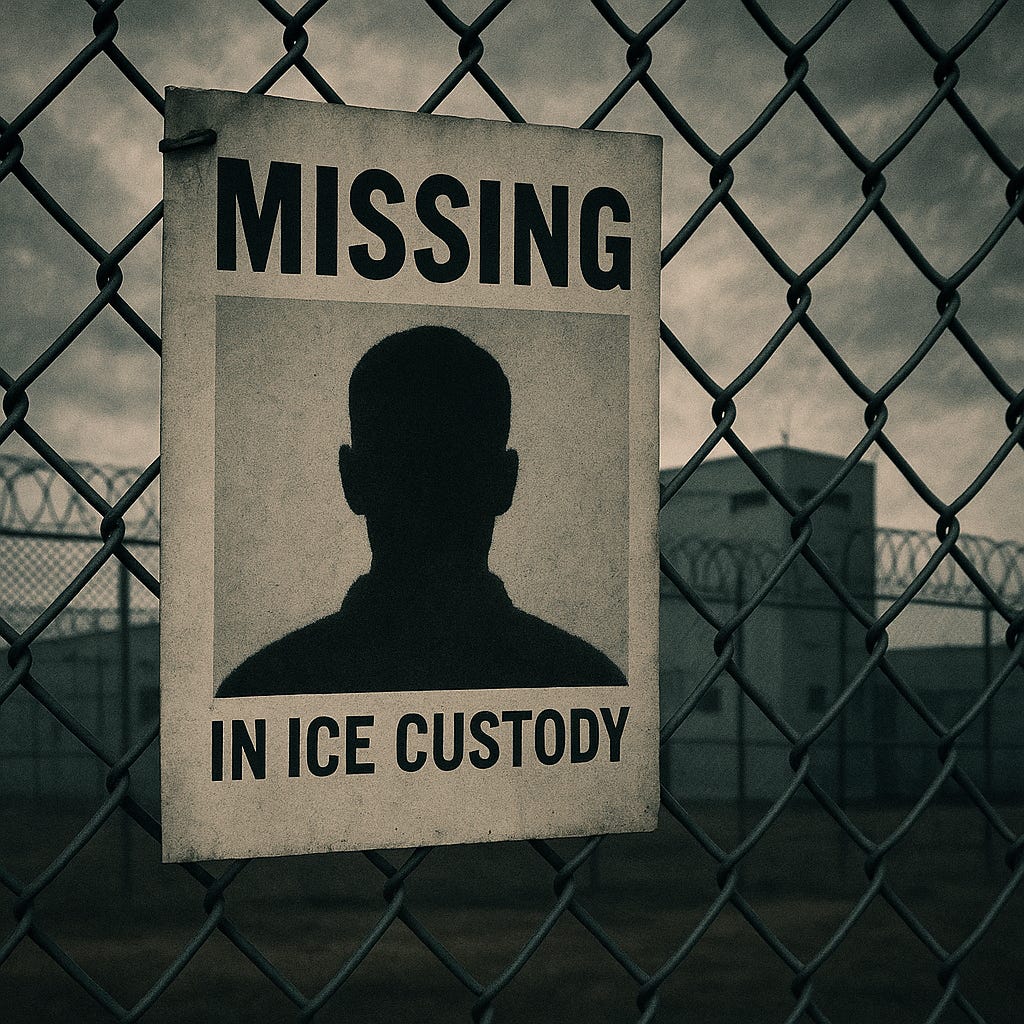
Within just weeks of opening, hundreds of people held at the facility vanished from public government tracking systems—not released, not legally transferred, not accounted for.
They just disappeared.
There have been no formal notifications, contact with lawyers, communication with family, or explanation.
We just hit 20,000 subscribers, 1,000 articles, and 1,000 podcast episodes. To celebrate, paid subscriptions are 20% off for two weeks only. That’s just $64/year—less than $1.25 a week.
The Disappearance
The first alarm came from the Miami Herald, which reported that roughly two-thirds of the people held at Alligator Alcatraz in July no longer appeared in ICE’s online detainee locator by mid-August. This early reporting drew on data from legal advocates and immigration attorneys who were unable to find clients they had previously located in the system.
Shortly after, reporters Brenda Medina and Jacobo García at El País confirmed the scope: approximately 800 detainees had disappeared entirely from ICE’s public database, and another 450 were listed without any facility location, simply a vague prompt to “Call ICE for details.”
In the following days, a pattern emerged. Lawyers were reporting that scheduled calls and legal visits were being abruptly canceled. Families were calling ICE field offices and receiving no answers. Advocacy groups monitoring detention hotlines were inundated with calls from panicked relatives.
The watchdog group Freedom for Immigrants, which operates a national detention hotline and monitors conditions across the country, warned that the camp had effectively become a “legal black hole.”
The ACLU’s National Prison Project joined the outcry. Senior attorney Eunice Cho stated plainly: “ICE’s persistent refusal to provide timely updates to the public detainee locator undermines access to legal counsel and constitutes a violation of detainees’ due process rights.”
Attorneys from the Southern Poverty Law Center, RAICES, and the National Immigration Justice Center filed emergency habeas petitions and FOIA requests, attempting to track their clients. Some cases involved people who had credible fear interviews or pending court dates, individuals who were legally entitled to remain in the U.S. pending review.
But they were simply gone.
Saying the Quiet Part Out Loud
In one particularly revealing moment, a Department of Homeland Security official defended the lack of notification by saying that giving legal counsel advance notice of transfers could “enable legal interventions that halt removals.”
That’s the quiet part screamed: the U.S. government is intentionally obscuring detainee locations to prevent them from exercising their legal rights.
This isn’t about paperwork delays. It’s about designing a system where removals are easier if no one knows they’re happening.
How Did We Get Here?
To understand how this is even possible, we have to trace the origins of ICE itself.
Immigration and Customs Enforcement (ICE) was established in 2002 as part of the Homeland Security Act, a comprehensive post-9/11 reorganization that merged immigration enforcement, customs, and border operations under a new security mandate. ICE absorbed functions from the defunct Immigration and Naturalization Service (INS) and parts of the U.S. Customs Service.
It quickly became a powerful domestic enforcement agency. However, it was never built like one.
Unlike local or even federal law enforcement agencies, ICE has virtually no public-facing accountability infrastructure. It’s not subject to state-level transparency laws. It doesn’t face local civilian review boards. It contracts out much of its detention work to private prison companies, such as GEO Group and CoreCivic, which are shielded from public records laws under “proprietary” contract terms.
Even ICE’s internal oversight is weak. Its facilities are supposedly governed by something called the Performance-Based National Detention Standards (PBNDS), but these are contractual guidelines, not federal law. When violations occur, facilities rarely face consequences. The Government Accountability Office (GAO) has documented years of failed inspections, ignored warnings, and a complete lack of meaningful enforcement.
A 2023 GAO report found that ICE had not fully implemented or tracked corrective actions for serious violations across multiple facilities. A 2025 policy brief from the National Immigrant Justice Center described ICE’s inspection system as “an accountability mirage.” Even the Harvard Law Review referred to the agency’s detention operations as a “legal black hole” where constitutional norms are effectively suspended.
ICE Is Not Held to Police Standards, And That’s the Problem
Most Americans assume that if the government detains someone, there are basic rules that apply, including access to phone calls, the right to a lawyer, a paper trail, and court review. However, immigration detention exists outside those assumptions.
Because ICE detains people under civil law, not criminal law, they are not entitled to:
A public defender
A guaranteed hearing
Immediate notification to family
The protections that apply in the criminal legal system
That civil loophole has created a shadow system, one where people can be held for months, moved without notice, and deported without ever appearing before a judge.
And because ICE is a federal agency, it is exempt from most local accountability mechanisms. There is no sheriff to vote out, no city council to question policies, and no police commission to demand reports.
When you combine civil detention + federal immunity + private contractors + weak internal oversight, what you get is a system that can disappear people and then claim it’s not breaking any rules.
Because there are no real rules to begin with.
What We Should Demand: The Bare Minimum
We don’t need to reinvent the wheel to solve this problem. We simply need to hold ICE to the same standards we already hold police to.
If a local police department has to:
Track and report every person in custody
Notify families of arrests
Maintain records of transfers and complaints
Cooperate with civilian oversight
Then ICE — which detains over 20,000 people on any given day — should be required to do the same.
Here’s what that looks like:
Real-Time Detainee Tracking
Every person in ICE custody must appear in a public, searchable system within 12 hours of detention, transfer, release, or deportation.
Legal and Family Access
Detainees must have protected access to legal counsel and family contact. Transfers must include notice to attorneys. Communication can’t be obstructed for “logistical reasons.”
Independent Oversight
An outside board — not DHS — must be empowered to conduct unannounced inspections, publish findings, and enforce compliance.
Transparency With Teeth
Facilities that obstruct detainee tracking or violate access rules should face contract cancellation, loss of federal funding, and civil lawsuits.
This isn’t radical. This is what accountability looks like.
This Isn’t About Policy. It’s About Power
You don’t need to support open borders or abolish ICE to agree with this: If the U.S. government takes a human being into custody, it should be required to tell someone where they are.
We’ve let this go on for 24 years. The disappearance of hundreds of people from Alligator Alcatraz isn’t a scandal. It’s a system working exactly as designed — in the dark, without consequence. How many other facilities have this many people simply erased from their records?
That system needs to end.
The ending starts with a simple demand: no more vanishing people.
Take Action
Contact your representatives. Demand real-time detainee tracking, legal access guarantees, and independent ICE oversight.
Share this article. The public needs to be informed and take action.
Ask your community: Why does ICE get fewer rules than your local police department?
Because if the answer is “they need secrecy to do their job,” then we need to change the job.
Stay Informed. Stay Loud.
Subscribe to The Coffman Chronicle for no-BS political analysis, action guides, and daily truth bombs you won’t get from corporate media.
Sources:
Miami Herald: Two-thirds of immigrants held at Alligator Alcatraz in July have disappeared
El País: The mysterious disappearance of hundreds of immigrants detained at Alligator Alcatraz
NIJC Policy Brief: ICE’s Abusive Detention Inspection and Oversight System
Harvard Law Review: The Legal Black Hole of Immigration Detention

If we have to pay companies to imprison people, then we have too many prisoners. There should be no large profit margin that incentives arrests and incarceration. Profits just encourage crowded cells and inferior food. Put money into education, rehabs and mental health clinics instead of prisons. The private companies don't want that as they are profit driven not humanity driven. Thank you for your emphasis on this matter.
If you're in an American jail, you should have rights. We are neither Nazi Germany nor Stalin's Russia.
Period.
That's all I got.