


They vanished. We warned you they would.
While domestic detention of undocumented immigrants is dominating headlines, the development we reported on this spring has expanded. According to the Department of Homeland Security, detainees who are refused by their home countries continue to be sent to third countries.
This spring, the focus was on El Salvador and the notorious CECOT, as well as other Central American nations. However, as we documented in May, that model has been expanded to other continents. In that article, we highlighted eight men who were being sent to South Sudan, despite having no connection to the country.
Now, in early August, we still do not know their names, their alleged crimes, or their condition. We now also know that they are not an isolated example.
What the United States has done is not deportation. It is disappearance, sanctioned, concealed, and calculated.
Stay Informed. Stay Loud.
Subscribe to The Coffman Chronicle for no-BS political analysis, action guides, and daily truth bombs you won’t get from corporate media.
May: Contained and Forgotten
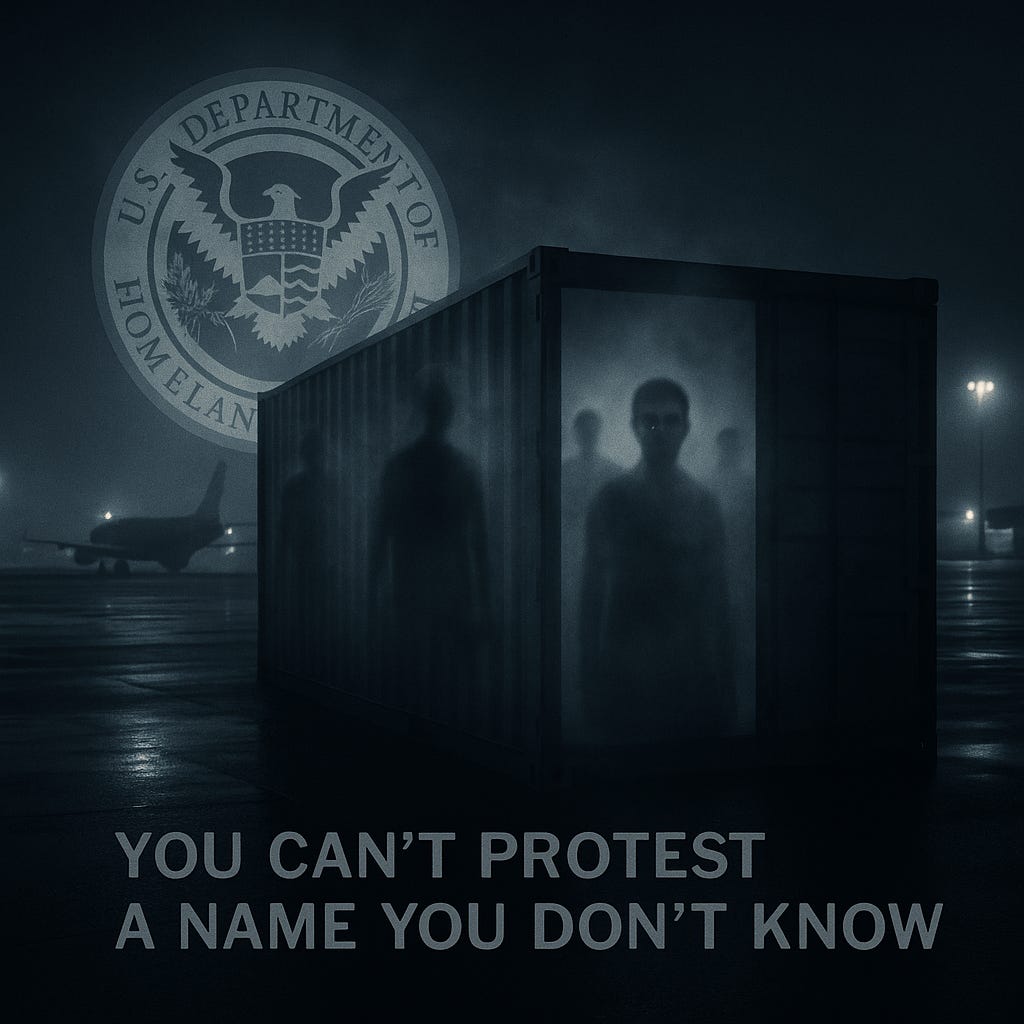
Eight men arrived at Camp Lemonnier in Djibouti around May 20. They came from Cuba, Laos, Mexico, Myanmar, and likely Vietnam and Bhutan. None were South Sudanese nationals. Held in a converted shipping container, they endured blistering temperatures, no ventilation, and minimal access to food or medical care.
Some became seriously ill. ICE officers themselves reportedly fell sick within 72 hours.
Meanwhile, a federal judge in Massachusetts issued an injunction ruling that these men could not legally be deported to South Sudan. The judge cited both U.S. law and international conventions against refoulement—the forcible return of individuals to countries where they could face persecution, torture, or death.
The injunction held for over a month. However, the administration waited them out.
July: The Legal System Folds
On June 23, the U.S. Supreme Court lifted the injunction. No new evidence was presented. A legal technicality allowed the administration to proceed.
On July 4, the last legal barrier fell. The eight men were moved to South Sudan under the cover of Independence Day weekend.
By July 7, the South Sudanese government confirmed they were in the country, though no independent monitors, journalists, or legal advocates have been allowed to meet with them. The State Department has offered no details.
They are, for all practical purposes, ghosts.
See our reporting from May here:
Note: This article is more than 45 days old and now lives in our archive. Consider becoming a paid subscriber for exclusive perks including full access to all 850+ articles.

A Pattern of Displacement
The South Sudan case is not an anomaly. It is part of an expanding network of exile that the U.S. has begun building across the Global South.
In April, Venezuelan asylum seekers were deported to CECOT, El Salvador’s infamous mega-prison, where they were held without charge and without due process.
In February, over 130 Eastern Europeans—including 65 children—were sent to Costa Rica, stripped of documents, and detained without legal aid.
One green card holder, Aasis Subedi, was deported to Nepal, despite having no connection to the country. He now lives in a refugee camp.
Two U.S.-born children were deported to Honduras alongside their undocumented mother. One of them was two years old.
In each of these cases, documentation was delayed, obfuscated, or entirely withheld. The public was told these were criminals. But when advocates demanded records, those records didn’t exist or weren’t real.
The Ghosts Multiply
Just days after the South Sudan incident, the U.S. quietly deported five more individuals to Eswatini, a small monarchy in southern Africa. These men reportedly came from Cuba, Laos, Vietnam, Yemen, and Jamaica. DHS labeled them “violent criminals,” but again, no charges, names, or court records have been released.
All five are now being held in solitary confinement in an undisclosed prison facility. Their lawyer has been denied access. Eswatini’s government has refused to release any documentation. Local civil society organizations were blindsided by the transfers, calling it “a dark deal made behind closed doors.”
No international monitors have been permitted. There’s no way to verify who these men are or even if they’re still alive.
Rwanda: What the UK Rejected, the U.S. Embraces
The newest addition to this network is Rwanda.
On August 5th, the AP reported that the Trump administration finalized a deal to deport up to 250 individuals to Rwanda, specifically to Hope Hostel, a facility originally prepared for a UK deportation program.
However, the UK never used it. Their Supreme Court ruled the plan unlawful, citing serious concerns about Rwanda’s human rights record and inability to guarantee asylum protections.
Instead, that same infrastructure will now be used by the U.S.
As of early August, no deportations to Rwanda have been independently confirmed. However, flights could begin at any moment, under the same secrecy now defining this policy. No names or transfer dates have been released. The U.S. government has not disclosed who is being considered for removal to Rwanda, or whether they have legal counsel. What we do know is that Rwanda has agreed to accept them, and the funding has already been authorized.
This is No Accident
The choice of South Sudan, Eswatini, and Rwanda is not random. It is strategic. Each country shares three traits: instability, impunity, and opacity. These are not places where transparency thrives or legal safeguards function. They are countries where the U.S. government can offload people with minimal resistance and no expectation of accountability.
South Sudan is still reeling from civil war. Armed militias operate with impunity, and some warn that further conflict is inevitable. The justice system is nearly nonfunctional, and the government struggles to provide even basic services to its own citizens. Into this environment, the U.S. has dumped people with no legal connection to the country, trusting that they will disappear from sight and concern.
Eswatini, a repressive monarchy, has cracked down violently on protests in recent years. There is no free press. Political opposition is criminalized. International human rights observers are routinely denied entry. It is not a country prepared to uphold international refugee standards, but it is willing to accept U.S. money in exchange for silence.
Rwanda has been hailed as a development success story, but beneath the polished image lies a harsh authoritarian regime. Dissent is crushed. Refugees are not protected. The UK’s Supreme Court found that Rwanda could not guarantee asylum seekers would be safe from further deportation or persecution. That’s why the UK abandoned its deportation plan. The U.S. picked it up.
And this is only the African wing of the program.
In El Salvador, Venezuelan asylum seekers have been locked in CECOT, the mega-prison built to break gang resistance through indefinite detention. In Costa Rica, Ukrainian children were held without translation or support. In Nepal, a green card holder was rendered stateless and dumped in a refugee camp.
These countries are chosen not despite their abuses, but because of them.
No oversight. No press. No questions.
The Logic of Silence
In April, when the deportation of Kilmar Abrego Garcia to El Salvador became public, it caused a firestorm. He had a court order barring his removal. He had family in the U.S. A senator flew down to demand access. Protests erupted. Coverage exploded.
Eventually, he was returned to the United States.
That, the administration has clearly decided, was a mistake. However, the mistake, in their eyes, wasn’t the quick and reckless deportation, but instead the slim transparency.
So this time, they adjusted. No names. No faces. No headlines.
The eight men sent to South Sudan were held in total isolation for nearly two months. Then they were moved out under a legal cloud, in the dead of summer, on a holiday weekend, without a single name ever made public. The people sent to Eswatini are equally unknown, moved quietly without transparency.
We only know about them because we were watching and have already reported it.
Where Is Congress?
Senator Tim Kaine and a small coalition of lawmakers have introduced resolutions demanding transparency. They want to know who was deported, where they were sent, and what condition they’re in now.
But the votes won’t come until after the August recess.
That means the executive branch has nearly two more months to sanitize the record, disappear paperwork, and bury the truth.
By the time anyone checks, it may be too late to find anything or anyone.
What We Still Don’t Know
Despite weeks of follow-up, the following remains unconfirmed:
The names of the people deported to a third country.
The charges or immigration status that justified their removal.
The conditions under which they are now being held.
Whether they were given any chance to contact legal counsel or family.
Whether they are even still alive.
We don’t even know what agreements—formal or otherwise—were signed with the South Sudanese and Eswatini governments. So far, there is no public paper trail of any money exchanged or promises made.
A System Designed to Disappear
Let’s be clear: this isn’t incompetence. This is design.
There is no legal obligation for DHS to publish the names of deportees.
There is no oversight from Congress unless they force it.
There is no access for journalists, NGOs, or international monitors unless the receiving country allows it.
This system was built after 9/11 to operate in the shadows. It has now been turned on civilians, asylum seekers, green card holders, even children.
And it has learned that no names means no backlash. No faces mean no headlines. No paperwork means no accountability.
This Is the Test
In May, we named it for what it was: not immigration enforcement, but a global purge.
Now it has happened. The legal system bent. The bodies were moved. The world looked away.
If we don’t fight this now, the next phase will be even worse.
Because if the U.S. government can disappear people without public notice, it can disappear anyone. If nations in Africa can take them, any regime willing to take a check can play host to our exiles.
And if we normalize this, the ghosts will multiply.
Visibility is the only resistance left
Demand transparency. Demand names.
No American agency should work without transparency, especially one tasked with human lives. Whether these were “very bad people” as the administration claims or not, they are still granted basic legal rights. We cannot claim to be a democracy when we trap people in a sweltering shipping container, when we send them to nations that are routinely accused of human rights violations, and when we refuse to say the names transparently of those we shove out.
If this is not stopped now, this won’t be the last time a shipping container becomes a holding cell, the last time a one-way flight becomes the last anyone hears of a human life.
Now it is alleged criminals, reportedly, undocumented immigrants.
However, it is essential to remember that these cases are just the ones that reporting has brought to our attention. We only have the word of the DHS that the people sent to these countries are dangerous.
Today, it is the phantom ghost of the criminal immigrant. Tomorrow, it could be the journalist. The protester. The expert. You.
We don’t need a future tense to imagine this. It’s already begun.
Stay Informed. Stay Loud.
Subscribe to The Coffman Chronicle for no-BS political analysis, action guides, and daily truth bombs you won’t get from corporate media.
Bibliography:
“U.S. Supreme Court Sides with Trump in South Sudan Deportation Fight.” Reuters, July 3, 2025.
“Court Allows Trump Administration to Move Forward in Sending Group of Immigrants to South Sudan.” SCOTUSblog, July 3, 2025.
“US Completes Deportation of Eight Men to South Sudan After Weeks of Legal Wrangling.” The Guardian, July 7, 2025.
“Lawyer Says He’s Not Been Allowed to See 5 Immigrants Deported by the US to a Prison in Eswatini.” Associated Press, August 1, 2025.
“Five Immigrants Deported by the U.S. to Eswatini Are Held in Solitary Confinement.” Politico, July 17, 2025.
“Eswatini Opposition Attacks US Deal as 'Human Trafficking Disguised as Deportation.’” The Guardian, July 23, 2025.
“Rwanda Agrees to Take Deportees from the US After a Previous Migrant Deal with the UK Collapsed.” Associated Press, August 5, 2025.
“D.V.D. v. Department of Homeland Security,” legal summary and context. Wikipedia.

This literally makes me ill. For them to go to the trouble to send these people (identify them, collect them, hold them, arrange for transportation, coordinate 'acceptance' by the shit-hole country, and deliver them) is mind-boggling. What's the payoff? What did they get or will they get for kidnapping them? No doubt there are others that we just haven't heard of. I can't wait for the day the evil puppet masters of this regime are tried and ideally executed, but I'll settle for like kind treatment. Let the punishment fit the crime.
I trust you. ICE agents are brutal. US government is .