


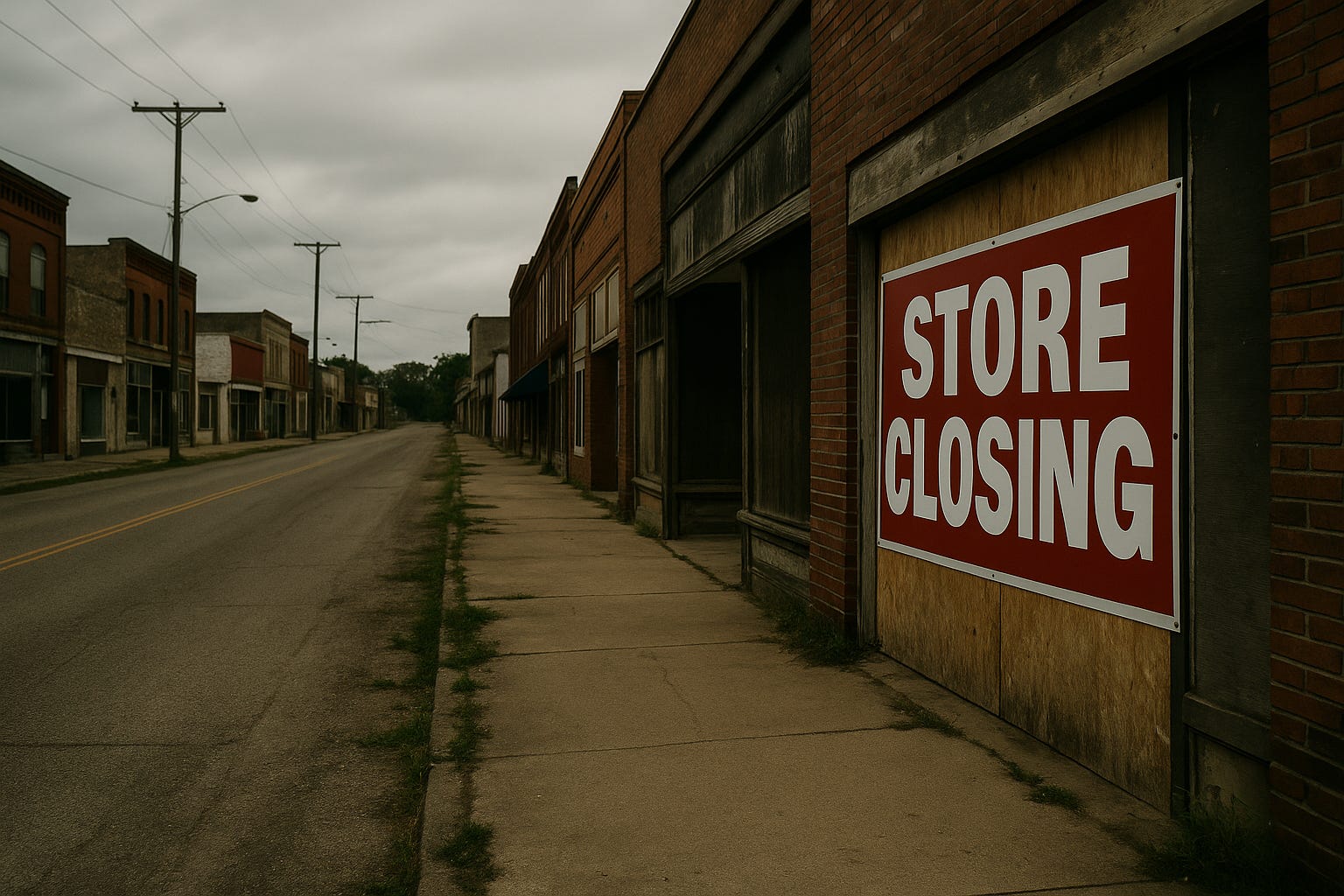
On August 29, the Walmart in Coon Rapids, Minnesota, will close its doors for good. The company calls it an “underperforming location.” Locals call it a gut punch.
“People used to spend two, three hundred dollars a week here,” said one regular shopper who also runs a small business in north Minneapolis. “Now they’re just getting the basics. Maybe thirty, forty bucks. Tortillas went from $1.50 to $2.69 — you notice that.”
For some, the closure means a longer drive. For others, it’s the loss of the only full-service grocery within reachable distance. For the more than 170 employees, it could mean disaster. And while Walmart’s official line points to performance, the numbers behind that “underperformance” tell a bigger story, one that starts with tariffs, trickles through corporate pricing, and lands squarely on the checkout belt in communities like this.
And Coon Rapids? They may just be one of many.
Stay Informed. Stay Loud.
Subscribe to The Coffman Chronicle for no-BS political analysis, action guides, and daily truth bombs you won’t get from corporate media.
Tariffs and the Price Squeeze
Tariffs sound like a penalty on the other guy, a bill we send to China, Mexico, or whoever we’re supposedly teaching a lesson. In reality, they’re a tax on imports, collected at the U.S. border from American companies. The retailer or wholesaler writes the check, not Beijing. If they can’t or won’t absorb the cost, it gets passed on to you in the form of higher prices.
Under Trump’s revived trade-war strategy, some Chinese goods have faced stacked tariffs pushing their rates as high as 145 percent. Even after this spring’s brief reduction, many categories still carry rates of around 55 percent, including electronics, tools, apparel, toys, and a long list of household goods. The overall effective tariff rate in the U.S. now hovers around 18 to 20 percent, the highest since the Great Depression.
Walmart and Amazon both warned that these tariffs would make prices climb. Walmart CEO Doug McMillon told investors that “even at reduced levels, higher tariffs will result in higher prices.” The response from the White House? Trump told them to “eat the tariffs” — to swallow the cost instead of passing it to customers. It was a rare slip that hinted he knows exactly who pays those duties: the U.S. companies that import the goods. But telling them to take a profit hit would also mean admitting corporate profits are high enough to absorb it, and that’s not a message he’s eager to deliver.
Tariff Stacking — How One Fee Turns into Many
Tariffs aren’t always one-and-done. In today’s trade landscape, many goods face “tariff stacking”, multiple duties applied for different reasons, all hitting the same shipment. A single Chinese-made tool, for example, might be subject to the original 2018 trade-war tariff, a newer “strategic” tariff, and an additional penalty tied to unrelated disputes like intellectual property or fentanyl precursors. Each layer is calculated on top of the landed cost, so the combined rate can quickly balloon.
Earlier this year, some categories saw stacked tariffs push effective rates to nearly 145 percent. Even after the mid-2025 reductions, many goods still land at around 55 percent before they ever reach a store shelf. That’s not a typo. More than half the cost of the item is now tax before the retailer adds a single penny of markup.
For a retail giant like Walmart, which imports a massive share of its merchandise from China, that kind of compounding hits the bottom line hard. In competitive markets, stores might shave margins to keep prices low. In rural areas with no real competition, there’s little incentive — and little ability — to absorb the cost. Shoppers end up paying for every layer of tariff, whether they know it or not.
In rural markets where Walmart often has no real competition, the choice is simple: pass the cost to customers or close the store. In Coon Rapids, they’re doing both.
We reported on the tariff situation this spring. See some of that reporting here:
Note: These articles are more than 45 days old and now live in our archive. Consider becoming a paid subscriber for exclusive perks including full access to all of our 850+ articles.


Walmart’s Rural Monopoly
In the 1980s and ’90s, Walmart’s expansion into small-town America was pitched as salvation: lower prices, bigger selection, one-stop shopping. What it delivered was a retail extinction event. Mom-and-pop grocers and general stores couldn’t compete with Walmart’s buying power, loss-leader pricing, and national distribution muscle. Many closed within a few years of the supercenter’s arrival.
By the 2000s, Walmart wasn’t just a player in rural retail. In many counties, it was the only one left standing. USDA data shows Walmart accounts for more than half of all grocery sales in over 200 U.S. counties. In some rural areas, its share is above 90 percent. That level of dominance is what economists politely call “market concentration” and everyone else calls a monopoly.
This dominance means Walmart isn’t just a store; it’s the anchor for food access, household goods, pharmacy services, and often the local job market. When it leaves, there’s no Plan B. You don’t get a new independent grocer popping up to fill the gap. Those supply chains and local businesses were dismantled decades ago. Instead, dollar stores and gas stations fill the vacuum, offering little fresh food and charging more per ounce for basics than Walmart ever did.
In rural America, losing a Walmart isn’t like losing a store. It’s like losing the town’s main artery.
Why Delivery Isn’t a Safety Net
In urban and suburban markets, losing a store is often softened by delivery. Groceries from Walmart, Amazon Fresh, or Instacart arrive at your door in a matter of hours. In rural America, that safety net doesn’t exist.
Many rural ZIP codes aren’t served by Walmart Grocery Delivery at all. Amazon Fresh operates in fewer than half of U.S. ZIP codes, and its coverage is overwhelmingly urban. Where services are technically “available,” they often mean waiting days, paying steep delivery fees, and getting only shelf-stable goods. Fresh and frozen items are often not an option.
This isn’t just about convenience. It’s about geography and economics. Low population density means fewer deliveries per mile, so companies simply don’t run routes to sparsely populated areas. Even if they did, a 50-mile “last mile” run from the nearest hub risks fresh food arriving wilted or thawed.
The same gap exists for prepared food. Most rural communities lack coverage from services like Uber Eats, Grubhub, or DoorDash, and even where they are available, fees can make a $12 meal a $30 luxury. The driver pool is thin, the restaurants are few, and long delivery times mean food often arrives cold.
Without a store in town and without delivery, “buying groceries” can mean a 30–50 mile drive each way. In those conditions, the concept of an “online solution” is about as real as a drone dropping a hot pizza in your driveway.
The Food–Health Connection
When access to fresh, affordable food disappears, so does the foundation for good health. Rural food deserts consistently show higher rates of obesity, type 2 diabetes, hypertension, and heart disease. It’s not hard to see why. If the closest grocery is 45 minutes away and your only nearby options are dollar stores and gas stations, your diet is going to skew toward ultra-processed, shelf-stable foods.
Add in the fact that many rural areas also qualify as healthcare deserts, with closed or overloaded clinics, limited specialists, and no public transportation, and you have a feedback loop of worsening health outcomes. Conditions that could be managed early instead progress unchecked. People skip checkups and delay filling prescriptions because the travel time and fuel costs are too high.
For seniors and people with disabilities, the problem compounds. Driving long distances may not be possible. Many live on fixed incomes, making fuel and delivery fees even less affordable. Without a reliable ride, they are effectively cut off from both medical care and nutritious food.
And public transportation? In rural areas, public transportation infrastructure is often limited to a single loop per day, with long waits and few pickup points. Some areas may have on-demand service, but it often requires booking days in advance and may be limited to medical appointments in a specific zone.
This is the part of the story that doesn’t make the headlines when a Walmart closes. The ripple effect isn’t just about empty storefronts and lost jobs. It’s about shrinking lifespans and declining quality of life.
See our previous reporting here:


Closing the Loop
The closure in Coon Rapids isn’t an isolated business decision. It’s a case study in what happens when decades of retail consolidation meet tariff-driven price hikes and a shrinking safety net. Walmart’s dominance in rural America was built on the promise of low prices and local access. Now, in some communities, it’s pulling up stakes and leaving nothing behind.
This isn’t just a Minnesota story. Rural Walmarts in other states have closed under similar “underperformance” explanations, each one creating or deepening a food desert. Once the store is gone, the barriers stack fast: no nearby grocery, no delivery, no restaurant options, no transit, no affordable healthcare access.
For urban readers, the loss of a Walmart might sound like an inconvenience. For rural residents, it can mean an entirely different way of life, one where getting groceries becomes a multi-hour errand and seeing a doctor requires planning like a road trip.
That’s the real cost hiding behind the corporate earnings calls and tariff policy talking points. In the end, the consumer always pays, not just at the register, but in higher healthcare bills, lost time, and shortened lives. Coon Rapids just got the memo early.
Stay Informed. Stay Loud.
Subscribe to The Coffman Chronicle for no-BS political analysis, action guides, and daily truth bombs you won’t get from corporate media.
Bibliography:
“Coon Rapids Walmart Closing Permanently,” CBS Minnesota, August 3, 2025.
“Trump tells Walmart to ‘eat the tariffs’ instead of raising prices,” Reuters, May 17, 2025.
“‘Tariff stacking’ is creating problems for businesses,” The Week, June 2025.
“Tariff ‘stacking’ adds another headache for US importers,” Reuters, June 16, 2025.
“Walmart Warns of Price Hikes as US Tariffs Hit Goods From China and Latin America,” Food & Wine, May 15, 2025.
“USDA data highlights monopoly risk in rural grocery markets,” Investigate Midwest, June 18, 2025.
USDA Economic Research Service, Eliana Zeballos, Xiao Dong, and Ergys Islamaj, “A Disaggregated View of Market Concentration in the Food Retail Industry” (ERR-314, January 2023).
“Rural counties losing share of grocery stores, gaining other types of food retailers,” ERS Amber Waves, December 7, 2021.
“Takeaways from the National Rural Grocery Summit, USDA,” Food & Power, June 27, 2024.
“Trump’s Tariffs Are Being Picked Up by Corporate America,” Wall Street Journal, July 24, 2025.
“Tariffs in the second Trump administration.” Wikipedia.
“Food deserts in the United States.” Wikipedia.
“Trump’s higher tariff rates hit goods from major US trading partners,” Reuters, August 7, 2025.
“Walmart CEO Doug McMillon gets ‘schooled’ by Donald Trump,” Times of India, May 20, 2025.
“Bessent acknowledges Trump’s tariffs may mean shoppers will pay more at Walmart,” PBS NewsHour, May 18, 2025.

It's not just the lack of access to food - the cuts to health programs mean hospitals will disappear, too - No nearby food, no ready access to healthcare - the times ahead are likely very dark.
If you were paying attention, you knew it was coming. They forced all the small businesses out; drugstores, grocery stores, local clothing stores, hardware stores, all the businesses that connect people in small communities.
Every time one of those businesses closed there were fewer people coming into town. The fallout from that was small specialty businesses had to close; repair shops of all kinds, restaurants, movie theaters, and the list goes on until the small town is effectively destroyed. Everyone is going to Walmart. And then when Walmart decides the town has lost too much of its population and it’s not worth keeping their store open…