


On July 24, 2025, Donald Trump signed an executive order with a title so sterile it sounds like a zoning regulation: “Ending Crime and Disorder on America’s Streets.” Buried beneath its bureaucratic language is a blueprint for vanishing the poor. It calls for the arrest, displacement, and involuntary institutionalization of people experiencing homelessness, addiction, and mental illness. It promises not support, not shelter, but removal.
And it rewards those who make people disappear.
This isn’t just policy. It’s punishment repackaged as public safety. It doesn’t try to fix the conditions that lead people into crisis. It only seeks to erase the evidence that they exist.
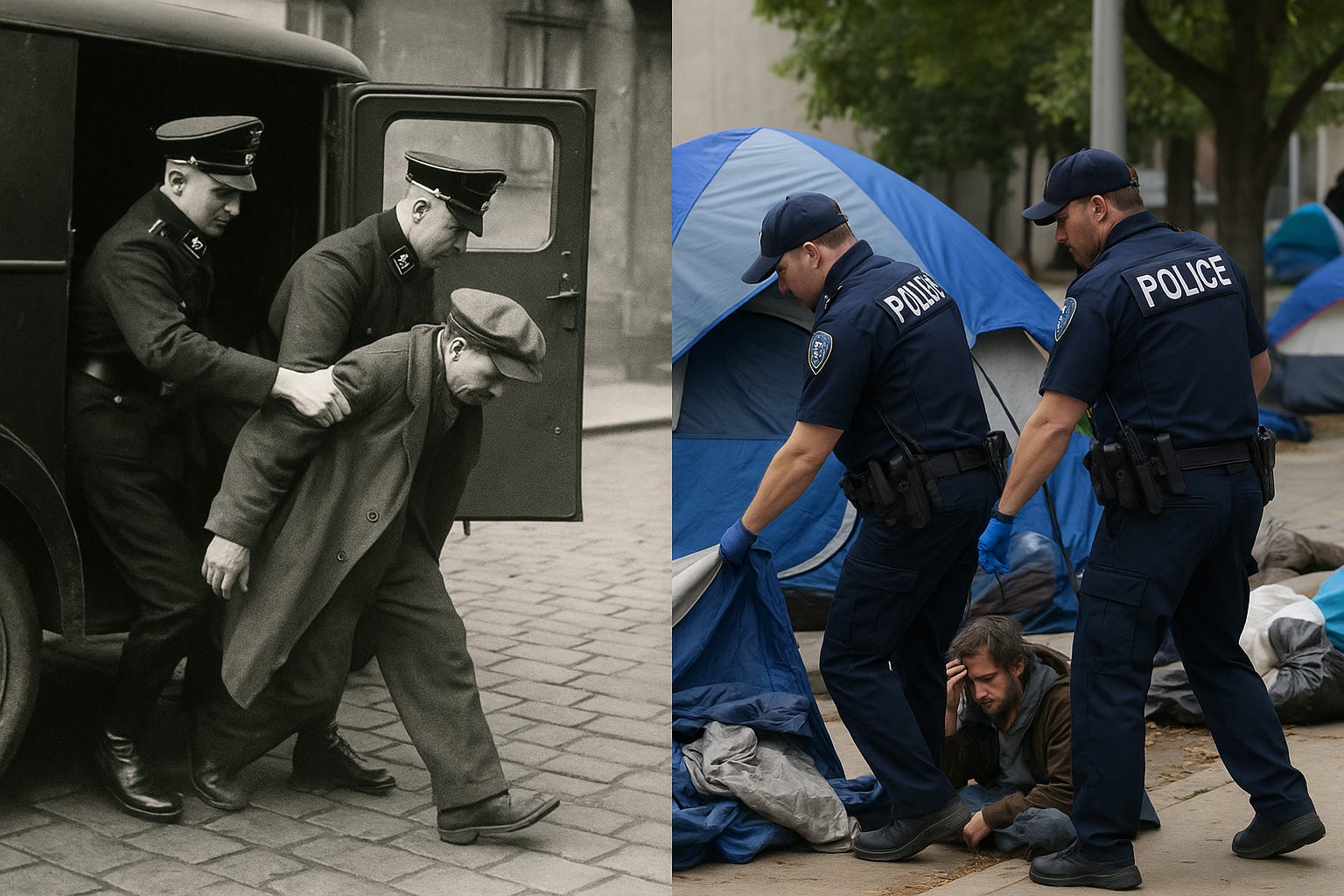
If this feels familiar, it should.
In 1933, Hitler signed the Law Against Dangerous Habitual Criminals, which swept “asocials”—a vague category that included the homeless, the mentally ill, alcoholics, and sex workers—into indefinite detention without trial. The streets were “cleaned.” The poor became prisoners. The law labeled it order.
Trump’s order avoids the word asocial, but not the intent. It directs cities to sweep public spaces, prosecute loitering and “urban disorder,” and institutionalize the people whose presence challenges the illusion of prosperity. States that comply get money. Those that don’t will be starved of resources until they break.
This is not a return to “law and order.” It’s a return to something colder, a government deciding who deserves visibility and who gets locked away.
The warning signs are flashing. We’ve seen this road before. And this time, it wears a flag pin.
Want to Know Your Rights?
Download a free digital copy of the U.S. Constitution—the same document Trump is trying to bulldoze. Learn exactly what he's breaking… and how to fight back.
📬 Stay Informed. Stay Loud.
Subscribe to The Coffman Chronicle for no-BS political analysis, action guides, and weekly truth bombs you won’t get from corporate media.
What Trump’s Executive Order Actually Does
On paper, it appears to be a set of policy guidelines. In practice, it’s a manual for erasure.
Trump’s executive order doesn’t offer solutions. It offers removal, not services or shelter. It provides silence, the kind achieved with handcuffs, locked wards, and bulldozers at dawn.
Here’s what it really does:
It criminalizes the act of surviving in public.
Cities are now financially rewarded for enforcing laws against sleeping outdoors, loitering, panhandling, or setting up camp on public land, not because these are crimes, but because they are reminders of poverty, inequality, and a system that would rather jail the poor than feed them.
Under this order, existence becomes offense.
It pushes forced institutionalization without trial.
States are encouraged to expand civil commitment programs. That means locking away people with mental illness or addiction without their consent, and often, without any crime committed. “Treatment” becomes a pretext for indefinite detention. The bar for confinement is lowered. The paper trail is erased.
You don’t have to break the law. You just have to look like someone who might.
It redirects federal money to those willing to disappear the problem.
Communities that engage in harm reduction, trauma-informed care, or Housing First approaches will be defunded. The money now flows to those who crack down, clear out, and criminalize. The message from Washington is unmistakable: We don’t want your poor. We want them out of sight.
This order doesn’t fix homelessness. It doesn’t reduce crime. It simply rewrites the moral equation: suffering is a threat; order is obedience; visibility is defiance.
The federal government is now in the business of disappearing the inconvenient, not with fanfare or with headlines, but with quiet bureaucratic precision, a paper genocide of the poor.
And it’s already happening.
What Hitler’s Early Laws Did & Why You Shouldn’t Look Away
Genocide didn’t begin with gas chambers. It began with policy memos, court rulings, and speeches about “cleaning up the streets.”
In 1933, Adolf Hitler didn’t need camps to start building a society that erased people. He needed laws and a public willing to look the other way.
The Law Against Dangerous Habitual Criminals gave the state power to detain anyone labeled “asocial.” The word was vague by design. It could mean homeless, jobless, mentally ill, addicted, queer, Roma, or simply undesirable. No trials, no charges, and no need to commit a crime. All it required was to be seen as broken and disappear.
They called it protective custody, but no one was being protected. The regime wasn’t shielding people from harm. It was shielding the public from the discomfort of seeing poverty, sickness, and difference. It was state-sponsored disappearance.
That same year, Hitler signed the Law for the Prevention of Hereditarily Diseased Offspring, a cold, clinical name for a program of forced sterilization. Over 400,000 people were sterilized in the name of public health. Many were institutionalized first. Many never walked free again.
By the end of the decade, the regime no longer sterilized the “unfit.” It killed them.
The T4 Euthanasia Program marked the first organized mass murder of the Nazi regime, starting with disabled children, then adults, then the mentally ill.
They were loaded into vans and told they were going to clinics. Instead, they were gassed or burned and forgotten.
And most Germans said nothing. Because the people being taken were “asocial.” Because the government said it was necessary. Because the cruelty looked like paperwork, not death.
Until it didn’t.
It started with laws. It always starts with laws. We tell ourselves we’d never let it happen again. But the signs aren’t just here. They're following the same script.
The Parallels That Should Terrify Us
It would be comforting to believe we’re nothing like them, that what happened in Germany was an anomaly, that America is too evolved to follow a similar path.
But history isn’t interested in comforting you. It’s interested in repeating itself if you let it.
What we’re seeing in 2025 isn’t a carbon copy of 1933. It’s something more dangerous: a pattern wrapped in plausible deniability.
Here’s what that pattern looks like:
Nazi Germany (1933):
“Asocial” label used to criminalize the poor, disabled, and addicted
Forced institutionalization justified under “protective custody”
Sterilization and disappearance are framed as public health
Legal systems are re-engineered to remove “undesirables”
Visibility is punished; suffering erased
United States (2025):
Trump’s EO criminalizes public sleeping, loitering, and addiction
Civil commitment occurs without trial and is expanded nationwide
“Treatment” and removal are framed as public safety
DOJ, HHS, and HUD are tasked with dismantling local protections
Encampment sweeps, arrests, and defunding of Housing First programs are justified
This isn’t a strained comparison. It’s a one-to-one structural echo, the same logic dressed in modern language, enforced by a different flag.
And just like in 1933, the justification isn’t cruelty. It’s order, safety, and “restoring dignity to our streets.”
But ask yourself: Whose dignity?
We are not in 1942. We are in 1933. And if that doesn’t chill your blood, you’re not listening.
Silence, Sanitization, and the Machinery of Disappearance
This isn’t chaos. It’s choreography.
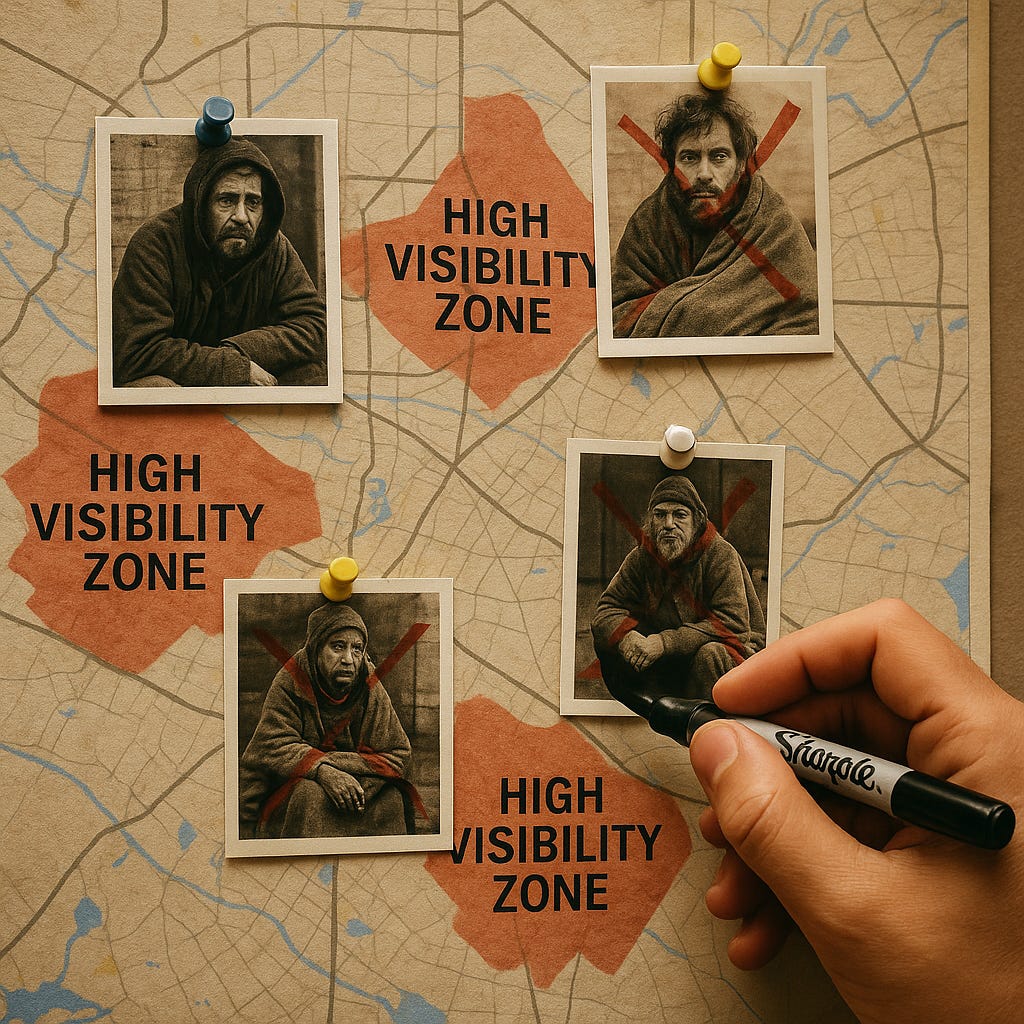
Trump’s executive order isn’t just a command; it’s a cue, a signal to states and cities to make them vanish quietly, efficiently, and with enough legal veneer to keep the cameras from lingering.
And already, the machinery is moving.
In Phoenix, city contractors destroy tent encampments with backhoes, sometimes while people’s belongings are still inside. Police offer a choice: shelter beds that don’t exist, or jail cells that do.
In Los Angeles, people are arrested for sitting on sidewalks where they used to sleep. Trash collectors confiscate survival gear. Civilian “clean-up teams” are sent into Skid Row like hazmat units.
In Florida, unhoused people are detained under civil commitment laws and involuntarily hospitalized, often indefinitely, with little access to legal counsel.
This is not social policy. This is strategic disappearance.
Ask yourself: where do those people go? After the raid? After the sweep? After the “treatment”?
They don’t go to housing. They don’t go to safety. They are absorbed into the carceral state.
What we’re witnessing is not neglect. It is intention. But silence is not universal. Across the country, some are refusing to play their part in this machinery.
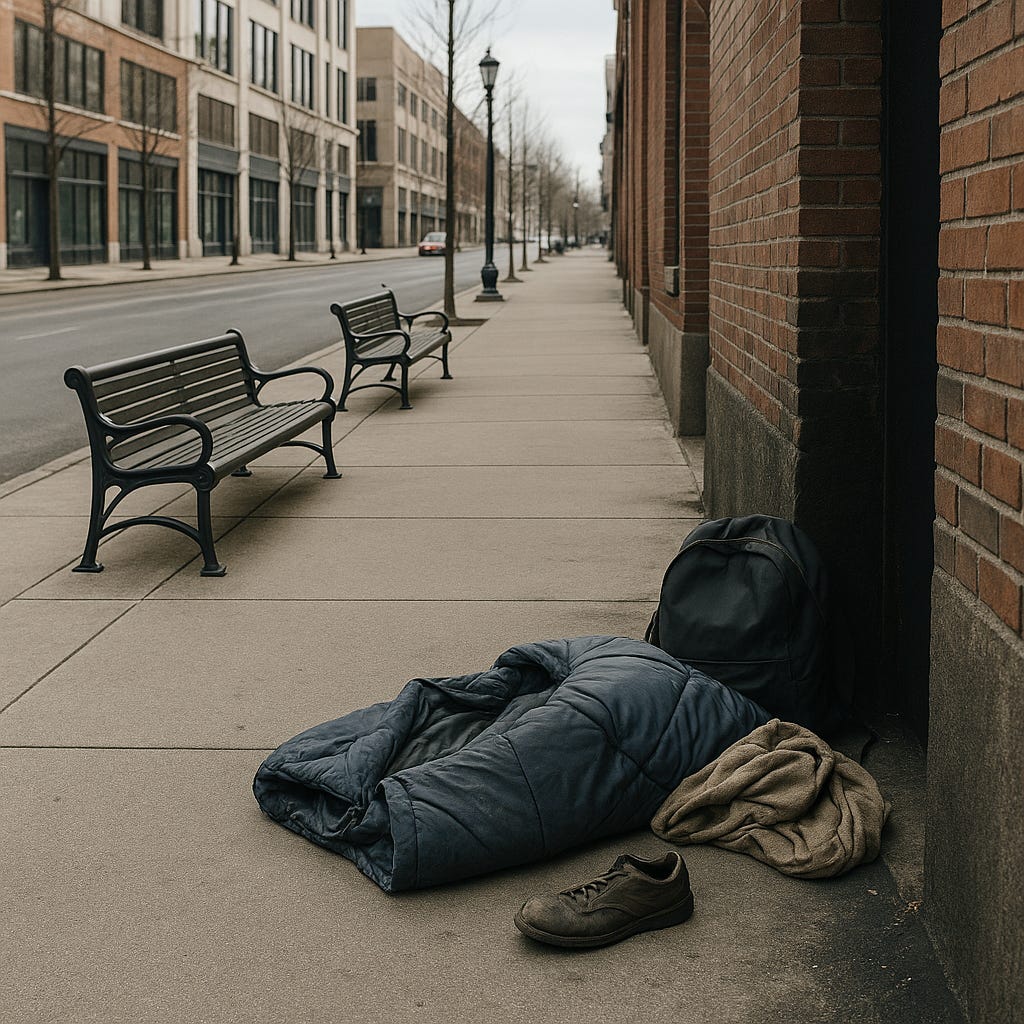
The People Fighting Back
Authoritarianism thrives on helplessness. It counts on people being too tired, too scattered, or too afraid to resist. However, Trump’s executive order didn’t fall into a vacuum. It landed on a country already in the midst of organization.
The ACLU immediately condemned the order, calling it a direct attack on unhoused people, disabled communities, and due process itself. Their legal teams are preparing constitutional challenges under the 8th and 14th Amendments.
Disability Rights advocates warn that it violates Olmstead v. L.C., the Supreme Court ruling that mandates community-based services over institutionalization.
The National Homelessness Law Center stated:
“This order does not reduce homelessness. It criminalizes it. It creates a federal incentive to violate constitutional rights in exchange for grant money.”
In San Francisco, mutual aid groups like Food Not Bombs are distributing meals, Narcan, and flyers. In Portland, tents now surround City Hall, not in hiding but in protest.
On July 26, more than a dozen cities saw coordinated actions under the banner:
“You Can’t Evict the Poor from Public Space.”
Some cities, such as Seattle, Austin, and Philadelphia, have pledged non-compliance.
Others, even blue cities, are enforcing the order quietly. This is not a partisan divide. It’s a moral one.
The people most targeted by this order will not be the ones writing policy.
But they’re not waiting to be saved. They’re fighting already.
What This Moment Demands of Us
This isn’t a moment for neutrality. There’s no safe middle ground between those sweeping tents and those sleeping inside them.
You either believe suffering deserves dignity, or you believe it deserves containment.
Trump’s executive order is a test: Will you look away?
In 1933, most people did.
By 1939, it was too late.
But even then, some resisted quietly and courageously. They refused to sign the paperwork. They spoke up when it counted.
Now it’s our turn.
If we stay silent while the vulnerable are swept, jailed, or institutionalized, then we’re not bystanders. We are the mechanism.
We can’t afford to whisper. We can’t wait to see how bad it gets. Because it’s already happening. And it will only escalate unless we take action to stop it.
Call to Action: How to Fight This Now
This is not the end of the story unless we let it be.
Know What You're Fighting
Executive Order: “Ending Crime and Disorder on America’s Streets”
Signed: July 24, 2025
Directives: Criminalize homelessness, expand forced institutionalization, defund harm reduction
2. Call Congress
Capitol Switchboard: (202) 224-3121
Script:
“Hi, I’m [Name] from [City]. I demand that [Rep/Senator] publicly condemn Trump’s executive order targeting unhoused and disabled people. This policy violates civil rights and must be stopped.”
Demand Local Non-Compliance
Find your reps: https://www.commoncause.org/find-your-representative
Tell your city council and mayor:
Refuse federal incentives
Protect Housing First programs
Defend due process and consent in mental health care
Support Legal Resistance
Donate or amplify:
ACLU – https://www.aclu.org
NHLC – https://homelesslaw.org
DREDF – https://dredf.org
Break the Silence
Use hashtags:#StopTheEO #HousingNotHandcuffs #WeWillNotDisappear
If you’ve lived this, your voice matters more than ever.
It’s Already Happening. The Only Question Is What You’ll Do About It.
The most dangerous thing about this moment isn’t Trump’s executive order. It’s how normal it already feels.
How easily we say “clean up the streets” without asking who gets swept. How comfortably we shift from compassion to containment.
We always imagine we’d recognize the signs, that if history repeated, we’d act.
We’d fight.
But the signs aren’t flashing. They’re buried in memos, in cleared encampments, and in hospitals with locked doors.
History doesn’t care what you meant to do. It cares what you did.
You can call. You can organize. You can refuse.
But the window is closing, and the next generation won’t ask if you cared.
They’ll ask why you let it happen again.
Stay Informed. Stay Loud.
Subscribe to The Coffman Chronicle for no-BS political analysis, action guides, and weekly truth bombs you won’t get from corporate media.
Bibliography:
Donald J. Trump, Executive Order: Ending Crime and Disorder on America’s Streets, issued July 24, 2025. White House press release and full text. The White House.
“Akingump: Ending Crime and Disorder on America’s Streets (Trump EO Tracker),” Akin Gump Strauss Hauer & Feld LLP.
“The National Alliance to End Homelessness on Trump’s EO,” National Homelessness Law Center, July 24, 2025.
“NAMI Statement on Executive Order Targeting Homelessness and Criminalizing Mental Illness,” National Alliance on Mental Illness (NAMI), July 25, 2025.
“Trump Order Pushes Local Officials to Clear Unhoused People from Streets,” The Guardian, July 24, 2025.
“Holocaust Chronology of 1933,” Jewish Virtual Library.
“Law for the ‘Prevention of Offspring with Hereditary Diseases’ (July 14, 1933),” United States Holocaust Memorial Museum.
“Nazi eugenics – remembering the victims,” Deutsche Welle (DW), July 14, 2013.
“Habitual and Dangerous Criminals Law, 1933,” PBS NOVA Online – Holocaust On Trial: Timeline of Nazi Abuses 1933.
“Law Against Dangerous Habitual Criminals and Measures for Protection and Recovery (1933),” Internet History Sourcebooks Project (Fordham University).
“Nazi eugenics,” Wikipedia.
“Law for the Prevention of Hereditarily Diseased Offspring,” Wikipedia.
“The Nazi Penal System – Law Against Dangerous Habitual Criminals” by Scholarly Commons (Northwestern University legal journal).
Thank you for this article. It's a story that needs to be read, realized, and repeated or restocked. I saw the Trump machine for what it was years ago. Fascism, but more importantly it was Hitler’s version, the vilification of the Jews and Hispanics were a carbon copy of creating the fear to win support from the masses. The propaganda arm, had Goebbels's prints all over it. The deportation was slow and expensive, we have already seen the building of the camps, as more segments of society are “dealt with” the cost will rise. Soon death will be the preferred solution, the Final Solution.
As you point out this is here now, its expansion has been planned. Now the question will be how will Americans respond. When ICE are kidnapping people, how many will be open to physically stopping them? Will we answer the NAZI doctrine as we did in 1942? Because then the enemy was elsewhere, in 2025 the enemy IS the United States of America.
The enemy within, is the enemy sitting behind the Resolute Desk.
Your nation is seriously f***ed. Shame on any and all politicians who voted for this disgusting piece of social cleansing.