


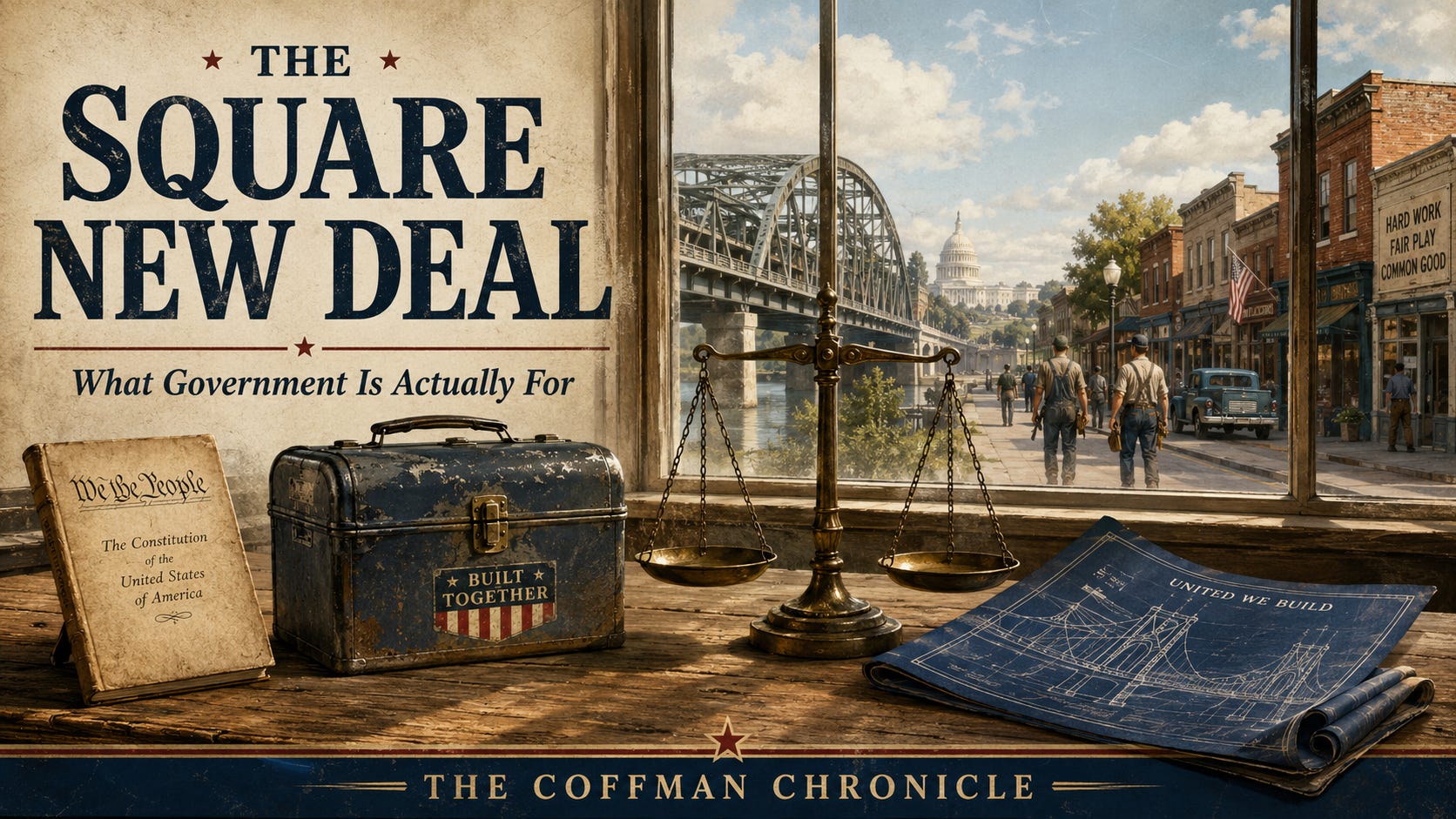
We Have Been Asking the Wrong Question
For most of modern American politics, we have been arguing about government as though it were a thermostat. Turn it up. Turn it down.
For decades, much of American politics has organized itself around whether Washington should do more or do less. Campaigns are built around spending totals, agency head counts, regulations added, or regulations repealed, as if the size of government alone could tell us whether it is doing its job. However, that is not how most Americans experience government.
A mother trying to find affordable childcare does not care whether the solution qualifies as big government or small government. A family buying lettuce does not care how many federal employees inspect produce. A worker facing a monopoly employer does not measure freedom by the number of pages in the Federal Register. When a president claims a power the Constitution never clearly gave him, the danger does not disappear because we happen to like the president.
At the kitchen table, the questions are more practical: Is the job getting done? Does somebody have the authority to do it? Who makes sure that authority is not abused?
Those questions point toward a different way of thinking about government, not maximum government, not minimum government, but government sufficient to do the work only government can do, restrained from doing what it has no right to do, and accountable to the people whose power it exercises.
That idea is the beginning of what we call the Square New Deal. Before we argue about any particular policy, there is a more basic question worth answering: What is government actually for?
This Community Is Powered by You
What started as a small circle has grown into something much bigger, and it’s all because of readers like you.
Every time you forward this email, post it on socials, or bring someone new into the fold, you’re helping build one of the most passionate, independent communities out there.
Want to keep the momentum going?
Share this newsletter with someone who should be part of this conversation.
Thank you for being here. It means everything.
Small Government Can Fail People
Americans can and should do many things for themselves. Families make choices. Businesses take risks. Communities solve local problems. Individuals bear responsibility for their own lives. However, some jobs no individual can reasonably perform alone.
A family buying ground beef cannot inspect the slaughterhouse that produced it. A worker cannot personally break up a monopoly that controls an entire industry. A parent driving across an interstate bridge cannot crawl underneath it and determine whether the steel is failing. A patient picking up a prescription cannot independently reproduce the testing required to know whether the medicine is safe.
That is part of what government exists to do. When government does those jobs well, most people barely notice. The bridge stays standing. The medicine does what it is supposed to do. The bank follows the rules. The drinking water comes out of the tap without making anyone sick.
That invisibility can make necessary government easy to dismiss. Cut enough inspectors, and nothing may happen tomorrow. Stop maintaining enough infrastructure and the bridge probably will not fall next Tuesday. Hollow out an enforcement agency and the market may continue functioning for years.
Until it does not. Then the public discovers that eliminating government capacity did not eliminate the need for the work. It merely eliminated the people responsible for doing it.
There is nothing conservative about paying for a government function that accomplishes nothing. Waste should be eliminated. Rules that no longer serve a legitimate purpose should be rewritten or repealed. Agencies should have to demonstrate that their work matters. Efficiency is part of stewardship too.
However, reducing government simply because reduction itself has become the goal confuses a smaller payroll with a better country. Sometimes smaller government means greater freedom. Sometimes smaller government is simply abandonment.
The Square New Deal begins from a different standard: Government must be capable of doing the work the public cannot reasonably do for itself.
It does not advocate maximum government or minimum government, but sufficient government.
Big Government Can Fail People Too
The opposite mistake is just as dangerous. Government does not become wise because it becomes larger. A program does not become just because its intentions are good. An agency does not become accountable because its mission sounds important.
Government can waste money. It can write rules that make perfect sense in Washington and almost none at a kitchen table, a shop floor, or a small-town council meeting. It can protect its own procedures long after those procedures have stopped serving the people they were created to help.
When public power grows without clear limits, it can become something more dangerous than inefficient. It can become personal.
A president can treat emergency authority as a substitute for legislation. A prosecutor can be pushed toward a particular defendant because someone powerful wants a particular result. An agency can stretch a vague mandate until temporary discretion begins to resemble permanent law. Congress can avoid difficult decisions by surrendering responsibilities the Constitution assigned to the people’s branch. None of those problems are solved by saying the government meant well.
The Square New Deal does not begin with the assumption that every public problem deserves another program, another agency, or another grant of executive authority. Government should have enough power to perform the work entrusted to it. It should not have power simply because someone can imagine a useful purpose for it.
Every authority created for a president we trust eventually becomes available to a president we do not. Every shortcut accepted because we approve of the outcome becomes precedent for another government pursuing an outcome we may despise. A functioning republic therefore needs something more than capacity. It needs restraint.
Government must remain the servant of the people rather than becoming their master. The better question is whether public power is sufficient for its legitimate purpose, limited to that purpose, and accountable while it is being used.
That requires something more demanding than either expansion or reduction. It requires stewardship.
Public Power Is Held in Trust
Stewardship begins with a simple idea: Public power does not belong to the people who temporarily hold it.
A president does not own executive authority. Congress does not own legislative authority. A prosecutor does not own the power to prosecute. An agency does not own the power to regulate. Those powers belong to the American people. The Constitution distributes them, limits them, and entrusts them to particular institutions for particular purposes.
That makes every public official a steward. A steward is not an owner. An owner can use his property for his own purposes. A steward is responsible for something that belongs to somebody else.
Public officials therefore owe the country more than good intentions. They owe competence, restraint, honesty, and accountability.
Whenever government exercises significant power, we should be able to ask basic questions: What public purpose is being served? Who gave the government this authority? Is the power necessary to accomplish that purpose? What prevents it from being abused? Who answers when something goes wrong?
Those questions should apply whether the official using the power has an R or a D beside the name. They should apply when we like the policy and when we hate it. They should apply when government acts boldly and when government chooses not to act at all.
This is the foundation of what we mean by stewardism, not blind faith in government, not automatic hostility toward it, but a recognition that public power is necessary, dangerous, and borrowed.
Power held in trust must be exercised for the people who entrusted it, not for the personal, political, or institutional interests of the steward. Once we understand government that way, another principle follows naturally.
The Constitution Comes Before the Politician
Americans are remarkably good at discovering limits on government power when the other side is using it. We are much less consistent when the person exercising that power is someone we voted for. That is one of the oldest temptations in a republic.
A president claims new authority, and supporters defend it because they trust the president. A prosecutor stretches the rules, and people excuse it because they dislike the defendant. Congress gives away another piece of its authority, and voters tolerate it because the president receiving that authority happens to share their politics.
Then the administration changes. Suddenly the power that once seemed necessary looks dangerous.
The Square New Deal rejects that way of thinking. The proper question is not “Do I trust this president with this power?” It is: Would I trust the president I dislike most with the same power? That test forces us to separate constitutional principle from political convenience.
If a president can bypass Congress when we believe the cause is urgent, another president can claim the same authority for a cause we consider outrageous. If due process can be weakened because the defendant is unpopular, then due process is no longer a right. It is a favor extended to people we approve of.
If Congress can surrender its responsibilities whenever governing becomes politically difficult, the people’s branch eventually becomes little more than an audience for executive government.
Constitutional restraints are frustrating by design. They slow government down, divide power, and force compromise. They sometimes prevent presidents from doing things many Americans desperately want done. That frustration is not evidence that the system has failed, but that no single person was supposed to possess all the power necessary to govern alone. The Constitution was built for the president we distrust as much as the president we admire.
That gives the Square New Deal another basic rule: A power too dangerous for the other side is too dangerous for our side.
The goal of constitutional reform should never be to find a leader wise enough to exercise unlimited authority responsibly. It should be to build institutions strong enough that wisdom is not the only thing standing between the public and abuse.
Repair the republic, not a better king.
Markets Need Stewardship Too
Public power is not the only kind of power that can become concentrated. Private economic power can, too.
The Square New Deal is not an argument against capitalism. Markets can reward invention, create opportunity, build wealth, and turn good ideas into things people actually use. However, markets do not remain competitive simply because we call them free.
A monopoly can become powerful enough to dictate terms to workers, suppliers, and customers. A financial institution can grow so large that its failure becomes everybody else’s emergency. A technology company can reshape entire industries while communities and workers absorb the disruption.
That does not mean government should run the economy, but that it has a duty to keep the rules honest. Competition should be real. Workers should not have to surrender basic dignity simply because their employer holds all the leverage. Companies should be allowed to profit from innovation without pushing every social cost of that innovation onto everyone else.
That is the economic side of stewardship. Profit is legitimate. Enterprise is valuable. Success should be rewarded. However, enormous economic power carries responsibilities to the workers, communities, and country that make that success possible. It can not be purely extractive.
We call that Good Steward Capitalism. It is neither hostility toward business nor worship of business. It is the recognition that private power, like public power, needs rules when its decisions can shape the lives of millions of people who never had a seat at the table.
The coming transformation from artificial intelligence makes the principle especially clear: Private companies may own AI. The American people must own the rules. A healthy republic should protect the freedom to build. It must also preserve the freedom of everyone else to live in the world that gets built.
The Working Class Is the Test
A country can look prosperous on paper while millions of people living inside it feel as though they are falling behind. Gross domestic product can rise, the stock market can set records, corporate profits can climb, and investment can pour into new technologies. While those things matter, none of them, by themselves, tell us whether the economy is working for the people who get up every morning and keep it running.
The Square New Deal starts with a more practical test. Can a person who works full time afford a decent place to live? Can parents find childcare without spending the equivalent of a second mortgage? Can a family get sick without being financially destroyed? Can young people reasonably believe that work will allow them to build something of their own?
Can small businesses compete against companies large enough to write the terms of the market? Can a worker displaced by technology find a path into the prosperity that technology creates rather than simply being handed the bill for somebody else’s innovation?
Those are not side questions. They are the point.
An economy exists to produce more than impressive charts. It should create the conditions in which ordinary people can work, raise families, build security, and exercise some meaningful control over their own lives.
That does not mean everybody receives the same outcome, nor does it mean success should be punished or ambition flattened. It means prosperity should be broad enough that the people creating it can reasonably expect to share in it.
The Square New Deal therefore measures economic success against the dignity and prosperity of the great American working class. Dignity means more than wages. It means time with family, a safe workplace, a community worth staying in, the ability to retire without terror, and the confidence that one medical emergency, rent increase, or lost job will not erase twenty years of responsible decisions.
Prosperity without that foundation may still produce wealth. It just does not produce a square deal. The standard is not equality of outcome. It is whether an economy growing richer is also allowing working people to become more secure, independent, and prosperous.
If the country becomes richer while the people doing much of its work become less secure, we should not congratulate ourselves on the average. The working class is not another interest group in the Square New Deal. It is the test.
The Square Means Everybody Has Duties
A square deal cannot run in only one direction. If government has obligations to the public, then the people and institutions benefiting from the country’s stability, infrastructure, markets, and laws have obligations too.
That begins with government. Public officials owe the people competence, constitutional restraint, honesty, and transparency. Agencies should be able to explain what they are doing and why. Congress should exercise the powers the Constitution assigns to it instead of handing difficult decisions to presidents and then complaining about the results.
But stewardship does not stop at the courthouse or the Capitol. Businesses benefit from roads, courts, educated workers, public research, financial systems, and legal protections that make commerce possible. They should be free to innovate, compete, and profit. They should not be free to privatize every gain while pushing every cost onto workers, communities, and taxpayers. That is corporate stewardship.
Citizens have duties too. A republic cannot survive if constitutional rights are defended only for people we like. Due process must protect the defendant we cannot stand. The principle of free speech must still matter when the speech makes us angry. Limits on presidential power must apply to the president we voted for.
Democratic citizenship requires something harder than cheering for our own side. It requires defending the rules even when those rules frustrate us.
None of this means citizens owe obedience to government, workers owe submission to corporations, or communities owe gratitude to institutions that fail them. Stewardship is not deference. It is reciprocal responsibility.
Government owes something to the citizen. Economic power owes something to the society that makes prosperity possible. Citizens owe something to the republic they expect to protect their freedom.
That is what makes the deal square. Power carries obligations. Prosperity carries responsibilities. Citizenship carries duties. Nobody gets to claim all the benefits while pushing every obligation onto somebody else.
This Is a Measuring Stick, Not Yet a Shopping List
The Square New Deal is not meant to be a catalog of predetermined answers. It is a way of deciding which answers deserve our support.
Political movements often begin with a list of policies and work backward to justify them. The Square New Deal should work the other way around. Start with the principles, apply the same tests consistently, then follow the evidence where it leads.
When government proposes to act, ask: Does government actually need to do this? Can government do it effectively? Is the authority constitutional? Who holds that power accountable?
When economic policy is involved, ask: Does it preserve real competition? Who receives the benefit? Who carries the cost? Does it strengthen or weaken the dignity and prosperity of ordinary Americans?
Those questions will not always produce the answer one political tribe expects. A governing philosophy that can only confirm what we already wanted to believe is not much of a governing philosophy. Sometimes the Square New Deal should lead us toward stronger public action because the work cannot be done any other way. Sometimes it should lead us toward restraint because government has crossed a constitutional boundary or built a program that no longer accomplishes its purpose.
Sometimes it should demand tougher rules for concentrated corporate power. Sometimes it should demand that government get out of the way and let people build, compete and experiment. The point is consistency.
We should not suddenly discover the virtues of federalism when our opponents control Washington, or the virtues of executive power when our candidate wins the White House. We should not celebrate competition when it benefits corporations and forget it when workers or small businesses need it. The standard must survive the outcome.
That is why the Square New Deal is better understood first as a measuring stick rather than a shopping list. It asks what government should do, what government has no right to do, what powerful private institutions owe the society around them, and whether the people doing the country’s work are actually sharing in its prosperity.
The specific policies will come. They should have to earn their place.
The Square New Deal
Put those principles together, and the Square New Deal asks us to judge government by something more useful than its size. Government should be strong enough to inspect the farm, competent enough to build and maintain the bridge, capable enough to protect the country and enforce the law, and powerful enough to preserve competition when private power becomes concentrated enough to crush it.
However, that same government must remain limited enough to respect constitutional boundaries. A president does not become Congress because the problem is urgent. A prosecutor does not get to abandon due process because the defendant is hated. An agency does not get unlimited authority because its mission is worthwhile. Public power remains borrowed power.
The same principle applies to the economy. Businesses should be free to build, innovate, compete, and prosper. Success should be rewarded, but prosperity cannot be called a national success when its benefits rise upward while its risks and costs are steadily pushed downward onto workers, families, and communities.
Citizenship carries responsibilities of its own. We cannot demand constitutional protection for ourselves while denying it to our opponents. We cannot complain about concentrated power only when somebody else controls it. We cannot expect a republic to survive if every election becomes permission to abandon the rules until the next one.
This is the bargain at the center of the Square New Deal: The Square New Deal is a governing philosophy built on stewardship: government sufficient to perform the work the people cannot do for themselves, constitutional restraints strong enough to keep public power accountable, markets governed by fair rules, and an economy measured by the dignity and prosperity it produces for ordinary Americans.
The answers produced by that philosophy will sometimes resemble ideas associated with the political left. Sometimes they will resemble ideas associated with the political right. Sometimes they should make both sides uncomfortable.
That is fine. The Square New Deal does not exist to make an ideology comfortable. It exists to make power answerable.
Therefore, the standard is government strong enough to do what only government can do, government restrained from doing what it has no right to do, markets free enough to create prosperity, with rules strong enough to keep power from swallowing competition, and a republic judged by whether working Americans can build decent lives within it.
It is not bigger government for its own sake, nor smaller government for its own sake. It is not a stronger president, a friendlier billionaire, or another promise that everything will work out if we simply put better people in charge of the same broken incentives.
A square deal requires something harder. It requires rules that apply when our side loses, institutions capable of doing the jobs entrusted to them, markets that reward creation without allowing power to consume competition, and citizens willing to defend a republic that belongs to people with whom they profoundly disagree.
That is the Square New Deal.
Support Independent Media
The Square New Deal is not finished because one article is finished. This is the beginning of a larger argument about what government owes the people, what powerful institutions owe the country around them, and what we owe one another as citizens of the same republic.
If this way of thinking makes sense to you, share this article with someone who is tired of being told the only choices are bigger government or smaller government, left or right, our side or theirs. The Square New Deal will only matter if people are willing to argue for something better than the choices we have been handed.
Subscribe to The Coffman Chronicle if you want to follow this project as we build it piece by piece. And if you can afford to become a paid subscriber, your support helps make this work possible.
We are not looking for a better king. We are trying to repair the republic.
Inspiring common sense. Thank you. I think a few extensions should be made explicit. First, the citizens of a democratic republic owe respect and responsibility to all the other members in their existing conditions, from before birth to old age. Second, men and women in this society owe respect and responsibility to their human counterparts globally. Third, governments at all levels owe respect and responsibility to all other beings in the natural world, which offer a panorama of resources for use and realities to be enjoyed and wondered at. Species and areas of land and water must be used with care for their future and protected for countless generations to come.
I think the vast majority of people would have no problem with higher taxes if they saw they were getting a lot for them. It’s when they see their tax money wasted or spent on political issues rather than stuff that benefits most people. Granted, private companies can waste a lot of money also (see all the car companies that wrote off billions in EV expenditures-not that I think the expenses were a mistake, it was the junking of them that was).
The Scandinavian countries tend to have higher tax rates but the citizens don’t mind as much because they get a lot in return.
It seems the US is so huge that a lot of money gets wasted and no one is watching.