


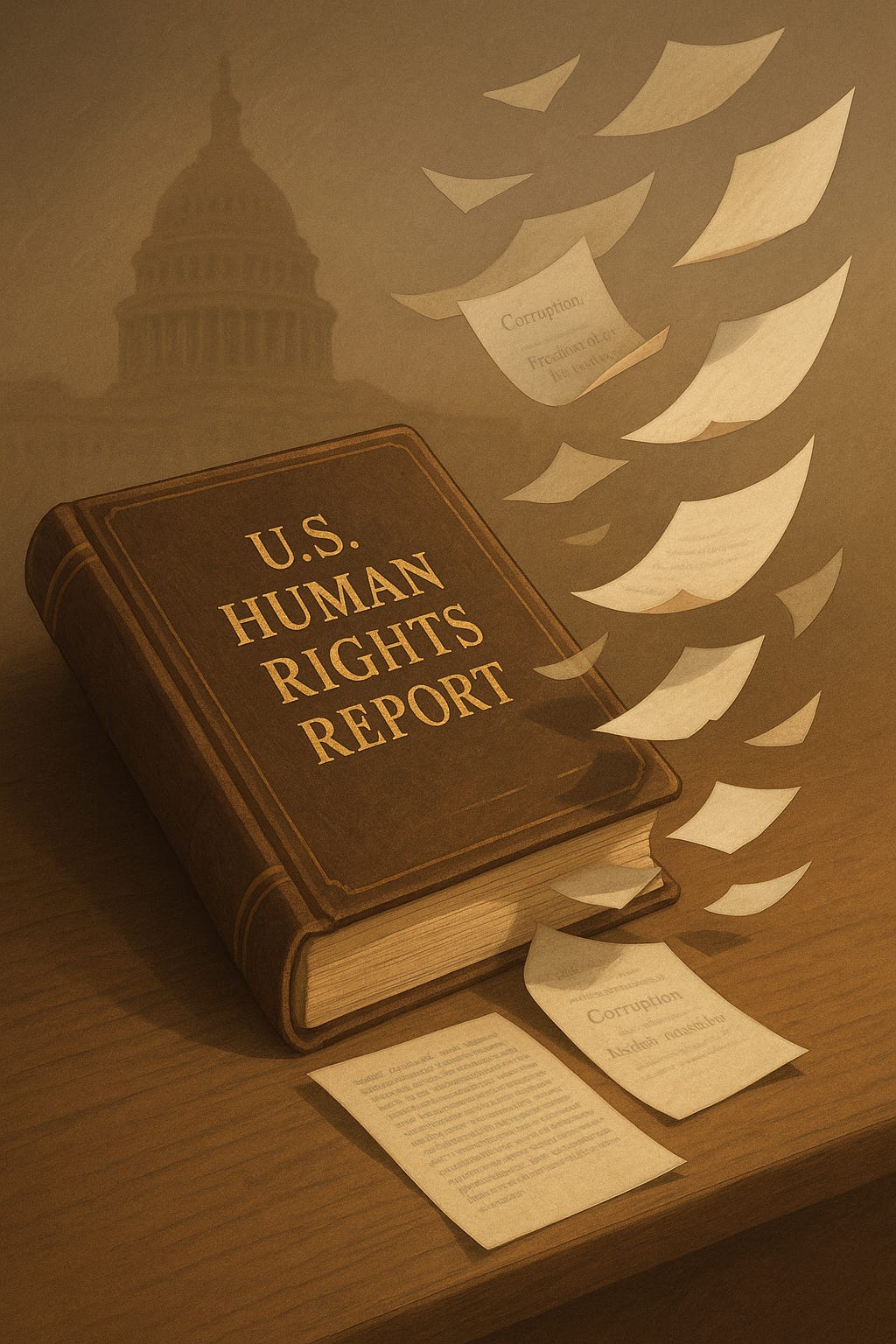
It landed with all the fanfare of a DMV form update — six months late, on a sweltering August afternoon, without a press conference, without the usual solemn announcement from the Secretary of State. While Congress was scattered to the four winds on summer recess, the State Department quietly posted its annual Country Reports on Human Rights Practices to its website and walked away.
If you missed it, that’s the point. This year’s report isn’t just delayed; it’s been gutted, rewritten, and reframed in ways that make it almost unrecognizable. Gone are the detailed, standardized categories that have been the backbone of U.S. human rights documentation for nearly fifty years. In their place are vague abstractions like “Life” and “Justice,” entire sections erased, and a noticeable softening toward authoritarian allies — Russia included.
The timing is no accident. Just days before Donald Trump sits down with Vladimir Putin in Alaska to “listen” about Ukraine, the U.S. has quietly issued a document that feels less like a moral ledger and more like a diplomatic peace offering.
Because democracy doesn’t defend itself, and neither does your sanity. Subscribe here to keep your eyes open and your sarcasm sharp.
What Changed in the 2025 Report
For decades, the State Department’s human rights reports have followed a predictable structure. Whether under Carter, Reagan, Bush, Obama, or Biden, the framework was steady enough that watchdog groups, lawmakers, and foreign governments could compare year to year and spot trends. Each country profile had its own litany: sections on arbitrary killings, torture, freedom of assembly, corruption, discrimination, and the rights of marginalized groups. The categories were blunt, legalistic, and impossible to mistake for anything but a formal accounting of abuses.
This year, that scaffolding has been torn down. The detailed headings have been replaced with broad, almost aspirational concepts, such as “Life,” “Liberty,” “Justice,” “Security of the Person”, that sound noble but blur the boundaries of what’s actually being measured. Specific legal definitions have been folded into general statements or dropped altogether. What was once a distinct section on corruption, for example, now appears in passing, if at all, and only for a handful of countries. Freedom of assembly, long treated as a bedrock indicator, is simply absent from most profiles.
The omissions go further. Coverage of gender-based violence, LGBTQ+ rights, and protections for persons with disabilities — topics that have been standard for decades — has either been compressed into a few sentences or erased entirely. The result is not just a shorter report, but a fundamentally different one. Some country entries, like Israel’s, are now barely a third of their former length. In Russia’s case, war crimes are no longer spelled out in detail, domestic crackdowns are glossed over as “restrictions in public discourse,” and the word “corruption” is nowhere to be found.
These changes are not cosmetic. By removing discrete sections, the report makes it harder to track abuses over time or to hold governments accountable for specific violations. It creates space for selective omission, softening language for allies while retaining sharper criticism for adversaries, all without having to admit that anything has been cut.
Timing as a Political Strategy
The release date alone tells a story. Human rights reports are usually published in late winter, accompanied by a formal briefing from the Secretary of State and a volley of questions from the press. This year’s came in mid-August, long after most foreign policy reporters had stopped expecting it, and long after it could be tied into the normal congressional oversight cycle.
August is when Washington empties out. Lawmakers scatter to their districts for recess, committees stop holding hearings, and most political staff operate on half-speed. It’s the same stretch of the calendar where administrations have historically tucked away bad news, late-night rule changes, and unpopular executive orders — anything they want on the record without having to answer for it in real time. By the time Congress returns in September, the moment has passed, and the damage is already done.
This year, the delay did more than bury the headlines. It put the release just days before Donald Trump’s planned meeting with Vladimir Putin in Alaska. That timing all but guarantees the administration can frame the summit however it likes, without having to navigate fresh diplomatic friction over the report’s contents. The Russia section, now scrubbed of direct language about war crimes and stripped of its corruption entry, becomes less a public condemnation and more a silent gesture. For a White House eager to lower the temperature before a high-stakes meeting, it’s a strategic gift wrapped in bureaucratic language.
The Russia Factor
No country profile illustrates the shift more clearly than Russia’s. In previous years, its entry read like a ledger of abuses: detailed accounts of civilian massacres and forced deportations in Ukraine, names and dates attached to the jailing or killing of journalists, descriptions of mass arrests at anti-war protests, entire sections devoted to oligarch networks and state–corporate graft. It was explicit, granular, and difficult to wave away as mere diplomatic posturing.
The 2025 edition is a different document. The Ukraine war appears only in broad strokes, described as “loss of civilian life” and “ongoing conflict,” with no mention of war crimes or accountability mechanisms. Crackdowns on dissent are softened into “restrictions in public discourse” and “government oversight of media,” phrases so elastic they could apply to almost any state. The familiar corruption section — long a mainstay of the Russia profile — is gone entirely.
This gentler tone is striking not just for what it omits, but for what it includes elsewhere. Ukraine’s entry still raises corruption as a governance challenge, but without the context of the anti-corruption reforms it has pursued during wartime. The imbalance is hard to miss: an adversary gets its flaws emphasized, while a summit-bound counterpart gets the white-glove treatment. Coming just before Trump and Putin meet face to face, the Russia section reads less like an indictment and more like an invitation to keep talking.
A Coordinated Diplomatic Signal
Russia isn’t the only beneficiary of this new editorial touch. El Salvador’s entry, once thick with accounts of extrajudicial killings, prison overcrowding, and abuses tied to President Bukele’s gang crackdowns, now assures readers there are “no credible reports of significant human rights abuses.” Israel’s section sidesteps the humanitarian catastrophe in Gaza entirely, leaving out casualty figures and allegations of war crimes that appeared in earlier editions. India’s coverage, once blunt about religious violence and erosion of minority rights, now frames such incidents as “social tensions.”
These changes don’t feel random. They map neatly onto the administration’s circle of political and strategic partners, governments with whom Donald Trump has cultivated close personal relationships or transactional alliances. At the same time, the report reserves sharper language for countries currently at odds with U.S. policy, like Brazil and South Africa, criticizing them for “suppression of political speech” or “discriminatory land reforms.”
Seen together, the omissions, softened phrasing, and selective targeting read less like the product of career human rights officers and more like a foreign policy priorities list. They signal to friendly governments that uncomfortable topics can be scrubbed from the public record, and to adversaries that today’s adversary can become tomorrow’s exempted partner. In the days before a high-profile summit with Vladimir Putin, that is not just a bureaucratic coincidence. It is choreography.
The Bigger Shift: Abandoning the Beacon
For all its contradictions, the United States has long cultivated the image of a democracy that at least aspires to hold others accountable. Even when it failed to meet its own standards, it maintained the ritual: an annual, methodical accounting of abuses abroad, delivered in the same structured language no matter who sat in the Oval Office. That consistency wasn’t just a bureaucratic habit. It was part of the brand. The report’s credibility came from the sense that, however selectively enforced, the rules themselves didn’t change.
The 2025 edition breaks that continuity. By rewriting the categories, erasing entire areas of concern, and replacing direct legal terms with abstract virtues, the administration has shifted the United States away from the role of global scorekeeper and into the role of political editor. It no longer pretends to apply the same yardstick to friend and foe alike. In practice, that means the document now tells us less about the state of human rights worldwide and more about the state of U.S. alliances.
That may suit an administration leaning into a transactional model of foreign policy, where human rights are one chip among many in the negotiation pile. But it comes at a cost. The moment you abandon the pretense of universality, you also surrender the moral leverage that comes with it. Other governments notice. Allies who once relied on the U.S. to amplify their own rights advocacy will find less cover. And those inclined toward authoritarianism will see an opening, knowing that public criticism from Washington is no longer automatic.
For decades, American leaders — left, right, and center — clung to the idea that the U.S. could be, if not the world’s moral compass, then at least a loud voice for democratic norms. This year’s report suggests that role is being quietly set down.
Why the Quiet Matters
The absence of fanfare does more than hide the changes from immediate scrutiny. It changes the very function of the report. In the past, release day was a stage. Secretaries of State used it to underscore U.S. commitments, to warn abusive governments, and to reassure allies that Washington’s moral compass was still set, even if imperfectly. The ritual itself was part of the message.
By stripping that away, the administration has recast the report as an internal filing rather than a public statement of principles. It’s no longer meant to rally global opinion or shape the narrative in multilateral forums. Its audience isn’t the American public, Congress, or the press. Instead, it’s the governments whose profiles have been rewritten. The quiet isn’t just to avoid controversy at home; it’s to make sure the message abroad is received without the noise of domestic debate.
The result is a report that operates like a diplomatic backchannel, even though it sits in plain view. That’s a profound shift: human rights have moved from the front window of U.S. foreign policy to the closed-door side of the ledger.
The Domestic Mirror
The most telling thing about what’s missing from this year’s human rights report is how neatly those omissions track with the administration’s own domestic agenda. Corruption, once a fixture of every country profile, has vanished from most entries, just as federal oversight bodies have been sidelined at home and watchdog positions left vacant. Freedom of assembly, long a global benchmark, is absent; at the same time, the administration has federalized the California National Guard to place restrictions on protests and demonstrations, and the Justice Department has shown less interest in defending dissent in court.
Protections for LGBTQ+ people, gender-based violence, and the rights of persons with disabilities have been sharply reduced or reframed in the report, mirroring the administration’s ongoing dismantling of federal DEI programs, rollbacks of Title IX protections, and loosening of enforcement in civil rights cases. Even the shift to abstract virtues like “Life” and “Justice” feels familiar. It’s the same rhetorical turn used domestically to recast rights as vague ideals rather than concrete guarantees, softening the ground for selective enforcement.
Seen this way, the report isn’t just a diplomatic signal to foreign governments. More alarmingly, it’s a preview of the kinds of rights the U.S. government is willing to downplay or redefine within its own borders. The foreign policy shift and the domestic agenda aren’t separate tracks; they’re parallel lines heading in the same direction.
Conclusion & Call to Action
The human rights report was never perfect, but it was one of the few annual traditions that put the U.S. on record, year after year, for how it judged the state of freedom in the world. This year’s version does something far more revealing than list abuses abroad. It tells us which rights the administration no longer considers worth defending, and by omission, which it’s willing to let slide at home.
This is not a footnote. It’s a test case for how quickly decades of norms can be rewritten when the public’s attention is elsewhere. If we let this pass quietly, we normalize the idea that human rights — foreign and domestic — are negotiable. That’s not just a foreign policy shift; it’s a warning flare for the health of our own democracy.
You can help push back. Congress will be back in session soon, and they need to hear that the gutting of this report is unacceptable and that oversight matters.
Congressional Switchboard: (202) 224-3121
Ask to be connected to your Senators’ and Representatives’ offices.
Sample Script:
Hi, my name is [Name] and I’m a constituent from [City, State]. I’m calling because I’m deeply concerned about the changes to the 2025 State Department human rights report. Entire sections on corruption, freedom of assembly, and minority rights have been removed or softened. This undermines America’s credibility abroad and signals that these rights aren’t a priority at home. I’m asking [Senator/Representative] to call for public hearings, demand the original unedited drafts, and make it clear that human rights are not negotiable. Thank you.
Also consider:
Supporting watchdog groups like Human Rights Watch, Amnesty International, the Council for Global Equality, and Democracy Forward, which are tracking these changes and fighting to restore accountability.
Sharing credible coverage and analysis so others understand what’s at stake, especially before this becomes the new normal.
The report may have been released quietly, but our response doesn’t have to be.
Don’t let the bastards sneak anything past you. Subscribe and get your daily dose of rage and receipts delivered fresh, before the spin doctors can scrub it.
Bibliography:
“Rubio recasts long-held beliefs with cuts to U.S. human rights reports.” Washington Post, August 12, 2025.
“US scales back human rights report; softens criticism of some Trump partner nations.” Reuters, August 12, 2025.
“As U.S. scales back criticism of rights abuses, a look at past reports.” Washington Post, August 7, 2025.
“U.S. plans to ease human rights criticism of El Salvador, Israel, Russia.” Washington Post, August 6, 2025.
“US to ease human rights criticism of El Salvador, Israel and Russia, Washington Post says.” Reuters, August 7, 2025.
Wikipedia. “Country Reports on Human Rights Practices.”
Wikipedia. “Foreign policy of the second Donald Trump administration.”
“U.S. escalates human rights criticism of South Africa and Brazil.” Washington Post, August 11, 2025.
“White House says Trump-Putin meeting is a ‘listening exercise.’” Reuters, August 12, 2025.
“White House sharply lowers expectations for Trump-Putin summit.” Washington Post, August 12, 2025.
“Europe races to try to influence US position ahead of Trump-Putin talks.” Reuters, August 11, 2025.
“Russia and US hold talks, Putin says contacts inspire hope.” Reuters, February 27, 2025.

I don’t know in Human Righty Report was a vague. Trump and Putin are meeting in Alaska - the same for US and Russia.
This publication should have been cancelled completely. Instead, it's a propaganda tool. The mainstream media wont report this corrupt scheme.
Biden and Garland invented a high road that went nowhere. The entire world is paying a deadly and permanent price. The courts are the weak people's drama stage. The most powerful and the super rich skate past any accountability.