


On September 16, Donald Trump filed a $15 billion defamation lawsuit against The New York Times and Penguin Random House. He accused them of conspiring to damage his reputation with what he described as a coordinated campaign of false reporting, citing multiple articles and a book titled Lucky Loser.
Three days later, the case was thrown out.
Judge Steven Merryday dismissed the filing in scathing terms, calling the 85-page complaint “self-aggrandizing,” “irrelevant,” and legally incoherent. He likened it to a political manifesto, rather than a valid legal complaint. Trump has been given 28 days to refile, with a strict 40-page limit and instructions to remove the political rhetoric and focus on actual legal claims.
Considering Trump’s army of lawyers and decades of experience filing defamation and related lawsuits, it is surprising that he handled this one so poorly. But the dismissal didn’t really defeat Trump’s purpose. If anything, it confirmed it. As we wrote earlier this week, the lawsuit was never about winning. It was about making noise. The goal was the filing itself, not the outcome.
Like what you're reading?
This is independent analysis tracking the erosion of democratic norms in real time. If you want more reporting like this — grounded, unapologetic, and focused on what matters — subscribe to get the next story straight to your inbox.
Beyond the Courtroom: A Broader Pattern Emerges
The New York Times suit is just one in a series of high-profile legal attacks Trump has launched against journalists and media outlets. He’s still pursuing a $10 billion case against The Wall Street Journal over its reporting on a letter allegedly sent to Jeffrey Epstein. That case may soon face its own procedural issues due to Florida’s five-day notice rule for defamation claims.
Elsewhere, Trump has already extracted major settlements from CBS and ABC, each reportedly worth over $15 million. The pattern is clear: lawsuits are being used not to win legal victories, but to punish critics, intimidate future reporting, and convert legal action into a form of political messaging.
See our previous reporting on the NYT lawsuit here:

From Lawsuits to Lawfare
But the strategy doesn’t stop with private lawsuits. Trump and his allies are increasingly testing how far they can stretch government power to suppress criticism and dissent — not just through courts, but through regulatory and prosecutorial threats.
On September 17, Trump said he would “probably go after” ABC News correspondent Jonathan Karl for “hate” in his coverage. In a separate comment from earlier this summer, he told supporters that he had asked the Department of Justice to investigate Barack Obama and others, stating, “Whether it’s right or wrong, it’s time to go after people.”
Pam Bondi, a senior legal adviser in Trump’s circle, floated the idea of using federal law to prosecute what she referred to as “coordinated political speech” on the left. Although she has since walked back that remark, the signal was sent.
See that reporting here:

Even regulatory bodies have joined the chorus. FCC Chair Brendan Carr publicly praised ABC’s suspension of Jimmy Kimmel Live! following a monologue where Kimmel criticized Trump and others over their reactions to the Charlie Kirk shooting. Kimmel’s suspension came just days after the monologue aired. Carr’s comments weren’t formal enforcement, but they didn’t need to be. The threat was implicit, and the chilling effect very real.
See our recent reporting on this story here:

Public Threats: The License Game
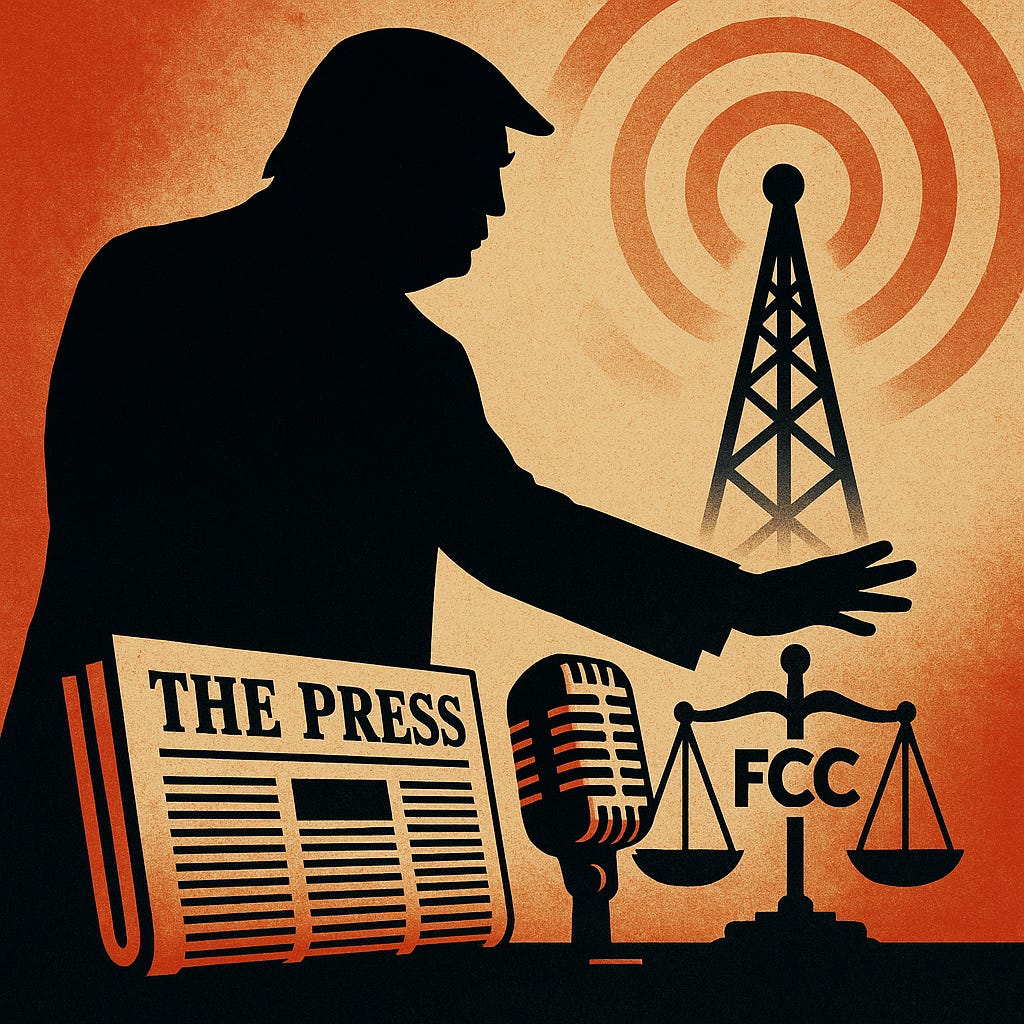
On September 18, aboard Air Force One, Trump escalated the rhetoric. Speaking to reporters, he complained that television networks were “97% against” him. He then added: “Maybe their license should be taken away… that would be up to Brendan Carr.”
The statement wasn’t subtle. Trump was openly suggesting that broadcasters who give him “bad publicity” — his words — should have their licenses revoked by a federal regulator.
This regulatory pressure is expanding. On September 18, FCC Chair Brendan Carr floated the idea that The View might no longer qualify as a bona fide news program under the agency’s equal opportunity rules. Speaking on a conservative podcast, Carr questioned whether the long-running daytime talk show, which frequently critiques Trump, should retain its exemption from requirements to offer equal airtime to opposing political views. He called it “worthwhile” to investigate whether the show still meets the standard. This isn’t a formal ruling, but like his earlier remarks about Jimmy Kimmel Live!, it operates as a warning. The message is unmistakable: criticize Trump too much, and your legal protections as a broadcaster may be reexamined.
Broadcast licenses are not symbolic. They are federally regulated permissions that allow networks to operate. Revoking them would be an extraordinary and authoritarian act, and the fact that a sitting president would publicly suggest it, even indirectly, underscores just how far this campaign has drifted from democratic norms.
The Terrorist Designation Float
Meanwhile, the White House is reportedly drafting an executive order that could label Antifa or other left-leaning groups as domestic terrorist organizations. Trump has referred to Antifa as “a sick, dangerous, radical left disaster” and suggested they may soon be subject to federal law enforcement targeting.
There is no existing legal mechanism to designate domestic groups as “terrorist organizations” in the same way the government designates foreign entities. There are also open legal questions about whether Antifa — a loosely organized and ideologically diffuse movement — even qualifies as an “organization.”
And yet, the float exists. The idea has been released into the discourse. The administration is waiting to see what kind of resistance it gets or doesn’t.
It’s worth remembering that no right-wing groups connected to the January 6th insurrection were ever formally designated as terrorist organizations. Not the Proud Boys. Not the Oath Keepers. Not the Three Percenters. That context makes the renewed push to label anti-fascist activists as terrorists all the more revealing.
This isn’t about public safety. It’s about political control.
What They’re Really Testing
Across courts, agencies, press conferences, and executive drafts, the Trump administration is engaged in a coordinated test of boundaries.
Can you sue journalists into silence without winning? Can you get the DOJ to investigate your critics? Can you float criminalizing dissent and retreat if backlash gets too loud? Can you get away with revoking licenses, even rhetorically?
These are the questions being asked, not in secret, but repeatedly in public. Because if no one pushes back, the next attempt won’t be a test. It will be a policy.
The point of all this isn’t to win every case or revoke every license. The point is to make speech cost something, to turn criticism into a risk, to flip the legal system into a tool of narrative enforcement.
And every time a judge throws out a suit or a regulator steps back, the message isn’t that the system is working. It’s because someone tried to break it again, and might try harder next time.
This isn’t law and order. It’s lawfare. And it’s accelerating.
Stay Informed. Stay Loud.
Subscribe to The Coffman Chronicle for no-BS political analysis, action guides, and daily truth bombs you won’t get from corporate media.
Sources:
“Judge throws out Trump's $15 billion lawsuit against New York Times, citing improper content” — Reuters
“Florida federal judge tosses Trump's $15B defamation lawsuit against The New York Times” — AP News
“Trump floats revoking licenses for networks critical of him” — Scripps News
“Trump suggests broadcasters who cover him negatively should lose licenses” — LiveNOW from FOX
“Trump claims licensed networks ‘not allowed’ to give him bad publicity” — People
“White House readies executive order on political violence, liberal groups sound alarm” — Reuters
“Trump sues Wall Street Journal for libel over reporting of alleged Epstein letter” — Georgetown Free Speech Project
“Trump says he asked DOJ to investigate Obama, others for ‘treason’” — Politico
“Trump “probably” going after ABC’s Jonathan Karl over coverage” — Entertainment Weekly
“FCC chair puts ‘The View’ under the spotlight after Kimmel pressure” — Politico
“Trump's FCC Chair Carr uses old powers in new ways to rein in media companies” — Reuters

We are about to enter a constitutional crisis!!
Time to spit in the eye of the Devil and take back our country. Courage not fear