


It’s been over a month since voters in Arizona’s 7th Congressional District elected Adelita Grijalva to the U.S. House of Representatives. Her election was certified. She is ready to serve. And yet, she has not been sworn in.
Arizona’s Attorney General, Kris Mayes, has now filed a lawsuit to force the process forward. The suit argues that Grijalva’s continued exclusion violates the constitutional rights of her constituents, who remain unrepresented in Congress. It even seeks the possibility of having someone other than the Speaker administer the oath if Mike Johnson continues to delay.
However, legal experts are skeptical that the courts will intervene. Internal House procedures — including who gets sworn in and when — are rarely touched by outside authorities. That means Grijalva may have no path forward but to wait.
And honestly, that is exactly what Speaker Johnson seems to be counting on.
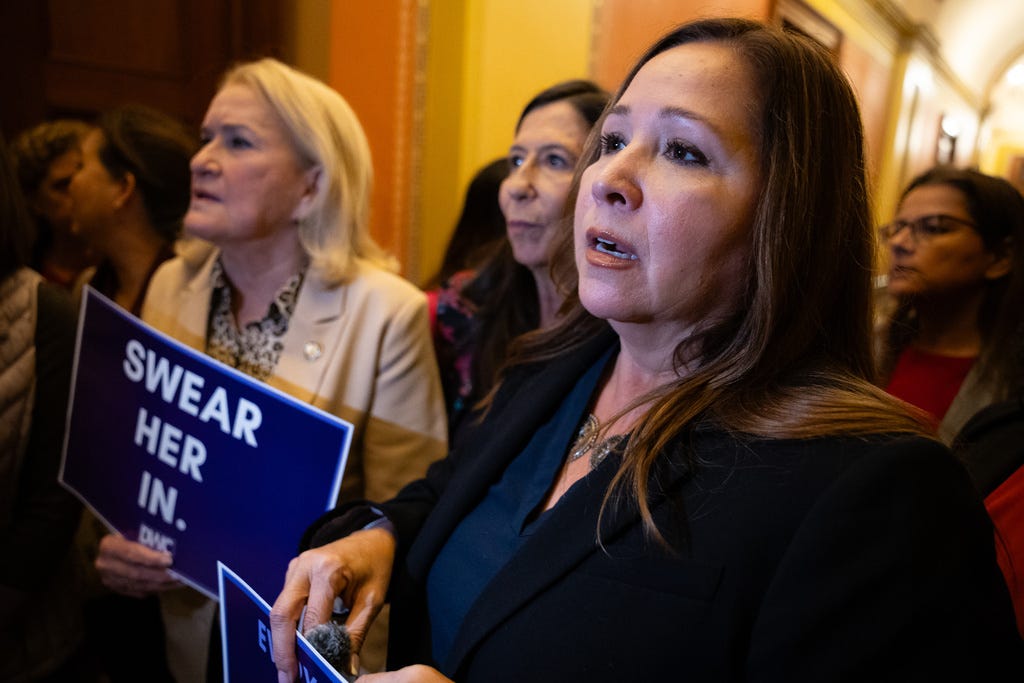
(Francis Chung/POLITICO via AP Images)
Because democracy doesn’t defend itself, and neither does your sanity. Subscribe here to keep your eyes open and your sarcasm sharp.
Time that was never used
Grijalva won her election on September 23. The government shutdown didn’t begin until October 1. In between, there were two full working days on the House schedule — September 29 and 30 — that could have been used to swear her in. They weren’t.
Speaker Johnson canceled those sessions.
This wasn’t a shutdown-mandated closure. These cancellations happened before the shutdown. As a reminder, this was just after the House returned from summer recess, right as members were supposed to be back at work —most notably on the budget, but also on all the other legislation they have yet to pass.
With the fiscal year deadline looming, the House was already staring down a crisis. Instead of keeping the lights on and the legislative process moving, Johnson chose silence. Two full days of potential work — gone. No votes. No debate. No swearing-in.
The vote that hangs in the balance
This delay would already be troubling. However, what elevates it into full-blown obstruction is what Grijalva is expected to do once sworn in.
She is widely believed to be the 218th vote on a bipartisan discharge petition to force a floor vote to release the Jeffrey Epstein files. The petition stands at 217. Grijalva’s signature would hit the threshold and force Congress to act.
That vote terrifies House leadership.
Publicly, Speaker Johnson and his allies insist the Epstein files are already being handled, that there’s nothing new to find, and that transparency is unnecessary. However, privately, House Republicans are watching the numbers, and as long as Grijalva stays unsworn, the petition stays one vote short.
Every day of delay increases the likelihood that one of the Republican signatories will back out, likely under pressure. Flip just one signature, and the whole effort collapses. The longer the seat stays empty, the more time they have to apply pressure.
This, of course, begs the question: if there’s nothing in the files, why go to these lengths to block a vote?
This isn’t the only empty seat
Arizona’s 7th isn’t the only district being denied a voice. In Texas, the 18th Congressional District has been without representation since March, when Rep. Sylvester Turner died in office. The governor delayed calling a special election for months. It’s now scheduled for November 4, but if no candidate wins outright — and early polling suggests that’s likely — the race will go to a runoff, potentially leaving the seat vacant into March 2026. That’s right. This seat will likely remain empty for an entire year.
In Tennessee’s 7th District, a Republican representative resigned this summer. The state scheduled a special election quickly and efficiently. The district won’t go more than six months without representation. And unlike Arizona or Texas, there was no delay in confirming the election date.
Two majority-minority, Democratic-leaning districts have been intentionally stalled for months. One Republican-leaning district has been handled by the book. The pattern isn’t hard to spot.
Age and power, clinging tight
These vacancies didn’t emerge out of nowhere. Both Grijalva’s father, longtime Rep. Raúl Grijalva, and Rep. Sylvester Turner were in their seventies when they passed away. That raises uncomfortable questions about succession planning — or the lack of it — in Congress.
The minimum age to serve in the House is 25. However, the average age is pushing 60. For the Senate, it’s over 64. The political pipeline isn’t producing fresh voices. Instead, it’s clogged with incumbents holding on well past the point of flexibility or relevance. And when those seats suddenly become vacant, the system isn’t prepared to respond — or worse, chooses not to.
Young leaders are told to wait their turn. Often, however, that turn never comes. And in the rare cases where the door opens, the system stalls the moment they step in.
A system that delays by design
All of this — the delays, the calendar manipulation, the quiet refusal to swear in a certified representative — is happening inside a democracy that claims to represent all its people. But what does it mean when 800,000 Arizonans can cast ballots and still go unrepresented for a month? When 800,000 Houstonians can go nearly a year without a seat at the table?
What does it say when leadership cancels work days — right after recess — in order to avoid doing their job?
And what does it mean when the thing they’re so desperate to avoid is a vote on documents they claim hold nothing of importance?
Representation shouldn’t be negotiable
This is not about bureaucracy. It’s not about tradition or protocol. It’s not even about partisanship — not really.
It’s about power— who holds it, who gets silenced, who the system will wait for, and who it will gladly leave behind.
The voters of Arizona’s 7th have done their job. So have the voters of Texas’s 18th. Yet Congress — and the Speaker in particular — has decided that their voice doesn’t matter. Not right now. Not yet. Not until it’s politically safe.
And if one seat can be blocked to avoid one vote, what else can be delayed?
And who else can be silenced?
Did you know? Because states control elections and each has its own rules on how soon a special election must be called, technically, there is no “appropriate” timeline. As a result, governors like Greg Abbott can act or delay as it serves their political aims. If you think this is unfair, verify your state’s rules, and if you think it is ripe for abuse, push for codification of a clear guideline.
Don’t let the bastards sneak anything past you. Subscribe and get your daily dose of rage and receipts delivered fresh, before the spin doctors can scrub it.
Sources:
“Lawsuit seeks to force swearing in of US Rep‑elect Adelita Grijalva of Arizona” — AP News
“Arizona AG sues over Speaker Mike Johnson refusing to seat new House member” — Washington Post
“Arizona sues Mike Johnson to force swearing‑in of Democrat who could sway Epstein vote” — The Guardian
“Arizona is suing the House to seat Rep‑elect Grijalva” — ABC News
“Who is Adelita Grijalva and why hasn’t she been sworn in to Congress yet?” — PBS NewsHour
“Arizona AG threatens lawsuit as Speaker Johnson delays Grijalva swearing‑in” — Axios
“Abbott sets Nov. 4 special election for CD‑18 seat left vacant by death of Sylvester Turner” — Houston Landing
“Governor Greg Abbott has set Nov. 4 as the special election date to fill the congressional seat left vacant by former Rep. Sylvester Turner” — VoteBeat
“Texas’ 18th congressional district seat is still vacant. What’s next?” — VoteBeat
“Where Adelita Grijalva ranks in Congress’ longest delayed swearing‑in” — Time
“Speaker Johnson is Shutting Down the House to Avoid Addressing the Health Care Crisis” — House Appropriations Committee Democrats press release (Sept 19, 2025)
“Epstein files discharge petition approaches critical threshold” — Axios (Sept 23, 2025)
“Speaker Johnson keeps House lawmakers away, canceling another week’s session as shutdown drags” — AP News (Oct 10, 2025)

Continued
Constitutional
Constituents
Congress
It all starts with a con, which is apt.
Time to dig, find and publish the dirt on all who oppose.
Speaking of which, isn't Lindsey Graham quiet these days...
the swearing in "cerimony" isnt truly required is it, would anyone allow cerimony to obstruct democracy and the peoples business, dont fool yourselves into believing normal is stoll viable anylonger, thats done...now how we gonna get our reps into the chamber?