


It began with a desperate phone call.
“Pass the phone,” Venezuelan detainee Luis Manuel Rivas Velásquez told attorney Eric Lee after collapsing from severe breathing difficulties in Florida’s Everglades. For 48 harrowing hours, he begged for medical help inside the notorious “Alligator Alcatraz” detention camp. When he was finally taken to a hospital, he was diagnosed with a respiratory infection, but on return, authorities confiscated the poetry and letters he had written, then transferred him without warning to a facility in Texas. Since then, Lee has heard nothing.
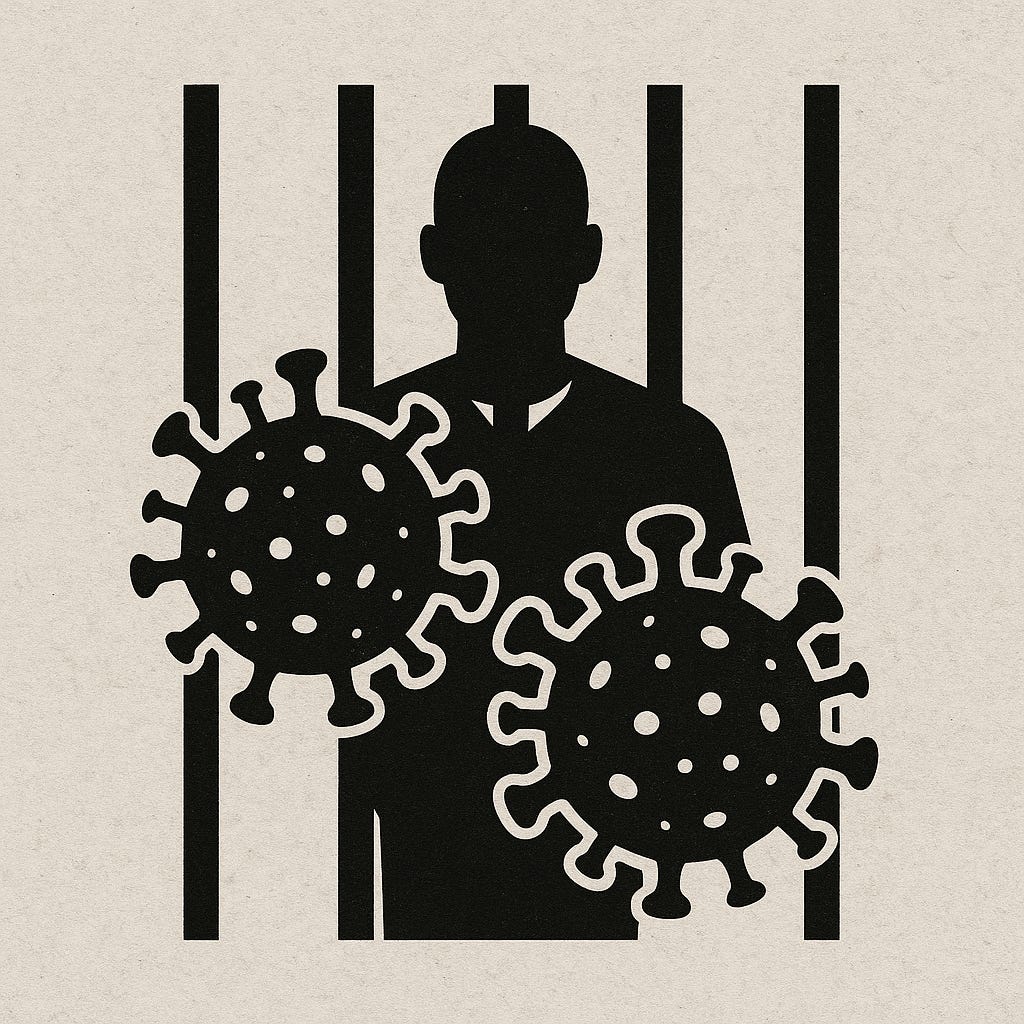
This is the human face of Alligator Alcatraz’s creeping outbreak, a “petri dish for disease” engulfed in coughing, backed-up toilets, and withheld care. State officials refuse to confirm whether it’s COVID-19, but whatever it is, it’s moving fast. And the stakes are not limited to one camp in the Everglades.
Already in 2025, U.S. detention centers have seen outbreaks of measles in New Mexico, suspected tuberculosis in Washington state, and now this mystery respiratory illness in Florida. The conditions inside, specifically overcrowding, poor ventilation, sewage overflows, and vulnerable people housed together, are tailor-made for contagious disease to spread. And in an era when COVID is rising again in the general public, avian flu is adapting to mammals, and federal health officials are quietly narrowing vaccine access, these camps could be where the next public health disaster begins.
Stay Informed. Stay Loud.
Subscribe to The Coffman Chronicle for no-BS political analysis, action guides, and daily truth bombs you won’t get from corporate media.
Outbreaks in U.S. Detention Centers: 2025’s Alarming Pattern
What’s happening at Alligator Alcatraz is not a one-off. It’s part of a year already marked by dangerous, and sometimes deadly, disease outbreaks inside U.S. detention facilities.
Measles — Luna County Detention Center, New Mexico (June 2025)
In June, New Mexico health officials confirmed a measles outbreak in the Luna County Detention Center in Deming. Five detainees tested positive. In a facility housing about 400 people with minimal medical resources, measles, one of the most contagious viruses on Earth, spread quickly. Only after state health teams intervened were MMR vaccines distributed. The episode underscored how easily preventable diseases can gain a foothold when vaccination histories are uncertain and living conditions are crowded.
Tuberculosis — Northwest ICE Processing Center, Washington (July 2025)
Just weeks later, a tuberculosis cluster emerged in Tacoma’s Northwest ICE Processing Center. At least seven detainees were suspected of having active TB, likely linked to transfers from Alaska. The airborne bacteria spread slowly but efficiently in poorly ventilated environments, and in detention, they can circulate silently for weeks before detection.
Respiratory Illness — Alligator Alcatraz, Florida (August 2025)
Now in Florida’s Everglades, lawyers, detainees, and advocates describe a wave of coughing, shortness of breath, and collapsing detainees. Whether it’s COVID-19, influenza, or another pathogen, the speed of spread is alarming. The state refuses to confirm an outbreak, insisting detainees have “access to care,” even as firsthand accounts suggest the opposite.
A Year of Escalation
By August, these outbreaks — measles, TB, and an unidentified respiratory illness — had hit three corners of the country. Worse, they come on top of a grim statistic: at least 14 detainee deaths in ICE custody in 2025 so far, already exceeding last year’s total. The rising death toll suggests not just more disease, but deeper systemic neglect.
See our reporting on deaths in ICE detention here:

The Public Health Backdrop: Contagion in a Peak-Summer World
The outbreaks in detention aren’t happening in a vacuum. They’re colliding with a wider public health moment where multiple highly transmissible pathogens are already circulating, and in some cases, rising earlier than expected.
COVID-19 – R₀: ~5–9 (Omicron lineage)
In the general public, COVID-19 is surging again. The Stratus (XFG) and Nimbus (NB.1.8.1) variants are driving case increases in at least 45 states. Wastewater monitoring shows viral levels climbing from “low” to “moderate” nationwide. Vaccination coverage is dismal: just 23% of adults and under 6% of children have received updated boosters. Compounding the danger, HHS has narrowed booster eligibility and undermined public vaccine confidence, leaving millions vulnerable with waning immunity from shots taken years ago.
Influenza – R₀: ~1.3–1.8 (seasonal)
The 2024–2025 flu season was the deadliest in more than 15 years. There were over 37 million infections, nearly half a million hospitalizations, and 21,000 deaths. This year’s updated vaccines target the expected H3N2 strain, but flu is already appearing out of season in some regions, suggesting we may be heading for another heavy winter. Normally, flu peaks in cold months, but in a detention facility, the “season” never ends.
Measles – R₀: ~12–18 (one of the most contagious pathogens known)
In June, Luna County Detention Center in New Mexico saw a measles outbreak. Five detainees were infected in a population where many had uncertain vaccination histories. In close quarters, measles can infect 90% of non-immune individuals after a single exposure, and the virus can remain airborne for up to two hours after an infected person leaves the room.
Tuberculosis – R₀: variable (~1 in typical conditions, much higher in poor ventilation)
The Tacoma, Washington TB cluster this summer illustrates how this ancient airborne pathogen thrives in confined spaces. Latent TB can reactivate in stressed, malnourished populations, and in its drug-resistant form, it’s far harder to treat, often requiring more than a year of toxic medications.
Avian Influenza (H5N1) – R₀: currently <1 in humans, but climbing in animals
There have been over 70 confirmed U.S. human cases so far, all linked to direct animal exposure, mostly dairy cattle and poultry. Globally, the virus is infecting more mammal species, a sign it’s adapting. If it gains efficient human-to-human transmission, with a case fatality rate historically above 50%, the consequences would be catastrophic. Detention centers, with mixed-origin populations, close contact, and poor ventilation, are ideal environments for that kind of viral jump.
The Summer Warning
What makes this moment alarming is the timing. These outbreaks are happening in the height of summer. Normally, high heat and humidity blunt the spread of many respiratory viruses, but in detention, the environmental controls, crowding, and poor air exchange create a permanent “winter,” where airborne diseases spread freely no matter the season.
How Detention Centers Turn Outbreaks into Explosions
The frightening transmissibility of COVID, measles, TB, and other pathogens becomes even more dangerous inside a detention facility. These aren’t just bad conditions. They’re amplifiers.
At Alligator Alcatraz, detainees sleep shoulder to shoulder in stifling tents or dormitories where the air barely moves. Poor ventilation means airborne pathogens don’t dissipate. They build up. In an environment like that, a single case of measles, with its ability to infect 90 percent of non-immune contacts and remain airborne for two hours, can sweep through an entire housing unit in days. COVID-19 variants like Stratus and Nimbus, with reproduction rates estimated between five and nine, can spread just as explosively.
Inside these spaces, vulnerable people, especially children, the elderly, and those with chronic illnesses, are not separated from the general population. The sickest are housed alongside the healthiest, creating an environment where the most fragile bodies are exposed first and hit hardest. In such conditions, a virus doesn’t just spread; it accelerates toward the people least likely to survive it.
Sanitation failures compound the problem. Reports from Alligator Alcatraz describe overflowing toilets, pools of sewage, and severely limited access to showers. These conditions turn the camp into fertile ground for waterborne diseases such as norovirus, hepatitis A, and Shigella. For detainees already battling respiratory illness, a second infection can be devastating and often fatal.
The danger doesn’t stop at one location. Detainees are frequently transferred between facilities, often without adequate infectious disease screening, even when there is clear evidence of illness. In the case mentioned in the introduction, Venezuelan detainee Luis Manuel Rivas Velásquez collapsed at Alligator Alcatraz and was hospitalized for a severe respiratory infection. When he returned, rather than being isolated or monitored, he was transferred to a facility in Texas without notice. If his illness was contagious, that single move could have carried it hundreds of miles, introducing it into another detention population and potentially to the surrounding community before anyone outside the system even knew he was gone.
Layered over all of this is a culture of secrecy. State and federal agencies withhold outbreak data, delay public acknowledgment, and tightly control access for outside medical experts. The administration’s narrowing of COVID booster eligibility, paired with its public undermining of vaccines, means that when an outbreak finally is addressed, it’s striking populations already under-immunized and under-protected.
Detention centers do not contain disease; they circulate it. Staff return to their families each night. Transfers move illness across state lines. Lawyers, contractors, and volunteers come and go. By the time the public hears about an outbreak, it has often already escaped the fences.
See our previous reporting on Alligator Alcatraz and related facilities here:


The Warning We Can’t Afford to Ignore
The United States is not short on public health warnings in 2025. COVID-19 variants are on the rise, influenza is threatening another severe season, and avian flu is mutating across species. But nowhere are these threats more concentrated, more poorly monitored, or more politically invisible than in the nation’s detention centers.
The administration has built a dangerous contradiction into its public health approach: suppressing outbreak data while publicly undermining vaccines, narrowing booster eligibility, and cutting disease surveillance programs. On paper, this may look like political messaging control. In practice, it leaves frontline populations — detainees, staff, and their surrounding communities — more vulnerable to pathogens with the power to spread far beyond the fences.
See our reporting on the administration’s approach to health here:
Note: These articles are more than 45 days old and now live in our archive. Consider becoming a paid subscriber for exclusive perks including full access to all of our nearly 900 articles.


Inside detention, the conditions for viral evolution and explosive transmission are constant. Overcrowding, poor ventilation, sanitation breakdowns, and mixed housing of vulnerable populations create the same high-risk environment in August as in January. Inter-facility transfers stitch these isolated outbreaks together into a national web, carrying disease from state to state before health officials even know it exists.
Luis Manuel Rivas Velásquez’s story is not just an account of neglect. It’s a case study in how an infectious disease can move from one overcrowded tent in the Everglades to another state’s detention population in a matter of days, and from there, potentially into the public. When outbreak data is hidden, the first real signal we get may be when hospitals start to fill, or when a pathogen emerges that public health officials can’t contain.
Detention centers are not just humanitarian crises. They are, in this moment, the most dangerous blind spot in our pandemic defenses. If we want to know where the next wave will start, whether it’s COVID, measles, TB, or a human-adapted strain of avian flu, we need to be watching these places closely. Because the virus will not wait for transparency. And once it’s out, we won’t be able to put it back.
Stay Informed. Stay Loud.
Subscribe to The Coffman Chronicle for no-BS political analysis, action guides, and daily truth bombs you won’t get from corporate media.
Bibliography:
“‘Petri Dish for Disease’: Attorney Raises Alarm of Possible Covid Outbreak at ‘Alligator Alcatraz.’” The Guardian, August 12, 2025.
“DHS Covers Up Medical Crisis at Florida Detention Camp.” McEntee Law Blog, August 7, 2025.
“New Mexico Announces Measles Outbreak in a County Detention Facility.” AP News, June 7, 2025.
“Seven Suspected TB Cases Reported at Northwest ICE Processing Center.” World Socialist Web Site, August 6, 2025.
Ellis, Rebecca. “U.S. ICE Detention Deaths Hit Highest Level in Years.” The Guardian, June 30, 2025.
“Alligator Alcatraz Is Psychological Terrorism.” The Washington Post, July 18, 2025.
“What to Know about Rising COVID-19 Cases and the Surging ‘Stratus’ Variant.” Axios, August 8, 2025.
“CDC COVID-19 Data Tracker: Variant Proportions.” CDC, August 8, 2025.
“Flu Season 2025–2026.” CDC, August 6, 2025.
“Under the Weather: Unpacking the Impact of the 2024–2025 Influenza Season.” Pharmacy Times, July 21, 2025.
“Baylor College of Medicine Experts: It’s Time to Vaccinate Cows, Poultry and Their Caretakers for Bird Flu.” Houston Chronicle, March 13, 2025.
United States Department of Agriculture. “Highly Pathogenic Avian Influenza (HPAI) Detections in Livestock.” California Department of Food and Agriculture, August 1, 2025.
Paho/WHO. “Avian Influenza A(H5N1) – Situation Summary.” Pan American Health Organization, March 4, 2025.

Even though we know that a cruel government acts cruelly, it is still heartbreaking.
Meanwhile the real criminal who should be locked up is a pedo, felon, fraud running the country.