


In 2025, the toll of human life tied to U.S. immigration enforcement reached its highest level in more than two decades. At least 32 people died in Immigration and Customs Enforcement (ICE) custody, based on independent reporting and public records compiled by journalists and civil rights groups. This figure matches or exceeds the deadliest year on record.
Notably, these figures do not come from ICE’s own internal database. They are drawn from public reporting, media investigations, advocacy tracking, and congressional oversight requests, the only windows the public has into what is happening inside a system largely shielded from scrutiny.
What makes 2025 particularly striking is not just the number of deaths, but the context surrounding them. Last year included a record surge in detentions, ongoing reports of deplorable conditions, and evidence that many of those who died were held for civil immigration violations, not violent crime.
Want to Know Your Rights?
Download a free digital copy of the U.S. Constitution, the same document Trump is trying to bulldoze. Learn exactly what he’s breaking, and how to fight back.
100,000+ strong — and counting.
This winter, become a paid subscriber for just $1 a week and help us keep the truth alive.
Join The Coffman Chronicle — $1/Week
The Caveat We Should Never Have to Lead With
It bears emphasizing that these are not official ICE figures. They are a compilation based on visible evidence, press reporting, public announcements, and advocacy documentation. ICE’s own reporting mechanisms are limited, opaque, and delayed. In some cases, the agency will release critically ill people shortly before their deaths in order to avoid public reporting requirements.
That means the real toll, including deaths that are never publicly linked to ICE custody, is almost certainly higher. Furthermore, these numbers relate to deaths while in detention, and do not include those that occur during pursuit, arrest, or pre-booking.
A Brief Comparison: 2025 vs. Two Decades of Deaths in Custody
To understand how unusual 2025 was, it helps to look at the broader historical record.
ICE began reporting deaths in custody internally in 2003, shortly after it was formed. However, the public reporting of deaths by ICE didn’t begin until later. According to sources tracking ICE reporting practices, ICE began publishing lists of press releases regarding in‑custody deaths in 2015/2016 and became subject to legal and congressional requirements to release death reports in the late 2010s.
In 2025, the number of deaths in detention matched or exceeded the deadliest recent year on record — 2004 — with 32 confirmed fatalities.
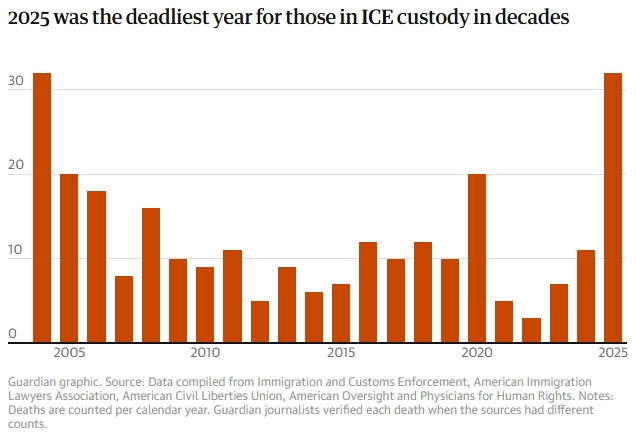
Source: The Guardian
This spike did not occur in isolation. Over the same period, the detained population ballooned to record highs, around 68,000 people in late 2025, the most ICE has held at once in its history.
Logically, the first full year of ICE deployment may have resulted in more deaths despite fewer detainees due to evolving policies, procedures, and a lack of training and experience. Therefore, for 20225 to have a similar death toll may be attributed to a larger number of detainees.
However, that may not be the only important factor.
Detention Without Conviction
What makes this trend even more alarming is who is being detained. Data analyzed from various detention tracking sources shows that the overwhelming majority of those in ICE custody have no criminal conviction, and only a small fraction have been convicted of violent offenses. This aligns with reporting that ICE held nearly 75% of detainees with no criminal record in mid‑December 2025.
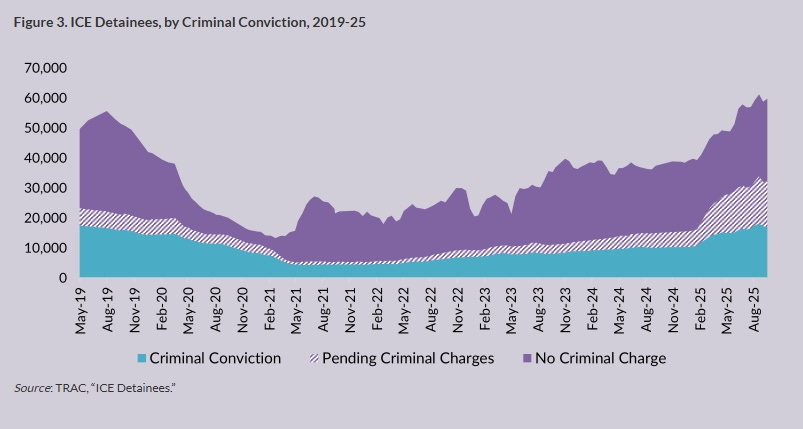
Source: Migration Policy
In ordinary criminal justice contexts, people without convictions would not be languishing in jail‑like conditions for extended periods, especially not where basic needs are routinely unmet. Yet ICE’s system treats civil immigration status as though it were equivalent to criminality, with consequences that far exceed what civil enforcement should entail.
Crucially, even violent criminals should have basic needs routinely met.
Moreover, there are increasingly detention of the very old, the very young, and the terminally ill.
Patterns of Preventable Harm
Sanitation and Living Conditions
Throughout 2025, independent investigations documented unsanitary, degrading, and potentially dangerous living conditions in multiple detention facilities. Reports from Human Rights Watch and other organizations describe severe overcrowding, poor hygiene, malfunctioning plumbing, and inadequate access to clean water, all conditions that create fertile ground for illness and suffering.
These are not isolated anecdotes. They are repeated across facilities of different types, from county jails holding ICE detainees to tent‑style processing centers, and they echo years of criticism that immigration detention facilities lack the basic infrastructure needed to maintain health and safety. When coupled with explosive growth in the detainee population and the rapid construction of multiple temporary sites, the risk of outbreaks increases.
Medical Neglect and Preventable Death
Perhaps the most devastating pattern is one that researchers, advocates, and oversight bodies have documented time and again. Medical neglect has repeatedly been noted, contributing directly to death in custody. A major report analyzing 2017–2021 deaths in ICE custody found that the vast majority (95%) were likely preventable with adequate medical care and attention.
This trend has not abated. In 2025, media accounts and family statements surrounding some deaths point to delayed treatment, lack of follow‑up care, and apparent failure to address serious medical needs before they became fatal.
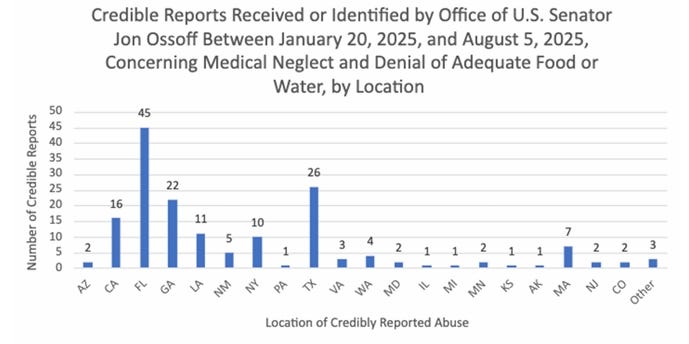
Source: Senator Jon Ossoff, October 2025
It gets worse, however. Specific cases of critically ill detainees being held in custody or deported have emerged, including a man in a vegetative state and a child with advanced cancer. Facilities that have consistently failed to provide adequate care for basic health are not appropriate for the critically or terminally ill.
Abuse and Underreported Violence
In late 2025, a congressional report cited at least 41 credible allegations of physical and sexual abuse in immigration detention facilities, including mistreatment of pregnant women and vulnerable individuals. Many of these reports were submitted to Congress by detainees, attorneys, and advocates.
These reports related to both abuse from other detainees and from members of staff. For example, in late 2025, local reporting from El Paso revealed dozens of sworn declarations from people held at the East Montana facility at Fort Bliss alleging beatings and excessive force by officers, and abusive physical contact, including alleged sexual abuse during enforcement actions.
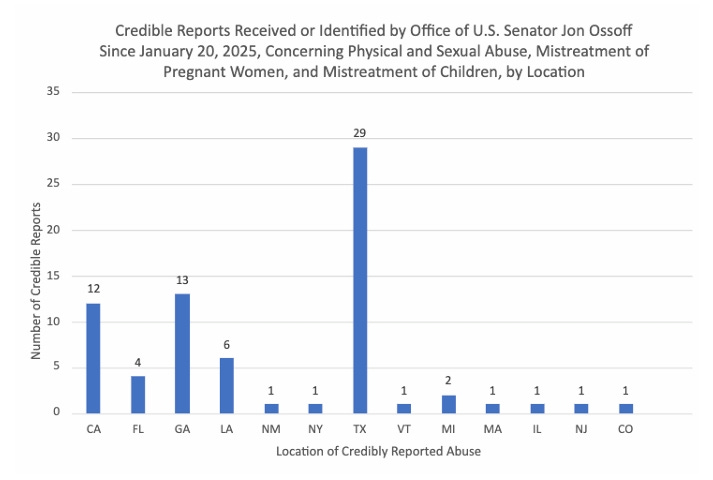
Source: Senator Jon Ossoff Report, July 30, 2025
Importantly, experts widely recognize that abuse of this nature is chronically underreported in detention settings due to fear of retaliation, shame, and lack of secure reporting channels.
Escalation Beyond Detention
While this piece focuses on detention conditions in 2025 and their implications, it’s worth noting that immigration enforcement in the same period also saw a dramatic escalation in the use of force by federal agents outside of detention facilities. Analysts tracking incidents have documented at least 16 shootings involving ICE and other immigration agents, as evidence of a broader trend of federal enforcement operating with increasingly militarized tactics.
As noted before, the number of deaths in 2025 attributed to ICE custody does not include those injured or killed during enforcement or arrest, including these ICE-involved shootings, falls from buildings, and other deaths related to pre-detention.
Whether these incidents are directly tied to detention practices or broader enforcement policy, they contribute to a perception of escalating state power with insufficient constraints or accountability.
Where We Are Now And What It Says About Oversight
The story of 2025 is not just a set of numbers. It’s a symptom of a system that has been expanding for more than twenty years, often with little meaningful oversight or public accountability.
Deaths in detention are climbing as detention populations reach unprecedented levels. Conditions documenting unsafe and neglectful practices persist. Credible reports of abuse are emerging despite obstacles to reporting. Independent scrutiny is often limited, delayed, or reactive rather than preventive.
While Congressional delegations visited more sites in 2025 than in the previous three years, and the extended Congressional report in the fall brought some attention to their concerns, the results, so far, have not included systemic change.
All of this is happening in a space defined as civil enforcement, not criminal punishment.
Why This Matters
This moment should give all of us pause. When the deadliest year on record for a federal enforcement agency coincides with record detention populations, a majority of detainees without criminal convictions, preventable harm and deaths, and systemic reporting gaps, we are not seeing a malfunctioning bureaucracy. We are seeing failures in oversight, accountability, and humane governance.
If any other institution were linked to this rate of death, abuse, and neglect, it would be shut down, investigated, and there would be criminal prosecutions.
Left unchecked, the data suggests an escalation and further damage that may one day be irreversible, both in human and institutional terms.
This is not a rhetorical argument. It is a factual, documented trend. And it is, perhaps, an invitation to finally treat civil enforcement with the proportionality, transparency, and humanity that any democratic system claims to uphold.
See our series earlier this year, which begins with this article:
Note: Articles roll into our archive over time. Consider becoming a paid subscriber for full access to the full archive and other exclusive perks.

If this reporting gave you something to think about, consider supporting this publication. Independent media exists to question the status quo, demand transparency, and document uncomfortable truths.
Sources:
“2025 was ICE’s deadliest year in two decades. Here are the 32 people who died in custody” — The Guardian, January 4, 2026
“Four died in ICE custody this week as 2025 deaths reach 20‑year high” — Reuters, December 19, 2025
“Four ICE detainee deaths in four days spark alarm as arrests grow” — The Washington Post, December 20, 2025
“Seven Immigrants Die in ICE Custody in December, Marking Deadliest Month This Year” — Notus, December 23, 2025
“U.S. Immigrant Detention Grows to Record Heights under Trump Administration” — Migration Policy Institute (MPI), October 29, 2025.
“Congress rediscovers ICE oversight authority” — Axios, January 8, 2026
“List of deaths in ICE detention” — Wikipedia
“The Abuse of Pregnant Women & Children in U.S. Immigration Detention” — Senator Ossoff Office, July 30, 2025
“Medical Neglect & Denial of Adequate Food or Water in U.S. Immigration Detention” — Sen. Ossoff Office, October 31, 2025
“Senate report details dozens of cases of medical neglect…” — AP News, October 31, 2025
“‘Horrific’: report reveals abuse of pregnant women and children at US ICE facilities” — The Guardian, August 6, 2025
“Over 500 Credible Human Rights Abuses Reported in US Immigrant Detention Centers” — ValverdeLaw.com summary, August 27, 2025
“Senate Investigations Find Medical Neglect and Other Human Rights Violations…” — Reason.com, November 3, 2025
“US immigration agents linked to 16 shootings under Trump’s crackdown” — The Guardian, January 7, 2026
“Detainees at ‘Alligator Alcatraz’ facing ‘harrowing human right violations,’ new report alleges” — The Guardian, December 4, 2025
“Deaths at Adult Detention Centers” — AILA, September 23, 2025
It's time defund and disband this group of thugs and burn their jackboots.
Dictatorships rule through intimidation, brute force, stoking fear and violence. As an example, we've all seen the murder of Renee Nichol Good in Minnesota at the hands of a trigger-happy Nazi thug. Making matters worse is the lack of oversight or accountability for deaths of people in their custody. But then the mission of ICE was never meant to protect US citizens.