


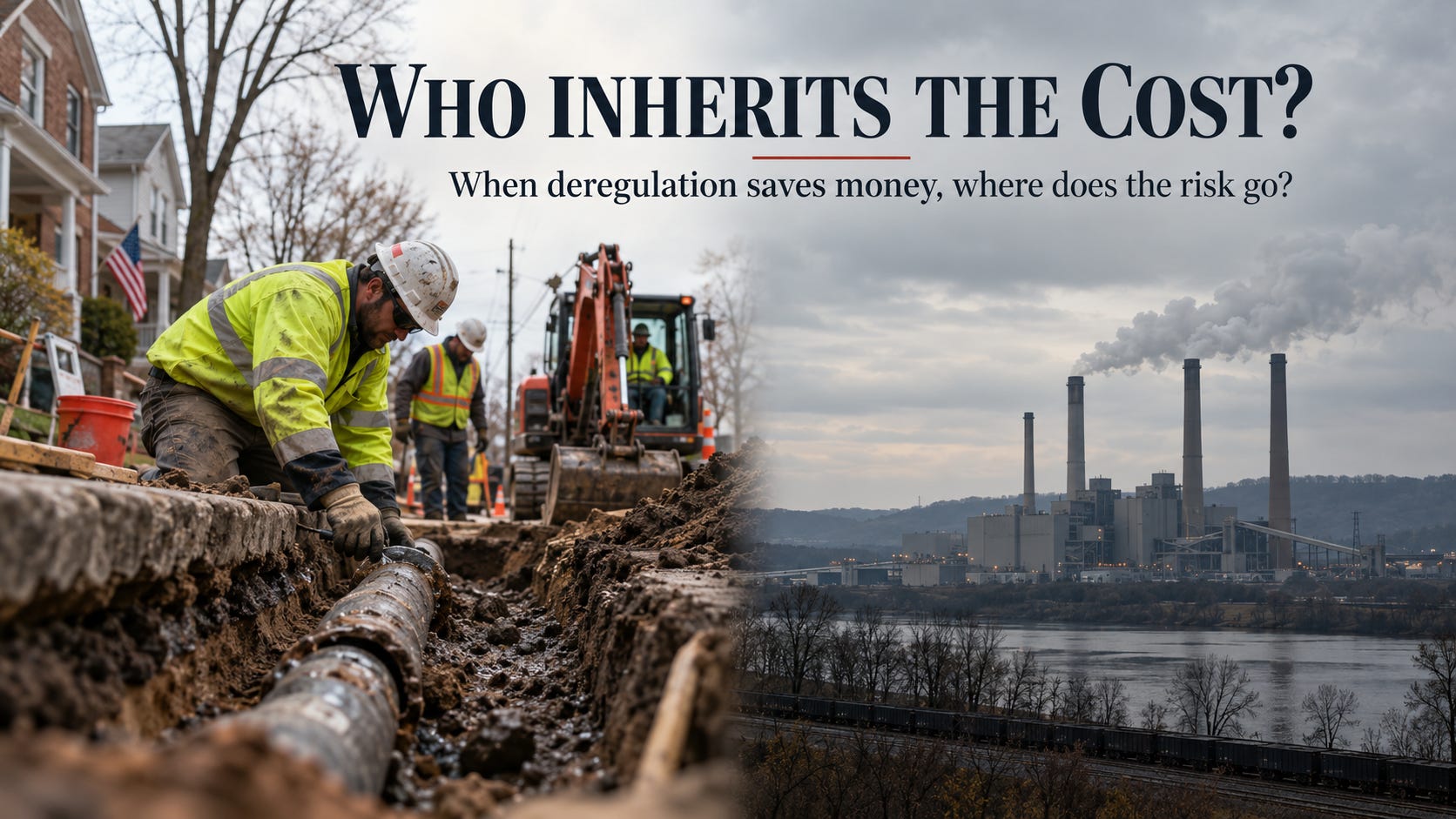
Two Toxins. Two Different Decisions.
Lead and mercury do not care which political party controls the White House. Both are toxic. Both can damage human health, and reducing exposure to either one costs money. This year, the Trump administration’s Environmental Protection Agency has been living on both sides of that equation.
In 2024, the Biden EPA finalized stronger requirements to replace lead service lines across the country. The current Trump EPA has continued implementing those requirements, issuing guidance in August to help water systems identify and remove lead pipes. The EPA describes lead as a powerful neurotoxin that is especially dangerous to children.
The work is expensive, disruptive, and complicated. Someone has to identify the pipe, dig it up, replace it, repair the property, and pay for the work. However, the reason for doing it is straightforward. Where lead service lines are present, the EPA says they are typically the most significant source of lead in drinking water, and replacing them removes that source of exposure.
Earlier this year, the same EPA made a different calculation involving mercury. In February, the agency repealed tighter 2024 requirements for coal-fired power plants and returned affected facilities to older standards. EPA estimates the rollback will save about $670 million and says American families will ultimately benefit through lower everyday living costs.
The older mercury protections did not disappear. This is not a story about government suddenly deciding mercury is harmless. It is a story about government deciding that an additional level of protection was no longer worth what it required industry to spend.
That raises a question much larger than either regulation: If spending money to reduce exposure to one toxic substance is considered a reasonable cost of protecting the public, what determines when spending money to reduce exposure to another becomes an unnecessary burden?
If the danger remains after the compliance cost disappears, somebody may still inherit the risk. Eventually, somebody may inherit the bill.
This Community Is Powered by You
What started as a small circle has grown into something much bigger, and it’s all because of readers like you.
Every time you forward this email, post it on socials, or bring someone new into the fold, you’re helping build one of the most passionate, independent communities out there.
Want to keep the momentum going?
Share this newsletter with someone who should be part of this conversation.
Thank you for being here. It means everything.
Regulation Is Not Automatically the Enemy
None of this means every regulation deserves to survive. Industries change, technology improves, and some requirements become outdated. Others duplicate protections that already exist. Sometimes government creates a burden whose cost simply cannot be justified by what the rule accomplishes.
Those rules should be changed or removed. That is not a retreat from government stewardship. It is government stewardship.
Regulation should never be the purpose of regulation. Government should be able to explain the problem a rule addresses, the protection it provides, and why that protection justifies the burden imposed on businesses and citizens.
Lead makes that principle easy to see. Replacing pipes costs money, but the expense does not make lead less dangerous. The EPA and the Centers for Disease Control and Prevention agree there is no known safe level of lead in a child’s blood, and the EPA says lead service lines are the leading source of lead in drinking water where they remain.
We understand what the money is buying: prevention. That does not mean every dollar spent complying with every environmental rule produces an equal public benefit. It means compliance costs alone cannot tell us whether a regulation is wasteful. To know that, we have to ask what the rule was protecting us from.
Then Look at Mercury
In February 2026, Trump’s EPA repealed specific amendments to the Mercury and Air Toxics Standards finalized two years earlier. While the repeal did not eliminate the original mercury rules, it removed the tighter 2024 requirements: a stricter particulate-matter standard for coal-fired power plants, a tighter mercury standard for lignite-fired units, and a requirement for continuous particulate monitoring.
The administration’s argument is straightforward. The EPA says the older standards remain strong and effective, while the additional 2024 requirements imposed costs the agency no longer considers justified. The agency points to the enormous reductions already achieved under the mercury standards and other changes in the power sector. By 2017, mercury emissions from covered power plants had fallen 86% from 2010 levels.
If an older rule already provides substantial protection and a newer requirement costs a great deal while accomplishing very little, government should be willing to reconsider it. However, the 2024 amendments were not paperwork requirements. They concerned emissions of mercury and other hazardous pollutants, and mercury did not become less toxic when the regulation changed.
The EPA identifies mercury as a neurotoxin. High exposure can harm the brain, heart, kidneys, lungs, and immune system, while methylmercury is particularly dangerous to developing nervous systems. It can also accumulate through aquatic food chains.
None of that proves every additional reduction is worth any price. It does mean that when government celebrates the money no longer being spent on pollution controls, the accounting cannot stop there.
Savings for Whom?
The EPA says the repeal is expected to save about $670 million in compliance costs. The administration says those savings will ultimately help American families.
Maybe they will, but before we call $670 million a savings to the American people, another question is worth asking: savings for whom?
Compliance costs are easy to see. A company buys equipment, installs monitoring systems, changes operations, or pays workers to meet a standard. Those expenses appear on a balance sheet. Remove the requirement, and some of those expenses disappear.
What is harder to see is what that spending was purchasing. If a tighter requirement would have prevented additional pollution, eliminating the expense does not automatically eliminate the consequences of the emissions no longer being prevented. Some costs may show up somewhere else through health effects, environmental damage, cleanup, lost work, insurance, or public spending.
Not every dollar industry saves becomes a dollar charged to the public. The accounting is not that simple, but neither is the opposite.
A cost disappearing from one corporate ledger does not prove the economy as a whole has been relieved of it. Sometimes a cost really has been eliminated. Sometimes it has been moved. That is the distinction deregulation has to confront.
A Working Family Eventually Runs Out of People to Pass the Bill To
Large institutions have ways to move costs. A corporation can raise prices, cut expenses, renegotiate contracts, change investments, buy insurance, or pass some portion of a burden through to customers. Government can raise revenue or move money around a budget.
A working family has fewer options. When a higher cost reaches the kitchen table, there may be nowhere left to send it. The electric bill still has to be paid, as do the rent or mortgage, the insurance premium, and the doctor.
Transferred costs do not arrive in the mailbox labeled “deregulation.” They can arrive as a copay, a higher insurance premium, a missed shift, a cleanup bill, or another demand on a public budget. The people with the smallest financial cushion have the least room to absorb another surprise.
That does not mean every regulation protects working families or every deregulation hurts them. Regulation itself can raise prices and impose costs, and those deserve to be counted too. The accounting simply has to follow the cost all the way to the end, because a corporation can pass a cost down the line. A working family eventually runs out of people to pass the bill to.
The Square New Deal Test
The Square New Deal does not begin with a preference for more regulation or less regulation. It begins with stewardship.
Government stewardship means obsolete, duplicative, or ineffective rules should go. Government should not require businesses or citizens to spend money merely because Washington has grown accustomed to requiring it. However, government stewardship also requires honesty about what happens when an actual safeguard is weakened.
Corporate stewardship recognizes that businesses have every right to earn a profit and challenge unnecessary burdens. Profit is not the problem, nor is economic growth. Reducing a company’s expense, however, is not necessarily the same thing as eliminating a social cost.
If preventing pollution, injury, or contamination requires spending money, then the public has a legitimate interest in knowing what happens when government decides that money no longer needs to be spent.
Then comes the working-class test. Economic policy cannot end its accounting at the corporate balance sheet. It has to follow the consequences far enough to see who ultimately carries them.
That gives us a simple test for deregulation: What danger was the rule addressing? What did compliance cost? What protection did that spending purchase? Who receives the savings when the requirement is weakened? Who inherits any additional risk? And who eventually pays the bill?
Those questions do not guarantee that every regulation survives, and they should not. They require government to count both sides of the ledger.
Congress Has a Responsibility Too
This cannot be left entirely to whichever administration controls the EPA. Congress writes the law. Agencies write many of the detailed regulations used to carry it out.
The Clean Air Act gives the EPA authority to regulate hazardous air pollution from power plants, including mercury. The Safe Drinking Water Act authorizes the EPA to establish national health-based standards for public drinking water systems.
That leaves administrations room to make different policy judgments within the authority Congress has granted them. One EPA can strengthen a standard. Another can reconsider it.
Congress can intervene directly as well. In 2025, Congress used the Congressional Review Act to disapprove the Biden EPA’s Waste Emissions Charge regulation, and President Trump signed the resolution. The rule consequently lost legal force. Later that year, Congress amended the underlying law so the charge would not begin until emissions reported for 2034.
For the Square New Deal, that raises a straightforward Article I question: If a protection is fundamental enough to safeguard Americans from a known danger, how much of its basic floor should be able to rise and fall every time control of the executive branch changes?
Agencies need flexibility to carry out the law, but Congress also has a responsibility to decide when the public needs something more durable.
Deregulation Should Remove Waste, Not Simply Move the Cost
That is why the Square New Deal doesn't need a quota for regulation. It needs a standard. Remove what is obsolete. Simplify what is unnecessarily complicated. Update rules when technology makes them outdated. Stop making businesses and citizens spend money on requirements that cannot justify themselves.
However, do not confuse a safeguard with paperwork merely because the safeguard costs money. If weakening a rule saves money without meaningfully increasing risk, that may be responsible deregulation. If the savings come from accepting consequences that will eventually be carried elsewhere, government has not necessarily eliminated the cost. It may have moved it.
Lead costs money to control. Mercury does too. The current EPA is helping water systems implement stronger lead protections inherited from the previous administration while also repealing tighter mercury requirements inherited from that same administration. That comparison does not prove the mercury decision was wrong. It tells us what government should have to prove before calling it a savings. What were we buying with that money? What protection are we giving up? Who receives the benefit? Who accepts the risk? And if consequences arrive later, who gets the bill?
Sometimes a dollar saved really is a dollar saved. Sometimes it is simply a bill that has not reached the next person yet. Deregulation should eliminate waste. It should not allow Washington to call something a savings simply because the cost disappeared from one ledger and arrived on somebody else’s.
The Square New Deal asks one final question: Who inherits the cost?
Support Independent Media
If you believe public policy should protect people before it protects a balance sheet, help support The Coffman Chronicle.
If you can afford it, become a paid subscriber. Your support helps keep this work independent, reader-supported, and focused on the questions too often buried beneath partisan noise.
If a paid subscription is not in the budget, you can still help by sharing this article, forwarding it to someone who should read it, or subscribing for free.
The republic belongs to all of us. So does the responsibility to pay attention.
Sources
U.S. Environmental Protection Agency. “Analysis of the Final Repeal of the Mercury and Air Toxics Standards Amendments.” February 2026. EPA source
U.S. Environmental Protection Agency. “Biden-Harris Administration Issues Final Rule Requiring Replacement of Lead Pipes Within 10 Years.” October 8, 2024. EPA source
U.S. Environmental Protection Agency. “Environmental Laws that Apply to Mercury.” Accessed October 4, 2026. EPA source
U.S. Environmental Protection Agency. “EPA Continues to Reverse Democrats’ War on Beautiful Clean Coal, Finalizes Repeal of Costly Restrictions on Baseload Power Generation.” February 20, 2026. EPA source
U.S. Environmental Protection Agency. “EPA Releases New Guidance to Reduce Lead Exposure in Drinking Water, Protect American Children.” August 21, 2026. EPA source
U.S. Environmental Protection Agency. “EPA Releases Proposal to End the Burdensome, Costly Greenhouse Gas Reporting Program, Saving up to $2.4 Billion.” September 12, 2025. EPA source
U.S. Environmental Protection Agency. “Health Effects of Exposures to Mercury.” Last updated November 21, 2025. EPA source
U.S. Environmental Protection Agency. “Lead in Drinking Water.” Accessed October 4, 2026. EPA source
U.S. Environmental Protection Agency. “Mercury and Air Toxics Standards.” Last updated July 29, 2026. EPA source
U.S. Environmental Protection Agency. “Waste Emissions Charge.” Last updated April 29, 2026. EPA source
These things like lead and mercury in our environment should be bipartisan issues.