


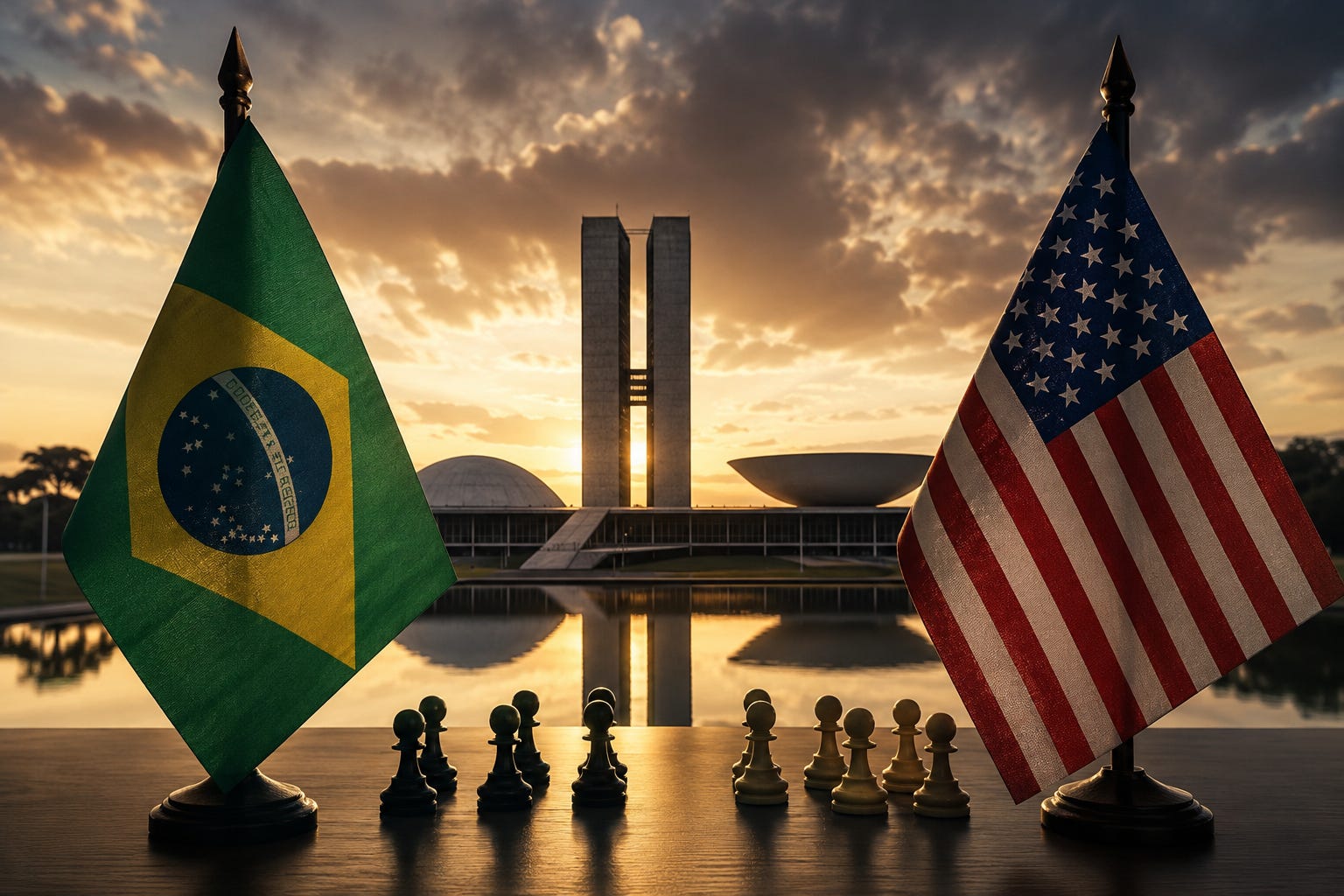
Last week, Brazil denied visas to two senior U.S. State Department officials who planned to visit the country roughly ten weeks before its October presidential election.
The officials were expected to discuss election integrity, religious freedom, and freedom of expression. Brazil confirmed the visa denials but offered no public explanation. The State Department described the proposed visit as routine, while Brazilian officials speaking to multiple news organizations later said they believed the trip risked undermining confidence in the country’s electoral process.
The decision immediately became part of Brazil’s domestic political conversation. It also raises a larger question that extends well beyond this particular election. Why would one democracy refuse entry to senior officials from another democracy just weeks before voters head to the polls?
This Community Is Powered by You
What started as a small circle has grown into something much bigger, and it’s all because of readers like you.
Every time you forward this email, post it on socials, or bring someone new into the fold, you’re helping build one of the most passionate, independent political communities out there.
Want to keep the momentum going?
Share this newsletter with someone who should be part of this conversation.
Thank you for being here. It means everything.
What Happened?
Two Senior State Department Officials Planned the Visit
The proposed delegation consisted of Riley Barnes, the Assistant Secretary of State for the Bureau of Democracy, Human Rights, and Labor, and Samuel Samson, a deputy assistant secretary within the same bureau. The Bureau of Democracy, Human Rights, and Labor (DRL) is the State Department office responsible for promoting democracy, monitoring human rights, advancing religious freedom, supporting labor rights, and engaging with governments and civil society organizations worldwide.
According to Reuters reporting, the officials applied for visas on July 20th ahead of a proposed visit that would have included meetings with Brazilian authorities on topics including election integrity, religious freedom, and freedom of expression. Brazil’s Foreign Ministry denied the applications four days later, on July 24th, less than three months before the country’s October presidential election. Reuters reported that the officials had hoped to travel to Brazil this week.
Brazil Confirmed the Decision but Offered Few Details
Brazil publicly confirmed that the visa applications had been denied. The Foreign Ministry did not release a detailed explanation for its decision, nor did it accuse the United States of attempting to interfere in the election.
That restraint is worth noting because many of the strongest claims surrounding the dispute have come not from official statements, but from Brazilian officials speaking anonymously to major news organizations. Those officials told Reuters that the government believed the proposed visit could undermine public confidence in Brazil’s electronic voting system and become part of the country’s increasingly polarized presidential campaign.
The U.S. State Department sharply disputed that characterization. Officials described the trip as a routine diplomatic engagement consistent with DRL’s longstanding mission and rejected suggestions that the delegation intended to influence Brazil’s election.
At this point, the public record establishes only a handful of facts with certainty. Two senior American officials sought permission to visit Brazil before a presidential election. Brazil declined to issue the visas. The United States says the visit was routine. Brazilian officials, speaking privately rather than formally, have suggested they viewed it as carrying unacceptable political risks.
Why This Visit Was Different
On paper, there was nothing unusual about the proposed trip. The Bureau of Democracy, Human Rights, and Labor (DRL) regularly engages with governments around the world on these issues, sometimes even in the lead-up to elections.
Context, however, often matters as much as the meeting itself. Brazil is expected to hold the first round of its presidential election in early October, and the proposed agenda reflected issues that have become deeply intertwined with the country’s domestic politics. Questions surrounding election integrity have remained politically charged since former President Jair Bolsonaro repeatedly challenged Brazil’s electronic voting system after losing the 2022 election. Religious freedom and freedom of expression have become recurring themes in debates involving the country’s growing evangelical movement, judicial oversight of social media, and expanding legal protections for LGBTQ citizens.
That is part of why a visit that might have attracted little attention at another time was almost certain to be viewed differently in the closing months of a presidential campaign. This DRL’s vision of election integrity, religious freedom, and freedom of expression is shaped by the Trump administration’s policies and rhetoric, which also intersect with current Brazilian candidate platforms.
The Election They Would Have Entered
To understand why those topics carried such political weight, it helps to understand the election itself.
President Luiz Inácio Lula da Silva, known simply as Lula, leads the Workers’ Party, a left-wing political party founded during Brazil’s transition away from military rule in 1980. Before entering politics, Lula rose to national prominence as a metalworkers’ union leader. His political identity remains closely tied to organized labor, workers’ rights, and efforts to reduce poverty and inequality.
His chief political rival, former President Jair Bolsonaro, emerged from a very different political tradition. Bolsonaro built his movement around nationalism, social conservatism, support from Brazil’s rapidly growing evangelical community, and criticism of what he viewed as an increasingly activist judiciary. Following his defeat in 2022, he repeatedly questioned Brazil’s electronic voting system and refused to fully accept the election results.
The aftermath of that election continues to shape Brazilian politics. Bolsonaro was later prosecuted and convicted for an alleged effort to overturn the constitutional order following the election, leaving him unable to seek the presidency again. His political movement, however, did not end with his conviction.
Instead, Bolsonaro’s Liberal Party, somewhat ironically a right-leaning conservative political party, has rallied behind his eldest son, Senator Flávio Bolsonaro. Flávio has continued to raise concerns about Brazil’s electoral system while seeking to unite the coalition his father built over the past decade.
For many Brazilians, then, debates over election integrity are not abstract discussions about voting procedures. They remain deeply connected to the country’s most recent presidential election, the legal proceedings that followed, and the political movement now seeking to return to power.
The View from Brasília
One way governments evaluate one another is recent behavior. President Donald Trump has repeatedly defended Jair Bolsonaro, describing the former Brazilian president’s legal troubles as politically motivated. Earlier this year, Brazil also denied entry to another Trump administration official who reportedly hoped to meet with Bolsonaro while he was serving his sentence. Brazil is also subject to tariffs imposed by the Trump administration, unlike neighboring close allies of the administration. As a result, the visa dispute over Barnes and Samson did not emerge in isolation, but amid an already strained diplomatic relationship.
Brazilian officials were also watching events elsewhere in Latin America. Since returning to office, Trump has publicly endorsed candidates in several elections across the region, including in Honduras and Colombia. In some cases, those endorsements came only days before voters went to the polls and were accompanied by the suggestion that America’s future relationship with those countries could depend, at least in part, on the election's outcome.
While that context does not answer the question of intent, it does help explain why Brazil may have viewed the visit differently than it would have had it been another country, under a different administration, or at a separate moment in the relationship between the two countries.
Looking Through Brazil’s Eyes
By the time the visa requests reached Brazilian officials, they already knew far more than the names of the two visitors and the subjects they hoped to discuss. Governments rarely evaluate diplomatic requests in isolation. They consider timing, relationships, recent events, and the political climate in which those requests will be received. They must also take history into account.
A Long Memory
Relations between the United States and Brazil have often been cooperative, but they have not always been uncomplicated. During the Cold War, the United States supported forces behind Brazil’s 1964 military coup and prepared additional assistance if it became necessary. Similar episodes elsewhere in Latin America, including Guatemala, Chile, Nicaragua, and Panama, left many governments in the region with a lasting awareness that Washington was sometimes willing to involve itself in domestic political affairs.
See our previous reporting here:

Though that history does not dictate how every American diplomatic initiative is received, nor does it mean every request will be viewed with suspicion, it does mean that conversations involving elections, democratic institutions, or domestic politics are unlikely to be evaluated in a historical vacuum.
Making Decisions Without Perfect Information
Equipped with recent and historical information, perhaps Brazil concluded that the visit would have no effect on the election or that it carried unnecessary political risk. The government has not publicly explained its reasoning, so no one outside those discussions can know with certainty. What is clear is that the decision involved more than two visa applications. By the time the request arrived, it had become one more question for Brazilian officials to answer during an already sensitive election season.
That calculation is particularly difficult during an election. Political campaigns have a way of assigning meaning to events regardless of the intentions behind them. A routine meeting can become a campaign advertisement. A diplomatic visit can become evidence for competing political narratives. Governments have little control over how those events are interpreted once they enter the public conversation.
Sometimes restraint and avoidance are the best options available, especially when any choice will be taken up as proof of whatever story a side is telling.
The Story Beneath the Story
Brazil’s decision ultimately says very little about what the United States intended. The public record simply does not answer that question, and it may never do so. What it does reveal is how governments make decisions when certainty is impossible, and elections are approaching.
The visa requests arrived during the final months of a presidential campaign. They involved senior officials whose portfolio touched on issues already at the center of Brazil’s political debate. They came from an administration that has publicly supported Jair Bolsonaro, endorsed preferred candidates elsewhere in Latin America, and sought to engage Brazil on subjects that had become deeply intertwined with its domestic politics. Those facts are accompanied by a long history.
Whether Brazil made the right choice is almost immaterial. Some will see an unnecessary diplomatic snub, while others will see a prudent effort to avoid introducing another variable into an already polarized election.
Regardless, governments are not required to justify every diplomatic decision, and observers both inside and outside Brazil will largely interpret the facts along predictable lines based on their existing beliefs. The broader lesson is less about whether Brazil was right than about how democracies behave when trust in elections has become part of the political contest itself.
In the end, the story is less about Brazil and more about the difficult choices governments make when diplomacy, history, politics, and public perception intersect. Those choices rarely produce universal agreement, but they do offer a reminder that even the smallest administrative decisions can reveal the larger systems operating beneath the headlines.
The news rarely exists in isolation. Subscribe to The Coffman Chronicle for thoughtful analysis that explores the history, context, and larger forces behind today’s headlines.
Sources:
“Brazil officials say visa requests denied to Trump officials ahead of election,” Reuters, July 25, 2026.
“Brazil’s government denies visas to US officials over upcoming elections,” Associated Press, July 25, 2026.
“Flavio Bolsonaro launches Brazil presidential campaign, touts support from Milei, Netanyahu,” Reuters, July 25, 2026.
“Argentina President Milei flies to Brazil to kick-start Bolsonaro presidential bid,” Reuters, July 24, 2026.
“Brazil’s Lula holds lead over Bolsonaro in BTG/Nexus election poll,” Reuters, July 27, 2026.
“Brazil’s Bolsonaro sentenced to 27 years after landmark coup plot conviction,” Reuters, September 11, 2025.
“Ex-President Bolsonaro starts serving 27-year sentence for coup plot,” Reuters, November 25, 2025.
“Lula says Trump must ‘stay out’ of Brazil elections,” Reuters, June 17, 2026.
“Brazil revokes visa of US diplomat who sought to visit Bolsonaro in prison,” Associated Press, March 13, 2026.
“Brazil’s top court bars Trump adviser from visiting Bolsonaro,” Reuters, March 12, 2026.
“Eduardo Bolsonaro to face trial in Brazil for seeking Trump help in his father’s legal case,” Reuters, November 14, 2025.
“Trump imposes 50% tariffs on Brazil after spat with Lula,” Reuters, July 9, 2025.
“Trump hits Brazil with tariffs, sanctions but key sectors excluded,” Reuters, July 31, 2025.
“Brazil’s president sees no point in tariff talks with Trump,” Reuters, August 6, 2025.
“Trump backs conservative Asfura in Honduras’ tight presidential race,” Reuters, November 26, 2025.
“Trump endorses Colombian presidential candidate de la Espriella,” Reuters, June 3, 2026.
“Trump won’t ‘waste our time’ with Argentina if Milei loses in midterms,” Reuters, October 14, 2025.
“Trump’s Milei election warning fuels backlash and ‘colonialism’ accusations in Argentina,” Reuters, October 22, 2025.
“Bureau of Democracy, Human Rights, and Labor,” U.S. Department of State, undated.
“Bureau of Democracy, Human Rights, and Labor,” U.S. Department of State Foreign Affairs Manual, undated.
“Brazil,” Foreign Relations of the United States, 1964–1968, Volume XXXI, U.S. Department of State Office of the Historian, 1964–1968.
“Telegram From the Ambassador to Brazil to the Department of State,” U.S. Department of State Office of the Historian, March 28, 1964.
“Memorandum of Telephone Conversation,” U.S. Department of State Office of the Historian, March 31, 1964.
“Sources for the Foreign Relations Series,” Foreign Relations of the United States, 1952–1954, Guatemala, U.S. Department of State Office of the Historian, undated.
“Note on U.S. Covert Actions,” Foreign Relations of the United States, 1969–1976, Volume XXI, Chile, 1969–1973, U.S. Department of State Office of the Historian, undated.
“The Allende Years and the Pinochet Coup, 1969–1973,” U.S. Department of State Office of the Historian, undated.
Why does Brazil have to allow the US to question the integrity of its elections? Especially since the Trump regime is currently undermining US elections. And this cannot be viewed only through an electoral lens. This is part of the Trump regime's revival of the 19th century Monroe doctrine. He believes all of North and South America should be part of Trump land. Bolsonaro was prosecuted for instigating Brazil's failed coup, whereas Americans re-elected Trump after January 6th. Trump supports conservative governments who support him. Brazil is rightfully concerned about whether the US is an objective election observer or a disruptor of another sovereign nation's internal politics.
Brazil Gvt made the right choice…They are better off not affording Trump more opportunity to interfere in their election…he has no interest in fair and free elections…always puts his thumb on the scale