


The Day You Become a “Domestic Extremist”
It starts with something ordinary. A neighbor texts you about a local protest — nothing big, nothing dramatic. It is just a handful of people in your town square holding signs about immigrant families being torn apart, a mutual-aid group passing out food and winter clothes, or students speaking out about anti-LBGTQ harassment in their schools. There are no broken windows, no black-clad street battles, no drama, just people exercising the most basic American liberty: the right to gather, speak, and demand better.
You show up because it feels like the right thing to do. Your kid is on your shoulders, waving a tiny homemade sign. You share a picture with the caption: “Proud of our community.” You go home feeling hopeful, connected, and energized.
And then, maybe days or weeks later, your name pops up somewhere you never imagined: a watchlist.
You’re tagged as someone who attended an event “linked to extremist ideology.” Why? Because the Attorney General decided that groups like the one you stood beside that Saturday — immigrant advocates, LGBTQ+ activists, anti-deportation coalitions — might be part of what the government now calls a “domestic extremist network.”
And suddenly, that simple act of solidarity — something we’ve been told our whole lives is patriotic — becomes “suspicious activity.” An agent looks at your social media history. Your donation to a civil rights nonprofit is flagged. Maybe your phone metadata is reviewed because someone at the protest once retweeted someone who once used the word antifa. You don’t know. You don’t get told. That’s how surveillance works.
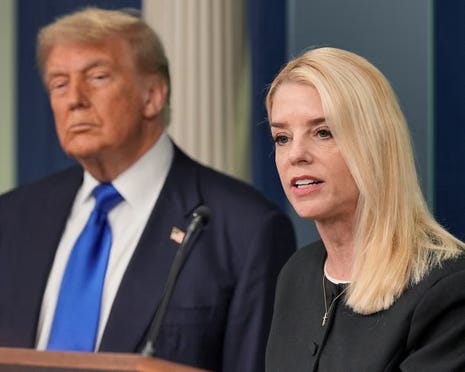
Because here’s what Pam Bondi just did. She ordered federal law enforcement, including the FBI, Joint Terrorism Task Forces, and federal prosecutors, to treat ideology as a threat, to investigate not what you do, but what you believe, or what they assume you believe.
And if they assume wrong? Too bad. The label sticks long before any courtroom ever sees your name.
The scariest part is that this new world doesn’t target people hiding in shadows. It targets people who dare to stand in the light.
Everyone wants to believe the government only investigates the “bad guys.” However, the easiest way for a government to create bad guys is to redefine bad and apply it to whoever stands in the way.
Want to Know Your Rights?
Download a free digital copy of the U.S. Constitution—the same document Trump is trying to bulldoze. Learn exactly what he’s breaking… and how to fight back.
70,000+ strong — and counting.
This holiday, become a paid subscriber for just $1 a week and help us keep the truth alive.
Join The Coffman Chronicle — $1/Week
The Memo Nobody Voted For
Here’s the thing about rights. We tend to imagine that if somebody wants to take them away, there will be a big debate first, a bill on the House floor, angry speeches on cable news, and a presidential signing ceremony with big flags and bigger consequences. We expect that an attempt to redefine “free speech” or “political dissent” will come with fireworks, not with a quiet memo slipped into inboxes at the Department of Justice.
But that’s exactly what just happened.
On December 4, 2025, U.S. Attorney General Pam Bondi, the country’s top law-enforcement official, issued an internal directive ordering the FBI and other federal agencies to intensify investigations of Antifa and groups labeled “extremist.”
Bondi didn’t go to Congress. She didn’t hold a press conference to explain why everyday Americans might suddenly require federal surveillance. She didn’t even release the full memo to the public. We only know what’s in it because investigative journalists fought to see enough of it to warn us.
The directive tells the FBI to compile a list of entities “possibly engaged in domestic terrorism,” even if they are not accused of committing any crime. Just “possibly.” Just… suspicious.
And the list of priorities goes way beyond violence, which is what most people think of when they hear the word terrorism.
Bondi instructs agencies to dig into:
Tax crimes
Nonprofit status
Any group whose beliefs challenge government policy
Let that sink in. Ideology is now a crime scene. A church basement group raising bail money for protesters? A student organization helping classmates with rent assistance. A volunteer network delivering food to migrants?
Federal investigators just got permission to flip their world upside down, to search through their paperwork, their donors, their conversations, their past statements, looking for the faintest hint of “extremism.” If you think that sounds vague, that’s the point. Vague rules are easy to weaponize.
Nobody voted on this. Nobody debated it. There was no national discussion about whether civil society should be treated as a terror threat. A single official signed a memo, and suddenly the burden of proof shifted from the government proving you’re dangerous to you proving you’re not.
This is how democracy erodes, not with a law, but with a memo.
The Ideology Test: How Political Disagreement Becomes Terrorism
When you think of domestic terrorism, you probably picture bombs, violence, firebombs, or armed recklessness. What you seldom imagine is that disagreeing with government policy or simply belonging to a group that does could land you under federal investigation. But that’s the move Pam Bondi just made.
Her directive doesn’t ask: Did you commit violence? It asks: Do you believe the wrong things? And that, in theory, is enough.
The internal DOJ directive reportedly names a range of ideological markers supposedly signaling “extremism.” Among them:
Opposition to immigration enforcement
Support for “open borders” or “mass migration”
Advocacy of what the memo calls “radical gender ideology”
Anti-capitalist, anti-Christian, or anti-American political or cultural views
If that sounds like political speech, that’s because it is.
However, under this directive, such beliefs are being flagged as potential indicators of domestic terrorism, not because a crime was committed, but because someone holds or expresses certain views.
That’s a radical shift from traditional law-enforcement standards, which target conduct rather than convictions for disfavored ideas.
And suddenly, the most protected speech in America — political dissent — becomes a federal suspicion category with very real consequences attached.
That’s not justice. That’s not public safety. That’s intimidation.
Antifa Isn’t an Organization, But That’s the Point
Ask ten people what “Antifa” is, and you’ll get eleven answers. A conspiracy. A philosophy. A friend of a friend who once threw a trash can at a Starbucks. What you won’t get is a membership card, a national office, or a leadership board plotting in a basement somewhere.
That’s because Antifa isn’t a group. It’s not even a network in the traditional sense. Experts describe it as a “decentralized, leaderless movement composed of loose collections of groups, networks, and individuals.”
That means it’s an idea, not an institution. You can’t join Antifa. You can’t quit Antifa. There’s no membership meeting or annual fundraising gala. There’s no donor roll to subpoena. There’s no treasurer and no tax-exempt status to revoke.
That creates a practical problem for law enforcement. How do you prosecute a ghost?
The simple answer is you broaden the definition until everyone looks like the ghost.
When the government can’t find enough enemies, it invents them.
The Tools of Punishment, Without Ever Proving a Crime
Imagine a toolkit, but not one for building. Imagine a toolkit for erasing, erasing rights, erasing dissent, erasing entire networks through paperwork, audits, and fear. That’s what this strategy hands the government, instruments of power that don’t require a single crime to have been committed.
Tax-crime probes can bankrupt nonprofits before they’re ever charged.
RICO-style conspiracy accusations can make anyone connected to activism look criminal.
Financial surveillance can freeze bank accounts and intimidate donors.
Retroactive reclassification turns old protests into “historical extremist incidents.”
JTTF referrals and secret watchlists quietly turn civic leaders into targets.
No handcuffs are necessary. The fear does the work.
If this were truly about violence, the DOJ would define specific violent groups and pursue them narrowly. But that’s not the mission here. The mission is to shut down the infrastructure of dissent before dissent even happens.
You don’t have to cut out the tongue. You just need to make speaking feel dangerous.
Who Gets Targeted First (It’s Not the People in Balaclavas)
If this were really about “extremists,” the memo would target violent plots, weapons stockpiles, or organized cells planning attacks, yet that’s not how this memo works. The groups most likely to be investigated under Bondi’s directive aren’t hiding in shadows. They’re tabling at community fairs. They’re feeding hungry families. They’re defending kids at school board meetings.
The first casualties of this crackdown aren’t the fringe, but the frontline of American democracy, such as mutual-aid networks delivering food and shelter, student activist groups defending peers, LGBTQ+ organizations protecting kids from harassment, immigrant-rights coalitions keeping families together, racial-justice groups demanding accountability, and environmental organizers trying to prevent disaster.
The earliest warning sign has already flashed. Members of the National Lawyers Guild, the legal observers who show up at protests to help people, have been publicly targeted by allies of this administration, pressuring the DOJ to strip their tax-exempt status and even threaten disbarment.
Investigating lawyers for defending people’s constitutional rights isn’t counterterrorism. It’s authoritarianism 101.
The Real Goal: Chilling Democracy Itself
There’s a dangerous myth we cling to in this country, that democracy dies only when someone kicks down the door.
In reality, democracy dies when people stop feeling safe participating in it. It is not voting, not posting “VOTE!” memes once a year, showing up, speaking out, and demanding accountability.
The Bondi memo is engineered to make those things feel risky, to make intimidation easier than activism.
What is a movement without courage? What is dissent without a crowd? An empty street is the dream of the powerful.
When Labels Replace Laws
America’s justice system is supposed to run on evidence, charges, courts, and verdicts — the whole machinery of law. But when the label comes first, that machinery becomes a formality or a threat.
Once you’re branded an “extremist,” everything changes. You don’t need to be charged. You don’t need to be convicted. You don’t even need to know why you’re being watched. Punishment shows up anyway, a lost job, a canceled lease, a frozen bank account, the kind of quiet consequences that never make headlines but change lives forever.
That’s the magic trick. Convert political suspicion into personal destruction, and do it all without touching the Constitution with a single pen stroke.
Democracy doesn’t collapse in one dramatic moment. It collapses when people stop using their rights because they’re afraid of what comes next.
Fear is a weapon. Silence is the wound it leaves behind.
Fight the Freeze: How We Protect Our Rights
Fear only wins if we stand still, and the point of this policy is to make us freeze, to make ordinary people opt out of democracy because suddenly it feels dangerous.
The counterstrategy is simple. We refuse to stop showing up. That means you need to know your rights, support civil-liberties organizations, document intimidation when it happens, and build community, not silence.
Authoritarians fear crowds because a crowd is a promise. If you come for one of us, you come for all of us.
They want us isolated, so we’ll stay together. They want us quiet, so we’ll be louder. They want us afraid, so we’ll stand up anyway.
If We Don’t Use Our Rights, We Lose Them
One day, your kid might ask what you did when the government started calling everyday Americans “extremists” for caring about their neighbors. You’ll want an answer you’re proud of.
The First Amendment isn’t just ink in a museum case. It’s a muscle. Use it, or it atrophies.
So let them watch. Let them scroll our feeds. Let them write it all down.
That’s not our problem. Our silence would be.
Because the truth is, they don’t fear “Antifa.” They fear solidarity — millions of us refusing to be intimidated.
Democracy isn’t a spectator sport. It’s show-up-or-lose-it.
So I’m showing up. Right here. Right now. And I’m asking you to come with me— not because it’s easy, not because it’s safe, but because this — right now — is when it matters.
Speak. Organize. Defend. Show up for each other, because if we don’t use our rights,
we lose them. And if we do — together — we win.
Don’t let the bastards sneak anything past you. Subscribe and get your daily dose of rage and receipts delivered fresh, before the spin doctors can scrub it.
Sources:
Lynch, Sarah N. “Bondi orders US law enforcement to investigate ‘extremist groups’.” Reuters, 5 December 2025.
“Pam Bondi tells law enforcement agencies to investigate antifa groups for ‘tax crimes.’” The Guardian, 5 December 2025.
“Trump targets antifa movement as ‘terrorist organization’.” Reuters, 18 September 2025.
“Countering Domestic Terrorism and Organized Political Violence.” WhiteHouse.gov (Presidential Memorandum, NSPM-7), 25 September 2025.
“Trump’s war on the left: Inside plan to investigate liberal groups.” Reuters, 9 October 2025.
“DOJ brings first terror charges under Trump’s antifa order.” Democracy Docket, 17 October 2025.
This is what it looks like when the mafia runs a country.
Standard practice in all dictatorships. The opposition becomes the enemy.