


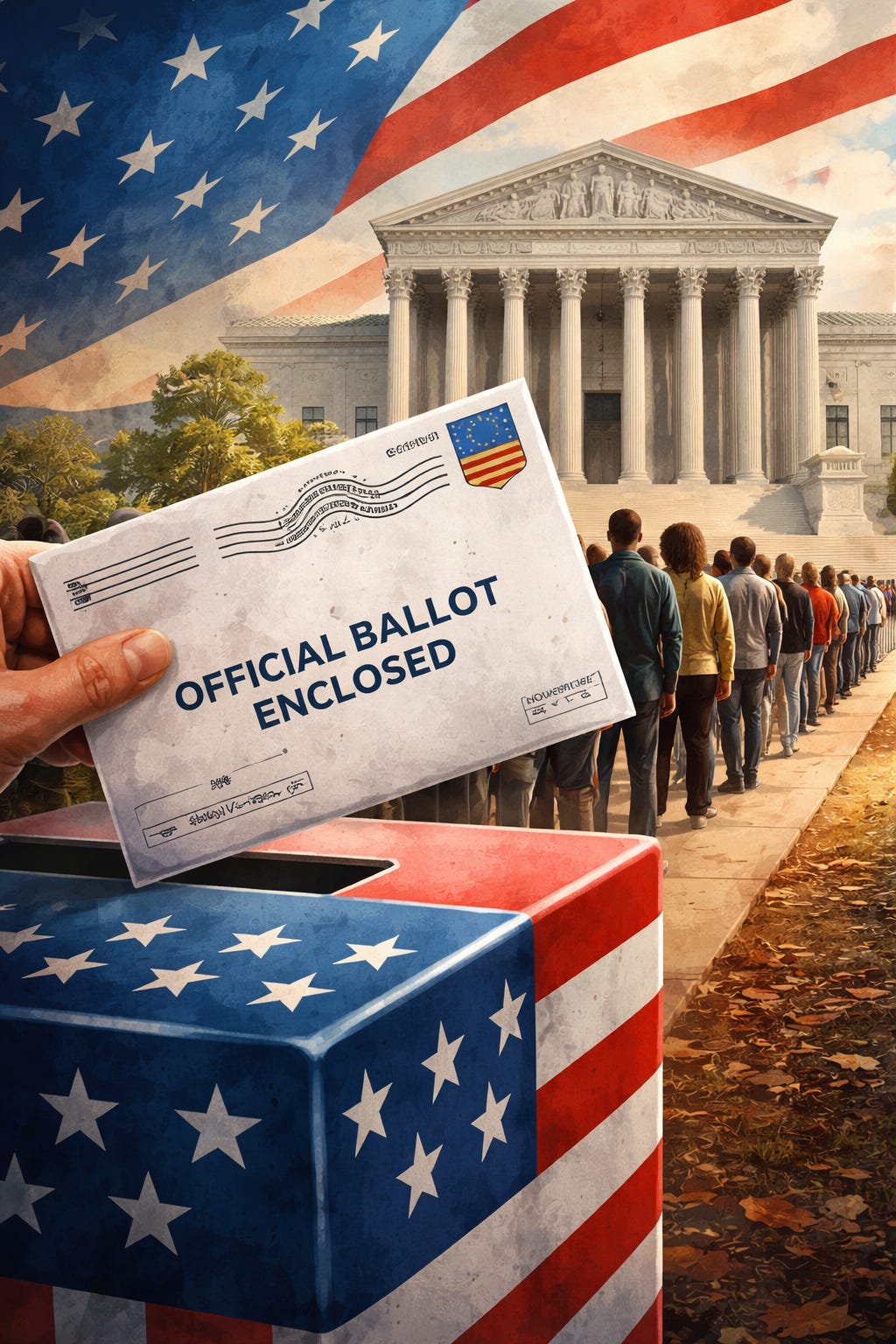
During oral arguments this week, the U.S. Supreme Court considered a challenge to Mississippi’s rule allowing mail ballots postmarked by Election Day to be counted if they arrive shortly afterward. On paper, the question is technical. What does federal law mean when it says “Election Day”? In practice, the stakes are far more concrete. If a voter did everything required by Election Day, should their ballot be discarded because of transit time beyond their control?
Reporting from the hearing suggests that several conservative justices are open to the argument that ballots must be received by Election Day to be counted. That reading would not only affect Mississippi. It could also upend long-standing rules in 14 states and the District of Columbia, all of which currently allow some form of post-Election-Day receipt for ballots mailed on time. The Court is deciding a legal question. The consequences, however, will be lived by voters.
This Community Is Powered by You
What started as a small circle has grown into something much bigger, and it’s all because of readers like you.
Every time you forward this email, post it on socials, or bring someone new into the fold, you’re helping build one of the most passionate, independent political communities out there.
Want to keep the momentum going?
Share this newsletter with someone who should be part of this conversation.
Thank you for being here. It means everything.
What States Actually Built
It is easy to talk about “grace periods” as if they were casual exceptions. They are not. States adopted these rules because they understood the limits of the systems voters rely on.
Consider Alaska. In many parts of Alaska, ballots do not travel by a simple, predictable route. They travel by plane, sometimes with multiple stops, and are often subject to weather delays that can extend delivery by days. The state allows ballots postmarked by Election Day to arrive up to ten days later. That is not a loophole. It is a recognition of geography.
Other states made similar calculations for different reasons. Some accounted for rural distances. Others accounted for known postal delays or administrative processing times. Still others designed their systems around the fact that certification already occurs days or weeks after Election Day. Across the country, the variation in deadlines reflects a basic reality. States tailored their rules to match how voting actually works where they live.
These systems are not theoretical. They have been used for years. States verify ballots, process them, canvass results, and certify elections on time. The presence of a short receipt window has not prevented them from completing their work. It has simply allowed them to count ballots from voters who complied with the rules, but depend on systems that are not instantaneous.
The Gap Between Law and Reality
At the center of this case is a quiet shift in definition. What does it mean to “cast” a ballot?
For voters, the answer is straightforward. For a mail-in ballot, a ballot is cast when it is placed in the mail or in the ballot dropbox by the deadline. That is the moment the voter completes their part of the process.
For the challengers in this case, the answer is different. A ballot is not fully cast until it is received by election officials. Under that view, the timing of the postal system becomes part of the voter’s responsibility.
That distinction matters because it transforms a system that measures voter compliance into one that measures delivery performance. A ballot postmarked by Election Day reflects a voter who followed the rules. A ballot received after Election Day, under a stricter interpretation, becomes invalid even if the voter acted on time.
The gap between those two definitions is not abstract. It is where real ballots are lost.
Who Pays the Price
A strict receipt deadline does not fall evenly across the electorate. It falls hardest on people with the least control over time, transportation, and access.
Disabled and homebound voters often rely on mail ballots because in-person voting is not feasible. Caregivers may not have the flexibility to stand in line or travel to a polling place. Rural voters face longer delivery routes and fewer nearby election resources. Shift workers and hourly employees may not be able to predict their availability on a specific day.
These voters are not marginal. They are part of the electorate that election systems are supposed to include.
Mail voting has functioned as a practical accommodation for these realities. It allows voters to complete their part of the process on time, even if the systems they depend on take longer to deliver the ballot. Removing that buffer does not create equal conditions. It exposes existing inequalities.
This Is Not Happening in Isolation
The stakes of this case become clearer when viewed alongside other changes in voting rules.
Across the country, states have expanded voter identification requirements, limited the availability of ballot drop boxes, and, in some cases, restricted assistance to voters waiting in long lines. In Texas, a recent primary in Dallas County forced voters to use assigned precincts rather than countywide vote centers, leading to confusion and voters being turned away from the wrong locations. In Georgia, state law limits the number and placement of drop boxes and prohibits the provision of food or water to voters waiting in line. Redistricting has made polling places more confusing. At the same time, the USPS announced last year that postmarks will now be applied upon first sorting, not upon receipt.
See our previous reporting here:

Each of these policies can be defended on its own terms. Yet taken together, they increase the friction involved in casting a ballot. They raise the cost of participation, particularly for voters who already face barriers.
Against that backdrop, a stricter federal rule on mail ballot receipt does not operate in a vacuum. It adds another point where a voter can comply with every requirement and still lose their vote.
Where Is the Evidence for the Tradeoff
The justification for tighter rules is often framed in terms of election integrity. Yet the public record does not show widespread fraud tied to late-arriving mail ballots.
Analyses of election data over multiple cycles have consistently found extremely low rates of fraud. Even organizations that track election fraud cases acknowledge that their databases represent a small and incomplete sample. The current Supreme Court case is not based on evidence that grace periods have resulted in systemic abuse, in part because the data doesn’t support it. It is built, instead, on a legal interpretation of federal statutes.
That matters because when a policy imposes new burdens on voters, the strength of the justification should be clear. In this case, the tradeoff is not between access and proven fraud. It is between access and a stricter reading of a legal phrase.
Access Versus Purity
There is no dispute that elections require rules. Deadlines exist for a reason. Results must be verified and certified. The question is how those rules should interact with the realities voters face.
States with postmark-based systems have answered that question in a specific way. They require voters to act by Election Day. The state then absorbs a limited amount of delivery uncertainty within its existing administrative timelines. That approach prioritizes the voter’s timely compliance while preserving the state’s ability to finalize results.
A strict receipt deadline prioritizes something else. It prioritizes a cleaner, more uniform endpoint, even if that means rejecting ballots from voters who followed the rules but encountered delays beyond their control.
That is why this debate can feel arbitrary from a human perspective. The voter did what was required. The system chose not to account for the rest.
What “Election Day” Should Mean
At its core, this case asks whether Election Day is defined by the voter’s action or by the system’s processing.
If Election Day is the day by which a voter must act, then a ballot postmarked on time reflects compliance. Counting that ballot, even if it arrives later, is part of administering the election.
If Election Day is the day by which the system must receive every ballot, then the burden shifts. The voter is no longer responsible only for their own actions. They are also responsible for the performance of the systems that carry their vote.
That shift may produce a simpler rule. It does not produce a fairer one.
The Stakes of the Decision
The U.S. Supreme Court is deciding a question of statutory interpretation, yet the outcome will shape who can effectively participate in federal elections.
If the Court adopts a strict receipt rule, states that have built systems around postmark deadlines will have to change them. Voters who have relied on those systems will face new risks. Some ballots that would have been counted will no longer be.
If the Court allows states to continue their current practices, the system remains imperfect. Mail will still be delayed at times, yet voters who act on time will have a better chance of being heard.
A Simple Principle
A representative democracy depends on more than rules. It depends on whether those rules allow eligible voters to participate in practice, not just in theory.
A ballot postmarked by Election Day shows that the voter followed the law. The remaining variable is transit. If a state can verify that the ballot, process it, and certify the election on time, rejecting it does not strengthen democracy. It narrows it.
States are already holding voters to Election Day. The question before the Court is whether they will now be held to the mail.
If you care about voting rights, election access, and how Supreme Court decisions shape real people’s ability to participate, consider subscribing.
I write about what’s happening in U.S. politics beyond the headlines, focusing on who is affected and why it matters.
Subscribe to stay informed and support independent, reader-focused analysis.
Sources:
Reuters — “US Supreme Court conservatives lean toward Republican bid to limit mail-in voting”, March 23, 2026
SCOTUSblog — “Justices seem ready to overturn state law allowing for late-arriving mail-in ballots”, March 23, 2026
Associated Press — “Supreme Court sounds skeptical of late-arriving ballots, a Trump target”, March 23, 2026
Votebeat — “The Supreme Court hears a challenge to counting mail ballots that arrive after Election Day”, March 23, 2026
Associated Press — “Many states count mail ballots that arrive after Election Day. Those grace periods could go away”, March 20, 2026
National Conference of State Legislatures — “How the New USPS Postmark Changes Could Affect Mail Voting”, January 15, 2026
Federal Register — “Postmarks and Postal Possession”, November 24, 2025
The reforms to the post office by Postmaster General Louis DeJoy, who resigned yesterday, made the post office slower and more inefficient. He removed sorting machines, which caused mail to be sorted by hand, a much slower, less accurate means of sorting. In addition he refused to pay overtime, so trucks, already delayed by sorting difficulties, had to stop delivery until the next day. In Atlanta, a letter that took previously two days to be delivered could take a week, since mail was sent to a new center which might send a letter to Alabama and then back to Georgia, delaying service. DeJoy had his own ambition to privatize the post office so his own company could compete. His mismanagement may continue to cast a destructive influence.
I unequivocally have absolutely no trust in the decisions coming out of the so-called supreme court of this country.