


On the morning after the first strikes on Iran, most Americans woke up the way we always do to big news now: half-formed push alerts, a few seconds of cable news over coffee, a flood of contradictory posts on social media.
Operation Epic Fury began in the early hours of Saturday, February 28, 2026, as a joint U.S.–Israeli campaign that killed Iran’s Supreme Leader and dozens of senior officials in a single day. Within 48 hours, a Reuters/Ipsos poll found that only about one in four Americans supported the strikes. A larger share opposed them, and nearly a third said they were unsure what to think.
That uncertainty is important. Into that fog of “What just happened?” and “Why now?” another story landed.
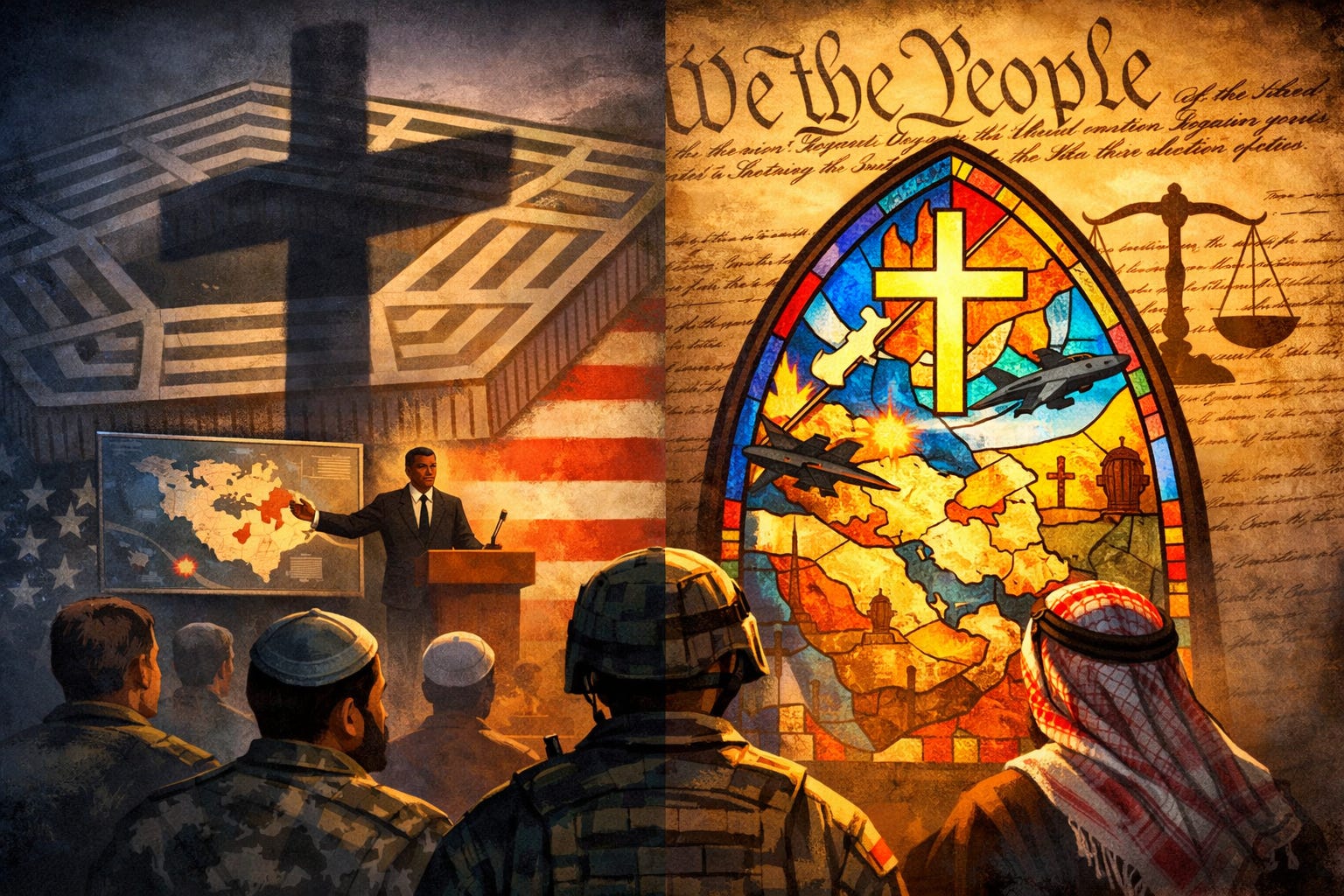
Service members began telling a watchdog group that some commanders were describing the new war in religious terms. Not just generic “God bless our troops,” but language about God’s divine plan and biblical end times. Within days, members of Congress were publicly asking the Pentagon to investigate.
For a plural, all-volunteer military that is supposed to fight for the Constitution, not a creed, that is not a small thing.
The question is how worried to be.
Two things may be true at once. Some of the panic is out ahead of the facts. Yet the complaints are serious enough, in this moment, to demand visible consequences for any commanders who crossed the line, a firm restatement of neutrality, and some dialing back from the man at the top of the department, Pete Hegseth, who has already pushed religious expression in official settings further than his predecessors.
This Community Is Powered by You
What started as a small circle has grown into something much bigger, and it’s all because of readers like you.
Every time you forward this email, post it on socials, or bring someone new into the fold, you’re helping build one of the most passionate, independent political communities out there.
Want to keep the momentum going?
Share this newsletter with someone who should be part of this conversation.
Thank you for being here. It means everything.
What Is Actually Being Alleged
In late February and early March, the Military Religious Freedom Foundation (MRFF) says it began receiving a wave of complaints from U.S. service members about the way some leaders were talking about the Iran campaign.
Military.com reported on March 3rd that more than 100 complaints had arrived between Monday and Tuesday alone. By the time of publication, MRFF said it had more than 200 complaints from across the services and from more than 50 bases.
The details are grim. According to those complaints, some officers and non-commissioned officers allegedly told troops that the war on Iran was “all part of God’s divine plan,” tied operations to biblical prophecy, or suggested that current events were fulfilling “end times” scripture.
On March 6th, Representative Julia Brownley and several colleagues released a public letter to the Defense Department. They requested a formal investigation into “alleged reports that military leaders claim war in Iran [is] part of biblical end-times prophecies,” calling the allegations “deeply alarming” and raising concerns about religious freedom and constitutional obligations inside the ranks.
At this stage, that is where we are. These are allegations and complaints, not yet the findings of an inspector general or a court-martial. The Pentagon has not released a comprehensive account.
However, this is not a single anonymous tip. It is a described pattern that has already triggered a formal request for investigation from multiple members of Congress. That alone makes it a story that deserves more than a shrug.
The Hegseth Factor
These complaints are not arriving in a vacuum. They are landing under a Secretary of Defense who has already chosen to make explicit Christian expression part of his public profile.
On May 21, 2025, Reuters reported that Hegseth led a “Secretary of Defense Christian Prayer & Worship Service” in the Pentagon auditorium. It was billed as a Christian service, not a generic non-denominational event. Hegseth told the audience he intended this to become a monthly gathering. His personal pastor from Tennessee led much of the worship, including prayers for Donald Trump by name.
The U.S. military has long allowed chaplain-led services of many kinds on bases. That is not new. What is new is the top civilian official in the building branding a recurring event around his office, his faith, and his pastor.
A few months later, on September 30, 2025, Hegseth addressed hundreds of generals and admirals at Quantico in a widely circulated speech used to announce the symbolic “return” of the War Department. In that speech, he praised the assembled officers as people who chose to “fight for God and country, for freedom and the Constitution.” Near the end of the same address, he described a commander’s prayer he had adopted as his own and said he had “prayed this prayer many times” since taking the job.
None of this proves that Hegseth ordered anyone to invoke Armageddon in a battalion briefing. It does something more subtle and, in some ways, more powerful.
It signals to the institution that overt Christian language is welcome from the top of the chain of command. It tells every subordinate commander that the boss is comfortable weaving his faith into official military rhetoric.
That is the context in which those Iran complaints are being heard. Even if Hegseth never uttered the phrase “holy war,” his own choices have changed the soundscape inside the building.
Personal Faith Versus Institutional Neutrality
It is worth stating clearly what this conversation is and is not about.
The issue is not whether a public official may be a person of faith. Hegseth is entitled to his beliefs. So are the officers writing the complaints, the soldiers sitting in those briefings, and the readers of this newsletter.
The issue is how faith is expressed and where it appears to attach to official purpose.
The First Amendment’s Establishment Clause bars the government from endorsing a particular religion. Inside the Defense Department, that principle is spelled out in policy. DoD Instruction 1300.17, the main guidance on religious liberty in the military, affirms service members’ rights to practice their religion or no religion at all, while adding a critical condition. Religious expression and accommodation must be balanced against “military necessity” and must not undermine mission accomplishment, readiness, unit cohesion, good order, or discipline.
That is the line. A commander may privately pray before a mission. A secretary may talk, in restrained ways, about how faith shapes his character. However, once leaders begin framing operations themselves as part of divine plans or biblical timelines in front of subordinates, they are no longer in the realm of purely personal expression. They are using the authority of their office to suggest that a particular religious interpretation is linked to the mission.
In civilian life, a boss who talks that way risks creating a hostile work environment. In the military, where commanders control evaluations, promotions, and assignments, the pressure can feel far less optional.
A Faith That Does Not Believe in Neutrality
One reason Pete Hegseth seems so at ease blurring the line between personal faith and official duty may lie in the particular church world he inhabits. The Communion of Reformed Evangelical Churches, the small but vocal denomination he has praised and promoted, stems from a dominion-minded Calvinist tradition that explicitly rejects the idea of a “neutral” public square. Its slogan, “All of Christ for All of Life,” is not just a devotional bumper sticker. It is a political program. In that theology, Christ is meant to rule every sphere of life, including law, education, and state power.
If you start there, hosting a “Secretary of Defense Christian Prayer & Worship Service” at the Pentagon or telling generals they fight “for God and country” does not feel like breaking norms. It feels like finally aligning a powerful institution with its supposed true purpose. The federal expectation of religious neutrality and the military’s own rules against using command authority to push a particular faith are not cherished guardrails. They are secular compromises to be overcome.
That does not mean there is a secret theocratic blueprint for the Iran campaign pinned up in the E Ring. It does mean that Hegseth’s theology makes him unusually comfortable in eroding the informal guardrails that once kept personal faith and official mission at an arm’s length. In a dominionist frame, the question is never whether the church’s vision should shape public life. The only question is how far its reach will extend. From that perspective, the U.S. military is not an exception. It is a prize.
Why This Iran War Feels Different
It is also important to acknowledge that this is not the first time Americans have heard religious overtones around Middle Eastern wars.
George W. Bush famously used the word “crusade” in a brief remark after 9/11, a choice the White House quickly walked back once it realized how it would sound in Muslim-majority countries. During the wars in Iraq and Afghanistan, there were controversies over Bible verses etched into rifle sights, over proselytizing by some officers, and over Christian songs played at official events.
What is different now?
Part of the answer really is the media ecosystem. In 2003, it was harder for a junior soldier to send a screenshot of a commander’s slide deck to a national outlet. Today, a watchdog group can receive an email, talk to half a dozen clients, and have a story up on Military.com in a day. Transparency and speed matter.
However, there are at least two other differences.
First, the public casus belli for this war is murkier.
In the Kuwait crisis, Americans saw Iraqi tanks roll into a neighbor. On 9/11, they watched planes hit the Twin Towers and the Pentagon in real time. Even critics of the later Iraq invasion usually concede that the initial Afghanistan campaign had a clear triggering event in the public mind.
This time, the opening salvo came as a surprise to many people. In the early hours of February 28th, the United States and Israel launched a massive strike that killed Iran’s Supreme Leader and other senior officials. The administration has since offered a shifting mix of reasons. Trump has framed the war as a way to “knock out” Iran’s missile and nuclear programs and to stand with Israel, while Senator Marco Rubio has emphasized a broader struggle against Iran’s regional influence. Their public explanations have not always lined up cleanly, and reporting from Capitol Hill says Pentagon officials told lawmakers there was no clear evidence that Iran was about to launch an imminent attack on the United States before the strikes. In that fog of mixed messages, many Americans were left unsure what specific threat justified killing another country’s leadership on a Saturday morning.
When the justification feels fragmented and shifting, people listen harder to other signals about what the war is “really” about. In that environment, hearing officers talk about God’s plan and end-times prophecy is not just offensive. It can sound like an attempt to provide a meaning for the war that the civilian leadership has not clearly and consistently supplied.
Second, we live in a political moment where white Christian nationalism is more visible and self-confident. Polling from the Public Religion Research Institute in recent years has found significant shares of white evangelicals and Republican voters endorsing explicitly Christian nationalist statements, such as the idea that the United States should be declared a Christian nation or that God intended America to be a promised land for European Christians.
In that context, the sight of the Secretary of Defense leading a branded Christian worship service inside the Pentagon, then telling senior officers they fight “for God and country,” lands differently than it might have in a more secular political moment.
The View From The Ranks
Imagine you are a Muslim captain whose unit has just been told that this war is part of God’s divine plan for the end times.
You know, on paper, that the military is supposed to be neutral about religion. You can probably quote the part of the briefing where someone said participation in any religious activity is voluntary.
Yet you also know that the person speaking controls whether you get a strong evaluation. You know that your peers just heard the same biblical framing you did. You know that in the country you serve, commentary shows and politicians have spent years painting Islam itself as a threat.
Do you feel fully safe in that room?
Maybe your immediate colleagues are consummate professionals who see you as a teammate first and last. That is true in many, maybe most, units. The U.S. military has a long record of bringing together people from very different backgrounds and forging them into functioning teams.
However, the fear that rhetoric like this might chip away at that trust is not irrational.
The U.S. armed forces include Christians from many denominations, Muslims, Jews, Hindus, Buddhists, Sikhs, atheists, agnostics, and others. They are supposed to be united by a shared oath to the Constitution and a shared mission, not by a shared theology. DoD policy explicitly says service members may practice religion “or observe no religion at all,” and that leaders have a responsibility to maintain unit cohesion and good order.
When commanders appear to tie the mission itself to a particular religious interpretation, it risks creating an in-group and an out-group. Some troops may quietly feel more licensed to harass or question colleagues whose faith does not fit the story being told from the front of the room. Others may simply withdraw, less willing to raise questions or dissent because they are not sure where the line between professional disagreement and religious defiance lies.
That is not paranoia. It is an understandable reaction in a hierarchy where leaders’ words carry real weight.
Norms Are Eroded Quietly
The danger here is not that the U.S. military has suddenly become an official crusader army. It has not. The danger is that uncorrected behavior shifts what people think is normal.
If Hegseth continues to use his office to host explicitly Christian worship services and to describe military service in overtly theological language, it becomes harder for the institution to tell a brigade commander that he cannot do something similar. If complaints about commanders invoking biblical prophecy are shrugged off, it becomes easier, next time, for someone to go a little further.
Norms do not usually shatter in a single moment. They decay through a series of signals that certain lines no longer matter. In a civilian workplace, that can mean more offensive jokes and fewer people speaking up. In a military, it can mean something deeper, a slow drift away from the idea that the mission is grounded in the Constitution and toward the idea that it is grounded in the will of a particular God as interpreted by particular leaders.
That is not a hypothetical risk in some far-off theocracy. It is a live concern in a country where a president and his allies now routinely describe themselves as engaged in a spiritual battle for the soul of the nation, and where many of his supporters explicitly embrace a Christian nationalist identity.
If you wait to act until someone says, on camera, “This is officially a holy war,” you have waited far too long.
Concern Without Conspiracy
So where does that leave us if we want to be serious rather than hysterical?
First, we should avoid claims that the evidence cannot support. We do not have proof that the Iran campaign is being run as a religious war. We do not have evidence that official orders from the top invoke scripture. We do not know how many commanders actually used improper language, or in what exact terms, until an investigation runs its course.
Second, we should not dismiss the moment as business as usual. The volume and speed of the complaints, the public letter from members of Congress, the reporting on explicitly Christian events led by the secretary himself, and the broader political context all make this more than a stray bad anecdote.
The most responsible stance is probably this. The concern is warranted. Panic is not. Conspiracy theories are not. The right response is institutional, not apocalyptic.
What Accountability Should Look Like
If we take constitutional neutrality, mission clarity, and unit cohesion seriously, then some next steps follow.
The Pentagon should investigate the complaints thoroughly and publicly state its findings. If leaders used their authority to frame the war as part of God’s plan or a biblical end-times prophecy in official settings, they should face consequences appropriate to their rank and the severity of their conduct. That is not because they are religious. It is because they misused their positions in ways that risked cohesion and violated long-standing norms.
The department should also use this moment to restate the basic principles out loud. Service members’ personal faith is protected. Participation in religious activities is voluntary. Official missions are justified by law, national security needs, and civilian policy, not by theology.
For his part, Pete Hegseth should be asked, and perhaps required, to dial back the ways he uses his office to promote his particular faith. He can pray as much as he wants in private. He can attend church. He can talk about his beliefs in personal terms. However, he should not continue to brand Christian worship services around the title “Secretary of Defense,” nor should he routinely present military service as explicitly “for God and country” in official addresses to the chain of command.
That is not an attack on his religion. It is a defense of the idea that the office he holds belongs just as much to Muslim, Jewish, Hindu, Sikh, atheist, and agnostic troops as it does to conservative Christians.
What The Military Is For
The United States can and should have fierce internal arguments about the wisdom, legality, and morality of this war on Iran. Those arguments are essential in a democracy, and this newsletter will certainly continue to have them.
At the same time, there is a narrower, crucial question that cuts across our usual partisan lines. Do we still agree that the U.S. military exists to defend the country and the Constitution, not to vindicate any one group’s religious story about history?
If the answer is yes, then we do not have to wait for the worst version of this story to come true before we act. We can insist, now, that commanders keep their religious framing out of official briefings. We can insist that the Secretary of Defense treat his personal faith as personal. We can insist that Muslim and Jewish and Christian and nonreligious service members alike hear, from the top, that they all stand on level ground in front of the mission. And we can insist on clear answers regarding the justification for this operation.
The danger here is not only what may already have been said. Rather, it is that it becomes normal if no one clearly says this is not what the American military is for. A plural force cannot be held together by sectarian cues. It has to be held together by law, by mission, and by a shared promise that the power of the state will not be harnessed to a single creed.
If this kind of slow, careful unpacking of a messy story is useful to you, we hope you’ll subscribe and share. Independent writing like this only survives when readers who care about democracy, civil-military norms, and basic decency decide it is worth backing.
Sources:
Military.com, “Military Officers Accused of Framing Iran War as Biblical Mandate” — March 3, 2026.
Cornell University – Media Relations, “End-times rhetoric in US military ‘didn’t infiltrate, was invited in’” — March 3, 2026.
Office of Rep. Julia Brownley, “Brownley and Colleagues Request Investigation into Alleged Reports that Military Leaders Claim War in Iran Part of Biblical End-Times Prophecies” — March 6, 2026.
war.gov, “Secretary of Defense Pete Hegseth Town Hall at the Pentagon” — February 7, 2025 (official transcript).
war.gov, “Secretary of War Pete Hegseth Addresses General and Flag Officers at Quantico, Virginia” — September 30, 2025 (official transcript).
Reuters, “US defense chief Hegseth leads Christian prayer service at Pentagon” — May 21, 2025.
Yahoo News (Reuters syndication), “Pete Hegseth’s ‘Incredibly Problematic’ Pentagon Event Promotes Christian Worship” — May 22, 2025.
Reuters, “US-Israeli strikes kill Khamenei and Iranian retaliation shakes Gulf – As it happened” — live blog, March 1, 2026 (covering initial February 28 strikes).
Reuters, “Just one in four Americans say they back US strikes on Iran, Reuters/Ipsos poll finds” — March 1, 2026.
Al Jazeera, “Poll suggests only a quarter of Americans support attacks on Iran” — March 2, 2026.
Reuters, “Pentagon tells Congress no sign that Iran was going to attack US first, sources say” — March 2, 2026.
Reuters, “Trump seeks to justify Iran war, but stated objectives shift” — March 2, 2026 (updated March 3, 2026).
Cornell Chronicle – Tip Sheets Index, listing “End-times rhetoric in US military ‘didn’t infiltrate, was invited in’” — March 3, 2026.
I am so sick of this BULLSHIT! Hijacking a religion for military and political reasons is just disgusting. Hopefully, as more and more people believe less and less in religion, this will backfire soon.
Christian Nationalism is not Christianity. Frank Zappa warned us decades ago about this. My ancestors came to "the new country" during the Holy Wars and started their own churches here in Pennsylvania. And now we have people in charge of our country who started their own Holy War and expect our children to fight against our beliefs. I hope soldiers choose not to follow illegal orders for this illegal war. We need to rid our government of the people who do not follow the law or the constitution or represent us. Religion does not belong in government.