


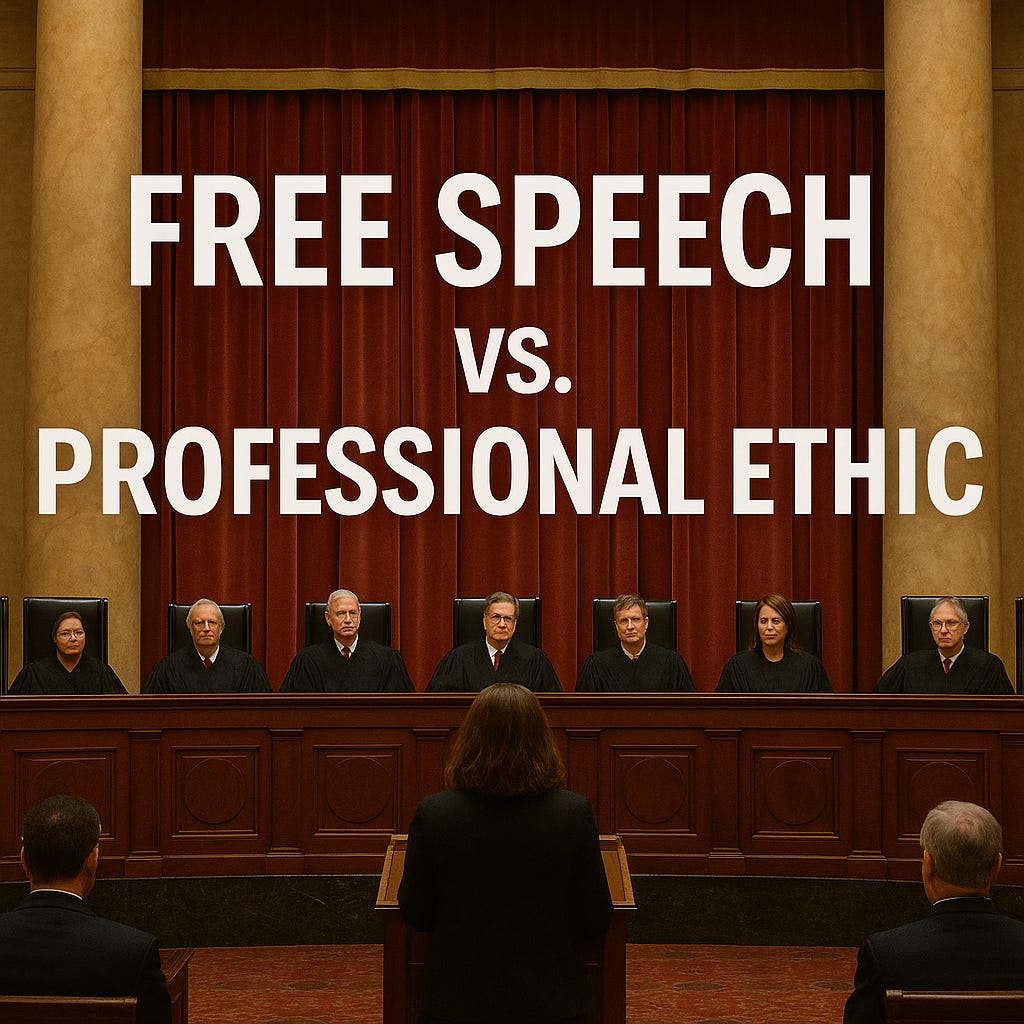
This week, the U.S. Supreme Court will hear oral arguments in Chiles v. Salazar, a case that hasn’t attracted the attention it deserves, but could quietly reshape the very foundation of how we understand professionalism in America.
The case involves a Colorado therapist, Kaley Chiles, who is challenging a state law that bans licensed mental health professionals from offering so-called “conversion therapy” to minors. The law reflects an overwhelming scientific consensus that trying to change a young person’s sexual orientation or gender identity is not just ineffective, but is actively harmful.
Every major medical and psychological association has rejected the practice. It’s not controversial among professionals. It’s not a matter of debate in the mental health field. It’s settled.
We just hit 20,000 subscribers, 1,000 articles, and 1,000 podcast episodes. To celebrate, paid subscriptions are 20% off for two weeks only. That’s just $64/year—less than $1.25 a week.
The Argument: Speech Over Ethics
However, Chiles isn’t arguing that conversion therapy is medically sound. She’s not presenting new research. Her claim concerns the First Amendment, specifically, that she has a constitutional right to provide this therapy because it constitutes a form of speech.
She’s essentially saying: It doesn’t matter if my methods are unethical. I have the right to defy professional ethics in favor of my own beliefs.
And that’s what makes this case so dangerous.
The Stakes: Every Licensed Profession Could Be Affected
The question before the Court isn’t just about therapy. It isn’t even, at its core, about LGBTQ+ rights or conversion therapy. It’s about whether any licensed professional — in any field — can ignore their profession’s ethical standards under the banner of free speech.
If Chiles wins, the precedent could allow:
A doctor to refuse treatment to an individual patient based on “moral beliefs”
A pharmacist to deny birth control, HIV meds, or other prescriptions due to religious opposition
A teacher to promote discriminatory views in the classroom
A librarian to remove or refuse to purchase books because of personal objections
All could be justified not as ethical decisions, but as “viewpoint-protected speech.”
Chiles has the right to her beliefs. She has the right to serve clients informed by those beliefs. What she does not have is the right to put an entire profession’s ethics at risk in the process.
She can be a licensed therapist and adhere to the standards associated with that title.
Or she can become a spiritual advisor and speak from her convictions outside the bounds of clinical ethics.
But she cannot do the latter while claiming to be the former.
Justice Jackson stated, “I understand if Ms. Chiles here were writing an article about conversion therapy or writing or giving a speech about it. I’m just trying to understand how the First Amendment protects that doctor from providing therapy that is outside the standard of care.”
The Parallel: Ethics Under Attack in Libraries
While this case is centered on therapy, the reverse dynamic is unfolding in libraries and schools, where professionals are being punished not for pushing ideology but for adhering to ethical standards.
Across the country, public librarians are being accused of “grooming” for including age-appropriate, diverse, LGBTQ+, or medical books in collections. These professionals follow national ethical guidelines and curate materials for diverse communities, not personal agendas. They select based on community need and interest rather than individual beliefs.
Yet they’re being harassed, fired, and doxxed.
Meanwhile, in this Supreme Court case, a therapist is seeking legal protection to use her license to push a discredited and harmful ideology. One profession is punished for doing its job. The other is defended for refusing to do theirs.
The Bigger Question: Do Professional Ethics Still Matter?
The real danger here isn’t just what happens to conversion therapy laws.
It’s what happens to the very idea of professionalism. Ethical codes exist for a reason: to protect the public. They ensure that care, treatment, education, and information are grounded in evidence, not ideology.
If the Court rules in favor of Chiles, it sends a clear signal: Personal belief can override ethical obligation.
That’s not just a blow to LGBTQ+ protections. It’s a blow to medicine, mental health, public education, libraries, and any field that requires its professionals to serve the public, not their own ideologies.
This Isn’t a Slippery Slope. It’s a Landslide
This case may have started in a therapist’s office, but it won’t end there. If professional speech is untouchable, then we are no longer serving the public. We’re protecting belief systems over public safety, science, and trust.
We should all be paying attention.
Stay Informed. Stay Loud.
Subscribe to The Coffman Chronicle for no-BS political analysis, action guides, and daily truth bombs you won’t get from corporate media.
Sources:
SCOTUS Appears Poised to Strike Down Conversion Therapy Bans. Here’s What We Know From Opening Arguments — Them
Supreme Court Seems Skeptical of Colorado’s Ban on Conversion Therapy — Politico
Christian Group ‘Deceived’ Supreme Court About LGBTQ+ Research, Cited Scholars Say — The Guardian
Christian Therapist Seeks Right to Counsel Gay Teens to Change Attraction — The Washington Post
Supreme Court’s ‘Trans Therapy’ Case Is a Free‑Speech Slam Dunk — That Will Save Lives (op ed) — New York Post
US Supreme Court to Hear Challenge to Colorado Ban on Gay ‘Conversion Therapy’ — Reuters
Chiles v. Salazar: What You Need to Know — The Trevor Project
Chiles v. Salazar — (10th Cir. decision) Justia Law
The Supreme Court Fights Over Whether Medical Expertise Actually Exists — Vox
SCOTUSblog: Supreme Court Takes Up Challenge to Colorado Ban on “Conversion Therapy” — SCOTUSblog
SCOTUSblog: Does Colorado’s “Conversion Therapy” Ban Violate Free Speech? — SCOTUSblog
Chiles v. Salazar — Constitutional Accountability Center
Colorado Attorney General Defends Ban in Brief — Colorado Newsline
Chiles v. Salazar — GLAD Law
How This Week’s Supreme Court Case on Conversion Therapy Works — STAT
Supreme Court Wrestles With Colorado Counselor’s Challenge to “Conversion Therapy” Ban — CBS News
Petition for Writ of Certiorari, SCOTUS File (PDF) Supreme Court
Banning Harm Without Harming Speech: Alternatives to Broad Professional Speech Regulation — Missouri Law Review
First Amendment & Conversations Between Counselors and Clients — J Am Acad Psychiatry Law

Going back to the Middle Ages. Just the thought of it makes me furious. Kaley Chiles, what an ignorant and stupid person! It's just disgusting.
I’m a retired home health psych RN so I definitely have my biases as far as the therapist is concerned. There are proven problems with trying to change a person’s orientation, especially if the person is a child and the person has no desire to change or this is initiated by a parent or the therapist. A therapist has no right to impose their views on their clients, esp children, this can involve a lot of guilt and having seen the results of some of this “therapy” when working in a locked adolescent unit, not only can I definitely not condone it, but I think that therapist should be sued from here to eternity. It’s highly unethical. The question of banning books, while I don’t believe in it, should be up to the parents alone, not the schools. Kids are able to find books that are “banned” and the parents should have the total responsibility of taking to their child about why they prefer their kid avoid it. It should not be the responsibility of the schools, no one should be talking to another’s child about their reading, period. But serious psychological damage can be done to a person with “conversion therapy” and that is truly immoral, that person is no “therapist” but is trying to force her values on someone else. That is not therapy, it’s indoctrination, and that makes nobody feel better.