


Iranian asylum seekers came to the United States asking for protection from the Iranian government. A federal lawsuit filed Tuesday alleges the Trump administration then gave Iranian officials confidential information about some of those asylum seekers, allowed Iranian representatives to meet with detainees in U.S. immigration custody, and pressured some to agree to return to the country they said they feared.
The Department of Homeland Security denies that Immigration and Customs Enforcement, or ICE, shared asylum application records with Iran. While the allegations have not been proven in court, the lawsuit will test what information was shared, who authorized it, and what happened when Iranian detainees met with officials representing the government they had asked the United States to protect them from.
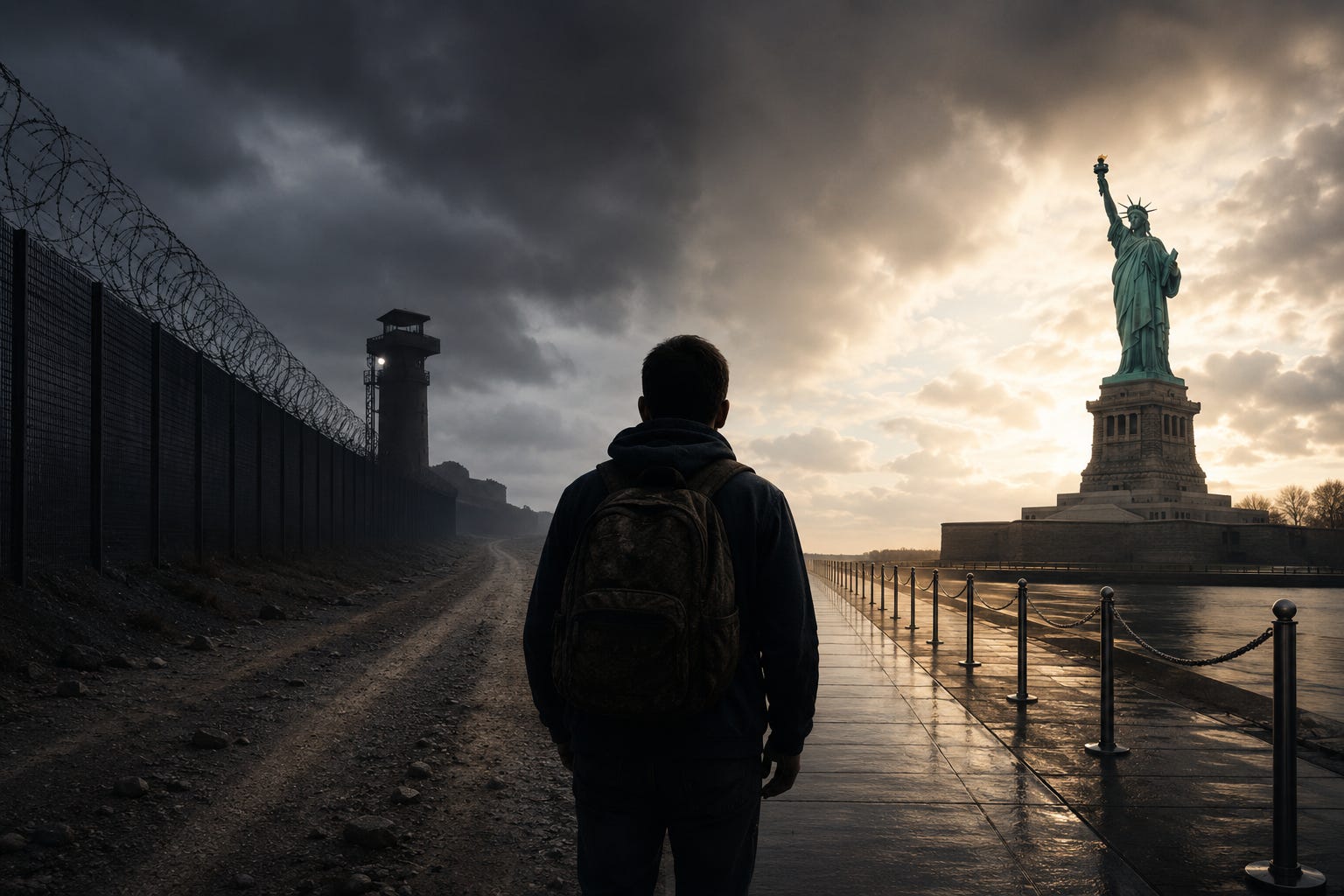
It also exposes a more fundamental vulnerability in the American immigration system. The asylum process requires people fleeing persecution to trust the United States with information that could place them in greater danger if it reaches the government they fled.
This Community Is Powered by You
What started as a small circle has grown into something much bigger, and it’s all because of readers like you.
Every time you forward this email, post it on socials, or bring someone new into the fold, you’re helping build one of the most passionate, independent political communities out there.
Want to keep the momentum going?
Share this newsletter with someone who should be part of this conversation.
Thank you for being here. It means everything.
What the lawsuit alleges
The Iranian American Legal Defense Fund filed the lawsuit Tuesday in federal court in Washington, D.C., represented by Public Citizen Litigation Group. The complaint names senior Trump administration officials and accuses the government of violating federal asylum confidentiality rules by sharing protected information about Iranian asylum seekers with representatives of Iran.
According to the complaint, U.S. officials began meeting with Iranian representatives in March 2025 to discuss Iranian nationals held in immigration detention and potential removals. The United States and Iran do not maintain formal diplomatic relations, so Iranian consular functions in Washington are instead handled through Iran’s Interests Section at the Embassy of Pakistan.
At the first meeting, the lawsuit alleges, U.S. officials provided Iranian representatives with a list containing the names of about 150 Iranian nationals. The complaint says subsequent meetings occurred approximately once a month and that federal officials provided additional immigration records concerning Iranian detainees.
The lawsuit further alleges that those records went beyond the identifying information normally needed to verify nationality or to obtain travel documents for deportation. According to the complaint, officials shared information connected to applications for asylum and other forms of protection. The affected people allegedly included political dissidents, participants in pro-democracy protests, religious minorities, converts to Christianity, and LGBTQIA+ individuals.
The complaint also claims that ICE gave Iranian officials access to detainees inside immigration facilities. Some of those detainees did not consent to the meetings, according to the lawsuit, but were required by ICE to attend.
Several detainees reported that Iranian representatives appeared to know details about their immigration cases that they believed they had disclosed confidentially to the U.S. government. The complaint also claims that American and Iranian officials worked together to pressure some detainees to abandon legal rights and agree to return to Iran without assurances for their safety.
More than 100 Iranians were subsequently returned on several deportation flights, according to the complaint. The lawsuit asks the court to stop further unlawful disclosures, identify people whose information may have been compromised, notify them, and appoint an independent monitor to review the government’s compliance with asylum confidentiality rules.
DHS has categorically denied the central allegation. The department says that claims that ICE shared asylum application records with the Iranian government are false. DHS has also pointed to the rights of detained foreign nationals to communicate with consular representatives.
Those ordinary functions create the factual dividing line at the center of the case. Contacting a foreign government to verify a person’s identity can be a routine part of removal. Giving that government information connecting an identifiable person to an asylum claim is governed by federal confidentiality rules.
The lawsuit alleges ICE crossed that line.
The secrets an asylum seeker must tell
Imagine you are an Iranian political dissident who has reached the United States, and you say the Iranian government will imprison, torture, or kill you if you are forced to return. That assertion alone is not enough to receive asylum.
The United States needs to know why you, specifically, face persecution. An asylum officer or immigration judge may need to understand what protests you attended, whether you helped organize them, what you said publicly, and who worked alongside you. You may be asked about arrests, interrogations, threats, or violence. If your claim involves religious persecution, you may need to discuss your beliefs or conversion. If you fear persecution because you are gay or transgender, you may have to disclose an identity you spent years hiding to stay alive.
The questions are intrusive because the government has a legitimate responsibility to evaluate the claim. Asylum is a legal protection for people who meet specific standards, not a general finding that conditions in another country are dangerous. The system needs enough information to distinguish between someone who qualifies for protection and someone who does not.
An asylum application can therefore become one of the most detailed dossiers a political dissident will ever create about themselves, and thus, the most potentially dangerous.
Federal law recognizes the danger contained in that information. Under a regulation known as 8 C.F.R. § 208.6, information connected to asylum and certain related protection claims is generally confidential, subject to specific exceptions. The protection extends beyond a copy of the asylum application itself. Government guidance has recognized that disclosure can be dangerous when it links an identifiable person to an asylum claim, reveals allegations made in that claim, or gives someone enough information to reasonably infer that the person sought asylum.
The reason is not difficult to understand. A government accused of persecuting its citizens may retaliate against someone who reports that persecution to the United States. Family members and associates who remain in the country may also face consequences.
Confidentiality is therefore more than an administrative privacy rule. It is part of the infrastructure that allows the asylum system to function.
The United States asks people seeking protection to tell the truth, including truths they may have kept secret to survive. The system works only if they believe the government receiving those secrets will protect them.
When protection creates a new danger
Imagine being that Iranian dissident. You have told ICE what you did, what happened to you, and why you are afraid. You may have identified political activities that the Iranian government did not fully know about, and discussed people who helped you, described interrogations, or accused government officials of violence.
Then, while detained by the country you asked for protection, you are brought into a meeting with a representative of Iran, and the official knows who you are. According to the lawsuit, some detainees believed Iranian representatives knew additional information they had disclosed during the American immigration process.
Consider what changes in that moment. Iran may now know you sought protection in the United States. Its representatives may even know what you told American officials about your actions and those of your government. Your family and friends may still live in Iran. Even if you are never deported, people you love may remain within reach of the state you accused of persecuting you.
A threat does not always need to be spoken aloud. Sometimes the information in another person’s possession is enough to change the choices available to you.
The lawsuit then alleges that U.S. and Iranian officials pressured detainees to agree to return to Iran. We do not yet know precisely what that pressure involved or what detainees may have been asked to sign, withdraw, or waive. Those details will be instructive.
The setting is essential to this thought experiment. Consent given freely is different from consent given in detention after an official from the government you fear appears to know information you believed was confidential. A person in that position may reasonably conclude that the danger has already changed. Iran knows who they are. Iran may know they talked. Refusing to cooperate could feel like another risk whose consequences will not become clear until after they return. There may even be threats against your loved ones if you refuse.
Asylum law can account for circumstances that arise after a person leaves their country when those new circumstances increase the danger of persecution. The concept is sometimes called a sur place claim. The principle is straightforward. The risk facing someone upon return is not frozen on the day they fled.
That raises an uncomfortable question in this case. If the United States disclosed information that increased an asylum seeker’s danger, did the government reassess that new danger before returning the person to Iran?
More than 100 Iranians have already been deported, according to the lawsuit. We do not know what has happened to each of them. We also do not yet know whether any danger they face today is greater than it was before they asked the United States for protection.
What if hiding feels safer?
Imagine you have not yet reached the United States. You are a political dissident considering whether to seek protection from America. Perhaps you are Iranian. You may be a Russian who opposed the war in Ukraine, a Venezuelan opposition organizer, or someone who is gay in a country where your government considers your existence a crime.
The formal asylum system asks you to identify yourself. It may collect your fingerprints, review identity documents, examine your history, and ask for a detailed account of the persecution you fear. You may need to provide information about your family, political activity, religious beliefs, or personal relationships.
Normally, cooperation makes sense. The United States needs that information to evaluate your claim, conduct security screening, and decide whether you qualify for protection.
Then you hear what is alleged to have happened to Iranian asylum seekers in American custody. Perhaps the reports are incomplete. Perhaps the Department of Homeland Security’s denial is correct. Perhaps the lawsuit ultimately fails to prove that protected information was shared.
Does someone hiding from an authoritarian government gamble their life on perhaps?
The alternative is to avoid the formal system. Do not give the government your name. Do not provide your political history. Do not explain why you are afraid. Find another way into the country and try not to be detected once you arrive. While that choice will violate immigration law, it may also feel safer.
This is one of the dangers of losing trust in an immigration system. The government has not necessarily deterred the migrant. It may have taught the migrant to hide.
The asylum process depends on people voluntarily identifying themselves to the government. From a basic state-capacity perspective, that is useful. The United States wants to know who is entering the country.
People who believe the system will protect sensitive information have an incentive to cooperate. People who believe cooperation could expose them or their families to danger have an incentive to conceal as much as possible.
The consequences can compound inside the asylum process itself. An applicant who withholds political activities, relationships, or past experiences out of fear may present a claim that appears vague or inconsistent. The government receives less information and becomes less able to evaluate the case accurately. A person with a legitimate fear of persecution may undermine their own claim by withholding the very facts that would prove it.
The Iran lawsuit concerns asylum, an unusually high-stakes part of immigration law because mishandled information can place lives at risk. The broader immigration system has struggled for years with backlogs, staffing shortages, delayed hearings, limited access to interpreters, and a legal process that is difficult to navigate without specialized help.
Those failures do not all carry the same danger as an alleged breach of asylum confidentiality. They do create the same basic institutional problem. A government that wants people to use lawful processes must make those processes functional enough to use and trustworthy enough to approach.
When the formal system becomes too slow, unpredictable, or frightening, some people will decide not to enter it. They still have to go somewhere.
The route becomes more dangerous
The person who decides to avoid the formal system still needs a way to reach safety. That may mean the back of a truck, the cargo hold of a plane, an overcrowded boat, or a walk through a desert where temperatures can kill within hours. It may mean paying a smuggler thousands of dollars and trusting a stranger whose financial interest begins with collecting the money, not ensuring everyone survives the journey.
Reports of trucks packed with people, migrants abandoned without food or water, and bodies found after exposure to extreme heat have been a recurring part of the news. Repetition can turn almost anything into background noise, but these deaths should not become ordinary.
In 2022, 53 migrants died after dozens of people were packed into a tractor-trailer found near San Antonio. The trailer had no functioning air conditioning. Prosecutors said migrants had paid as much as $15,000 to the smuggling network responsible for moving them into the United States.
Stronger enforcement can deter people from attempting to enter a country. It does not deter everyone equally. Someone migrating primarily for economic opportunity may decide the cost or danger has become too high. Someone who believes staying home could mean imprisonment, torture, or death faces a different calculation. Making the journey more dangerous does not necessarily make remaining in place safer.
Some people will still leave. The routes then adapt. Migrants learn where they were previously caught. Smugglers learn where enforcement is concentrated. A second attempt may use a more remote crossing, a more concealed vehicle, or a criminal organization with the resources to move people around surveillance and checkpoints.
Each adaptation can create new risks. More remote routes mean greater exposure to heat and dehydration. Concealed transportation can become deadly when people are packed into spaces without ventilation. Migrants who depend on criminal networks may face extortion, kidnapping, assault, or abandonment when they become injured or slow the group down.
The legal and illegal pathways do not exist in separate worlds. When the regulated route becomes inaccessible, untrustworthy, or frightening, circumventing it becomes more valuable. Smugglers sell that circumvention.
None of this excuses the people who intentionally place migrants in lethal conditions. A person who locks human beings in an overheated trailer or abandons them in the desert bears responsibility for those choices. Government policy still has to account for the environment in which those choices occur.
The risk to human life may be difficult to place on a budget sheet, but it remains real. A functioning immigration system should seek to reduce that risk. It should also recognize a practical reality. Every person frightened away from identifying themselves to the government becomes someone the government may later spend considerably more time and money trying to find.
Order requires a system that works
The United States can encounter the same person more than once. Each encounter may require immigration officers, detention space, transportation, court proceedings, interpreters, lawyers, coordination with foreign officials, and eventually a deportation flight. If the person believes returning home remains more dangerous than another attempt to enter the United States, the process may begin again.
That is not an efficient use of government resources. It is churn. As of May 2026, more than 3.2 million cases remain pending in U.S. immigration courts. Of those, upward of 2.3 million are asylum claims. People in the backlog had already waited an average of about 2.4 years for resolution. For asylum applicants, the average wait until a hearing was scheduled was nearly 4.8 years.
A functional immigration system should give people reasons to identify themselves once. The government can conduct security screening, evaluate legal claims, and reach an accurate decision within a reasonable amount of time. Those who qualify for asylum or another legal status can remain. Those who do not can receive a timely final decision and, where the law permits, be removed.
Reaching that point requires resources and consistent investment. Immigration judges, asylum officers, interpreters, legal orientation, administrative staff, and modern case management are sometimes discussed as though they are concessions to immigrants, but they are the operating infrastructure of a government that wants to know who is entering the country, why they are here, and whether they have a legal right to remain. The process must operate in a timely and efficient manner to consistently maximize its use.
The problems extend well beyond asylum. Families, workers, employers, and people facing removal can spend years navigating an immigration system burdened by backlogs and administrative delays. Asylum adds another reason institutional competence matters. The information needed to evaluate a protection claim can put someone or their family in danger if mishandled.
For now, the allegations involving Iranian asylum seekers have not been proven, and DHS denies that ICE shared asylum application records with Iran. A federal court may eventually determine what information changed hands and whether the government violated its own confidentiality rules.
The reputational damage may be harder to contain. A political dissident considering whether to seek protection in the United States is unlikely to study the eventual court docket. That person has a simpler decision to make. Is coming forward safer than hiding?
The United States should want the answer to be yes. It should want people to provide their names, submit to screening, explain their claims, and appear for proceedings. Once people decide the government itself is safer to avoid, the system loses legitimacy. Smugglers gain customers, and dangerous routes become more valuable. Taxpayers fund the effort to find people who might once have voluntarily identified themselves.
An asylum system that people trust is not a concession to illegal immigration. A properly resourced immigration system is not an alternative to border security, which is designed to prevent the entry of those ineligible for the regular system. Both are part of creating order.
The safest system is one that people are not afraid to use.
Immigration debates are often reduced to slogans about open borders or mass deportation. The systems underneath those arguments are more complicated, and their failures have real consequences for taxpayers, public safety, and human lives.
If you value political commentary that follows the facts, examines how government systems actually work, and asks what happens after the talking points end, subscribe to keep reading.
Sources:
“Complaint in Iranian American Legal Defense Fund v. Rubio,” Public Citizen Litigation Group, July 7, 2026.
“Lawsuit alleges US shared information with Iran about asylum seekers, US denies allegation,” Reuters, July 7, 2026.
“Lawsuit says US illegally shared confidential information on Iranian asylum seekers with Iran,” Associated Press, July 7, 2026.
“8 CFR § 208.6 — Disclosure to third parties,” Electronic Code of Federal Regulations, current as of July 8, 2026.
“Federal Regulation Protecting the Confidentiality of Asylum Applicants,” U.S. Citizenship and Immigration Services.
“Immigration Court Quick Facts,” TRAC Immigration, May 2026 data.
“DHS Doubles New Immigration Court Removal Filings,” TRAC Immigration, May 6, 2026.
“Immigration Courts: Actions Needed to Address Workforce Planning and Performance Assessment,” U.S. Government Accountability Office, April 26, 2023.
“Immigration Courts: Actions Needed to Address Workforce Planning and Performance Assessment,” U.S. Government Accountability Office, October 18, 2023.
“4 arrested for 2022 tractor-trailer smuggling incident that resulted in 53 deaths,” U.S. Immigration and Customs Enforcement, January 24, 2025.
“Two men found guilty in smuggling conspiracy where 53 immigrants died in a hot tractor-trailer,” Associated Press, March 19, 2025.
“Border Walls and Death on the US–Mexico Border: A Hot-Spot Analysis of the Impact of the Secure Fences Act in Arizona,” The Center for Growth and Opportunity, 2025.
“Offering more lawful pathways for US border crossings reduces unlawful crossings,” Peterson Institute for International Economics, April 18, 2024.
Who are you going to believe as to leaked confidential information: foreign nationals seeking asylum or the United States government? The answer is simple: It has been proven that the Trump administration and ICE lie about everything.
All part of Trump’s plan… blow the place up, cozy up with the damaged regime, get US taxpayers to pony up $300 million for reconstruction, find some nice desert property and build luxury resorts for the rich and famous. Like the Trump Riviera in Gaza.