


The 11 Who Never Stood Trial
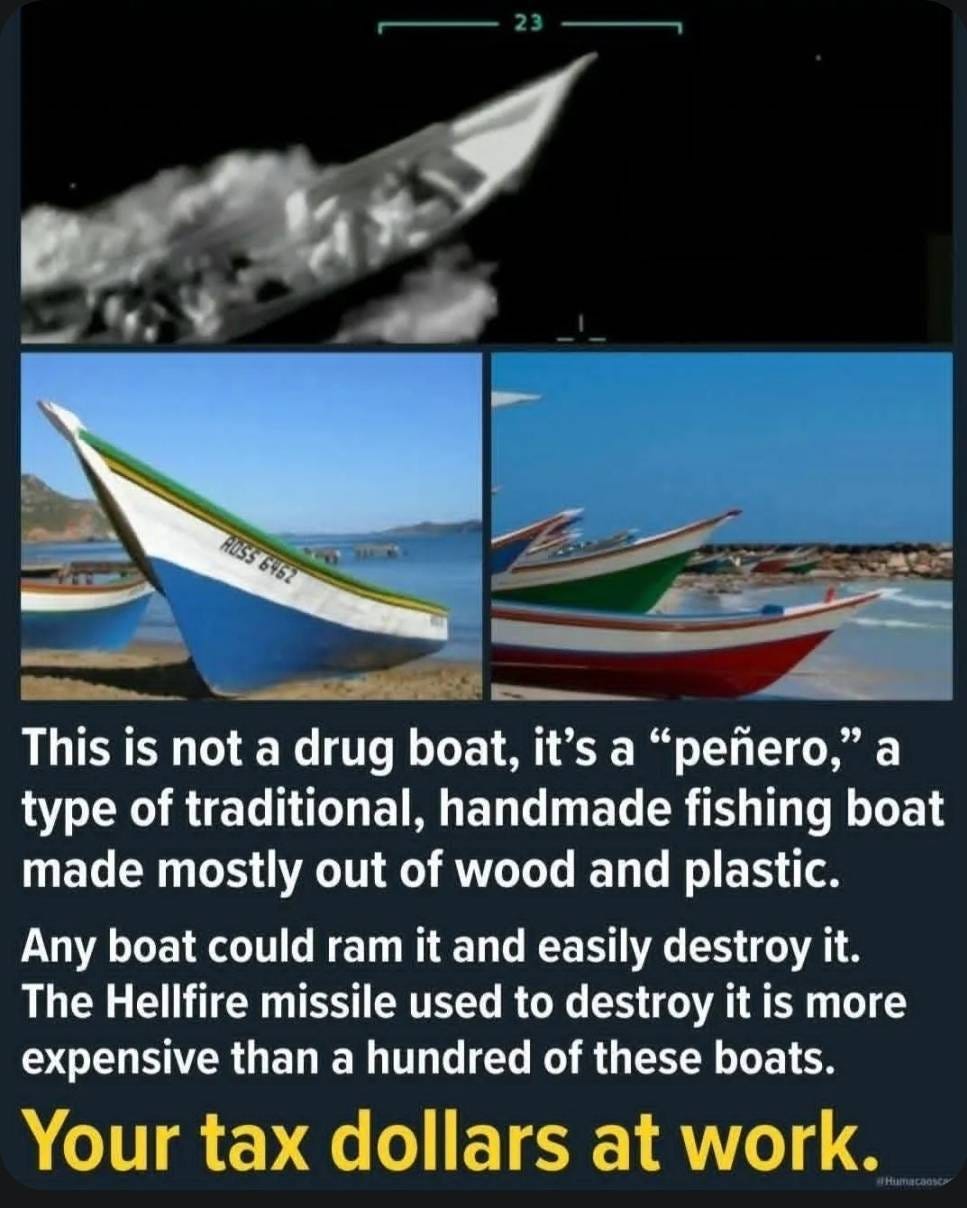
On September 2, 2025, in the waters of the southern Caribbean, a U.S. Navy aircraft unleashed firepower on a small vessel. Within seconds, it was gone, splintered and sinking beneath the waves. Eleven people were killed. None survived. None were captured. None were brought before a judge.
The Trump administration insists those eleven were “narco-terrorists,” smugglers tied to Venezuela’s infamous gang Tren de Aragua. Defense Secretary Pete Hegseth called the strike “a message that will not be misunderstood.” Vice President J.D. Vance praised it as “the best use of our military in decades.” And President Trump, never one to downplay violence, broadcast video of the strike with the promise: “There’s more where that came from.”
But outside of White House talking points, the truth is unknowable. The wreckage lies at the bottom of the sea. The dead cannot defend themselves. No drugs were seized, no weapons recovered, no identities verified. The only evidence we have is the government’s word and its carefully edited footage of an explosion.
This is not how maritime drug cases normally unfold. Smugglers caught in the Caribbean are usually intercepted by the U.S. Coast Guard, their boats searched, their cargos photographed and logged, their crews shackled and flown to Florida to face charges under U.S. law. Trials are held, convictions are won, sentences are handed down. Evidence builds legitimacy.
Here, legitimacy sank with the vessel. And the haunting question remains: who, exactly, did the United States kill? Fishermen pressed into service? Desperate migrants? Low-level gang recruits? Or truly the hardened narco-terrorists Trump describes? We will never know because they never stood trial. To answer that question, we need to examine how this strike unfolded.
Stay Informed. Stay Loud.
Subscribe to The Coffman Chronicle for no-BS political analysis, action guides, and daily truth bombs you won’t get from corporate media.
The Strike Itself: A Break from the Norm
The operation was swift and unprecedented. In the early hours of September 2, U.S. Navy assets tracked what officials described as a “go-fast” boat operating in international waters south of the Caribbean. Instead of the standard Coast Guard interdiction—hailing the vessel, ordering it to stop, then boarding to search for contraband—an aircraft from the Navy’s strike group opened fire. Within moments, the target was destroyed. Eleven on board were killed.
This was not a seizure. It was not an arrest. It was an annihilation.
The White House wasted no time in turning the event into a spectacle. That same evening, President Trump released grainy footage of the explosion during a campaign-style rally, declaring, “America doesn’t play games anymore. There’s more where that came from.” The crowd roared as the fireball lit up the screen behind him.
Secretary of Defense Pete Hegseth followed up with blunt confirmation: “This wasn’t training. This was war. We sent a clear message: if you traffic drugs in our waters, you will not return home.” Vice President J.D. Vance echoed the line, casting the strike as proof that the administration was taking the fight directly to the cartels.
But behind the rally screens and fireball footage lies a deeper problem: there is no evidence to support the government’s story.
What Evidence? The “Narco-Terrorist” Label
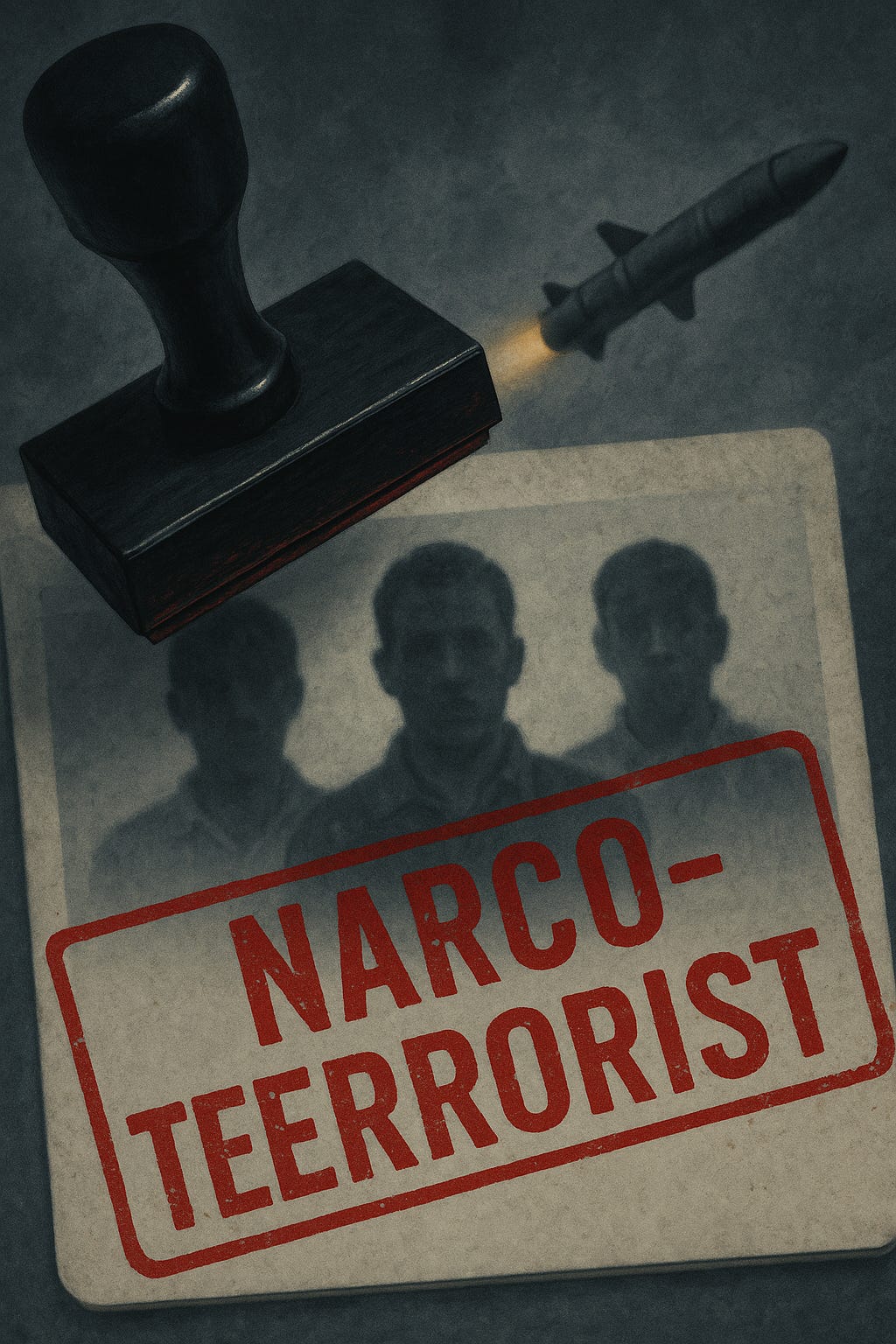
The case against the eleven men killed rests on a single word: narco-terrorist. It’s the phrase the administration repeats in every press conference, every media hit, every campaign stop. It’s meant to sound decisive and indisputable, conjuring images of men with rifles, cocaine-packed hulls, and blood on their hands.
But where is the evidence?
In a typical maritime interdiction, the Coast Guard boards the vessel, seizes the cargo, photographs every bale, logs GPS coordinates, and detains the crew. Those records form the backbone of prosecutions that unfold in U.S. courts under the Maritime Drug Law Enforcement Act. Even when the defendants are foreign nationals picked up in international waters, they are tried before American juries, with a substantial amount of evidence presented.
This time, there will be no evidence. The boat was reduced to debris. Its crew was reduced to casualties. The only “proof” of guilt is classified intelligence that the administration refuses to release.
Legal experts are raising alarms. Was the boat actually carrying drugs? Were its occupants armed? Were they even members of Tren de Aragua, or just hired hands trying to make a dangerous crossing? By destroying the vessel rather than seizing it, the U.S. government ensured those questions will never be answered.
And that, critics argue, may have been the point. Label them terrorists, erase the bodies, show the explosion on television, and the public is left with a narrative that can’t be disproven. Evidence was once the standard of justice. Now, it seems, a presidential decree and a strike video are all that is needed. To see just how far this departs from the norm, look at how America has always handled drug cases at sea.
Data Receipts: How It’s Always Been Done
For decades, the U.S. war on drugs at sea has followed a familiar pattern: chase, board, seize, arrest, prosecute. The Coast Guard, often working in conjunction with Navy support, has established a record that is both aggressive and meticulous.
Take fiscal year 2023 alone. The Coast Guard reported interdicting more than 200 vessels, seizing over 150,000 pounds of cocaine and 50,000 pounds of marijuana. Hundreds of suspected traffickers were arrested and flown to Miami or Tampa to face charges. Trials were held. Sentences were handed down. Every bale, barrel, and GPS track became part of the court record.
The numbers tell the story: seizures are the norm, not strikes. Over the past five years, Coast Guard interdictions have resulted in more than 2,000 prosecutions in U.S. federal courts. By contrast, the number of suspected smugglers killed in U.S. maritime operations in that same period is vanishingly small, usually limited to shootouts when suspects fired on Coast Guard crews.
That’s what makes the September 2 strike so jarring. Instead of adding another seizure to the tally, it added eleven corpses and no evidence. By the administration’s own admission, this was not a law enforcement action. It was a military strike.
The rupture isn’t just in the numbers. It’s in the values. For decades, the U.S. has insisted that even foreign nationals caught far from its shores must face American justice. They got lawyers, juries, and court records thick with evidence. That process was messy, expensive, and imperfect, but it proved that America’s war on drugs still bowed, at least in form, to the rule of law.
Now that scaffolding is being kicked away. No juries. No lawyers. No evidence logged into court. Just a president pointing at a blurry explosion and telling Americans to trust him.
In years past, the images that accompanied drug busts were bales of cocaine stacked high on a Coast Guard pier, fuel drums hauled from a smuggler’s hold, shackled suspects marched into federal courtrooms. Today, the image is a fireball broadcast at a rally. The evidence has been replaced by propaganda.
That is the true meaning of the September 2 strike. Not eleven dead. But eleven people erased, evidence, identity, and accountability consumed in flames. And if evidence is gone, what’s left is power and the question of who has the right to wield it.
Law, War, and Oversight: Who Authorized This?
When the United States government drops bombs, there are supposed to be rules. The Constitution puts the power to declare war in Congress’s hands, while the President acts as commander-in-chief only within those limits. Over the last two decades, that balance has been eroded by the Authorization for Use of Military Force (AUMF) passed after 9/11, a law stretched far beyond its original intent. It has justified drone strikes in Yemen, raids in Somalia, and even assassinations in Pakistan.
But until now, it has never been stretched to cover drug smugglers at sea.
The administration insists the strike was legal. Secretary Pete Hegseth claimed it fell under the President’s inherent authority to defend the United States. Vice President J.D. Vance described it as “a necessary extension of the global war on terror.” Trump himself was blunter: “They were terrorists. We took them out.”
Legal experts disagree. The War Powers Resolution requires the President to notify Congress of hostilities within 48 hours and limits unauthorized military action to 60 days. No such notification was made. Maritime law allows the boarding and seizure of stateless vessels, but it does not authorize execution without trial. And the 2001 AUMF makes no mention of “narco-terrorists” in the Caribbean.
Senator Mark Warner, chair of the Senate Intelligence Committee, has warned that the strike “pushes the boundaries of presidential authority in ways Congress never approved.” Human rights groups call it a blatant extrajudicial killing. Even some Republicans, privately at least, worry that if the President can bomb drug boats without oversight, there may be little he cannot do.
At its core, this is about more than a single strike. It is about whether the President can unilaterally decide that alleged criminals, operating far from U.S. shores, can be hunted and killed like enemy combatants. If that answer is yes, the line between law enforcement and war has not just blurred. It has vanished. Congress may be silent, but the world is not.
Regional and Global Fallout
The strike didn’t just ripple across American politics. It jolted the entire hemisphere.
In Caracas, President Nicolás Maduro denounced the attack as “piracy dressed up as counterterrorism.” Venezuelan state media aired grieving families who insisted their sons were fishermen, not cartel foot soldiers. Officials went further, accusing Washington of fabricating the video footage, claiming the explosion was artificially generated to sell a narrative of strength. Whether anyone beyond Venezuela believes that is beside the point—the message was clear: the U.S. had given Maduro a propaganda weapon.
Colombian President Gustavo Petro, who has often been at odds with both Trump and Maduro, condemned the strike on different grounds. “These men should have been captured, not executed,” he said, warning that U.S. actions undermined international law and risked turning the Caribbean into a “zone of open warfare.” Brazil’s President Luiz Inácio Lula da Silva echoed that concern, cautioning against “a precedent that erodes sovereignty.”
Other voices were more supportive. The Prime Minister of Trinidad and Tobago broke ranks with regional critics, praising the strike as “decisive action against traffickers” and urging more forceful U.S. involvement to stem the flow of drugs across Caribbean waters. Smaller island states, caught between cartel violence and U.S. influence, issued carefully worded statements, condemning the drug trade but avoiding comment on the legality of America’s actions.
Outside the Americas, Russia and Iran seized the moment to accuse Washington of “state terrorism,” while European allies, though muted, expressed unease behind closed doors.
For Trump, though, the real battlefield was never the Caribbean. It was the American political stage.
Propaganda or Policy? Why Broadcast the Kill
It’s not just that the strike happened. It’s that the President chose to make it a show.
Within hours, the video of the blast was spliced into Trump’s rally reel, looped on giant screens as the crowd chanted, “USA! USA!” It was marketed not as a military action, but as political theater. The White House didn’t release an after-action report, chain-of-custody evidence, or even still photographs of seized contraband. It released spectacle: a fireball against the sea, stripped of context, served as proof of victory.
This wasn’t counter-narcotics. It was counter-programming.
For decades, the visuals of America’s drug war were courtroom exhibits: stacks of cocaine bales, captured boats, shackled traffickers shuffling into Miami courthouses. Those images proved the government had evidence. They gave legitimacy to prosecutions and sentences. But a blurry video of an explosion proves nothing except that a missile hit its target.
And that, perhaps, was the point. Propaganda is most effective when the narrative is simple and unverifiable. Trump’s message was blunt: trust me, they were terrorists. Trust me, we did the right thing. Trust me, we’ll do it again.
The strike was more than a military action. It was a political ad, a campaign stunt wrapped in the language of national defense. In turning war into spectacle, the administration wasn’t just targeting a boat—it was targeting the truth. And that spectacle obscures the most haunting detail of all: who was actually on that boat?
The Question That Haunts
In the end, the most haunting detail may not be what we saw on the video, but what we didn’t.
Drug-running boats are built for speed and payload. Every extra body on board is space lost to cargo. Smugglers usually travel light—three or four crew at most—to maximize room for cocaine bales and fuel drums. Eleven people packed into a single vessel? That’s not a trafficking profile. That’s the profile of a desperate escape. Families fleeing Venezuela’s collapse. Migrants pressed into service. Or low-level recruits whose lives were worth less to their bosses than the gasoline that powered the engine.
We’ll never know. Because the boat was obliterated, the bodies lost, the evidence sunk. What’s left is a White House narrative and a video clip played on loop at campaign rallies. No courtroom. No evidence. No names. Just eleven people erased at sea.
And that erasure is the true danger. If a president can declare any boat of his choosing a “narco-terrorist” vessel, drop a missile on it, and then use the footage as political theater, what limit remains? Today, it’s alleged smugglers. Tomorrow, it could be anyone caught in the wrong waters at the wrong time.
America’s power has always rested on more than firepower. It has rested on law, process, evidence, and the belief that even the accused deserve their day in court. On September 2, that tradition came to an end with the wreckage. And the question that haunts us is simple: who did we really kill?
Stay Informed. Stay Loud.
Subscribe to The Coffman Chronicle for no-BS political analysis, action guides, and daily truth bombs you won’t get from corporate media.
Bibliography:
“U.S. shows deadly 'war on terror' tactics by striking cartel-boat in Caribbean” - Business Insider
“US upends its role as the high-seas drug police with a military strike on Venezuelan boat” - AP News
“U.S. military conducts lethal strike against drug-smuggling boat; Trump calls them terrorists” - The Guardian
“Trump wants to ‘hurt’ more criminals after blowing up drug boat” - The Daily Beast
“Defense Secretary tells sailors off Puerto Rico: ‘this isn’t training’” - Reuters
“Coast Guard seizes 40,000 pounds of cocaine through Operation Pacific Viper” - U.S. Coast Guard Press Release
“Coast Guard achieves historic milestone with offload of over 76,000 lbs in illegal drugs” - U.S. Coast Guard
“U.S. Coast Guard and USS Sampson conduct drug interdiction in Eastern Pacific” - U.S. Navy
“Coast Guard did not meet cocaine removal goals, audit finds” - DHS Office of Inspector General
“Colombian President Gustavo Petro: U.S. strike was murder” - Latin Times
“Mark Warner says Senate intelligence was not briefed ahead of boat strike” - Semafor
“With the strike on a ‘drug-carrying boat,’ Trump returns to intervention-era imagery” - The Nation
This strike gave gave Putin the permission to attack his NATO enemies - how stupid. Don't worry though. By the time Putin gets done with the US and it's former alies, we'll all be a footnote in history.
Remember the Maine! Which Spain apparently did NOT sink....
And that the Bloated Yam is the only man outside of Canton, Ohio, who admires William McKinley.