


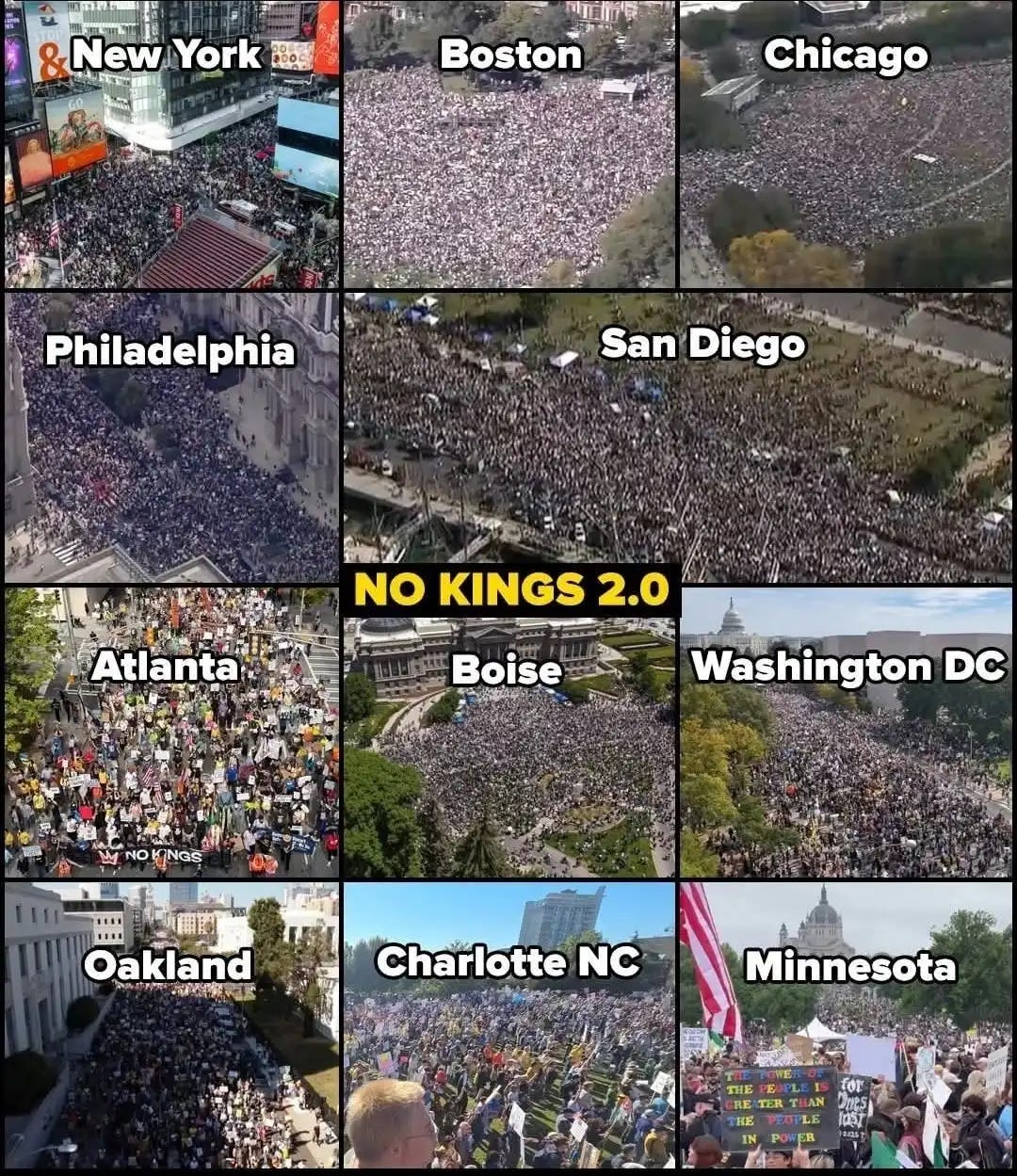
When millions of ordinary people fill the streets, history starts keeping count.
The Day Millions Said No Kings
From dawn on the East Coast to dusk in the Pacific Northwest, the internet became a single, humming broadcast. Streams poured in from phones, drones, and street corners — Boston, Atlanta, Houston, Denver, Portland. The No Kings symbol flashed on cardboard signs and handmade banners; chants overlapped through livestreams until they blurred into one national heartbeat. If you were online that Saturday, you didn’t have to ask what was happening — it found you.
By the end of the day, data analysts and journalists were scrambling to quantify what their screens had already shown. Was this five million people? Six? Seven? The counts varied by method and bias, but one truth held: it was among the largest coordinated protests in American history — possibly rivaling the Women’s March of 2017 and the George Floyd demonstrations of 2020.
Stay Informed. Stay Loud.
Subscribe to The Coffman Chronicle for no-BS political analysis, action guides, and daily truth bombs you won’t get from corporate media.
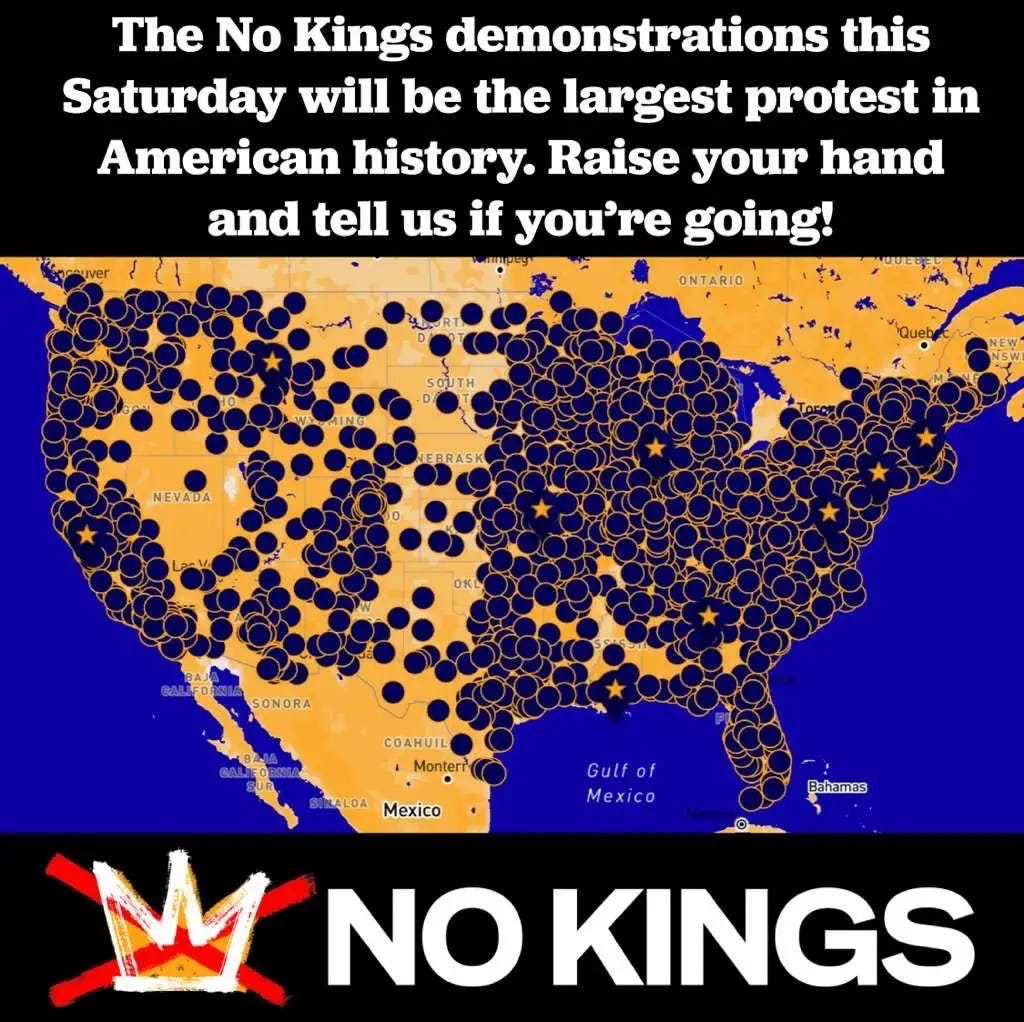
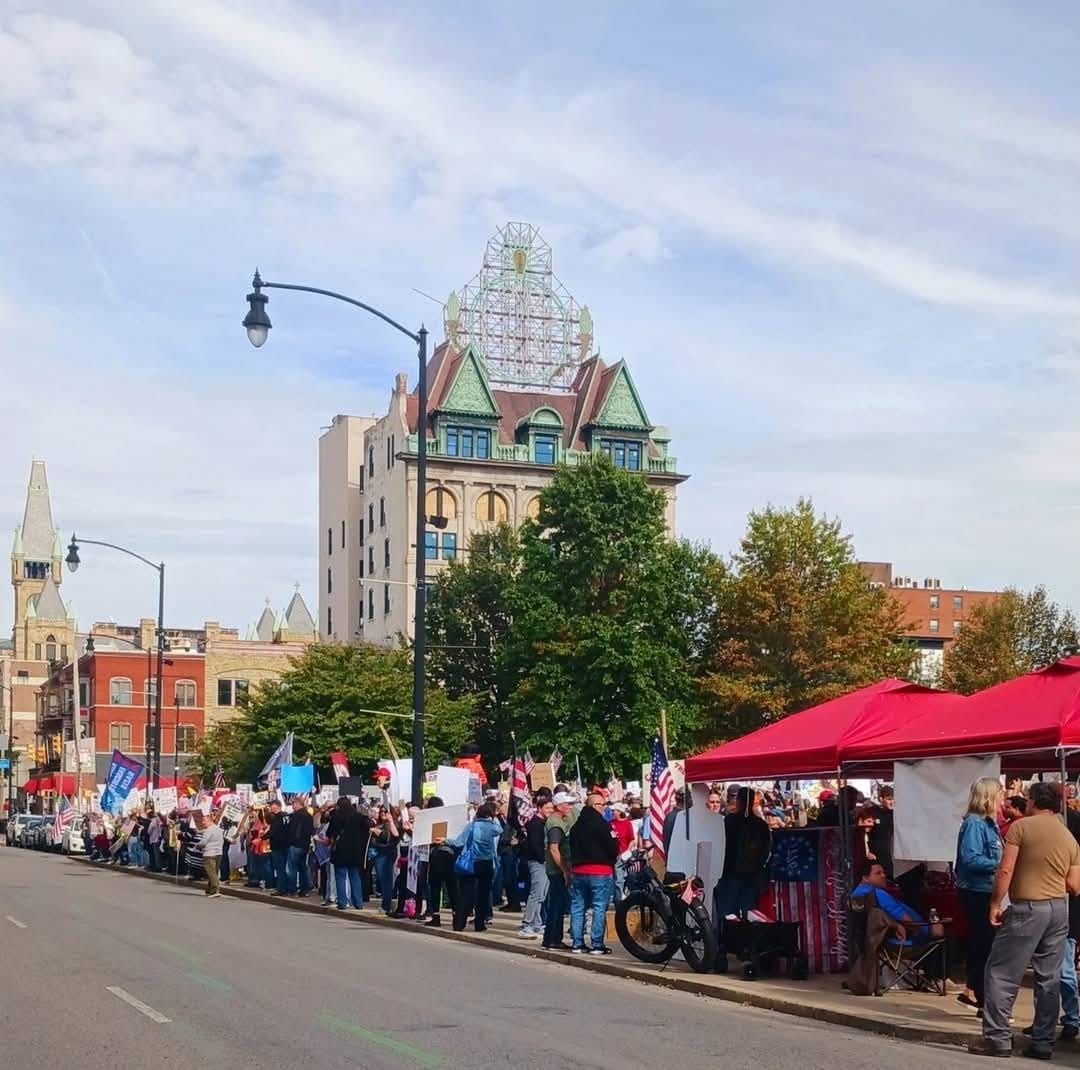
Organizers logged events in every state, as well as the District of Columbia and several cities abroad. Police scanners in major metros ticked off crowd-control updates — not reports of violence, but of traffic closures, overflow march routes, and volunteer medics keeping pace with marchers. Aerial shots stitched together a portrait of scale that numbers alone couldn’t express: the people who filled boulevards weren’t professional activists. They were teachers, veterans, nurses, truckers, parents with strollers, and retirees leaning on canes.
There was no single stage or podium, no celebrity headliner — just a unifying rejection of a political order that had begun to feel more monarchical than democratic. The protest’s rallying cry, “No Kings,” was less a slogan than a line in the civic sand.
As dusk fell, the livestreams didn’t end; they multiplied — candlelight vigils, courthouse steps, front-yard gatherings under homemade flags. And as the footage spread, one question started moving through comment threads, podcasts, and group chats:
If millions of people show up like this, how close are we to real change?
To answer that question, the nation had to do something rare in the age of viral outrage. Stop shouting long enough to start counting.
Counting the Uncountable
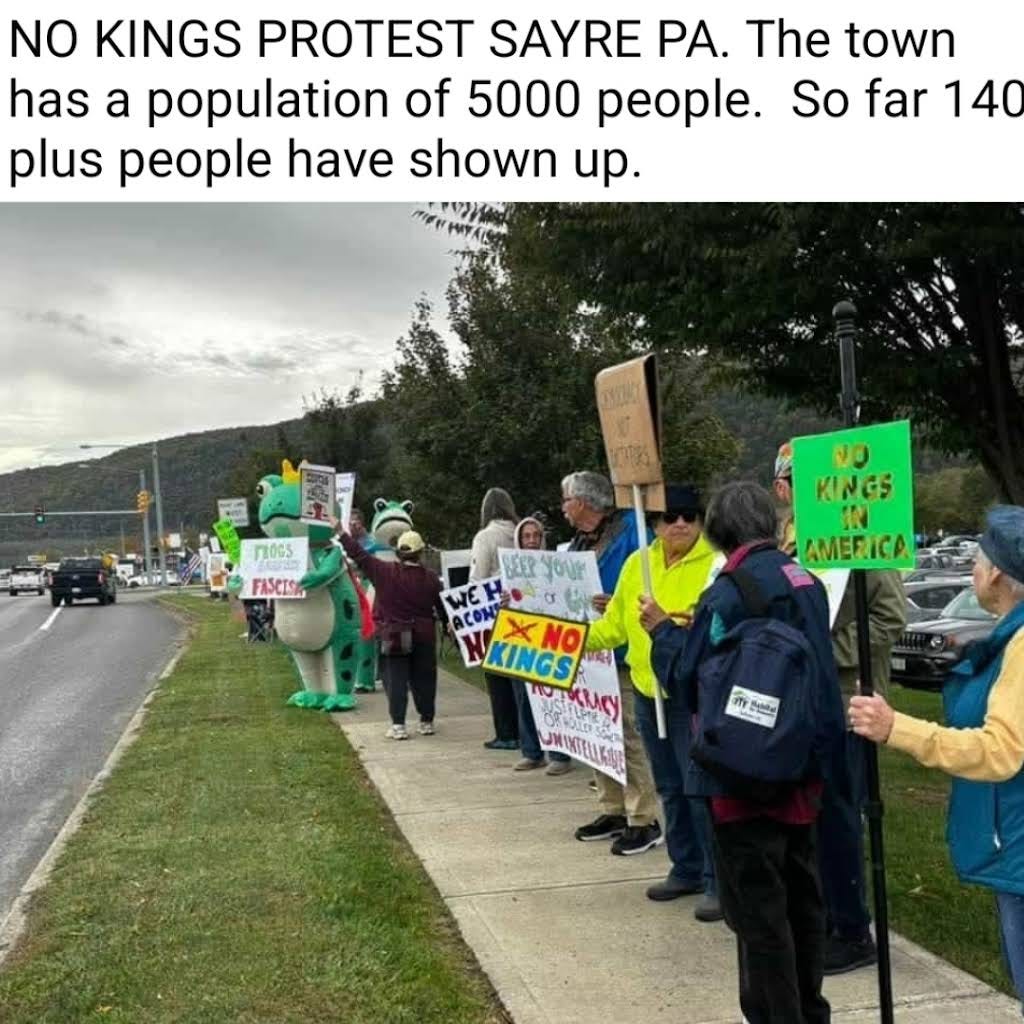
When a protest happens in one place, you can count heads. When it happens everywhere at once, the numbers turn slippery.
By nightfall on October 18, 2025, more than 2,700 events were logged under the No Kings banner. From courthouse steps to high school football fields, the images kept piling up — drone shots, TikTok feeds, local TV flyovers, and thousands of citizen livestreams. What no one could agree on was how many people those pixels represented.
Organizers claimed over 7 million. That figure spread quickly — bold, clean, round. Critics called it inflated. However, even independent data journalists, using cellphone density mapping, social media geotags, and permit counts, estimated the number of participants to be near 5 to 6.5 million. The difference wasn’t over whether millions showed up — only how many millions.
In Washington, D.C., the National Mall became a river of bodies, roughly 200,000 strong. New York clocked 100,000-plus, Chicago another 100,000, and Boston close behind. Even in towns that hadn’t seen a rally in years — Tupelo, Flagstaff, Council Bluffs — people came. Farmers leaned on tractors beside teachers holding cardboard signs; veterans stood beside college students who had never marched before.
For once, the digital record worked in democracy’s favor. The internet was its own census — each clip, each crowd selfie a tiny verification that this happened everywhere. And while statisticians argued margins of error, what no one could deny was the geometry of the thing: a movement big enough to be visible from orbit, small enough to touch every county line.
The precise number may take months to be settled, if it ever is. But somewhere inside that range — between five and seven million — lies something history might recognize: a crowd so vast, it began to look like a country taking attendance.
And buried in those spreadsheets, there’s a quiet kind of hope, the idea that civic participation, long dismissed as background noise, might still scale faster than cynicism.
That quiet hope led analysts to revisit an old theory, one that measures not just marches, but movements.
The 3.5 Percent Rule
A decade before this movement took shape, political scientist Erica Chenoweth studied hundreds of non-violent uprisings across the 20th century. Her finding was simple enough to fit on a bumper sticker: no peaceful movement that mobilized at least 3.5 percent of its population ever failed to change its government. The number isn’t magic; it’s momentum, the point where the machinery of the status quo begins to grind against the will of the governed.
In the United States today, 3.5 percent translates to approximately 11.9 million people. That’s not unreachable math. Even the most conservative estimates for No Kings — five to six-and-a-half million — put the movement at nearly halfway to history’s tipping point. If the higher counts prove closer to the truth, we may have already brushed it aside. Either way, the takeaway is the same: the distance between outrage and transformation has never felt so numerically narrow.
And that’s where hope sneaks in — not through slogans or speeches, but through arithmetic. A few million more ordinary citizens, and the country would have crossed the line that every successful non-violent campaign in modern history has shared.
How Close We Came
Census math rarely stirs emotion, but this time it does. The United States had roughly 341 million people in October 2025. Three and a half percent of that — the tipping line Chenoweth identified — comes out to 11.9 million participants.
Even using the lowest credible turnout for No Kings — about five million — that’s 1.46 percent of the country. At the median estimate of 6.5 million, the rate is 1.9 percent. And if the organizers’ claim of seven million holds, the movement reached 2.05 percent, two-thirds of the way to the historic benchmark where non-violent resistance begins to bend institutions.
In other words, if every person who marched had convinced just one more friend to show up, America would have crossed that 3.5 percent threshold.
That realization reframes the footage from the weekend. What looked like scattered cities was actually a national equation taking shape — millions of citizens testing how much democracy can still respond when pressed from below. The gap between what was and what could have been wasn’t ideological; it was numerical. A few million more neighbors, cousins, coworkers, and the country would have entered the statistical territory where history suggests systems start to shift.
And maybe that’s the real story of October 18th, that transformation didn’t feel impossible anymore. It felt countable. It felt close.
But numbers alone don’t move nations; people do, and how they connect now is changing everything.
The Shape of Modern Resistance
Movements used to need a headquarters. The No Kings protests proved they don’t anymore.
The organizing wasn’t run from a war room or a single union hall. It was crowdsourced, algorithmic, viral. Small local groups announced their rallies on Discord servers, community Facebook pages, and text threads. When one city’s permit got denied, another town five miles over volunteered a park instead. Momentum wasn’t managed; it was mirrored.
That’s the quiet revolution beneath the headcount: organization has become distributed. A message that might have taken weeks to spread in 1968 now circles the nation in an afternoon. One creator’s viral clip becomes a dozen spinoffs, each tuned to local dialects and causes. The effect isn’t chaos, but rather exponential growth built on trust fragments: small circles acting in sync without waiting for permission.
It’s why analysts expect the next wave to come faster. Once people have marched once, the barrier to marching again drops to almost nothing. History backs that up. Participation in the Civil Rights movement, Occupy, and the Women’s March all surged in their second year as new volunteers joined existing networks. With No Kings, those networks are digital, permanent, and global.
You can already see the signs: mutual-aid spreadsheets filling before official charities even post, regional coordinators scheduling teach-ins for November, and rural counties planning “second-wave” rallies under the same banner. When infrastructure lives online, momentum doesn’t fade. It queues.
And when the signal keeps scaling, something larger begins to stir — the sense that this isn’t just protest anymore, but practice.
Beyond the Threshold
No single day fixes a nation, but every movement that has ever done so started with one.
October 18th wasn’t the end of anything. It was proof of concept. Millions of people realized they weren’t alone, that their frustration had a body and a sound. The chants that echoed across the country weren’t about rage; they were about responsibility. They were a reminder that democracy isn’t inherited. It’s renewed, by hand and by presence.
If the 3.5 percent rule teaches anything, it’s that change isn’t abstract. It’s math plus endurance. What matters now isn’t how close we came, but whether we keep closing the distance. Each person who shows up again — or brings someone new — doubles the chance that the next march isn’t just a demonstration, but a declaration.
The footage will fade from trending pages, but the networks won’t. The chats, the carpools, the coffee tables turned into sign-making stations — those are the real infrastructure of a movement. The kind that can outlast a news cycle.
Hope, in this moment, is not a mood. It’s a choice disguised as a number.
And it’s growing.
Because if millions could rise once in a single day, then millions more can rise again — until the count tips, and the country follows.
Support Independent Media
Legacy media can tell you what happened; independent media tells you why it matters.
If you believe in data-driven reporting that centers ordinary people instead of power, become a paid subscriber. Your support keeps investigations alive, coverage uncensored, and voices like this independent.
🗞️ Subscribe to keep “No Kings” journalism free from corporate influence.
Because truth belongs at every kitchen table.
Bibliography:
Chenoweth, Erica. “Questions, Answers, and Some Cautionary Updates Regarding the 3.5 % Rule.” Carr Center for Human Rights Policy, Harvard Kennedy School, 2020.
Chenoweth, Erica. “The ‘3.5% Rule’: How a Small Minority Can Change the World.” Carr Center for Human Rights Policy, Harvard Kennedy School, 2016.
“No Kings.” NoKings.org.
“What to Know About the ‘No Kings’ Protests Against Trump’s Policies.” PBS NewsHour, June 14, 2025.
“New Data Shows No Kings Was One of the Largest Days of Protest in U.S. History.” Waging Nonviolence, August 2025.
Manistee County Democrats. “Manistee County Democrats say 925 attended protest.” Manistee News. October 18, 2025.
Benzie County Democrats. “Benzie County democrats protest with ‘No Kings’ rally.” Record-Patriot. October 19, 2025.
Love, Caroline. “Large turnout for No Kings protests reflects a shift in historically conservative Collin County.” KERA. October 20, 2025.
“Pentwater, Michigan, which saw 400 people join the protest in their 800-person town.” The Guardian – Live Coverage. October 18, 2025.
“Manistee County Democrats say 925 attended protest.” Manistee News Advocate, October 18, 2025.
“Hundreds rally at Alton’s Lincoln-Douglas Square for No Kings Day.” The Telegraph (Alton, Illinois), October 18, 2025.
“From Los Angeles to Libby, Montana: How Americans Protested King Trump.” The New Republic, October 18, 2025.
“On Eastern Shore, in Baltimore, across the state, thousands turn out for No Kings.” Maryland Matters, October 18, 2025.
“No Kings protests (October 2025).” Wikipedia.
And there was NO VIOLENCE!!!!!!!!!!!!!!!
That struck me as more important than the sheer size.
We will make 11 million very soon because when we fight back we win and as unity grows the fighting back will make change happen. This is our country democracy is worth fighting for so many men and women have given their lives as proof of that.protesting non violently is easier and just as effective. Remember trump hates two things the most dissent and criticism. The more no kings increases the more he will see both.