


On Monday, February 9, 2026, the Trump administration quietly told Congress it planned to rescind roughly $600 million in CDC public health grants, money that had already been awarded and was already flowing into state and local health departments. The cuts were framed as a shift in “priorities,” away from “population-specific” and “health equity” programs. Most headlines focused on HIV and STD prevention.
If that wasn’t alarming enough, the fine print tells a much sharper story.
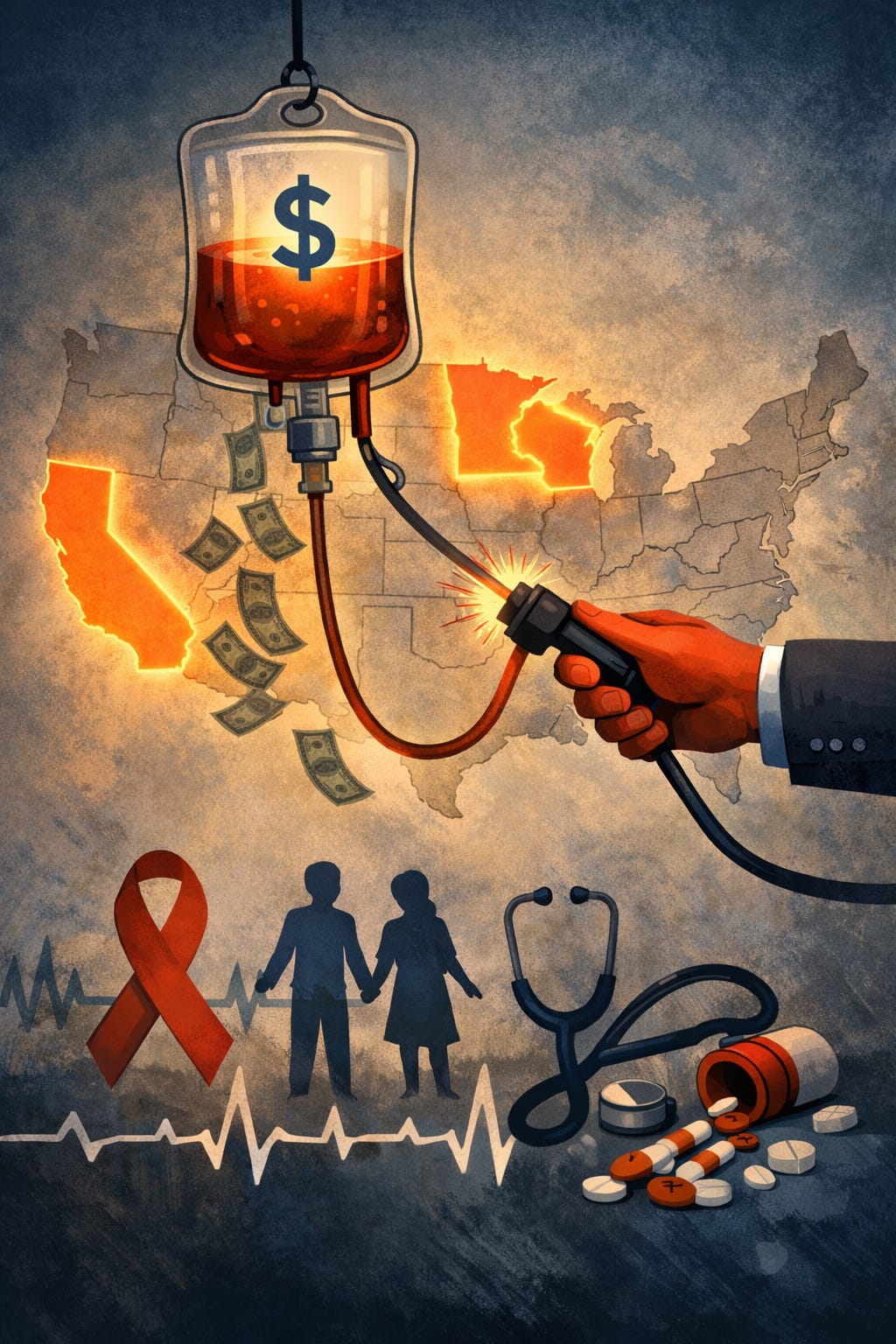
These cuts are aimed at exactly four states—California, Colorado, Illinois, and Minnesota—plus a small set of national medical organizations, including the American Medical Association and the American Academy of Pediatrics. They are not limited to HIV programs. They go straight through the core of public-health infrastructure, including workforce, disease surveillance, emergency preparedness, and equity work, those states built exactly the way CDC asked them to.
This Community Is Powered by You
What started as a small circle has grown into something much bigger, and it’s all because of readers like you.
Every time you forward this email, post it on socials, or bring someone new into the fold, you’re helping build one of the most passionate, independent political communities out there.
Want to keep the momentum going?
Share this newsletter with someone who should be part of this conversation.
Thank you for being here. It means everything.
What the CDC is Actually Cutting
According to HHS’s notice to Congress and subsequent reporting, the $600 million rescission would wipe out a cluster of CDC grants in those four states.
In California, the threatened grants include:
about $6 million for Los Angeles County to address health inequities,
$1.1 million for the county’s National HIV Behavioral Surveillance Project,
roughly $876,000 for a UCSF Prevention Research Center project on social isolation among older LGBTQ adults,
funding for the Los Angeles LGBT Center,
and a slice of the statewide Public Health Infrastructure Grant that pays for staff and systems across county health departments.
In Illinois, Colorado, and Minnesota, similar grants are on the chopping block: HIV and STD prevention projects in Chicago, Denver, and Minneapolis; disease surveillance systems; and the same infrastructure funds that help keep public health workers in their jobs.
A CDC inventory reviewed by Healthcare Dive shows cuts to state and local health departments, universities like the University of California and the University of Chicago, and nonprofits including the American Medical Association and the National Environmental Health Association.
One of the largest single items is the Public Health Infrastructure Grant, or PHIG, a five-year program Congress created after COVID-19 to rebuild state and local health departments. PHIG awards went to all 50 states. Only four are being told their awards will be terminated.
This is not a case of “we’re not funding this next year.” These are multi-year grants awarded in 2022, with staff already hired and projects already underway. Minnesota’s attorney general says more than $42 million in grants “already awarded” to his state are at risk, and warns that losing them means layoffs and dismantled programs.
That is what a rescission means here: clawing back money Congress already appropriated, and CDC already committed, and yanking out the financial floor from under ongoing work.
This isn’t even the first time this year the administration has tried to pull the rug out from under already-awarded health grants. In January, SAMHSA abruptly canceled up to $2 billion in mental health and addiction grants, citing “alignment with agency priorities,” only to restore the funding within 24 hours after a bipartisan uproar. The CDC rescission looks like the same muscle being flexed again, this time aimed much more narrowly at four blue states, and now restrained not by voluntary reversal, but by a federal court.
See our earlier reporting here:

The Official Story: “Priorities” and “Population-Specific Programs”
When reporters asked why these grants were being pulled, HHS and CDC did not offer program-specific critiques. They did not say the HIV surveillance in Los Angeles was redundant, or that Alameda County suddenly has enough staff.
Instead, they offered a generic justification. The grants “no longer reflect revised CDC priorities”, and the agency is “shifting away from population-specific, health-equity programs,” especially those aiding LGBTQ+ people and communities of color.
In other words, the administration is claiming this is not about punishing particular states or organizations. It is merely a change in philosophy about which public-health work the federal government should fund, with a move away from “population-specific” and equity-branded efforts.
On paper, that can sound like CDC is pruning niche projects to focus on broader, universal programs. However, if you know how public-health grants actually work, that explanation falls apart almost immediately.
How Public-Health Grants Actually Work
When a health department applies for federal money, it cannot just say, “We want to help people.” To win a competitive CDC grant, you have to do three basic things.
First, you have to define the problem in a specific population. That might mean Black women in certain neighborhoods, older LGBTQ adults, residents of particular rural counties, or people who inject drugs in a given city. You show that this group has a higher burden of a disease—more infections, more deaths, worse outcomes—than others.
Second, you have to show the evidence that this disparity exists. In HIV, for example, Black women make up roughly 13% of women in the United States, but about 50% of new HIV diagnoses among women. There is no biological reason they should be that over-represented. The difference, therefore, is in exposure, access, and conditions, things such as poverty, clinic deserts, violence, partner networks, and stigma. If you ignore that and write a “for everyone” proposal, reviewers will rightly ask why you are spending federal money on symptoms instead of root causes.
Third, you have to describe how you will reach that population and how you will measure change. How will you convince Black cisgender women on the South Side of Chicago to consider PrEP? How will you get older LGBTQ adults in San Francisco into social and clinical services? How will you track whether HIV incidence in those communities goes up or down?
Put simply, “population-specific” language is not some DEI garnish. It is the basic grammar of serious public-health work. If a grant application does not name who is affected, why they are affected, and how you will reach them, it is unlikely to be funded.
Seen from that angle, CDC’s new allergy to “population-specific programs” is not just ideologically odd; it is operationally incoherent and scientifically tone-deaf.
PHIG: CDC’s Own Equity Language Comes Back to Haunt Them
The Public Health Infrastructure Grant is the cleanest example of why the CDC’s “we’re done with equity” excuse does not support the recission.
PHIG is, by design, an infrastructure grant. It does not fund one disease. It funds people, data systems, and planning in state and local health departments, exactly the boring, unglamorous backbone that failed so spectacularly during COVID and that Congress decided to shore up afterward.
On CDC’s own PHIG “About” page, the agency describes the grant as being grounded in three principles. One of them is explicit: “Resources are directed to support diversity and health equity.”
A blog post by the Association of State and Territorial Health Officials is even blunter. It calls PHIG “a transformative infrastructure grant for health equity and inclusive workforces,” and describes how health departments have used it to tackle health disparities, strengthen diversity and equity in their staff, and build closer partnerships with marginalized communities.
In other words, CDC told all 50 states to use this money to modernize their infrastructure, strengthen their workforce, and do it with equity and diversity in mind. That is not something a few blue states invented in a side letter. It is baked into the grant’s DNA.
Now, only California, Colorado, Illinois, and Minnesota are being told their PHIG awards “no longer reflect agency priorities” and will be terminated. The same equity-framed program continues in the other 46 states.
If the problem were truly the grant model or its equity language, PHIG would be redesigned or ended nationwide. Instead, it is being surgically pulled only from four states that are also in open political conflict with the administration.
Not Just HIV, Not Just “DEI”: What’s Actually on the Cut List
At first glance, some of the cuts do look exactly like what HHS described.
There is the UCSF Prevention Research Center project on social isolation in older LGBTQ adults, funding for the Los Angeles LGBT Center, and grants labeled as addressing “health inequities” in Los Angeles County. These are textbook examples of population-specific, equity-oriented programs.
However, they are not the whole picture.
The cut list also includes LA County’s National HIV Behavioral Surveillance Project, which is basic epidemiology, tracking who is being infected with HIV, where, and through what behaviors, so health experts can intervene. It includes a $1.3 million grant for health staffing in Alameda County. That’s it. The public health workforce in a large, diverse, high-cost county with serious health disparities is not a priority, and is too population-focused.
Other grants under threat support planning for extreme heat events, a growing climate-related health threat, and help state and local health departments modernize their data systems and emergency-response capacity.
According to coverage by CIDRAP and Healthcare Dive, there are also cuts to:
disease-surveillance systems that monitor outbreaks,
workforce initiatives that pay for epidemiologists and disease-intervention specialists,
and general public-health infrastructure that has nothing to do, on its face, with gender-affirming care or DEI.
So while HIV and STD programs are a big and very real part of the story, this rescission is not narrowly pruning “identity politics” projects. It is stripping out core capacity in four states, including the capacity needed to find and stop whatever the next outbreak is.
If This Were Really About “Population-Specific Programs”…
If you take CDC’s stated rationale at face value, you would expect two things.
First, you would expect equity-branded, population-specific grants to be in trouble in every state, not just four. Almost every state has HIV or STD projects that focus on specific communities with higher burden—Black gay and bisexual men in Atlanta, Native communities in the Plains, transgender women in Miami, or rural injection-drug networks in Appalachia. If the new principle is “no more population-specific programs,” those grants in red and purple states should be on the chopping block, too.
Second, you would expect PHIG to be rethought everywhere, not just in California, Colorado, Illinois, and Minnesota. The grant’s own design, as CDC explains, directs resources toward diversity and health equity and urges states to prioritize under-resourced communities.
Neither of those things is happening.
Under the current rescission, equity-framed and hotspot-focused work continues in 46 states. PHIG continues in 46 states. Only four were told their “population-specific” and “health-equity” efforts no longer align with priorities.
That is a very strange way to enforce a neutral principle. It makes much more sense if you understand how targeted public health work typically operates.
Diseases are not sprinkled evenly across a map. They cluster, often by neighborhood, identity, income, and geography. If you discover scurvy in one city, you do not prove your fairness by dropping the same number of limes into every backyard in America. You get limes to the people with scurvy.
Public-health grants that focus on LA County, or Alameda County, or Black cisgender women in South Side Chicago, are doing that kind of work. Calling that “population-specific” in a pejorative way is not a technical critique. It is a rejection of the basic logic of epidemiology.
This raises the obvious question. If this is not really about program type, what do the targets actually have in common?
What the Four States and Two Medical Groups Really Have in Common
It is not population. These four states are not the worst HIV or STD states by rate; some of the highest-burden jurisdictions are deep-red Southern states that are untouched by this rescission.
It is not that they “no longer need” the money. Reporting details rising HIV diagnoses in Chicago and San Francisco, and the ongoing need for surveillance and prevention in those cities. While none of these four states have the worst healthcare outcomes, they also do not have the objectively best either.
What unites these four states is that they are Democratic-led “sanctuary” or sanctuary-adjacent jurisdictions that have spent years in open conflict with the Trump administration over immigration, gender-affirming care, and environmental policy. All have had very public, very recent spats over policy and executive action.
That pattern continues when you look beyond the states to the national organizations that have been swept into the same dragnet.
The American Academy of Pediatrics had nearly $12 million in HHS funding terminated in late 2025. These grants are for things like SIDS prevention, autism, fetal alcohol spectrum disorders, and rural child health. AAP had recently clashed with Health Secretary Robert F. Kennedy Jr. over efforts to roll back vaccine recommendations and had publicly defended both routine immunizations and evidence-based gender-affirming care for adolescents. A federal judge in Washington, D.C., blocked most of those cuts in January, finding that HHS likely violated AAP’s First Amendment rights by retaliating against the group for its advocacy.
The American Medical Association appears in the CDC cut list with a $7.2 million grant. Associated Press reporting on the administration’s own justification notes internal documentation states that the grant is targeted because of AMA’s support for gender-affirming care for minors, which conflicts with a Trump executive order.
Those grants were not gender-affirming care projects on paper. They were general pediatric, physician-training, and public-health projects. They were singled out because AAP and AMA, as organizations, have taken public positions that the administration dislikes.
Once you map those facts onto the targeted rescission, the picture comes into focus. The common thread is not a change in the science of HIV, or a sudden belief that targeted public-health work is bad. The common thread is who has the nerve to defy the administration in court or in public.
Congress Said “Yes.” The Administration Is Trying to Say “Not for You.”
There is also a constitutional layer here that goes beyond the specifics of HIV or even public health.
In 2025 and 2026, the Trump administration repeatedly proposed steep reductions to CDC prevention funding, including HIV and STD programs and the PHIG infrastructure grant. Congress, through a series of bipartisan minibus spending bills last month, rejected most of those cuts and funded HHS at roughly flat levels for fiscal year 2026, including the very programs now at issue.
In other words, Congress has already exercised its power of the purse. It appropriated money for these grants. CDC awarded them under that authority. States hired staff and signed contracts on the assumption that the PHIG awards and related grants were secure.
Now, after losing the budget fight, the administration is trying to achieve a version of those cuts by administrative fiat, rescinding specific grants only in four adversarial states and a small set of disfavored organizations, under the vague banner of “priorities.”
The four-state lawsuit leans hard on this point. It argues that retroactively imposing new conditions and selectively terminating grants in states that oppose the President’s immigration agenda violates the Appropriations Clause and the separation of powers, and is “arbitrary and capricious” under the Administrative Procedure Act.
On February 13, U.S. District Judge Manish Shah agreed there is a strong case. He issued a 14-day temporary restraining order blocking the $600 million cut while the case proceeds, explicitly finding that the states are likely to succeed on their claims and would suffer irreparable harm if the grants are pulled.
It is hard to overstate how significant that is. A federal judge has already said out loud what the pattern suggests: that this looks less like neutral priority-setting and more like retaliation and an attempted end-run around Congress.
The Human Cost: What Happens If the Cuts Stick
It is easy to lose sight of what this would mean on the ground when reading about grants and lawsuits.
California’s complaint warns that losing these funds will force layoffs of hundreds of public-health workers and “irreparably harm” the state’s ability to prepare for and respond to health threats, from STDs and HIV to measles, flu, avian influenza, and extreme heat.
In Illinois, officials point to rising HIV diagnoses in Chicago—cases increased from 727 in 2023 to 818 in 2024—and say that even the perception of federal retreat can discourage people from seeking testing and care.
Minnesota’s AG describes multi-year PHIG-funded positions—epidemiologists, data analysts, emergency-preparedness staff—that would vanish, leaving counties and tribes with weaker surveillance and slower response, just as COVID, RSV, and other threats persist.
For AAP and AMA, the threatened cuts affect work on SIDS, autism, rural child health, and national physician-training infrastructure. Those are not abstract line items. They shape what doctors know, how clinics operate, and which communities get attention.
None of these consequences are theoretical. They all flow directly from the decision to yank away money that Congress has already committed, and that health systems in these four states—and patients across the country—have come to rely on.
What This Precedent Would Mean
Taken together, the facts support a conclusion that is uncomfortable but hard to escape.
The Trump administration proposed deep cuts to prevention and equity-focused public-health work. Congress declined to go along. The administration is now trying to recoup part of that loss by rescinding already-awarded grants only in four blue, sanctuary states and from medical groups that have publicly opposed its policies on vaccines and gender-affirming care, using “priorities” and “population-specific programs” as an elastic justification.
If the real objection were to the structure of PHIG or the idea of equity in public health, those programs would be in trouble everywhere. They are not. They are in trouble where they are politically inconvenient.
If courts ultimately bless that approach, the precedent will reach far beyond HIV or even health care. It would say, in effect, that an administration may punish specific states and organizations by rescinding congressionally funded grants after the fact, based on ideological disagreements, while leaving the same programs untouched for others.
For now, a judge has said no. The $600 million stays put while the lawsuits proceed. A separate judge has said no in the AAP case, ordering nearly $12 million in pediatric grants restored because the cuts likely violated the First Amendment.
However, the underlying fight is not going away. It is about whether “priorities” can be used as a fig leaf for spite, and whether public-health infrastructure—and, by extension, people’s lives—can be treated as leverage in political disputes.
The CDC has not discovered a new principle of epidemiology. It has not found that HIV and STDs now spare older LGBTQ adults, or that Alameda County somehow no longer needs staff. The only priority that appears to have changed is which Americans deserve federally funded public health.
In this case, the answer, at least on paper, is not the people of California, Colorado, Illinois, and Minnesota, nor the patients served by the medical organizations that dared to contradict the White House.
If you found this useful and want to keep tracking how policy fights turn into real-world health consequences, consider subscribing. We cover this kind of slow, unglamorous power grab—the budgets, the buried memos, the lawsuits that decide who actually gets care—and try to translate it into plain language you can argue with at dinner. Hit subscribe to get the next piece in your inbox instead of hoping the algorithm feels generous.
Sources:
CDC To Rescind $600M In Grants To 4 Blue States; California Takes Worst Hit — February 10, 2026 — KFF Health News
Trump administration cuts $600 million in HIV, STD prevention and surveillance grants — February 11, 2026 — ABC News
CDC moves to cut $600M in grants to Democrat-led states — February 11, 2026 — Healthcare Dive
Proposed $600 million federal cut to public health funds could disrupt HIV prevention efforts in 4 states — February 11, 2026 — CIDRAP, University of Minnesota
Trump’s CDC is canceling $600M in HIV and STD funds to four Democrat-led states — February 12, 2026 — Scripps / KOAA / Scripps News Group
$600 Million in Trump Administration Health Cuts Will Hit California HIV Programs — February 10, 2026 — Los Angeles Times
California, other states sue over Trump administration’s latest cuts to HIV programs — February 11, 2026 — Los Angeles Times
California Sues Trump Administration Over $600M Health Funding Cuts — February 12, 2026 — CalMatters
Federal judge stops Trump plans to cut public health funding to Colorado, other Democratic-led states — February 12, 2026 — The Colorado Sun
Colorado, 3 other Democratic-led states sue to stop Trump from withholding $600M in health grants — February 12, 2026 — Sentinel Colorado / AP
Colorado attorney general sues Trump administration over cuts to public health funding — February 11, 2026 — Denver7
Trump administration cutting millions in Illinois HIV prevention grants — February 10, 2026 — Chicago Sun-Times
IDPH blames Trump administration for $100M in cuts to public health programs across Illinois — February 12, 2026 — WIFR
Illinois AG sues to prevent Trump admin. from cutting $600M in public health funds from 4 states — February 12, 2026 — ABC7 Chicago
Illinois, Other Democrat-Led States Sue to Halt Trump Administration’s Planned Cuts to Public Health Grants — February 12, 2026 — WTTW News
Illinois, other states sue Trump administration over HIV cuts — February 12, 2026 — Axios Chicago
California sues Trump administration over $600M in HIV prevention cuts — February 12, 2026 — Axios San Francisco
ATTORNEY GENERAL RAOUL FILES LAWSUIT OVER TRUMP ADMINISTRATION’S UNLAWFUL DIRECTIVE TO CUT MORE THAN $600 MILLION IN FEDERAL PUBLIC HEALTH GRANTS — February 11, 2026 — Illinois Attorney General
Judge temporarily blocks Trump officials from rescinding health grants to some Democratic-led states — February 12, 2026 — Associated Press via News4Jax
Judge blocks Trump administration from cutting $600 million in public health funds — February 13, 2026 — Reuters
Senator Baldwin Hits Trump on $600 Million Cuts to Public Health Funding, Including Disease and HIV Prevention — February 11, 2026 — U.S. Sen. Tammy Baldwin’s Office
Trump administration reverses course on $1.9 billion in cuts to addiction and mental health grants — January 14, 2026 — STAT
Trump Admin. Pulls Student Mental Health Grants, Restores Them a Day Later — January 15, 2026 — Education Week
SAMHSA reverses cuts to mental health, substance abuse grants after backlash — January 14, 2026 — Chicago Sun-Times / AP
Trump administration abruptly cancels — then reinstates — grants for mental health, substance use disorder — January 14, 2026 — New England Public Media
DeLauro Statement on HHS Reinstating Billions in Addiction and Mental Health Grants After Abrupt Cancellation — January 14, 2026 — House Appropriations Committee Democrats
This is a terrible idea!
Trump is trying to ruin American Healthcare.
He started by Stealing HUGE bundles of cash Medicaid and Medicare to pay for Huge Tax Cuts for Billionaires!
I am so angry at all of these recissions! Is there any way they can sue to administration to get this money back?