


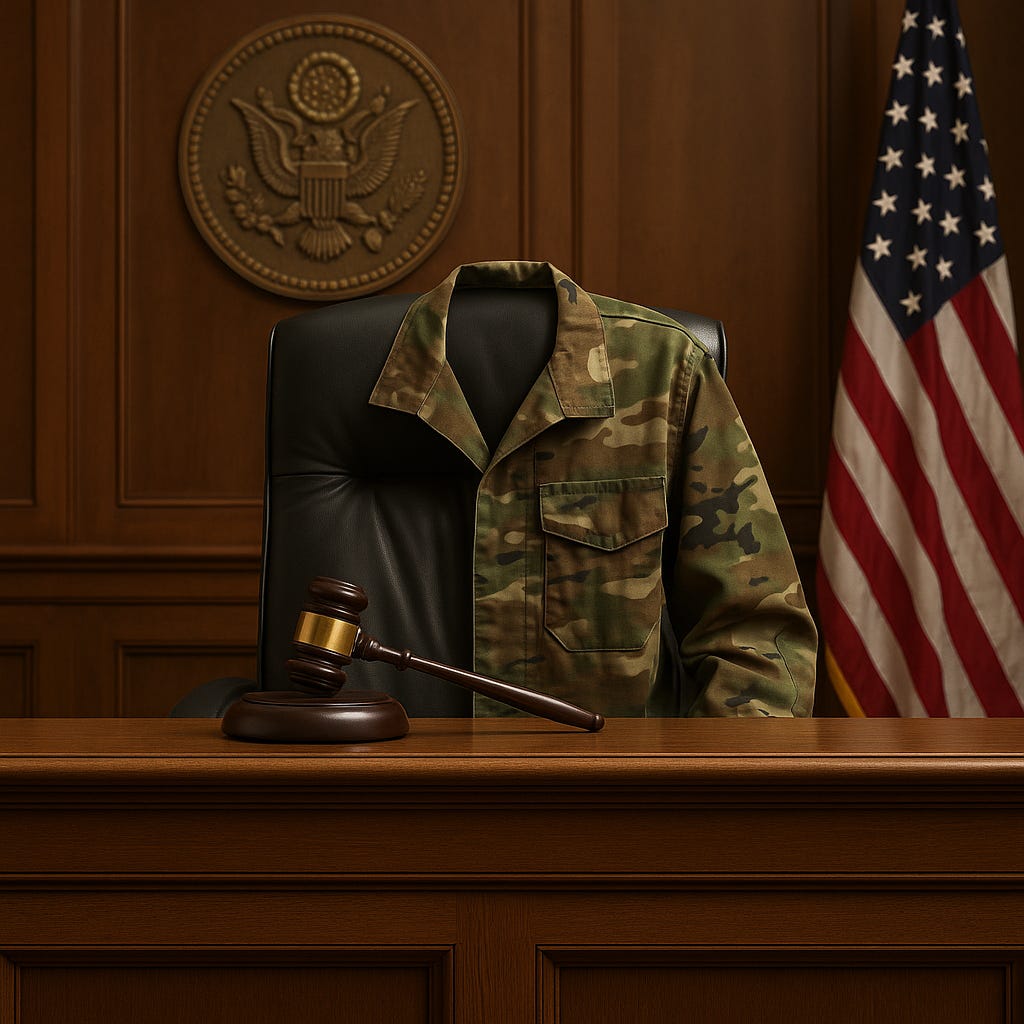
Camo on the Bench
Imagine walking into an immigration court expecting to see a judge versed in asylum law, refugee protections, and the labyrinth of U.S. immigration statutes, only to find a military officer in uniform sitting on the bench. That’s not a dystopian screenplay. It’s the reality that the Trump administration is preparing to roll out.
In late August, Defense Secretary Pete Hegseth authorized the Pentagon to reassign up to 600 Judge Advocate General (JAG) officers — military lawyers whose normal job is prosecuting courts-martial, advising commanders on rules of engagement, and handling internal military law — to serve as temporary immigration judges. According to the plan, the first wave of 150 will be deployed almost immediately, each serving stints of up to 179 days.
Supporters are calling this an emergency measure to address the ballooning immigration backlog, which now stands at a staggering 3.5 million pending cases. With more than 100 immigration judges recently fired or pushed out, and only about 600 left nationwide, the sudden addition of JAGs would nearly double the bench overnight. On paper, that sounds like a bold solution to a broken system.
But scratch the surface and the picture becomes far more troubling. Immigration courts are among the most complex arenas of American law. They determine whether asylum seekers are granted protection or deported to possible danger. Expecting military lawyers with little to no training in immigration statutes to suddenly wield this authority is akin to asking a cardiologist to perform brain surgery, a mismatch that borders on malpractice.
Even more alarming, this plan is without precedent. Never before has the U.S. government reassigned military lawyers en masse to preside over civilian courts. It is a move that raises grave constitutional, legal, and ethical questions. Why is America militarizing its immigration courts, and what does this mean for due process, civilian oversight, and democracy itself?
See our previous mention of this emerging story here:

Want to Know Your Rights?
Download a free digital copy of the U.S. Constitution—the same document Trump is trying to bulldoze. Learn exactly what he's breaking… and how to fight back.
📬 Stay Informed. Stay Loud.
Subscribe to The Coffman Chronicle for no-BS political analysis, action guides, and weekly truth bombs you won’t get from corporate media.
What’s Happening
The bare facts are startling enough. In a memo dated August 27, Defense Secretary Pete Hegseth authorized the Pentagon to reassign up to 600 JAG officers and civilian attorneys to the Department of Justice’s Executive Office for Immigration Review. The plan was set in motion at DOJ’s request, framed as a response to the crushing backlog in immigration courts.
The rollout is designed in waves. The first group of roughly 150 attorneys will be identified and dispatched “as soon as practicable,” according to the memo. Each will serve temporary terms of up to 179 days, with the possibility of renewal. If fully executed, the deployment would effectively double the size of the nation’s current immigration bench, which has been gutted in recent months by firings, forced resignations, and attrition.
On its face, this may look like a solution to a numbers problem. With only 600 immigration judges left nationwide, down from more than 700 before Trump’s second term began, and a staggering 3.5 million pending cases, the courts are overwhelmed. Asylum seekers and other immigrants often wait five to seven years for hearings, a delay that fuels political anger from both those demanding faster deportations and those demanding fairer treatment.
By flooding the system with military lawyers, the administration claims it can restore order and efficiency. Supporters argue that JAGs are trained attorneys and sworn officers, capable of adapting to new legal terrain. But critics counter that this move isn’t about easing delays at all. It’s about reshaping the very nature of immigration justice.
That tension — between the government’s stated justification and the deeper implications — is at the heart of this story. To understand it, we need to examine the “backlog emergency” being invoked and why so many believe it is more of an excuse than an explanation.
The “Backlog” Justification
The administration’s central argument rests on a single word: backlog. With more than 3.5 million cases pending, officials insist the immigration courts are collapsing under their own weight. In that light, importing hundreds of JAGs appears to be decisive action, a way to inject manpower and unclog the system. But the backlog itself is not some natural disaster. It is the product of deliberate choices.
Over the past two years, the Trump administration has presided over a systematic hollowing out of the immigration judiciary. More than 100 judges were either terminated or resigned under political pressure, leaving roughly 600 on the bench nationwide. At the same time, the administration has pursued aggressive enforcement policies that increase case filings while reducing resources to handle them. The result is a manufactured crisis, now repackaged as justification for a military intervention.
This strategy is hardly new. Politicians have long used bureaucratic dysfunction as both a cudgel and a cover. Create or worsen a problem, then present an extraordinary “solution” that bypasses normal checks and balances. In this case, the backlog is being leveraged to normalize an unprecedented step: placing military lawyers in civilian courts of law.
Even many former immigration judges say the premise doesn’t hold. Yes, delays are intolerable. However, rushing cases through with untrained judges will not deliver justice any faster. It will simply result in more denials, more appeals, and more human lives caught in a conveyor belt system. As one former supervising judge put it, “Six months is barely enough time to start to figure out the firehose of information and training.”
The backlog is real, but it is also a pretext. To see just how far the administration has gone to make this plan possible, we must examine a quiet but radical rule change that opened the door for JAGs to qualify as immigration judges.
The Rule Change That Enabled It
There was one major obstacle standing in the way of deploying JAG officers to immigration courts: by law, immigration judges have always been drawn from a specialized pool of attorneys with significant experience in immigration law. That barrier was quietly dismantled this summer.
In August, the Justice Department finalized a rule granting itself the power to appoint any licensed attorney as a temporary immigration judge. No requirement for immigration background. No expectation of years in the field. Just a law degree and a bar card. On paper, the change appeared to be a minor bureaucratic adjustment. In reality, it was the keystone that made the JAG plan possible.
Without it, military lawyers — experts in courts-martial, operational law, and military discipline — would never have qualified to preside over asylum claims or deportation proceedings. With it, the administration gained a fast track to double the size of the bench overnight by drawing on the Pentagon’s legal corps.
Critics immediately saw through the move. Immigration advocates warned that lowering qualifications wasn’t about efficiency, but about control. “Expecting fair decisions from judges unfamiliar with the law is absurd,” the American Immigration Lawyers Association declared. “This reckless move guts due process and further undermines the integrity of our immigration court system.”
The timing makes the intent clear. First, hollow out the existing court by firing experienced judges. Next, claim a backlog emergency. Then, change the rules so that outsiders — even military lawyers with no immigration training — can step in. It is less a rescue plan than a carefully staged takeover.
The result is an unprecedented shift: a civilian court system infused with military judges. To understand just how radical this is, we need to take a step back and examine history.
Why This Is Unprecedented
At first glance, it might be tempting to treat this plan as a novel administrative fix — unusual, yes, but within the realm of government improvisation. The truth is more jarring: nothing like this has ever been attempted in the history of U.S. immigration courts.
When military personnel have been deployed to the southern border in the past, their role was carefully circumscribed. Under presidents from both parties, troops and National Guard units were deployed to provide logistical and surveillance support, including building fences, flying drones, transporting Border Patrol agents, and setting up tents. What they did not do — and what they were explicitly barred from doing under the Posse Comitatus Act — was act in a law enforcement or judicial capacity. The firewall between military authority and civilian law has always been strong, even when strained.
Even during Donald Trump’s first term, when the Department of Justice reassigned immigration judges to border hotspots in an attempt to process asylum claims faster, the judges were still civilian attorneys drawn from within the DOJ itself. That move drew its own criticism, but it at least stayed within the legal architecture of the court system. No administration has ever attempted to fill the bench with military lawyers. Until now.
To understand how radical this shift is, it helps to be clear about what JAG officers normally do. Judge Advocates are trained to operate within the Uniform Code of Military Justice (UCMJ). Their core functions include:
Courts-martial: prosecuting and defending service members accused of crimes under military law.
Operational law: advising commanders on rules of engagement, targeting decisions, detainee treatment, and the law of armed conflict.
Administrative law: handling military contracts, ethics reviews, and internal investigations.
Advisory roles: occasionally detailed to other agencies or international bodies, but strictly as legal advisors, never as judges in U.S. civilian courts.
In short, JAGs are specialists in military justice and operational law, not in immigration statutes, asylum protections, or refugee conventions. Immigration law is among the most complex areas of American jurisprudence, often described as “second only to the tax code” in its complexity. Expecting a JAG officer to pivot overnight from drafting rules of engagement for a drone strike to deciding whether a Guatemalan asylum seeker qualifies for protection is less adaptation than malpractice.
As the American Immigration Lawyers Association quipped, “It makes as much sense as having a cardiologist do a hip replacement.” The analogy stings because it is accurate: legal expertise is not interchangeable. Years of specialized training are required to fairly adjudicate immigration cases. Substituting military lawyers into this role isn’t a solution to a shortage. It’s a red flag that the system is being deliberately distorted.
That distortion goes beyond incompetence. It represents a fundamental break with American legal tradition: the military is being asked, for the first time, to take on the role of judge in a civilian courtroom. That is not a fix for the backlog. It is the militarization of justice itself.
The Real Motives
On the surface, the JAG reassignment is framed as a humanitarian gesture, unclogging courts so that immigrants aren’t left waiting years in limbo. But look closer, and the pattern becomes clear: this isn’t about justice, it’s about speed. Not speed toward fairness, but speed toward removals.
Immigration hearings are complex by design. Asylum law requires careful evaluation of personal testimony, country conditions, and legal precedent. That process can’t be streamlined without cutting corners. And cutting corners is exactly the point. By filling the bench with military lawyers who lack immigration training, the administration virtually guarantees that more cases will be denied outright. The result? A conveyor belt of deportations disguised as efficiency.
The political optics are just as important as the outcomes. For Trump and his allies, this move signals “toughness.” Instead of investing in more immigration judges or modernizing the court system, they are sending in the troops — literally. It’s a performance meant to reassure the base that the administration is using military muscle to impose order on what they call “chaos” at the border. In reality, it’s chaos by design: first create a crisis, then declare yourself the only one strong enough to fix it.
At a deeper level, this is about consolidating power. Immigration courts are not independent; they are housed within the Department of Justice, under the authority of the Attorney General. That structure already raises concerns about political interference. By pulling in JAG officers — individuals who ultimately answer to the Defense Department and, by extension, the Commander-in-Chief — the White House tightens its grip even further. What should be a neutral adjudication process becomes an extension of executive will.
Seen in this light, the JAG plan is not an isolated fix but part of a larger project. Under the Project 2025 blueprint, the strategy is clear: replace career professionals across government with outsiders and loyalists who can be controlled. In science agencies, that means replacing climate experts with ideologues. In regulatory bodies, it means weakening enforcement staff. And now, in the immigration courts, it means sidelining judges with years of experience in favor of military lawyers who can be counted on to “move cases”, code for moving people out of the country.
Strip away the rhetoric, and the motive isn’t backlog relief. It’s about weaponizing the courts to serve politics rather than justice. And once that weaponization begins, it rarely stays confined to a single area of law.

Constitutional & Ethical Risks
The reassignment of JAG officers doesn’t just raise questions about efficiency. It cuts to the heart of constitutional principle and legal ethics. At its core, the plan blurs a line that American democracy has spent centuries maintaining: the line between military authority and civilian justice.
Immigration courts are already structurally unusual. Unlike Article III federal courts, they are administrative tribunals housed inside the Department of Justice, under the direct authority of the Attorney General. That arrangement has long drawn criticism for allowing political interference. By inserting JAG officers into the system, the administration is taking an already vulnerable institution and placing it even more firmly under executive control.
There are also serious concerns regarding due process. Immigration law is one of the most complex legal fields in the country, second only to the tax code in its difficulty. It requires a thorough understanding of asylum standards, human rights treaties, and evolving precedents. Military lawyers, however skilled in their own domain, lack this training. For immigrants seeking refuge, the stakes could not be higher: rushed hearings, flawed rulings, and wrongful deportations are not abstract risks but life-or-death realities.
Then there is the Posse Comitatus tradition, the principle that the military should not be used to enforce civilian law. While technically the reassignment of JAGs skirts the statute’s strict prohibitions. They are being placed in judicial, rather than enforcement, roles. The spirit of the law is being put to the test. If military lawyers can serve as civilian judges in immigration courts today, what stops a future administration from using them in tax disputes, labor cases, or even criminal courts tomorrow?
What’s being presented as a stopgap solution is in fact a dangerous precedent. Once the firewall between military and civilian justice is breached, it rarely gets rebuilt.
Global & Historical Parallels
What makes this moment so alarming is not just that it is new for the United States. It’s that it is familiar elsewhere. History is littered with examples of regimes that turned to the military to bypass civilian courts, always in the name of efficiency, order, or national security. The results have never been democratic.
In Chile under Pinochet, military tribunals were used to process political opponents, replacing judges who might have enforced constitutional protections. In Argentina’s Dirty War, generals relied on military courts to rubber-stamp detentions and disappearances. Civilian law was not abolished outright, but rather hollowed out and bent to the will of the executive.
Even the U.S. has flirted with this dangerous model. After 9/11, the Bush administration established military commissions at Guantánamo Bay to try terrorism suspects, explicitly designed to avoid the standards of civilian courts. Those commissions became a global symbol of America’s willingness to sideline due process when it was politically convenient. They still struggle with legitimacy two decades later.
The parallels are not exact. Immigration judges are not presiding over political trials or counterterrorism cases. However, the mechanism remains the same: when civilian law is deemed too slow, too cumbersome, or too independent, political leaders often turn to the military. And once that door is opened, it rarely swings shut again.
The administration insists this is temporary, a 179-day assignment, nothing more. But history suggests otherwise. Emergency measures often become permanent fixtures. “Just for now” becomes “just until the crisis ends,” and the crisis never ends.
By militarizing immigration courts, America is not solving a backlog. It is stepping onto a path well-worn by authoritarian regimes, a path that leads away from justice and toward unchecked power.
Voices of Resistance
The pushback against the JAG reassignment was immediate and fierce. For immigration lawyers, civil rights groups, and even former judges, the plan is not a creative solution but a direct assault on due process.
The American Immigration Lawyers Association (AILA) issued one of the bluntest warnings: “It makes as much sense as having a cardiologist do a hip replacement. Expecting fair decisions from judges unfamiliar with the law is absurd. This reckless move guts due process and further undermines the integrity of our immigration court system.” For an organization not known for hyperbole, the language was extraordinary, a measure of just how far outside the norm this plan is.
Former immigration judges echoed the concern. Jennifer Peyton, who once supervised the Chicago immigration bench, explained that six months isn’t nearly enough time for a new judge to gain competence: “Six months is barely enough time to start to figure out the firehose of information and training.” In other words, these military lawyers will be making life-altering decisions while still learning the basics.
Civil rights groups have gone further, labeling the move a constitutional crisis in the making. They warn that if the executive branch can import military officers to serve as civilian judges in one context, nothing prevents it from extending that model elsewhere. The firewall between civilian law and military power is not just under stress. It is being deliberately dismantled.
Even on Capitol Hill, some lawmakers are beginning to ask questions. A handful of Democrats have demanded hearings, warning that the reassignment risks violating the spirit of the Posse Comitatus Act. Whether that scrutiny turns into effective oversight remains to be seen.
What is clear is that this plan has already sparked outrage from those who understand the courts best. The experts are not confused. They are alarmed.
Conclusion & Call to Action
The reassignment of 600 JAG officers to immigration courts is being presented as an emergency measure to address a backlog. But step back and the truth comes into focus: this is not about efficiency. It is about power. It is about redefining justice itself, turning one of the nation’s most sensitive courts into a deportation machine operated by military lawyers.
Today, the targets are asylum seekers and immigrants without political power. Tomorrow, the logic could extend further. If the executive branch can declare a crisis and install military officers as civilian judges here, what stops it from doing the same in labor courts, tax disputes, or even protest-related trials? Once normalized, the militarization of justice rarely retreats. History tells us that much.
This is not just an immigration story. It is a democracy story. The firewall between military authority and civilian law is one of the pillars of American constitutional order. Breaching it — even under the guise of temporary necessity — weakens every other safeguard. And once that precedent is established, it can be invoked repeatedly.
What can be done? The first step is awareness. Share this story widely. Most Americans have no idea this plan is underway, and sunlight remains the strongest disinfectant. The second step is pressure. Call your representatives and demand hearings on the legality and constitutionality of this reassignment. Congress has the authority to oversee both the Department of Justice and the Pentagon, and it must be exercised. The third step is vigilance. Watch how this policy unfolds, and resist the inevitable attempts to make it permanent.
Democracy erodes not in one sweeping blow, but in a series of “temporary” fixes that become permanent habits. When military lawyers replace civilian judges, the issue is not just immigration. It is whether justice in America will remain truly civilian, or whether it will be drafted into uniform.
Stay Informed. Stay Loud.
Subscribe to The Coffman Chronicle for no-BS political analysis, action guides, and daily truth bombs you won’t get from corporate media.
Bibliography:
“Pentagon Authorizes up to 600 Military Lawyers to Serve as Temporary Immigration Judges.” AP News, September 2, 2025.
“Pentagon Plans for 600 Military Lawyers to Backfill Immigration Judges.” The Washington Post, September 2, 2025.
“US Military Lawyers to Serve as Temporary Immigration Judges.” Reuters, September 3, 2025.
“DOJ to Grant Itself Authority to Tap Any Attorney to Serve as an Immigration Judge.” Government Executive, August 27, 2025.
“Designation of Temporary Immigration Judges.” Federal Register, August 28, 2025.
“DOJ Says Temporary Immigration Judges No Longer Need Immigration Experience.” Truthout, August 28, 2025.
JAG officers handle water rights and real estate cases, for the most part. Court-martials are actually secondary.
Most military justice is done by the CO at an Article 32 or "Captain's Mast" hearing. No theatrics. the judge and jury is the CO. They deal with volunteer soldiers, who have committed military offenses, not run-of-the-mill crimes. Certainly not drug-related.
This guys will often -- not always -- be out of their league.