

When the Law Protects Big Tech Over Kids
How Section 230 Shields Platforms From Accountability and Leaves Children Unprotected
A teenager receives dozens of anonymous messages urging her to end her life. The app she used—YOLO—was designed to allow anonymous feedback, promising to ban abusive users. It didn't. Instead, it became a digital weapon in the hands of classmates, bullies, and trolls.
When the family tried to sue YOLO for enabling this, the courts said no. This week, the U.S. Supreme Court agreed.
On Monday, the Court declined to hear an appeal brought by the family of a cyberbullying victim who died by suicide after using YOLO, an anonymous messaging app once integrated with Snapchat. The family argued that the app's design—allowing anonymous, unmoderated messaging—created a foreseeable danger to young users. They also claimed the app falsely advertised itself as safe and committed to anti-bullying.
"We trusted what the app told us about keeping kids safe," said the victim's mother in a statement the family's attorney shared. "Instead, we buried our child. And now the courts say no one is responsible."
But the courts didn't want to hear it.
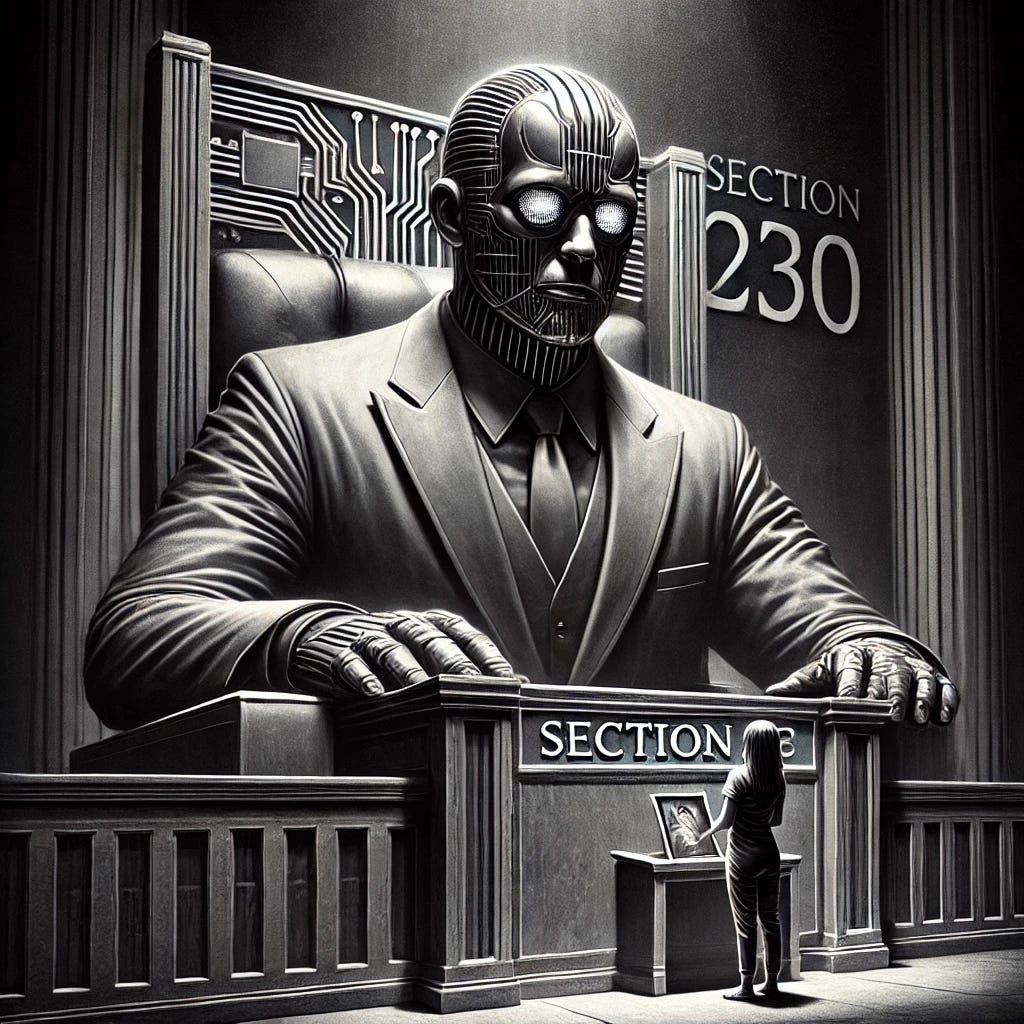
Section 230: The Internet's Great Legal Shield
Section 230 of the Communications Decency Act is at the core of this tragedy—a 1996 law often called "the 26 words that created the internet." It shields tech platforms from liability for content posted by users. In practice, it has also shielded them from lawsuits over how their platforms are designed, marketed, and moderated.
That shield protected YOLO. A trial judge tossed out the case, citing Section 230. An appeals court partially revived it, allowing a false advertising claim to proceed. However, the family wanted the Supreme Court to consider whether apps should bear responsibility for harmful designs. The Court said no.
And so the legal firewall held.
What Section 230 Does and Doesn't Do:
Protects platforms from being treated as publishers of user content
Allows moderation without liability
Doesn't require platforms to act on abuse or harassment
Shields platforms from accountability for harmful app designs
A Pattern of Refusal
This isn't the Supreme Court's first refusal to intervene in a case involving digital platforms and real-world harm. It's become a pattern of judicial indifference.
Doe v. MySpace (2008): A 13-year-old girl was assaulted after meeting a predator via the platform. Her family sued, but Section 230 blocked the case. The Supreme Court declined to hear it.
Herrick v. Grindr (2019): A man's ex used Grindr to send over 1,000 strangers to his home, impersonating him. He sued Grindr for negligent design. Section 230 shielded the company. The Supreme Court declined to hear it.
Force v. Facebook (2019): Families of terror victims sued Facebook for allowing Hamas propaganda. The courts rejected it under Section 230. SCOTUS declined again.
Gonzalez v. Google (2023): The Court dodged an opportunity to narrow Section 230's scope in a terrorism-related case, effectively preserving the status quo.
The trend is unmistakable: the highest court in the land consistently refuses to revisit a law written almost 30 years ago. As a reminder, that was before anonymous apps, AI moderation, or algorithmic feeds even existed.
The Battle Over Section 230: Who Wants Change and Why?
Calls for reform are growing, but the motivations couldn't be more different.
Republican Push for Reform: Political Bias Over Child Safety
For many Republican lawmakers, reforming Section 230 is more about alleged political bias than protecting children or vulnerable users.
Senator Ted Cruz has repeatedly framed Section 230 as a tool that allows tech companies to censor conservative voices. His argument rests on the premise that platforms should be stripped of their legal protections if they engage in politically biased moderation. But this has nothing to do with preventing cyberbullying, harassment, or exploitation. Senator Josh Hawley's proposed Ending Support for Internet Censorship Act also emphasizes political neutrality over user safety.
Senators Roger Wicker and Marsha Blackburn joined Cruz in proposing the Online Freedom and Viewpoint Diversity Act, designed to condition Section 230 protections on maintaining "viewpoint neutrality."
Senator Lindsey Graham's stance is somewhat more nuanced, acknowledging corporate irresponsibility, though still heavily focused on political bias.
From the Republican standpoint, it is more egregious for a platform to permit free speech on both sides than to allow cyberbullying to ruin lives.
See our ongoing reporting about the Trump regime’s attacks on free speech and the media:


Democratic Push for Reform: Accountability Over Neutrality
Democratic lawmakers have been more concerned with actual accountability for harmful content and dangerous platform designs.
Senator Dick Durbin has been vocal about how outdated Section 230 has become. His collaboration with Republican lawmakers like Graham aims to sunset the provision entirely, forcing a reevaluation of its necessity.
Senator Amy Klobuchar's SAFE TECH Act seeks to strip immunity from platforms that fail to address cyberstalking, harassment, and civil rights violations.
Hillary Clinton has called for a total repeal, arguing that the spread of hate speech and misinformation, largely unchecked, continues to harm marginalized communities disproportionately.
Senator Ron Wyden, one of Section 230's original architects, continues to defend its existence but has acknowledged the need for reform aimed at improving accountability without stifling speech.
For Democrats, reform is needed to address modern technology and real harm.
When the Law Protects Code Over Kids
This moment demands reflection. What does it say about our legal system that an app can contribute to a child's suicide, and no one—not the courts, not the companies—can be held accountable?
The Supreme Court's refusal to hear the YOLO case doesn't mean it agreed with the lower court. But it also didn't object. It didn't ask for review. It didn't see a need to revisit a law written in the dial-up era, now stretched to shield billion-dollar companies from even the most devastating of consequences.
When the law protects profit over people, especially children, it's time for the law to change.
Call to Action
It's time to stop pretending this legal immunity serves the public good. Congress needs to act and act now. Contact your representatives. Demand that Section 230 be reformed to protect children and hold corporations accountable when their platforms become instruments of abuse.
Independent News. Just $1/Week.
We just hit 10,000 subscribers—thank you! We’re offering full access to The Coffman Chronicle for just $1 a week ($52/year) to celebrate.
Get exclusive analysis, daily rundowns, and fearless reporting you won’t find in corporate media.
Support truth. Stay informed.
Bibliography
"High Court Won't Review Teens' App Defect Claims Against Yolo." Bloomberg Law, March 24, 2025.
"Lawmakers are trying to repeal Section 230 again." The Verge, March 21, 2025.
"S.560 - SAFE TECH Act 118th Congress (2023-2024)" Congress.gov, February 28, 2023.
"S.4534 - Online Freedom and Viewpoint Diversity Act 116th Congress (2019-2020)" Congress.gov, September 8, 2020.
"Section 230 of the Communications Decency Act" Wikipedia, Last edited March 25, 2025.
"Force v. Facebook, Inc., 934 F.3d 53 (2d Cir. 2019)" Justia US Law, 2019.
"Gonzalez v. Google LLC, 2 F.4th 871 (9th Cir. 2021)" Justia US Law, 2021.
"Internet Freedom and Nondiscrimination Act of 2006" Wikipedia, Last edited March 25, 2025.
"Doe v. MySpace, Inc., 528 F.3d 413 (5th Cir. 2008)." Casetext, 2008.
"Herrick v. Grindr LLC, 765 F. App'x 586 (2d Cir. 2019)." Casetext, 2019.
"Senator Hawley Introduces Legislation to Amend Section 230 Immunity for Big Tech Companies." Senator Josh Hawley's Official Website, June 19, 2019.
"Klobuchar, Warner, Hirono Announce the SAFE TECH Act to Reform Section 230." Senator Mark Warner's Official Website, February 25, 2021.
"Hillary Clinton Wants To Repeal Section 230." Reason Magazine, October 7, 2024.
"Wyden Statement on Calls to Regulate Speech Online and Repeal Section 230 of the Communications Decency Act." Senator Ron Wyden's Official Website, January 2, 2019.