


On Monday night, March 2, the U.S. Supreme Court quietly stepped into a fight over a single congressional district in New York City. With a brief order on its emergency, or “shadow,” docket, the Court blocked a lower court ruling that would have forced the state to redraw New York’s 11th Congressional District before the next election. For now, the existing map lives to see another cycle.
NY-11 might not sound like the stuff of constitutional drama. It’s the district that covers Staten Island and a slice of southern Brooklyn, New York City’s lone Republican-held seat in the House. However, what made this case stand out wasn’t just the politics of the district. It was the way Justice Samuel Alito chose to describe what the lower court had tried to do.
The New York trial court had ordered a new map that would give Black and Latino voters a better chance to elect their preferred candidate. Alito, writing in support of freezing that order, called the remedy “blatantly” discriminatory because it explicitly told mapmakers to draw a district in which minority voters could elect someone they chose.
In other words, fixing racial vote dilution was recast as racial discrimination.
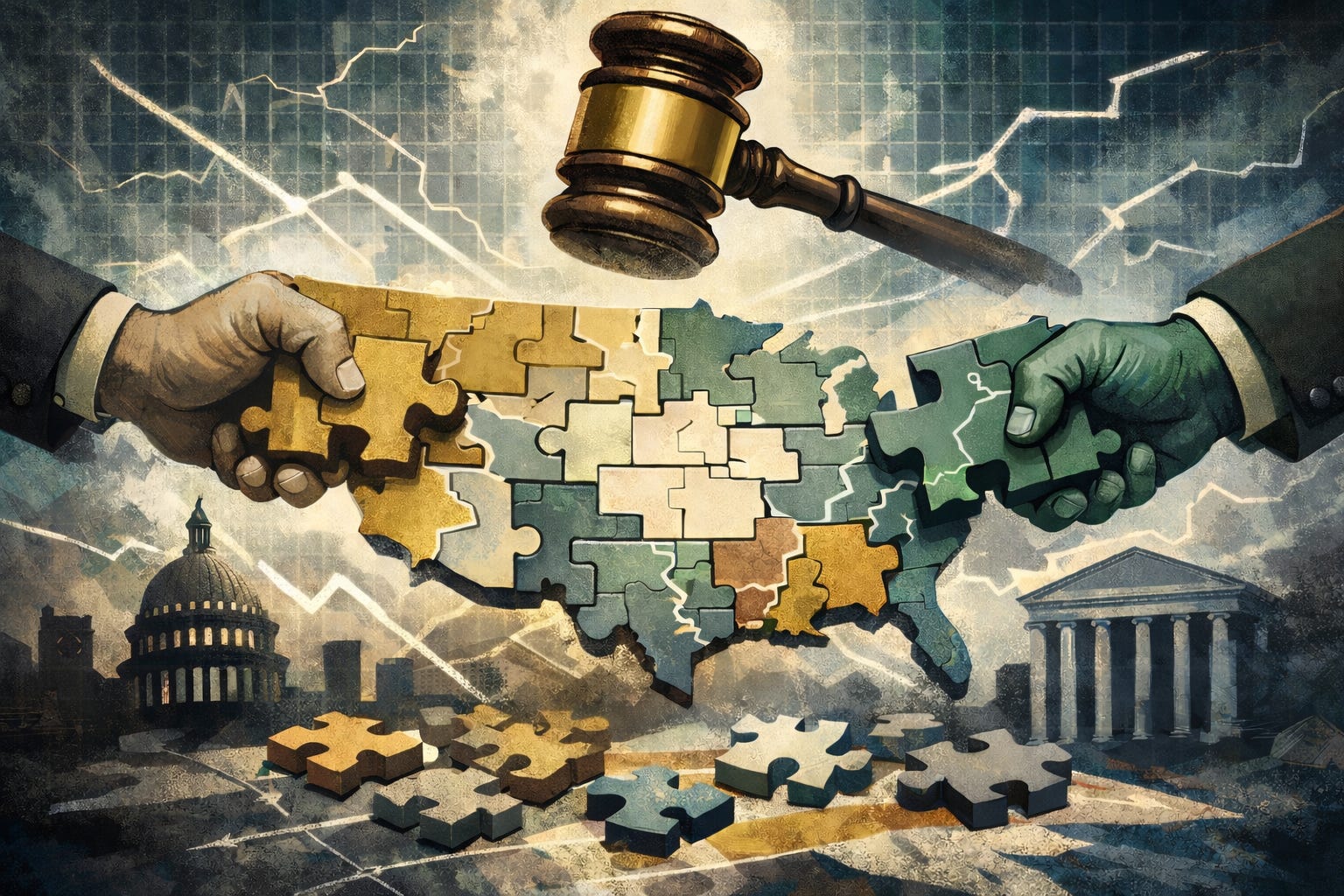
That framing matters far beyond Staten Island. The New York case is not an oddball dispute off in the corner of the map. It’s part of a broader pattern, in which courts, legislatures, and party operatives are colliding over who gets to draw the lines and whether anyone can still fix a rigged map once it’s in place.
If you zoom out, you can see three things happening at once: a legal collision over race and representation, a wave of mid-cycle redistricting that turns maps into permanent weapons, and a political system that keeps asking the courts to clean up messes created by partisan mapmakers. Together, those trends point to a simple conclusion. If we want any other democratic reforms to matter, we have to lock down how districts are drawn first.
This Community Is Powered by You
What started as a small circle has grown into something much bigger, and it’s all because of readers like you.
Every time you forward this email, post it on socials, or bring someone new into the fold, you’re helping build one of the most passionate, independent political communities out there.
Want to keep the momentum going?
Share this newsletter with someone who should be part of this conversation.
Thank you for being here. It means everything.
Two Rules, One Collision
Equal protection versus vote dilution, in plain English
Redistricting law in the United States rests on two big ideas that sound perfectly reasonable in isolation and deeply unstable when you put them together.
The first idea comes from the Equal Protection Clause of the Fourteenth Amendment. Courts have said that states cannot rely on race as the predominant factor when drawing district lines, unless they have a very strong reason. This doctrine, often called the law of “racial gerrymandering,” grew out of concerns in the 1990s that some districts were being drawn almost entirely around racial demographics. The core message is simple: the government should not sort voters by race as its main organizing principle.
The second idea comes from Section 2 of the Voting Rights Act of 1965. Section 2 says that election systems cannot result in minority voters having less opportunity than others “to participate in the political process and to elect representatives of their choice.” In redistricting, that often means courts can order states to create districts where Black, Latino, or other minority voters have a fair chance to elect candidates they support especially when existing maps “crack” those communities into many districts or “pack” them into one.
These two ideas pull in opposite directions.
If a state ignores race altogether when drawing maps, it can easily end up diluting minority voting power, especially in places with long histories of segregation and discrimination. If a state pays too much attention to race, it risks being accused of unconstitutional racial sorting.
For a long time, courts tried to split the difference: allow some race-conscious line drawing when needed to comply with the Voting Rights Act, but warn states not to let race dominate the process. It was an uncomfortable compromise, but it functioned.
Alito’s language in the New York case signals a more aggressive posture. By treating a remedy aimed at giving minority voters a meaningful voice as “blatant” racial discrimination, he pushes the law toward a world where it is much easier to attack race-conscious fixes than race-based harm.
And New York is not the only place where that conflict is being tested.
Louisiana: The Voting Rights Act in the Crosshairs
When a fix becomes a new target
Consider Louisiana. After the 2020 census, the state adopted a congressional map with just one majority-Black district out of six, even though around a third of Louisiana’s population is Black. Civil rights groups challenged the map under Section 2 of the Voting Rights Act, arguing that it diluted Black voting strength. A federal court agreed and ordered the state to draw a second district where Black voters could elect their preferred candidate.
Louisiana did. Then a new set of plaintiffs went to court to challenge the remedial map, arguing that creating that second district relied too heavily on race and therefore violated the Constitution’s ban on racial gerrymandering.
The same action—creating a district where Black voters have a fair shot—was first required as a remedy and then attacked as a constitutional violation.
The Supreme Court agreed to hear the resulting case, Louisiana v. Callais. The questions the justices choose to answer there will determine how much room states and lower courts still have to fix vote dilution without being accused of unconstitutional race-based line drawing.
See our previous reporting on this case here:
Note: Articles move into the archive over time. Become a paid subscriber for full access to our extensive catalog.

Put bluntly, the logic behind Alito’s opinion in the New York dispute is the same logic being advanced by those who want to narrow the Voting Rights Act in Louisiana. If race-conscious remedies are treated with deep suspicion, then the main federal tool for challenging discriminatory maps becomes much harder to use.
Mississippi: District Lines Everywhere
It’s not just Congress
Redistricting fights are not limited to congressional maps. The same basic tensions show up in state legislative districts and even in the way judges are elected.
In Mississippi, a case known as White v. Mississippi State Board of Elections challenges the districts used to elect the state’s Supreme Court. The plaintiffs argue that the current map dilutes the voting power of Black residents, in a state where Black Mississippians make up a large share of the population but have historically been underrepresented on the high court. The claim is, once again, that lines drawn decades ago carve up communities in ways that weaken their ability to elect judges who reflect them.
See our recent update here:

The legal tools are different in each context, but the pattern is familiar. District lines are not neutral geography. They are choices about which communities get a real chance at representation and which do not.
When you stack New York, Louisiana, and Mississippi next to one another, a picture starts to form. Courts are being asked to police a very fine line: do not ignore the reality of racial discrimination and vote dilution, but also do not let race become the dominant factor in map-drawing. Now, with justices like Alito openly questioning race-conscious remedies, that line is getting thinner.
As if that were not enough, the basic rhythm of redistricting is also changing.
The Era of Permanent Redistricting
From once-a-decade to whenever it’s convenient
For most people, redistricting used to be something that happened in the background once every ten years. The census would count the population. Seats in the House would be reapportioned among the states. Each state would then go through an ugly, contentious redistricting fight, and then, for better or worse, the maps would settle until the next census.
That informal “one census, one map” norm is fraying.
In the past few years, we have seen a rise in what’s often called mid-cycle or mid-decade redistricting: states redrawing maps between censuses, not because the population shifted dramatically, but because one party spots a chance to lock in more seats. Texas helped popularize this tactic in the modern era, using mid-cycle redistricting to seek additional partisan advantage. Other states have taken note.
Once one state reaches for that tool, others face a brutal choice. Do nothing, and you risk falling behind in the national race for House control. Respond in kind, and you help normalize a world in which every shift in state-level power invites a new map.
See our reporting on this here:
Note: Articles move into our archive over time. Become a paid subscriber for full access to our extensive catalog.

If mid-cycle redistricting becomes routine, redistricting stops being a periodic adjustment and turns into permanent warfare. Every new map invites a new lawsuit. Each lawsuit arrives on a tight election calendar. Courts start making more and more decisions on emergency timelines, and the question “Which map applies this year?” becomes as important as “What does the law actually say?”
It is hard to have stable democratic accountability if the basic boundaries of representation can be renegotiated every time a party wins a statehouse.
The Common Denominator: Partisan Mapmaking
When politicians choose their voters
You can follow the doctrinal debates about equal protection and the Voting Rights Act. You can track the growing number of mid-cycle redraws. Yet underneath all of it is a more basic problem. The people who stand to benefit from the maps are the ones drawing the maps.
When partisan actors control redistricting, the incentives are obvious. Every line on the map is an opportunity to shore up a vulnerable seat, punish an opponent, or make a future election less risky. Voters become pieces on a board, and communities get carved up or glued together not because they share interests, but because they share partisan lean.
Even when there are legal rules on the books—rules about equal population, contiguity, or minority representation—there is always pressure to push them as far as the courts will allow. That is how we end up with situations where a county is almost entirely in one district, except for a thin strip of a few thousand people that gets bolted onto another district down the road. Those people are not being grouped with their neighbors. They are being used to fine-tune someone’s electoral odds.
Courts are then asked to sort out the mess: is this line about race or about partisanship? Is the map legal under Section 2? Is the remedy itself constitutional? Should the new map apply this year, or is it “too late” in the election cycle?
None of that would be easy under the best circumstances. It is nearly impossible when the underlying process is designed around self-interest.
What It Would Mean to Take the Map Away
Reducing partisanship and adding guardrails
If partisan control of the map is the root of the problem, the obvious question is what it would mean to take that control away or at least to limit it severely.
Some states have moved toward independent or bipartisan redistricting commissions. Others have experimented with rule-based mapping systems that give professionals or even algorithms the first cut at a map, constrained by neutral criteria like equal population, contiguity, compactness, and keeping counties and cities as intact as possible.
The goal is not to pretend that politics can be removed entirely. It is to shrink the space where self-dealing is possible and make the remaining choices transparent enough that the public can see what is happening.
Any serious reform in this direction needs guardrails. Map-drawing criteria should be written down, ranked in order of priority, and applied consistently. The process should be open to public scrutiny, not conducted in back rooms with consultants. Perhaps most importantly, there should be a strong presumption that congressional maps are drawn once per census, with mid-cycle changes allowed only in narrow circumstances such as court-ordered corrections of clear legal violations.
Without those kinds of limits, even a nominally independent process can be dragged back toward the same old game.
Why Redistricting Is the First Domino
No accountability without fair maps
Redistricting reform is not a magic wand. It will not undo big money in politics, fix the Senate, or change the way cable news covers elections. However, it does something else that is hard to achieve any other way: it changes who politicians have to listen to.
When districts are engineered to be safe, the real election often happens in the primary. Politicians learn to fear a small, highly engaged sliver of the electorate, plus donors and party leaders, more than they fear the broad public in November. Under those conditions, performative politics—owning the other side on social media, picking fights that play well on partisan cable—becomes the rational strategy.
When districts are more competitive and lines reflect real communities instead of delicate partisan arithmetic, the incentive structure shifts. Representatives still disagree. Parties still fight. However, there is at least a chance that ignoring a large chunk of your constituents will cost you your job.
That is why redistricting sits at the foundation of so many other reforms. Campaign finance rules, ethics laws, and transparency measures all work better in a system where voters can realistically throw people out. They work much less well in a system where the map guarantees that most incumbents will be safe barring a landslide or a scandal of historic proportions.
The fight over New York’s 11th District is just one skirmish, but it is a revealing one. A state court tried to address vote dilution. A conservative justice on the Supreme Court suggested that the remedy itself might be unconstitutional. Meanwhile, other states are discovering that you can redraw maps mid-cycle whenever it suits you, and daring the courts to keep up.
We do not have to accept a politics where district lines are a permanent weapon and representation is always in flux. But getting to something better starts with a simple, unglamorous premise: voters should choose their representatives, not the other way around. Until we take the map out of partisan hands and lock in real guardrails, everything else we say about accountability is just wishful thinking.
If you appreciate clear, thoughtful analysis of the forces shaping American politics, consider subscribing. We focus on the systems and incentives behind the headlines so you can better understand how—and why—things work the way they do
Sources:
Reuters “US Supreme Court backs pro-Republican NY congressional district map” (March 2, 2026; updated March 3, 2026).
SCOTUSblog “Supreme Court grants Republicans’ request to pause order to redraw New York congressional map” (March 2, 2026).
Supreme Court of the United States “25A914 Malliotakis v. Williams (03/02/2026)” (March 2, 2026).
SCOTUSblog “Supreme Court to hear arguments in pivotal case on the Voting Rights Act” (October 10, 2025).
ACLU “Supreme Court Arguments Conclude in Landmark Voting Rights Case” (October 15, 2025).
Supreme Court of the United States “Oral argument transcript: Louisiana v. Callais” (Oct. 16, 2025) (argument held Oct. 15, 2025).
ACLU “Federal Court Orders Mississippi Supreme Court District Lines Be Redrawn” (August 19, 2025).
Reuters “Mississippi Supreme Court election map dilutes Black voters’ power, judge rules” (August 20, 2025).
Leave it to the completely, easily bribable trump's Scrotum Court to use racism in their decisions. Hope they enjoy being lumped in with trump's taint like noem, bondi, johnson, and all the rest.
Would an independent, multi-party commission like Canada has work here? They redraw electoral districts every 10 years after a census making sure that each district has roughly the same number of people in it and they take into consideration culture, etc. But Canada isn’t the only country that does this - other countries do it too, and it is supposed to eliminate the kind of adversarial gerrymandering that we see here.