


Under the Trump administration, the threshold for what counts as “safe” formaldehyde exposure has been dramatically loosened, a move that quietly transforms a known carcinogen into a legally acceptable household risk. Limits once set to protect tenants, factory workers, and families were raised, meaning building materials, furniture, and workplaces may now emit twice the formaldehyde before triggering enforcement. In short, what regulators once outlawed as toxic is now classified as “within safe limits,” thanks to a policy rewrite that favors corporate profit over public health.
Democracy isn’t supposed to be a trust fall. We elect leaders, we argue like hell over policy, and then — crucially — we rely on independent watchdogs to keep everybody honest. The Environmental Protection Agency doesn’t answer to oil companies. The Federal Trade Commission isn’t supposed to be a personal hit squad for the White House. The Consumer Product Safety Commission doesn’t check with political donors before deciding whether a crib is safe.
That independence is the thin line between public duty and political weapon.
And right now, that line is being erased in courtrooms most Americans never hear about.
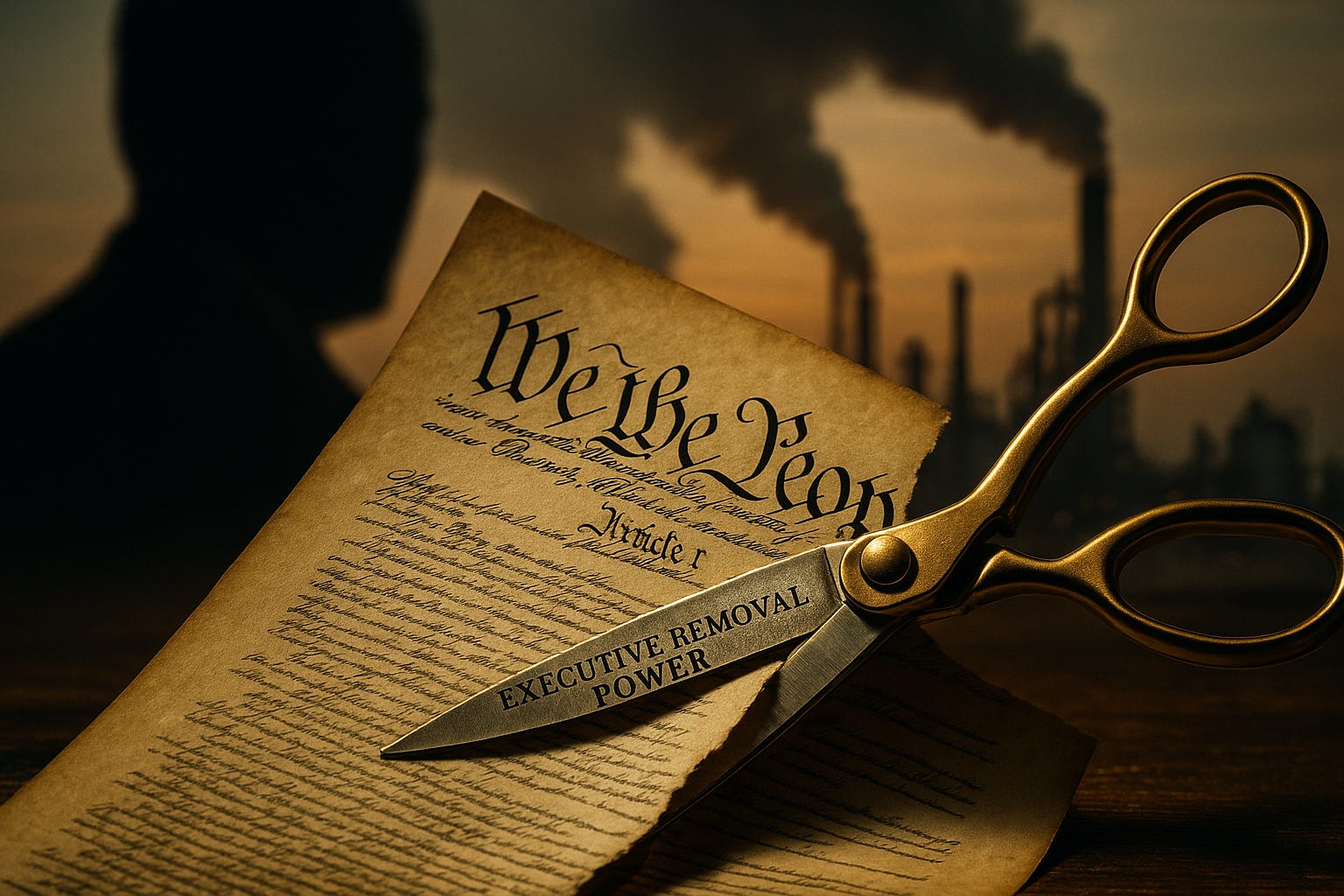
A quiet legal revolution is underway. Should a president be able to fire the leaders of independent regulatory agencies at will?
If the answer is yes, they’re no longer independent.
They become extensions of the Executive, political arms in regulatory clothing.
Imagine a future where:
A chemical company donates millions → EPA enforcement cases vanish.
Wall Street pushes back on oversight → the SEC chair gets a pink slip.
A safety official blocks a dangerous project → their replacement approves it overnight.
It’s not hypothetical. Legal arguments are already on the table. Judges are already shifting in that direction.
The technical terminology — “removal protections,” “unitary executive theory” — might sound academic, but don’t let the jargon fool you.
This is a fight over whether anyone can say “No” to a president when corporate money says “Yes.”
When watchdogs can be fired for doing their jobs… they stop doing their jobs. Independence dies. Accountability dies. People get hurt.
Oversight doesn’t collapse with fanfare. It collapses quietly while the powerful expect the public to look away.
Want to Know Your Rights?
Download a free digital copy of the U.S. Constitution, the same document Trump is trying to bulldoze. Learn exactly what he’s breaking, and how to fight back.
70,000+ strong — and counting.
This holiday, become a paid subscriber for just $1 a week and help us keep the truth alive.
Join The Coffman Chronicle — $1/Week
Courts as Gatekeepers and Enablers
The Founders split power because they knew one truth. Power always wants more power.
For generations, courts have recognized that independence is essential. Regulators must stand outside direct political pressure to protect the public. However, today, some judges seem eager to erase that firewall.
They call it “executive accountability,” but it’s really corporate control.
Because once one agency falls, the logic spreads:
Fire the consumer watchdog today
Fire the environmental watchdog tomorrow
Fire the labor watchdog next
The entire architecture of independence is connected. If a president controls the referees, the game is rigged.
The courtroom battles may sound dry — administrative law, appointments authority — but behind the legalese is a simple truth: Who protects you when the President decides corporations should be protected instead?
When courts hand over that power, the first favors go to donors — not the families breathing toxic air.
Rollbacks With Body Counts
Independence isn’t just a civic principle. It’s life and health.
Every time a safety rule is weakened, every time an enforcement action is delayed, real people pay the price.
Take formaldehyde. It’s not a mystery chemical. It causes cancer. It harms airways. It’s precisely why building products and workplaces are regulated, or they used to be. Because, under the latest revision, the “safe” exposure level is being quietly loosened, bureaucratically, without a press conference.
What does “loosened” mean in real life? It means:
A kid’s asthma becomes lifelong.
A worker’s cough becomes a diagnosis.
A new apartment that feels “off,” but tests say everything is “within legal limits.”
When limits move, sickness follows.
Corporations don’t repeal safety. They redefine it until danger disappears on paper.
That’s the corporate dream. When the most significant hazard isn’t poison — it’s paperwork.
And deregulation lands hardest on the same people every time:
Communities trapped next to factories
Workers with zero leverage
Families who can’t afford to move or sue
If you want to find the frontline of deregulation, don’t go to a boardroom. Look for the hospital nearest the industrial zone.
When Watchdogs Fear Retaliation
A watchdog that can be fired for barking stops barking.
Inside agencies, the new unspoken rule spreads fast: Don’t embarrass the boss.
Inspectors hold off on site visits to avoid conflicts.
Scientists soften conclusions because “maybe the data isn’t definitive.”
Lawyers drop politically sensitive cases, even when they’re airtight.
Whistleblowers are isolated out of sight until they resign. Enforcement teams learn to survive by doing less. The people who care most leave first.
Oversight doesn’t need to be outlawed to die. Fear kills it faster.
One high-profile firing can silence an entire agency. One quietly buried report can cost a community years of accountability.
They don’t have to rewrite every rule. They just have to make sure nobody enforces the ones that matter.
The quieter the watchdogs become, the louder corporate harm gets.
The Kitchen-Table Consequences
Americans feel this collapse not in headlines, but at home.
A $1,200 ER bill from a toxic workplace.
A child’s inhaler that insurance no longer covers because “exposure isn’t a qualifying condition.”
A landlord insisting the apartment “meets code” even when eyes burn, and lungs ache.
“Regulatory flexibility” translates to corporations saving money while you pay the difference.
Risk is being reassigned, from corporate to worker, from donor to consumer, from boardroom to living room.
And the people with the least political protection bear the highest exposure:
Rural towns with one plant
Black and brown neighborhoods boxed by highways
Low-income families next to the industrial fence line
They pay first. They pay the most. Often, they pay alone.
Regulatory independence is the shield they were promised. It is being broken.
Checks and Balances on Life Support
Our system had a simple design. Congress writes. Executive enforces. Watchdogs ensure fairness.
But now? The Executive is reaching into every corner, tightening its grip.
Environmental enforcement throttled.
Worker safety inspections delayed.
Consumer protection cases shelved.
Labor rights ground down.
Public-health standards rewritten to fit corporate comfort.
This isn’t chaos. It’s intentional. It’s the governing philosophy of a political movement that sees independent oversight as an obstacle.
When agencies are captured, profits rise, and accountability dies.
They keep the logos, the letterheads, the official seals, but strip away the mission.
That’s the most dangerous kind of decay, the kind you don’t see until the roof collapses.
What Happens If We Ignore This
Authoritarianism rarely kicks down the door. It slips in quietly while we’re distracted.
Poison becomes “acceptable exposure.” Retaliation becomes “policy discretion.” Overreach becomes “accountability.” Corruption becomes “efficiency.”
By the time the damage is undeniable, the system that could have stopped it is already gone.
Here’s the future being built if we look away:
Agencies punish enemies, not offenders
Safety rules exist only when profitable
Workers lose recourse, families lose protection
The rule of law becomes negotiable
You don’t get independent watchdogs back once they’re gone. You get whatever the people in power say you get.
The corporations cheering this shift already know who pays the bill — everyone who can’t afford a lobbyist.
This isn’t theoretical. It’s happening right now, and it accelerates every day that public attention drifts elsewhere.
When the public doesn’t watch the watchmen, there are no watchmen.
We the People Are the Last Line
Every democratic safeguard begins and ends with us.
When the government silences the watchdogs inside the system, the watchdogs outside the system must get louder.
Families hurt by pollution don’t have PR teams. Workers coughing through their shifts don’t have lobbyists. Communities suffering under toxic air don’t have Senators on speed dial.
But they have voices, and together, those voices can be impossible to ignore.
Here’s how we push back:
Follow the fine print — rule changes are where the action is.
Support whistleblowers and inspectors who risk their jobs for the truth.
Demand transparency when enforcement disappears.
Organize locally — stronger communities are harder to poison.
Support independent journalism that refuses to look away.
That’s why The Coffman Chronicle exists: To shine light where power wants darkness. To expose not just the consequences but the causes. To tell the story before the disaster hits home.
If you want this kind of reporting to continue — and grow — I need your help.
Become a paid subscriber.
You aren’t just backing a publication. You’re backing a brick wall between power and the people it prefers to exploit quietly.
Corporate interests can fire regulators. They cannot fire us.
They cannot stop millions of Americans who refuse to surrender the right to breathe clean air, work safely, and live under laws that value human life over profit margins.
The Founders built a system designed to be defended. Not someday. Not after the harm is already done. Now.
Oversight dies in silence, and we are not going silent.
Support independent media. Become a paid subscriber. Keep the fire lit.
This is our country. This is our fight, and this is our line in the sand.
Bibliography
Cancer.org. “Formaldehyde and Cancer Risk.” Last updated September 10, 2024.
EPA. “EPA Releases Updated Draft Risk Calculation Memorandum for Formaldehyde under TSCA.” December 3, 2025.
EPA. “Risk Evaluation for Formaldehyde.” Last modified 2025.
PBS. “Formaldehyde Is Everywhere, but Poses Dangers to Our Health — Here’s What to Know.” January 11, 2025.
ProPublica. Sharon Lerner. “Under Former Chemical Industry Insiders, Trump EPA Nearly Doubles Amount of Formaldehyde Considered Safe to Inhale.” December 8, 2025.
Truthout. Sharon Lerner. “Trump’s EPA Nearly Doubles Amount of Formaldehyde Considered ‘Safe’ to Inhale.” December 8, 2025.
This is scary.
Everyone in the government who is enabling the dismantling of our democracy, they are the real culprits. Trump is just the carnival barker.