


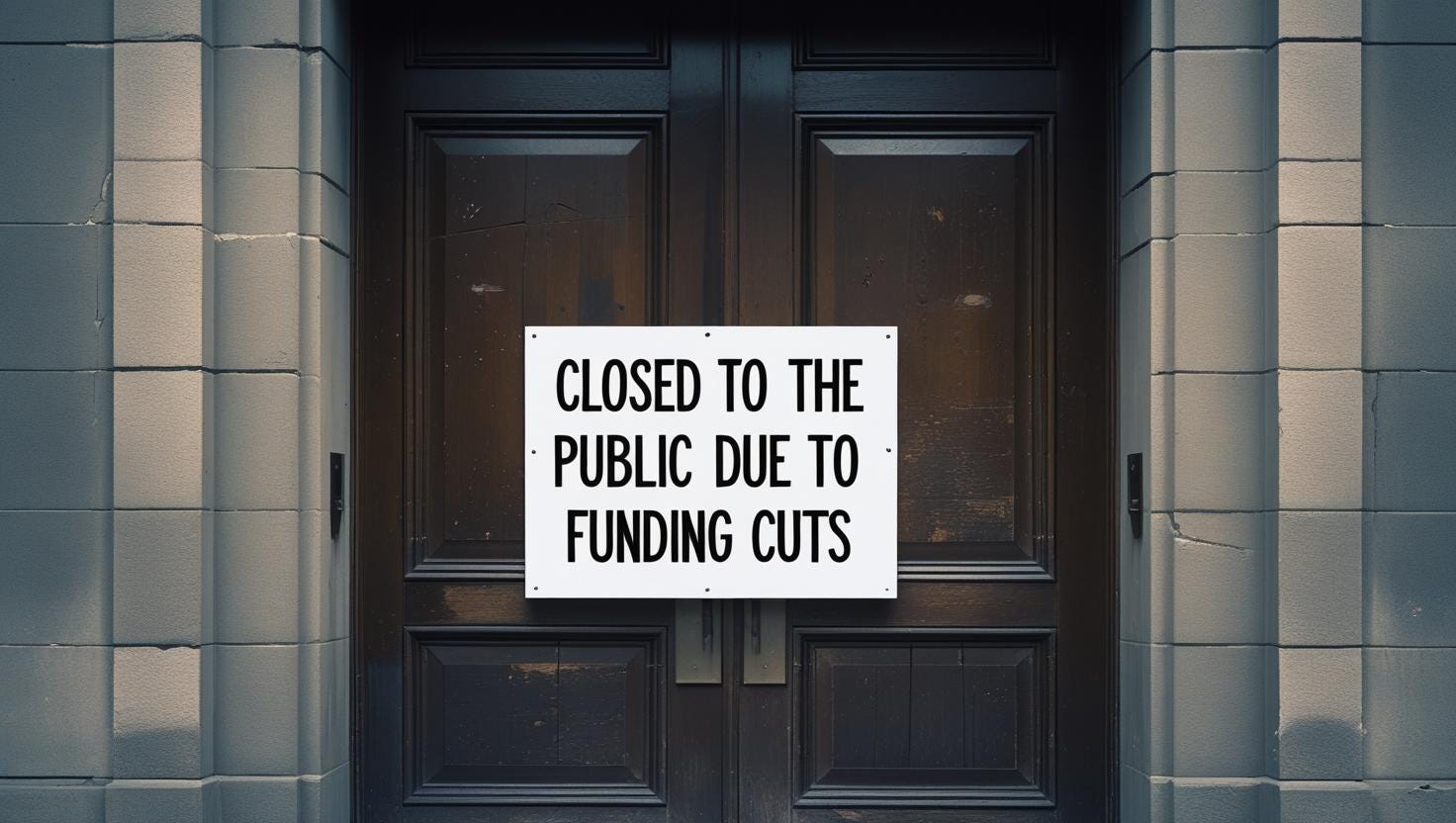
On July 1, Washington State will shut the doors of its Talking Book & Braille Library, leaving more than 7,200 blind and low-vision residents without access to the books, technology, and support systems they rely on to read. At the same time, the state’s public-facing research library and access to digital government archives will go dark. These are not isolated incidents. They are warning flares.
Libraries across the country are entering a crisis point, quietly, and in many cases, invisibly. While public attention has largely focused on banned books and political censorship, a slower, more systemic collapse has been unfolding: one driven by federal funding freezes, court battles, and a new wave of budget cuts that threaten the infrastructure libraries depend on to serve their communities.
The Talking Book & Braille Library’s 7,200 users may sound like a small number, but they represent just a sliver of the true need. Many eligible patrons never discover services like WTBBL due to barriers in outreach, access, or awareness. These programs have long operated with limited resources, and now, even that modest reach is being pulled away. And Washington is just one state. If similar closures spread—as they are beginning to—it’s not just a local loss. It’s the unraveling of a national safety net for accessibility.
We just hit 15,000 subscribers—thank you!
Get exclusive access for just $1/week or $52 a year.
Get exclusive analysis and fearless reporting you won’t find in corporate media.
The Collapse of Federal Library Support
At the center of this growing crisis is the Institute of Museum and Library Services (IMLS), a small but vital federal agency that, for decades, has quietly underwritten the operations of America’s libraries and cultural institutions. Through its Library Services and Technology Act (LSTA) grants, IMLS provides the backbone for initiatives ranging from rural broadband expansion to staff training, digitization efforts, and the Talking Book and Braille programs that visually impaired patrons depend on.
In March, an executive order from President Donald Trump directed the Office of Management and Budget (OMB) to halt all IMLS funding not directly related to agency dismantlement. Roughly 70 agency staff were placed on administrative leave, and hundreds of grant payments were frozen. The move triggered legal challenges from at least 21 states and a temporary court order halting the full dismantling of the agency, but the damage was already underway.
With no staff to process grants and no direction from OMB, the IMLS effectively entered a state of suspension. For libraries and state agencies that depend on those federal funds to plan their annual budgets, the uncertainty has been devastating. Several states have already begun making preemptive cuts, scaling back or closing services entirely to avoid mid-year funding collapses.
“You can’t run a library system on a blank check,” one state librarian told us. “If IMLS doesn’t deliver, we either make cuts now, or we make them when it’s already too late.”
For many libraries, particularly those in rural or underserved communities, IMLS support isn’t a bonus; it’s a lifeline. Without it, the systems that keep libraries equitable, accessible, and effective begin to unravel.
We’ve covered the cuts to IMLS and libraries in general for months. See some of our reporting here:
Note: This article is more than 45 days old and now lives in our archive. Become a paid subscriber for the full 650+ article archive, exlusive content, and occasional early access.


The Trickle-Down Impact on State and Local Libraries
When IMLS funding stalls, it isn’t just a federal hiccup. It’s a direct hit to the foundation that public and school libraries stand on. And it’s already forcing difficult choices.
In Maine, the state library laid off staff and temporarily closed its doors. Indiana eliminated major digital services and laid off 16 employees. Massachusetts, Mississippi, and South Dakota are all scaling back or suspending statewide access to shared digital platforms, such as e-book and research databases.
In Pennsylvania, where most public libraries fundraise for up to 80% of their budgets due to the lack of municipal support, even modest cuts to state-provided platforms like PowerLibrary could be catastrophic. That database, now facing a 50% funding cut, provides research access to thousands of students and patrons who could never afford these tools on their own.
“We’re talking about a subscription model that, if purchased individually, would cost each library tens of thousands of dollars annually,” said one district librarian. “It’s simply not feasible.”
Without state and federal coordination, the burden shifts entirely to local libraries, many of which are already under-resourced. Some will manage. Many will not.
The Disappearance of the Public Record
When a state library shuts its doors, it doesn’t just lose books or staff; it loses access, not just for patrons, but for researchers, journalists, legislators, and citizens trying to understand how their government works or what happened in their state’s past.
State libraries hold the official records of laws, regulations, court opinions, and executive actions. They preserve historical newspapers, land records, legislative archives, and public agency reports. They are, in effect, the memory of the state.
In Washington, the upcoming July 1 closure of the State Library’s research facility and Braille services will shutter access to those collections. As Secretary of State Steve Hobbs warned, “Libraries are cornerstones of civic life and education in many areas of our state. The impact of the closures will risk denying communities access to the information, literacy tools, and resources they depend on.”
The toll is personal. Marci Carpenter, a blind patron and long-time user of the Braille library, put it plainly: “I can’t walk into a public library and get a Braille book. This is the only place in the whole state of Washington where I can do that. It’s really a lifeline for people.”
State Librarian Sara Jones added, “These disruptions jeopardize equitable access to information for some of Washington’s most underserved residents, unable to read standard print.”
And despite the assumption that “everything is online now,” only about 10 to 15 percent of most state library collections have been digitized. The rest, including decades of newspapers, court records, policy documents, maps, and manuscripts, remain in physical form. When the doors close, those records don’t just become harder to find. They vanish.
As Arthur Curley, a past president of the American Library Association, once said about libraries: “If you blindfolded me and dropped me into any town, I could walk into the library and, in ten minutes, learn more about the values of that community than hours spent poring over census data.” The library tells the truth of a place unless no one can get inside.
The Long Erosion
None of this began with a single executive order. It’s the result of decades of slow disinvestment. The 2008 recession had a severe impact on public library budgets, and many states have yet to recover fully. As demands on libraries grow to offering job training, tech access, literacy programs, and even acting as public cooling centers, the funding has continued to shrink.
At the same time, the cultural narrative shifted. Libraries were “obsolete.” Google is free. Everything is “already online.” However, that myth has consistently overlooked the reality that access isn’t just about information. It’s about equity. It’s about the skills to find that information, the time to read it, the devices to access it, and the community institutions to help you make sense of it.
Libraries were treated like relics, but they were doing the work of resilience.
Now, even as libraries face harassment over book bans and political programming, the financial structure that supported them is being dismantled, state by state, grant by grant. The erosion took time. The collapse is moving faster.
Here at the Coffman Chronicle, we love libraries and have reported many times on the value of this essential public service. See some of that reporting here:
Note: This article is more than 45 days old and now lives in the archive. Consider becoming a paid subscriber for full access and other exclusives.


This Isn’t About Libraries. It’s About Power
It’s tempting to see all this as “just a library issue,” but that would be a mistake.
Libraries are where children learn to read and seniors learn to connect. They are where immigrants study for citizenship, and students access databases they can’t afford. They are where our public record lives. To dismantle them is not accidental. It’s strategic.
These aren’t budget quirks. The Executive Orders, DOGE cuts, budget packages, and recission bills are designed to codify these austerity measures, slice by slice, until there is nothing left. They are part of a broader agenda to shrink the public’s right to know, to erase historical accountability, and to privatize access to information.
This is just the beginning. Unless Congress acts or lawsuits are successful, more states will follow. What we’re losing isn’t just collections. We’re losing our shared memory.
When the library closes, it’s not just the building that disappears; it's the community that disappears as well. It’s the access, the accountability, and the truth.
See our reporting on authoritarianism and Project 2025 here:
Note: These articles are more than 45 days old and now live in the archive. Become a paid subscriber for the full 650+ archive, exclusive content, and occasional early access.


What You Can Do Before the Shelves Go Dark
This is not inevitable. It’s political. And it’s reversible if we act now.
Call Your Elected Officials
Your voice matters, and it takes two minutes.
Call the U.S. Capitol Switchboard at (202) 224‑3121 to be connected to your representatives.
Demand complete restoration of funding for the Institute of Museum and Library Services (IMLS).
Tell them libraries are essential public infrastructure, not political bargaining chips.
Call your local representatives.
Tell them that their citizens deserve the services provided by state and public libraries.
Demand that your state fund and adequately resource libraries to offset federal political theater.
Support Local Libraries
Many public libraries depend on fragile local support.
Attend municipal budget hearings. Speak out at city council meetings.
If your library has a Friends group, foundation, or fundraising campaign, join it.
If they’re under attack from political groups or facing ballot initiatives, rally behind them.
Show your support, however your resources permit. Libraries have one of the highest returns on investment for every dollar spent. If you can donate or volunteer, please do.
Support Library Advocates
Organizations like EveryLibrary are fighting to keep libraries funded and free.
Donate if you can.
Share their alerts.
Sign petitions.
Follow watchdogs like Library Journal and the ALA’s Office for Intellectual Freedom, as well as grassroots defenders like Unite Against Book Bans.
Build Community Coalitions
Libraries can’t fight this alone. Reach out to unions, disability rights groups, educators, veterans’ organizations, and local civic clubs. Coordinate. Mobilize. Invite library staff to speak at community events. Ensure that people understand what is at stake.
Democracy only works when information is free, accessible, and preserved. If we want to live in a country where history isn’t deleted and truth isn’t paywalled, we need to protect the institutions that make that possible.
Because when the library closes, the lights don’t just go out. They don’t come back on unless we turn them back on together.
We just hit 15,000 subscribers—thank you!
Get exclusive access for just $1/week or $52 a year.
Get exclusive analysis and fearless reporting you won’t find in corporate media.
Bibliography:
American Library Association. “Court Allows Trump Administration to Proceed with Efforts to Destroy Institute of Museum and Library Services.” ALA News, June 6, 2025.
“FAQ: Executive Order Targeting IMLS.” American Library Association, May 1, 2025.
American Library Association. “Federal Court Halts Dismantling of Federal Library Agency in ALA Lawsuit.” ALA News, May 1, 2025.
Secretary of State of Washington. “Washington State Library’s Research Library, Washington Talking Book & Braille Library Closed to Public Due to Budget Shortfall,” June 2025.
“Money crunch: Nearly 50 WA State Library employees facing layoffs.” Washington State Standard, May 13, 2025.
“Trump Admin. Cuts Library Funding. What It Means for Students.” Education Week, March 19, 2025.
The Art Newspaper. “Trump administration violated the law by withholding museum and library funding, GAO confirms.” June 17, 2025.
AP News. “Libraries are cutting back on staff and services after Trump’s order to dismantle small agency.” May 18, 2025.
Cascade PBS. “Dual budget cuts prompt layoffs, closures for WA state libraries.” June 2025.
KUOW. “Washington’s libraries face ‘deep and dramatic’ funding cuts… Trump terminates federal grants.” April 11, 2025.
Politico. “White House looks to freeze more agency funds—and expand executive power.” June 12, 2025.
Spokesman-Review. “Washington State Library closing to the public, 12 jobs getting axed.” June 6, 2025.
Time. “How Libraries Are Faring Under the Trump Administration Amid Detrimental Funding Cuts.” April 26, 2025.
“Institute of Museum and Library Services.” Wikipedia, The Free Encyclopedia.
This is really sad news. Libraries are critical to the well being of so many people and they should be protected at all cost. The suggestions for how to help are great, thanks for sharing them. Now if only we could also get some billionaires step in and fund these WA libraries short term to prevent them from closing. Bill Gates? Melinda French?
So sorry to hear that.
Perhaps poorly educated people are easier to govern ??