


On March 8, 2026, a federal judge delivered what looked, at first glance, like a decisive rebuke to one of the most aggressive episodes of the DOGE experiment. Judge Royce Lamberth ruled that actions taken to dismantle Voice of America were unlawful, voiding the authority of the official who carried them out and ordering a restoration of the agency’s operations.
It was a striking moment. After more than a year of disruption, layoffs, and silence across large portions of VOA’s global broadcasts, a court had finally drawn a clear line. The executive branch could not simply take a congressionally funded institution and hollow it out from within.
Yet the relief, while real, is fragile. The administration has already signaled it will appeal. Even if the ruling stands, the deeper reality is harder to escape. VOA is only one piece of a much larger story, and the damage done over the past year cannot be undone with a single decision.
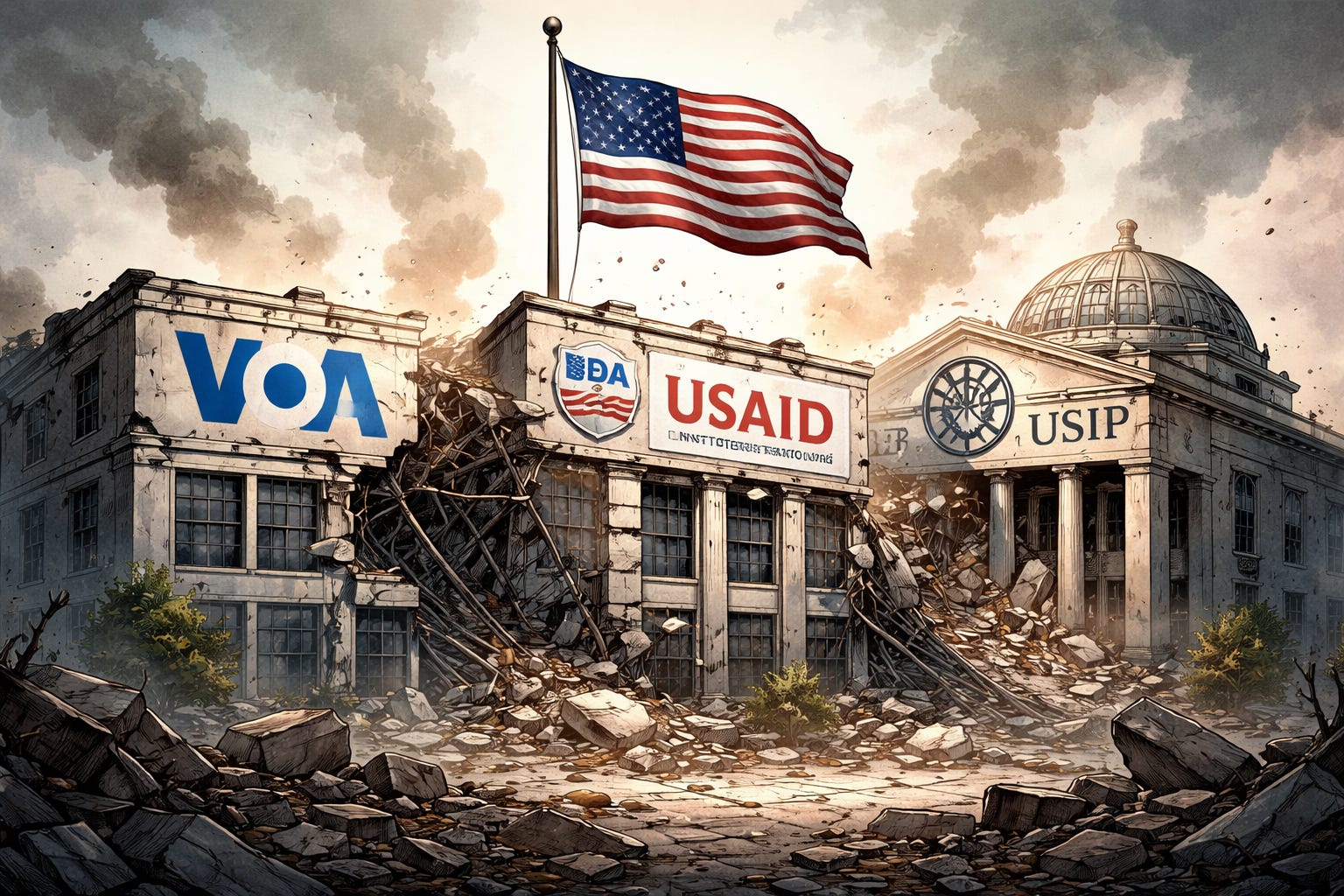
More than a year after DOGE began its sweeping cuts, three of the most consequential U.S. institutions operating on the global stage remain deeply impaired. VOA, the United States Agency for International Development, and the United States Institute of Peace were all gutted in rapid succession. Each now sits in a different stage of legal limbo. Together, they tell a larger story about how quickly institutional capacity can be dismantled, and how slowly it returns, if it returns at all.
This Community Is Powered by You
What started as a small circle has grown into something much bigger, and it’s all because of readers like you.
Every time you forward this email, post it on socials, or bring someone new into the fold, you’re helping build one of the most passionate, independent political communities out there.
Want to keep the momentum going?
Share this newsletter with someone who should be part of this conversation.
Thank you for being here. It means everything.
The VOA Ruling
A Year of Dismantling
To understand the significance of the March 2026 ruling, it helps to recall how quickly VOA unraveled. In early 2025, leadership installed under the U.S. Agency for Global Media (USAGM) began implementing sweeping changes. Staff were placed on leave. Contracts were terminated. Language services went dark or sharply reduced. What had been a global newsroom reaching hundreds of millions was reduced to a skeleton operation.
See our reporting from last March here:
Note: Articles move into the archive over time. Become a paid subscriber for full access to our extensive catalog.

These moves were justified publicly as part of a broader effort to eliminate waste and realign priorities. In practice, they amounted to a near-total shutdown of normal operations.
What the Court Said
Judge Lamberth’s ruling focused on a fundamental issue of authority. He found that the official overseeing these changes, Kari Lake, was not lawfully appointed under federal law. Because her appointment was invalid, her actions in that role were also invalid.
That conclusion has sweeping implications. It does not merely criticize how VOA was dismantled. It declares that the dismantling itself had no legal foundation.
The court ordered that VOA’s operations be restored and that employees be reinstated. In legal terms, this is as strong a rebuke as a district court can deliver.
What Happens Next
The administration’s appeal is expected and will likely define the next phase. The immediate question is whether an appellate court grants a stay, which would pause the ruling while the case is reviewed. If a stay is granted, VOA remains in its diminished state. If it is denied, restoration must begin even as the appeal proceeds.
Even in the best-case scenario, restoration will not be simple. Many journalists have moved on. Others may hesitate to return, given the risk of another reversal. They have, after all, already been through it once last May. Institutional knowledge, once lost, is difficult to rebuild. A global broadcaster cannot simply flip a switch and resume full operations.
The ruling matters because it establishes a clear legal boundary, yet it arrives after a year in which VOA’s capacity, credibility, and continuity have already been deeply compromised.
Three Institutions, One Pattern
VOA’s story is not unique. It is one example of a broader pattern that unfolded across multiple agencies in early 2025.
The three institutions most affected share little in structure, yet they serve a common purpose. Together, they represent key pillars of American civilian engagement with the world. VOA provides independent news in regions where press freedom is limited. USAID delivers humanitarian aid, health programs, and development assistance. USIP works on conflict prevention and peacebuilding.
Each plays a different role. All depend on continuity, expertise, and trust. All were disrupted at the same time.
That timing is difficult to ignore. The past year has seen continued war in Ukraine, ongoing violence in Gaza, and continuing escalation in Iran. These are precisely the kinds of conditions in which aid programs, credible information, and diplomatic engagement are most needed.
Instead, those capacities were weakened simultaneously.
USAID and USIP: Legal Fights, Uneven Recovery
USAID: Funding Without Function
The legal battles surrounding USAID have centered largely on appropriations law. Under the Impoundment Control Act of 1974, the executive branch cannot simply refuse to spend money that Congress has appropriated. Several court rulings have reinforced that principle, rejecting attempts to withhold billions in foreign aid.
These decisions are significant. They affirm that Congress retains authority over federal spending. However, they do not fully restore what was lost.
See some of our reporting on USAID here:
Note: Articles move into the archive over time. Subscribe for full access to our extensive catalog.


USAID is not just a budget line. It is a network of programs, partnerships, and personnel operating across the globe. When contracts are canceled and organizations shut down, the effects ripple outward. Clinics close. Supply chains break. Local partners lose trust. Restarting funding does not automatically restart the system.
Even if the courts ultimately require full compliance with congressional appropriations, the agency that emerges will not be the same as the one that existed before.
USIP: A Quieter Collapse
The situation at USIP is less visible but no less significant. In March 2025, DOGE-linked personnel entered the institute, removed leadership, and took control of its operations. A lawsuit followed almost immediately, with USIP arguing that the takeover violated its statutory independence.
A federal judge sharply criticized the manner in which the takeover was carried out, describing it as deeply troubling. However, immediate relief was limited, and the case has moved more slowly through the courts.
See some of our reporting relating to USIP here:
Note: Articles roll into the archive over time. Become a paid subscribe for full access to our extensive catalog.

USIP’s vulnerability lies in its scale. Unlike USAID, it does not manage large funding streams. Unlike VOA, it does not broadcast daily to a global audience. Its value is embedded in relationships, expertise, and credibility in fragile environments.
Those are precisely the qualities that are hardest to rebuild once disrupted.
Congress and the Erosion of Article I
What Congress Could Have Done
The Constitution gives Congress the power of the purse. It creates agencies, funds them, and defines their missions. When those agencies are dismantled without congressional approval, the institution has both the authority and the responsibility to respond.
Congress did not need to defend every program in its existing form. It could have debated reforms, reprioritized funding, or even approved reductions. What it could have insisted upon was process. Changes of this magnitude were meant to occur through legislation, not unilateral executive action.
A clear, bipartisan statement to that effect would have carried significant weight. It would have signaled that institutional authority mattered, even when policy preferences differed.
What Congress Actually Did
Instead, the response was fragmented and muted. Hearings were held, concerns were raised, yet no unified institutional defense emerged.
In some cases, Congress moved in the opposite direction, considering or approving rescissions that aligned with the cuts already underway. That dynamic effectively shifted the sequence from legislative decision-making to retroactive validation.
See some of our coverage of the recissions here:
Note: Articles roll into the archive over time. Become a paid subscriber for full access to our extensive catalog.

The result was a missed opportunity. The most direct check on executive overreach did not fully materialize. Courts were left to address questions that Congress could have confronted earlier and more decisively.
The Precedent Going Forward
This matters beyond the specific agencies involved. If the executive branch can act first and rely on Congress to respond later, the balance of power shifts in practice. Article I remains intact on paper, yet its force depends on whether legislators are willing to assert it.
The past year suggests that willingness cannot be assumed.
The Cost of Lost Time
The legal process will continue. Appeals will be filed, and rulings will be reviewed. Some decisions will be upheld, others narrowed. Over time, portions of these institutions may be restored.
What cannot be restored is the year that has already passed.
For VOA, that year represents lost reporting, diminished reach, and interrupted relationships with audiences around the world. For USAID, it includes halted programs, disrupted care, and communities left without support. For USIP, it means fractured networks and diminished credibility in places where trust is already fragile.
These losses are not easily measured in budgets or staffing levels. They are measured in absence, in what did not happen.
A System That Corrects Too Late
The VOA ruling is important because it affirms that there are legal limits to what the executive branch can do. It demonstrates that courts are willing to enforce those limits.
However, it also highlights a deeper problem. The system is capable of correcting unlawful actions, but it often does so only after significant damage has occurred.
That gap between action and correction is where institutions are weakened. It is where capacity is lost, and trust erodes. It is where the consequences of governance choices become real and, in many cases, irreversible.
The story of VOA, USAID, and USIP is not just about three agencies. It is about how quickly power can be exercised, how slowly it is checked, and what is lost in the space between.
If you found this piece valuable, consider subscribing.
We’re focused on connecting the dots between fast-moving political decisions and their real-world consequences—what happens after the headlines fade, in the institutions, systems, and communities that shape our daily lives.
Subscribe to get clear, grounded analysis like this delivered straight to your inbox.
Sources:
March 17, 2026, “Judge reinstates 1,000 Voice of America employees, deems wind-down illegal,” The Washington Post
March 8, 2026, “US judge voids 2025 actions taken by Kari Lake as Voice of America CEO, including job cuts,” Reuters
May 3, 2025, “US court halts ruling ordering Voice of America employees back to work,” Reuters
April 22, 2025, “Federal judge blocks Trump administration from dismantling Voice of America,” Associated Press
March 17, 2026, “Trump administration cannot implement ‘sweeping’ funding freeze, US court rules,” Reuters
September 4, 2025, “US judge blocks Trump from unilaterally cutting foreign aid funding,” Reuters
September 5, 2025, “US appeals court says Trump cannot continue foreign aid cuts,” Reuters
March 18, 2025, “US judge finds Musk’s USAID cuts likely unconstitutional, blocks him from making more cuts,” Reuters
March 19, 2025, “Judge denies request for temporary order to bar DOGE from USIP takeover,” Reuters
March 19, 2025, “US Institute of Peace sues Trump, DOGE over executive order, firings,” Reuters
Great information. But a sad reminder of the far reaching impact of these decisions. The gutting of USAID is the most heartbreaking to me. What could have and should have happened by Congress at the time this was happening, did not. I assume like everything other decision that is in the hands of Congress, the Republicans would not do their jobs and put the brakes on interfering with these decisions. The Democrats cannot do it alone, as we know. So to me, what this confirms is that we must protect voting rights, we must get people out to vote and we must win in every local, state and federal election. So let's do it!
In the little sphere of personal relationships, a break of more than a year of good conversations is likely to be difficult to overcome and heal. I hope that in the really big world of the international, intergovernmental institutions, real people have maintained connections. I imagine there has been and will be pain and sadness at the shutdowns. But I hope the connections are alive and can be transformed for the better when a more humane majority takes control in the capital. (I imagine the time apart will be like a prison sentence unjustly imposed and hard to endure within and without.)