


Where American Politics Actually Changes
American politics rarely changes where we are told to watch.
Cable news trains us to look at presidential elections. Social media fixates on national outrage cycles. Polling treats voters as static blocks whose preferences harden all at once. However, political change does not usually begin in places with high visibility or high turnout. It begins where attention is thin, rules are flexible, and the consequences are felt immediately by small groups of people who cannot afford abstraction.
It begins locally.
Local politics is not a sideshow to national politics. It is the environment where national ideas are first tested under real-world conditions — low turnout, uneven information, personal relationships, and institutions that matter deeply to daily life but attract little sustained scrutiny. These conditions make local government uniquely vulnerable to experimentation, but also uniquely revealing.
That is why local political battles deserve more attention than they receive, not because they predict the future, but because they show how political forces behave before they are widely understood.
Want to Know Your Rights?
Download a free digital copy of the U.S. Constitution, the same document Trump is trying to bulldoze. Learn exactly what he’s breaking, and how to fight back.
100,000+ strong — and counting.
This holiday, become a paid subscriber for just $1 a week and help us keep the truth alive.
Join The Coffman Chronicle — $1/Week
Local Politics as a Stress Test
Every political movement faces the same fundamental challenge: translating ideology into power. National campaigns sell values. Local governance imposes consequences.
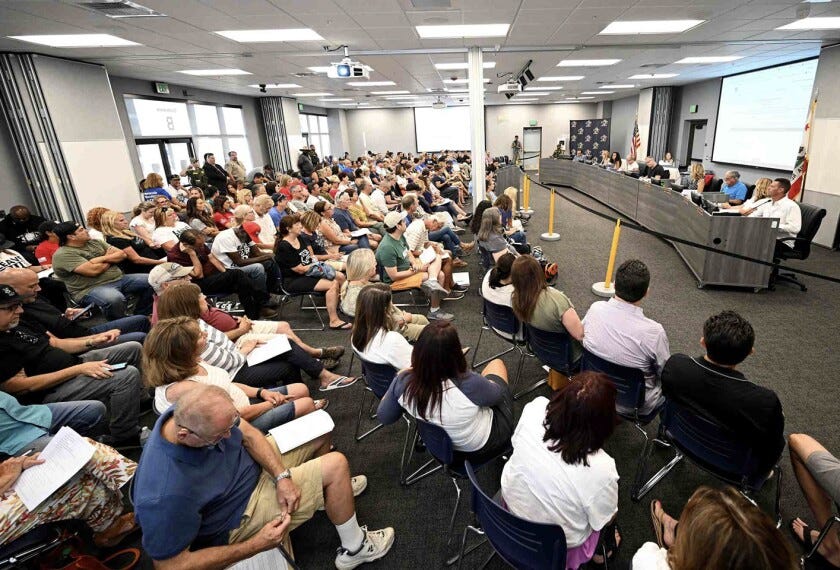
At the local level, ideas collide with reality quickly. Policies are not debated in abstract terms. They determine which books remain on shelves, how classrooms are run, how elections are administered, and who gets to participate in decision-making at all. When a political strategy succeeds locally, it does so not because it is popular everywhere, but because it exploits specific conditions: low engagement, procedural control, and institutions with outsized influence over everyday life.
This makes local politics a stress test. Strategies that fail quietly are discarded. Strategies that succeed are refined.
By the time similar ideas appear at the state or national level, they have often already been tested, not in theory, but in practice.
The Visibility Gap
Local politics suffers from a structural invisibility problem. Local elections typically draw far fewer voters than national contests. Media coverage is sparse, episodic, and often under-resourced. Many people cannot name their school board members or library trustees, even though those bodies exercise direct authority over education, access to information, and community norms.
This gap between power and attention is not accidental. It is a structural feature of American democracy.
Low-visibility institutions are easier to organize around, influence, and capture. They are also easier to reframe. A national policy debate invites scrutiny and opposition. A local procedural change often does not.
That does not make local politics less important. It makes it more consequential.
How National Conflict Gets Localized
National political conflict does not arrive intact at the local level. It is translated.
Culture-war rhetoric rarely survives first contact with a town meeting unchanged. It becomes a dispute over a school curriculum, a library acquisition policy, a parental complaint, or a school board vote scheduled on a Tuesday night.
These translations matter because they reveal how voters respond when national narratives become personal. Do people mobilize? Do they disengage? Do they reorganize? Or do they retreat, assuming someone else is paying attention?
The answers vary by community, but the mechanisms repeat.
Organization Matters More Than Ideology
One of the most persistent myths in American politics is that elections are decided primarily by persuasion. In reality, they are often decided by organization.
Local politics makes this visible in ways national elections obscure. When turnout is low, organization matters more than broad appeal. When institutions are small, motivated minorities can exert disproportionate influence. When oversight is limited, procedural control becomes a form of power.
This does not require a conspiracy. It requires incentives.
Groups that invest in understanding local rules, meeting schedules, and appointment processes gain an advantage over those who treat politics as episodic or symbolic. Over time, these advantages compound.
Local politics reveals which actors understand this and which ones do not.
Why This Matters Now
The United States is living through an era of intense national polarization, but polarization alone does not explain how political change actually happens. Change happens when ideas find institutional footholds. Local governments provide those footholds first.
This is not a claim about inevitability. Local outcomes do not determine national destiny. Many local efforts fail. Some generate backlash. Others expose limits that prevent broader adoption.
That, too, is part of the process.
Local politics shows us what works, what fails, and what provokes resistance before larger political systems absorb those lessons. Ignoring it does not make those lessons disappear. It simply ensures they are learned without public scrutiny.
Moms for Liberty and the Mechanics of Local Power
To understand how national political movements learn to operate, it is not enough to study rhetoric. Rhetoric persuades, but organization governs. The most instructive examples of political change are found not where messages are broadcast, but where they are converted into institutional control.
Few recent movements illustrate this more clearly than Moms for Liberty.
The organization did not begin as a national force. It emerged from pandemic-era school disputes and focused on school boards — obscure bodies with real authority, low-turnout elections, and minimal press coverage. That choice was strategic.
School boards sit at the intersection of culture, governance, and everyday life. They control curriculum, library access, and disciplinary policy. They affect families directly, but operate far below the level of sustained national attention.
Why School Boards Matter
School board elections are typically nonpartisan, lightly contested, and poorly covered. In many districts, a few hundred votes can determine policy for tens of thousands of students.
This creates a structural imbalance. Highly motivated groups can dominate participation even when they represent a minority of the broader community. They do not need to persuade everyone. They need only to show up consistently and understand the rules.
Moms for Liberty understood this early.
Rather than seeking national consensus, the organization focused on replicable local victories. Chapters formed around districts. Candidates were recruited. Talking points were standardized. Legal language circulated. Wins were shared internally, reinforcing tactics that worked and discarding those that did not.
This is how political organizations learn.
From Local Grievance to Infrastructure
Local chapters were not left to improvise. They were given frameworks for framing complaints procedurally, navigating public-comment rules, and pressuring administrators using transparency laws.
Each local contest became an experiment. When tactics succeeded, they were documented. When they failed, they were adjusted or abandoned.
By the time the organization drew national attention, its local strategies had already been tested repeatedly.
Backlash as Data
Backlash did not end the model. It refined it.
In some districts, Moms for Liberty-aligned candidates were defeated or removed. Those outcomes mattered, but they also revealed limits, points of resistance, and vulnerabilities.
Political movements that learn from backlash become more sophisticated. They adjust tone, shift targets, or relocate to institutions where resistance is weaker. Local politics provides this feedback earlier than national elections ever could.
Organization Over Persuasion
At the local level, winning rarely requires majority support in the abstract. It requires turnout among a motivated base, procedural fluency, and persistence.
Local politics exposes how unevenly power is distributed between those who engage continuously and those who engage episodically.
Beyond Education
Moms for Liberty matters not only because of education policy, but also because it demonstrates how national movements build operational capacity through local institutions.
Local governments function as laboratories. Ideas are tested, refined, normalized, or quietly abandoned long before they reach broader stages.
Beyond Schools: How Power Moves Through Low-Visibility Institutions
Once school boards are understood, the same mechanics appear elsewhere.
Libraries, county boards, election offices, and municipal commissions share key traits: limited media attention, procedural governance, and outsized influence over daily life.
Procedural conflicts are harder to mobilize against than overt ideological fights. They unfold slowly, require familiarity with rules, and demand sustained attention — all of which favor organized minorities over the general public. The same dynamics appear across county boards, municipal authorities, and election offices, where agenda control, meeting schedules, and administrative discretion shape outcomes long before any public vote is taken. These are not dramatic levers of power. They are quiet ones, and that is precisely why they are effective.
Election Administration
Election mechanics are handled locally. Polling locations, staffing, ballot design, and certification timelines are administrative decisions, but they shape participation without changing a single voter’s preference.
Motivated actors who engage consistently gain leverage. The barrier is not opinion. It is persistence.
Engagement vs. Exhaustion
Repeated procedural conflict does not always mobilize voters. Often, it exhausts them.
Meetings grow hostile. Participation shrinks. Governance continues, but with fewer voices. This creates a feedback loop that rewards persistence over popularity.
The Myth of Sudden Change
What appears sudden nationally is usually cumulative locally.
National shifts are often the delayed recognition of strategies that have already been quietly tested elsewhere.
Local institutions do their work long before outcomes become visible.
From Local Wins to National Strategy
Local politics does not remain local. It feeds upward — not automatically, but intentionally. What succeeds in one school district, county board, or municipal authority becomes a reference point for future efforts. Over time, these local lessons shape how political organizations recruit candidates, allocate resources, and define strategy.
This is how national politics quietly changes, not through sudden inspiration, but through accumulated evidence gathered in places where attention is low, and experimentation is cheap.
Local offices serve as training grounds. Candidates learn governance, conflict management, and institutional fluency. Wins produce proof. Losses still produce data.
Over time, this creates informal but effective pipelines.
What looks spontaneous nationally is often the product of years of local rehearsal.
But local strategies do not scale without resistance, and it is in that resistance that the limits of local power become visible.
Engagement, Backlash, and the Limits of Local Power
Backlash is not an anomaly. It is part of the system.
When attention returns, incentives change. Turnout rises. Media scrutiny increases. Some local gains unravel. Others endure, especially those embedded in governance structures rather than individual decisions.
Backlash sorts communities. Some mobilize briefly. Others reorganize deeply. Many disengage entirely.
Disengagement is the quietest outcome and often the most consequential. Institutions continue functioning, but with shrinking circles of influence.
Local power is not unlimited. Many strategies fail when scaled. Others provoke counter-mobilization strong enough to halt them.
Local politics guarantees neither success nor failure. It guarantees information.
What Local Politics Tells Us If We Pay Attention
American politics does not transform in moments alone. It transforms in places where attention is low and consequences are immediate.
School boards. Libraries. County offices. Municipal authorities.
These are not side stages. They are where political change is rehearsed.
Local politics does not predict national outcomes. It reveals what is being tested, what is being learned, and what is being normalized long before voters are asked to weigh in.
Ignoring local governance does not prevent national change. It ensures that change arrives fully formed and harder to contest.
The question is not whether local politics matters. It always has.
The question is whether we are willing to pay attention before the consequences are unavoidable.
Support Independent Journalism That Pays Attention Where Power Actually Moves
This kind of reporting doesn’t come from cable panels or press releases. It comes from paying attention where most outlets don’t — to local institutions, quiet power shifts, and the early signals of political change.
Legacy media often ignore local power until it’s too late. The Coffman Chronicle exists to fill that gap with deeply reported, reader-funded journalism that follows how power actually works.
If this piece was useful to you, consider becoming a paid subscriber. Your support keeps this work independent, accountable, and focused on the stories that shape our lives long before they become headlines.
Sources:
Moms for Liberty: Where Are They, and Are They Winning? October 10, 2023. Brookings
Moms for Liberty. Encyclopedia Britannica
Moms for Liberty Is Using School Boards to Advance Its Anti-LGBTQ Agenda. October 27, 2023. GLAAD
Moms for Liberty. n.d. About. https://www.momsforliberty.org/about/. Moms for Liberty
Far-Right Group Moms for Liberty Poised to Clash with Teachers Unions Over School Board Races Nationwide. July 2, 2023. PBS
Can School Boards Survive the “Parents’ Rights” Movement? February 8, 2024. Teachers College Columbia University
School Board Elections in the U.S.: What Research Shows. May 28, 2024. The Journalist’s Resource
The Political Influence of Mothers in Educational Activism. University of Chicago Knowledge. Knowledge@UChicago
Politics and Education. November 17, 2023. CQ Press
6 Signs Moms for Liberty Have Come to Your Town. October 23, 2023. ACLU of South Carolina
How Moms for Liberty Has Changed School Boards and Book Bans. March 8, 2024. Fourteen East
Congratulations on one of the BEST summaries of how Power works and is shaped in America! There is one other element to this that was barely touched upon that also significantly shapes the view power works in the US. It is money.
Money allows, feeds, and encourages Persistence. Money shapes the Message and directs, supports and focuses Persistence.
In real local terms, it's why the largest taxpayers have no trouble getting their calls answered by the Mayor, the Chief of Police, and the Superintendent of the school district. Money is why the position (s) and version of events of those same moneyed "Voters" is "heard" and repeated by local news outlets.
There is an unspoken and innate bias built into the American psyche that believes people with money know better than those without it.
That's why, from it's inception, money has ALWAYS controlled American politics, local AND national.
So as we focus on the need for persistent action and involvement, let's also be realistic about what that costs, and why it is so rare. Because the cost to the "average citizen" is always so much more than the cost to a rich oligarch, whether local or national.
Yes, David can defeat Goliath. But it takes more than organized persistence to be successful.
I enjoyed these insights on local politics. Here's a piece I wrote that is related, an example of small town politics at work: https://denniscmerritt.substack.com/p/small-town-politics