


While the headlines fixated on the “release” of the Epstein files, military strikes and kidnapping of Maduro in Venezuela, and civilian uprisings in Iran, another kind of story has more quietly been unfolding at home, one that speaks volumes about power, priorities, and who pays the price. In the dead of winter, with only demolition complete and no finalized design in place, President Trump was photographed shopping for luxury marble slabs, not for public infrastructure or disaster relief, but for his $400 million White House ballroom.
It’s just one of several extravagant projects now underway or in planning, including a $100 million “Triumphal Arch” set to disrupt one of D.C.’s busiest traffic circles, and a $50 million redesign of a military golf course he doesn’t even use. Each comes wrapped in vague promises of private funding and patriotic symbolism. However, the reality is harsher. While the President and his cronies are partying in Mar-a-Lago, Trump is funneling public resources — whether directly or indirectly — into vanity monuments and elite-only playgrounds, even as working Americans face rising costs, shrinking paychecks, and gutted support systems. The opulence is the point, and you’re footing the bill.
Want to Know Your Rights?
Download a free digital copy of the U.S. Constitution, the same document Trump is trying to bulldoze. Learn exactly what he’s breaking, and how to fight back.
100,000+ strong — and counting.
This winter, become a paid subscriber for just $1 a week and help us keep the truth alive.
Join The Coffman Chronicle — $1/Week
The $400 M Ballroom You’ll Never Dance In
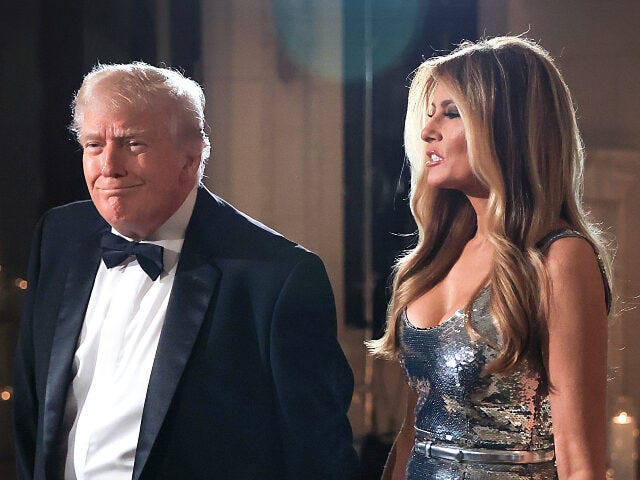
The East Wing is gone. Bulldozed almost overnight on October 20th under a veil of vague promises and a rushed timeline, it was sacrificed to make way for President Trump’s most extravagant personal addition yet, a towering, gold-accented White House ballroom. In his public remarks, the project has been framed as a tribute to America, a space for elegant diplomacy and formal state events. However, beneath the surface, it’s quickly revealing itself to be something else entirely: a private monument to excess.
See our October reporting here:
Note: Articles roll into the archive over time. Please consider becoming a paid subscriber for full access to our 2000+ article archive, exclusive content, and occasional early access.

Despite promises that the historic East Wing would remain untouched, then, at most, cosmetically refaced, the entire wing was razed by late fall. What followed was a flurry of contradictions. First, there was the architectural firm Trump brought on to translate his vision into reality, McCrery Architects. He dismissed them in late December. According to those familiar with the project, the firm was terminated not for incompetence or delay, but for refusing to endorse design decisions they deemed structurally dangerous. Trump had demanded an expansive ballroom footprint that defied the site's constraints, specifically, a ceiling span that could not be safely built without major internal supports. He also insisted on adding concealed mechanical spaces and underground tunnels late in the planning phase, features that would have required deep subgrade excavation just feet from historic White House foundations. When the firm raised concerns about the risk to the residence's structural integrity, they were replaced. Further, sources close to the project say the firm pushed back against Trump’s timeline.
Trump reportedly told people working on the ballroom that they did not need to follow permitting, zoning, or code requirements, and encouraged contractors to work quickly to meet the tight timetable of completion before 2029.
Fast Company, December 5, 2025
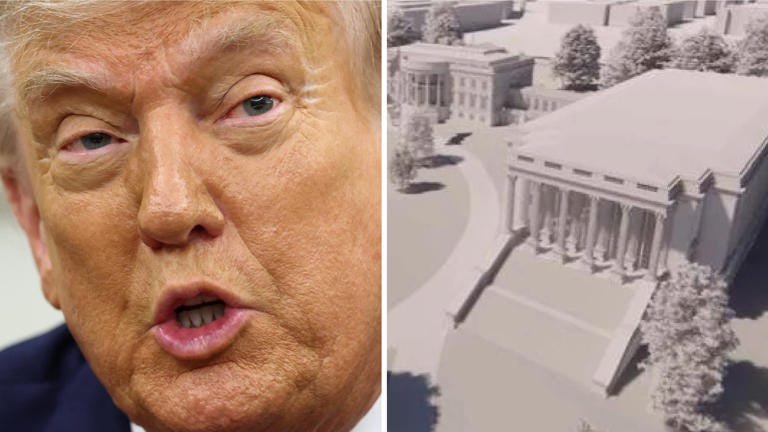
Trump’s new architects, Shalom Baranes Associates, inherit a project already delayed and disrupted by winter weather, permit uncertainties, and now, an entirely new design phase. Yet, while the country bundles up for January storms and federal contractors remain in limbo due to agency downsizing, the president is reportedly browsing imported marble options, not standard finishes or basic construction materials, but rare, high-end slabs from Italian quarries. This selection process typically comes near the end of a luxury build, not at the outset. He is choosing trim before concrete, prestige before permits.
Reuters/CBS News
While the White House insists this project will not cost taxpayers “a single cent,” there is still no legally binding guarantee that public money won’t be tapped if private funding falls short. The administration has now released a list of 37 confirmed donors helping underwrite the ballroom’s construction, including crypto billionaires, major charitable foundations, powerful financiers, and tech and media giants such as Amazon, Apple, Google, Microsoft, T‑Mobile, Meta, Palantir, and others with deep federal interests. Nearly 130 deep‑pocketed donors, allies, and corporate representatives gathered at the White House last fall for a lavish fundraising dinner tied to pledged contributions, and similar donor events have occurred beyond that one East Room gathering as the administration pushes to secure hundreds of millions more. Despite these high‑profile fundraisers and donor lists, the White House has not disclosed how much each contributor is giving, and there remains no transparent accounting to ensure that prospective shortfalls won’t be covered by taxpayers or political influence down the road.
Even if partially privately funded, the ballroom relies on significant public infrastructure and federal labor, including security coordination, logistical rerouting, and the restoration of surrounding historic grounds. Fire suppression systems, plumbing, HVAC, and accessibility retrofits must all be White House-compliant and federally coordinated, none of which comes cheaply. Current reporting, per a press release, indicates it is “expected to be completed long before the end of President Trump’s term” in January of 2029.
In the end, it is not just the cost or the timeline that make the ballroom emblematic of this administration’s priorities. It is the very impulse behind it — to destroy what already existed, to dismiss expert warnings, to prioritize spectacle over stewardship, and to begin construction of a gilded celebration hall at the precise moment millions of Americans are cutting essentials to afford groceries and heat. It is not governance. It is pageantry with public consequences.
The Arch That May Never Rise
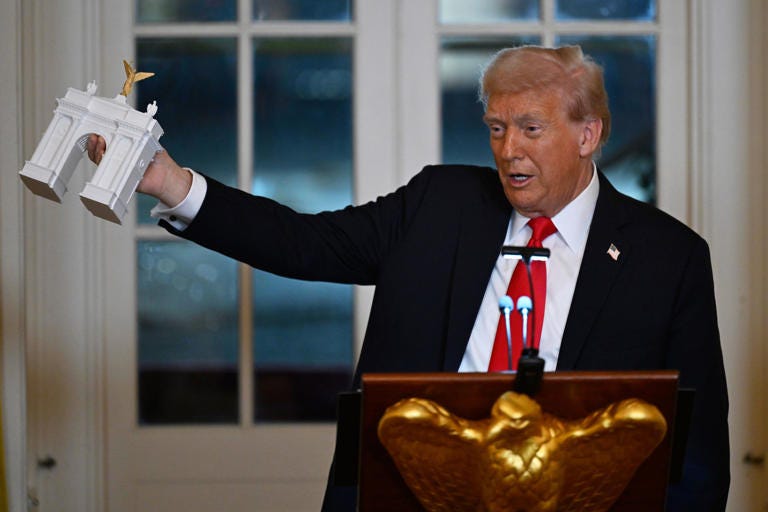
In the grand tradition of authoritarian aesthetics, President Trump’s proposed “Triumphal Arch” is less a commemorative monument than a declaration of self-image. Unveiled in late 2025 as part of the broader run-up to America’s 250th anniversary, the project envisions a towering classical structure rising in Memorial Circle, a densely trafficked, logistically delicate node in the heart of Washington, D.C. Yet despite Trump’s public assurances that construction could begin “within the next two months,” the project remains a fantasy rendered in mockups, with no permits, no finalized design, and no path forward beyond the president’s own aspirations.
© John McDonnell/AP Photo
There is no official completion timeline, no projected end date, and no federally approved schedule. What exists is an idea, a monument without engineering, a structure without environmental review, a disruption without traffic planning. Memorial Circle is not some peripheral parkland; it is a critical convergence point for city traffic, flanked by monuments, federal agencies, and national memorials. Any construction there would require extensive multi-agency coordination, including review by the National Capital Planning Commission, historic preservation authorities, and environmental impact regulators. As of January 2026, none of those steps have been completed, or even publicly initiated.
Trump has invoked the arch repeatedly in speeches, casting it as a tribute to American greatness and comparing it to the monumental triumphs of past empires. The symbolism is overt, and the design — reportedly modeled on the Arc de Triomphe in Paris — reflects that ambition. The location only reinforces it. While early reports were vague, it is now clear that the intended site is Memorial Circle. This roundabout connects the Lincoln Memorial to Arlington National Cemetery via the Arlington Memorial Bridge. The placement is deliberate. It positions the arch between the resting place of presidents and soldiers and the monument to American democracy, a gateway through which every presidential motorcade and ceremonial procession must pass.
“‘Every time somebody rides over that beautiful bridge to the Lincoln Memorial, they literally say something is supposed be here. We have versions of it… This is a mock-up,’ Trump told donors on Wednesday night, referring to a grassy, circular area at the end of the bridge.”
BBC, October 16, 2025
However, Memorial Circle is not some empty expanse awaiting reinvention. It is a key vehicular artery linking Virginia to central Washington, used daily by commuters, tourists, and federal staff. Any construction in the area would require massive traffic rerouting and infrastructure work, with risks not only to transportation flow but also to the preservation of adjacent historic sites. Engineers and planners familiar with the area have questioned whether the footprint could support a structure of the envisioned scale without radical alteration. This is not just a monument; it is a threat to the city's functional core.
Timing is a significant concern. While Trump recently announced that construction would begin in the next two to three months, the administration has announced massive plans for America 250 on the National Mall throughout 2026, including high-profile events such as the Great American Fair and the Patriot Games, scheduled for summer and fall 2026, respectively. Between traffic disruption, construction noise, equipment, and debris, it is hard to imagine that logistical concerns have been taken into account.
As with the White House ballroom, the White House claims the arch will be privately funded, but no list of donors has been released, and no legal framework exists to ensure taxpayers won’t ultimately bear the burden. For now, the arch remains a monument not to unity or commemoration, but to ambition unmoored from process, a gleaming edifice drawn in air, destined to remain there, so long as the real constraints of planning, law, and physics are allowed to matter.
A Golf Course for Optics, Not Use
Of all the projects now associated with President Trump’s second term, the redesign of the golf courses at Joint Base Andrews might be the most confusing, not because of its scale, but because of its intent. Trump is not known to play the Andrews courses regularly, if ever. He prefers the privacy and profitability of his own clubs. Yet in late 2025, the administration announced that the president would personally oversee a complete redesign and expansion of the two existing courses, in partnership with golf legend Jack Nicklaus. The two are said to have viewed the site from the air over Thanksgiving. The justification was vague: a modernized space for dignitaries, an upgraded “president’s course,” a place for ceremonies and symbolic rounds. What is clear is that the price tag is steep — early estimates place it around $50 million — and that the public will not be welcome to play there.
While the White House insists the funding will come from “leftover” donations from the ballroom campaign and, per Trump himself, will require “very little money”, no documentation exists to confirm that such a surplus will occur, or that it would be legally permissible to redirect private gifts given for one high-profile federal property to another unrelated facility on a military base. As with the arch and ballroom, no complete list of donors has been released, and no congressional appropriation has been tied to the project. What has been shared is largely aesthetic: renderings of enhanced landscaping, upgraded bunkers, and the addition of a multipurpose event space, which would require utility upgrades, construction permits, and sustained staffing, all under the purview of the federal government.
It’s difficult to see who benefits from this renovation, aside from the president and his inner circle. These are not public courses. They are not accessible to the majority of Americans, nor do they serve veterans in any direct way. They are managed by the Air Force, built for official use, and often off-limits for security reasons. Unlike Trump’s private properties, which at least operate as commercial venues, the Andrews redesign offers no revenue stream, no offsetting public access, and no apparent demand for change beyond presidential branding.

The Courses at Andrews
There is also the matter of timing. Construction on large-scale golf course renovations — particularly on secure military land — is slow, bound by federal contracting regulations and weather delays. Adding a high-end event center and revamping two full courses are not seasonal projects. It is a multi-year endeavor. That the president is pushing ahead with this initiative in the same breath as promising tax relief, deregulation, and spending restraint reveals the core contradiction of his platform: lavish investment in elite aesthetics while preaching fiscal discipline to everyone else.
The Private Parties That Cost the Public
No venue better captures the intersection of Trump’s personal business interests and presidential power than Mar-a-Lago. The Palm Beach estate, once simply his preferred escape, has again become the de facto Southern White House, not just a residence, but a political theater and revenue engine. Since returning to the office, Trump has resumed regular visits to the property, often for extended weekends or holiday events. Each trip, as during his first term, comes at significant taxpayer expense. Secret Service and White House staff must be housed and fed on-site. Secure communications and transport infrastructure must be maintained. Air Force One alone costs more than $1 million per round-trip flight. The costs stack quickly, and every dollar, minus Air Force One costs, flows into the pockets of the Trump Organization.
The events themselves are no less extravagant. Lavish galas, themed parties, and high-end fundraisers have been held throughout 2025, some explicitly tied to projects like the White House ballroom, others shrouded in social exclusivity. At Halloween, while federal workers went unpaid during a government shutdown, Trump hosted a Gatsby-themed event complete with costumed servers and gold-leaf desserts. On New Year’s Eve, as Americans braced for higher heating bills, expiring ACA subsidies, and continued inflation, the president welcomed wealthy donors to a formal gala on the resort’s oceanfront lawn. These events serve dual purposes: affirming Trump’s cultivated image of luxury and channeling political capital back into his family business.
See our coverage of his Gatsby Gala here:
Note: Articles roll into the archive over time. Please consider becoming a paid subscriber for full access to our extensive article archive, exclusive content, and occasional early access.

The ethical implications are staggering. Every time Trump travels to Mar-a-Lago, federal agencies pay the Trump Organization for rooms, meals, security space, and facilities. Unlike traditional presidential residences, Mar-a-Lago is a for-profit venture. These aren’t government properties being maintained, but private businesses generating revenue. In his first term, Trump funneled millions of public dollars into his hotels, clubs, and resorts. That pattern has resumed, with even less oversight than before. Reports of guest lists including foreign nationals, crypto investors, and defense contractors raise additional red flags, particularly when events are closed to the press.
And yet, the image is carefully curated. Trump does not hide the opulence. He leans into it. Gold trim, chandeliered halls, and fireworks above his logo all reinforce the core brand: a man above the fray, untouched by the economic struggles facing millions. As Americans cut back on groceries, downsize homes, or ration utilities, the president sips champagne with billionaires in a beachside ballroom that taxpayers help secure. It’s not just tone-deaf. It’s intentional.
While Americans Cut Back: The High Cost of the Basics
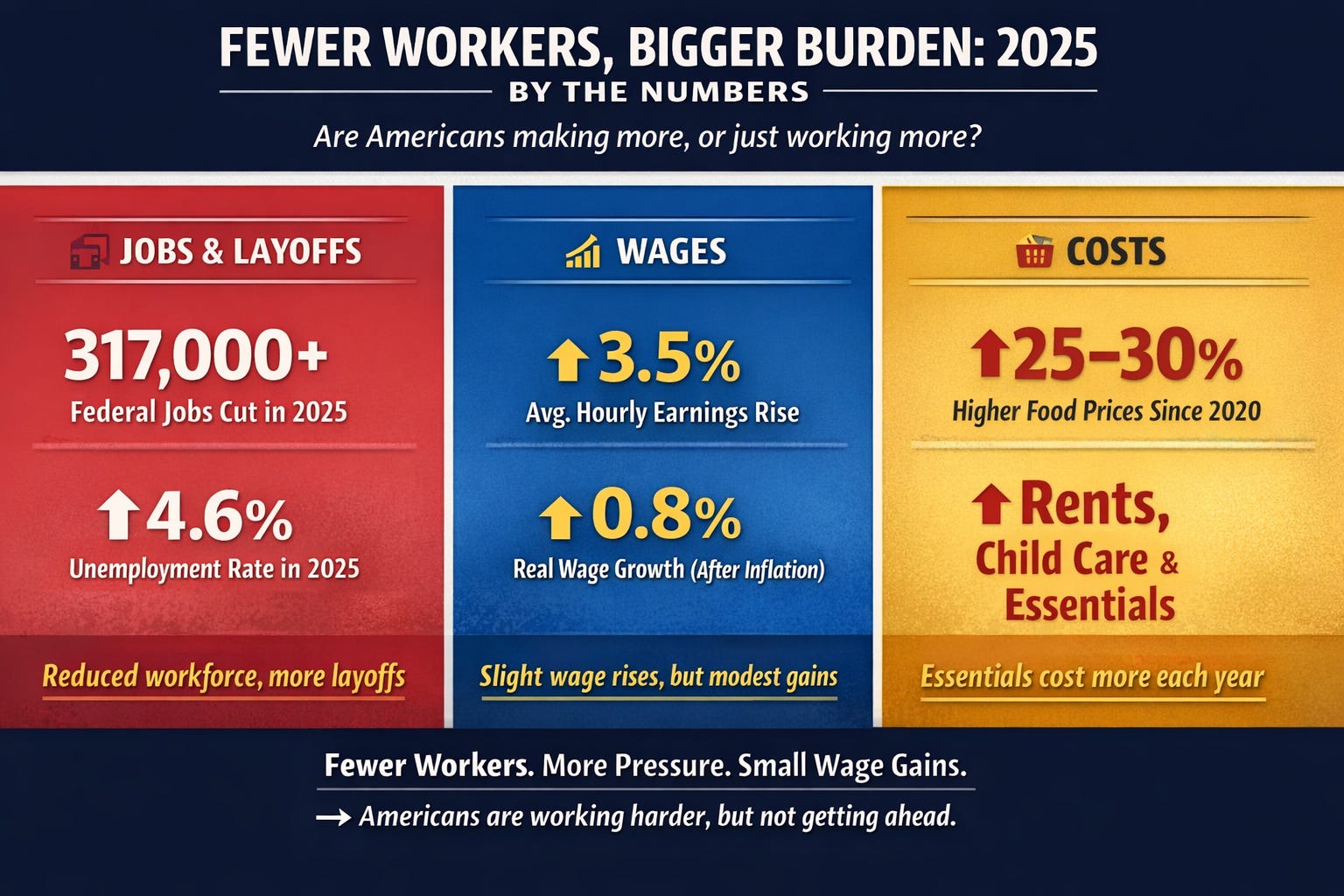
While the president browses marble slabs and hosts galas under crystal chandeliers, everyday Americans are facing a far different reality. For most households, 2025 was yet another year of financial strain, driven by a steady rise in the cost of basic necessities, such as food, household goods, and transportation, with little relief in sight. Grocery prices in particular remain a constant source of stress. Even after the pandemic-era spikes, prices for everyday items have continued to climb. Bread, eggs, milk, meat, and produce are all more expensive than they were just a year ago, with total grocery costs up roughly 30% since 2020.
This isn’t abstract inflation. It’s lived experience. It’s the slow elimination of name brands from shopping carts, the skipped meals at the end of the month, the quiet shame of checking your balance at the register. It’s families buying less food, of lower quality, less often, not because of market inefficiencies, but because the economic policies driving those markets prioritize posturing over practicality. Tariffs enacted under Trump’s trade war framework — and expanded during his second term — have raised the cost of imported goods and raw materials. Disruptions in trade with China, Mexico, and Brazil have had ripple effects across industries, from agriculture to electronics. Basic goods are more expensive not because of scarcity, but because this administration chose economic isolation over collaboration.
And it’s not just food. Household goods, clothing, school supplies, and electronics have all seen price increases well above wage growth. The president frequently blames others — his predecessor, immigrants, international markets — but these are costs generated on his watch, by his policies. American consumers are not overreacting. They are adjusting, lowering expectations, tightening budgets, and recalibrating what daily survival looks like in a country that promised prosperity but delivered pride instead.
Home, If You Can Afford One
It is no longer radical to suggest that the American dream of homeownership has slipped out of reach for millions. In 2025, housing costs continued to rise across nearly every region of the country, with the national median home price pushing beyond $430,000. For buyers, the hurdle isn’t just price — it’s borrowing. Mortgage rates hovered above 6% throughout the year, making monthly payments prohibitively expensive even for middle-income families. A modest starter home now requires not just savings, but wealth. First-time buyers are being priced out before they even get to the table.
For renters, the picture is no better. The national median rent in 2025 was over $1,600 per month, a slight drop from the previous year but still up nearly 20% from pre-pandemic levels. In major cities and smaller metros alike, rental costs are outpacing wage growth. At the same time, affordable housing construction has slowed due to material shortages, labor constraints, and a lack of federal support. The market has not corrected. It has calcified, rewarding landlords and developers while squeezing families already living at the margins.
Even for those who manage to keep a roof over their heads, the costs don’t stop there. Utility prices surged again in 2025. Electricity bills climbed nearly 7%. Natural gas rose over 9%. Heating oil, water, and waste services followed suit, leaving households — especially in colder regions — facing brutal winter expenses. More than $29 billion in utility rate hikes were proposed or approved nationwide in just the first half of the year. Families are paying more to stay warm, cook, shower, and keep the lights on.
None of this happened in a vacuum. Tariffs on fuel imports, launched in the name of economic nationalism, have backfired, driving up domestic energy prices and disrupting distribution. Deregulation of utility oversight boards has emboldened price hikes with little resistance. At the same time, Trump’s budget slashed funding for federal housing programs, first-time buyer assistance, and energy subsidies, stripping away the very safety nets that could have softened the blow. These are not unintended consequences. They are the direct result of a policy agenda that prioritizes austerity for the poor and luxury for the powerful.
Wages Rising, But Not Fast Enough to Matter
It is technically accurate that wages rose in 2025. The average American worker took home slightly more per hour than the year before. However, those gains were quickly devoured by increasing prices. When adjusted for inflation, real wages barely moved. For some, they declined. What looked like progress on paper felt like stagnation in practice, or worse, a quiet demand to do more for the same return. In many industries, that’s precisely what happened. As workforce participation shrank, remaining employees were expected to take on additional responsibilities, resulting in fewer people doing more work for less purchasing power.
The labor market was uneven throughout the year. Some sectors added jobs, but overall employment growth was sluggish. Government jobs in particular suffered steep cuts, especially at the hands of the Department of Government Efficiency and from provisions in the One Big Beautiful Bill, both of which mandated deep reductions across federal agencies. Entire offices were downsized or shuttered, and while some of those layoffs have since been challenged in court, with rulings mandating reinstatement and back pay in some instances, the disruptions remain. These were not small budget trims. They were targeted strikes against the administrative state, carried out not for efficiency but ideology.
Meanwhile, Trump’s aggressive immigration crackdowns created ripples across multiple low-wage sectors — most notably agriculture, hospitality, and construction — driving up costs and leaving critical labor gaps unfilled. In places where work was available, fewer people were there to do it. This, too, had a downstream effect on wages. In some regions, employers offered slight pay increases to retain or attract workers. Yet those gains were rarely enough to keep pace with the rising costs of food, rent, and transportation. Even when they were, they were not widely felt. They benefited those still employed, not those already priced out, laid off, or locked out.
Adding insult to injury, the OBBB slashed or restructured key social safety net programs. The failure to reauthorize Affordable Care Act subsidies, cuts to housing vouchers, food assistance, and childcare tax credits left many Americans with fewer options just as they needed more help. These programs were not waste, but lifelines. Worse, their removal was not surgical, but sweeping.
This is the backdrop against which Trump touts an “America winning again” economy. For those at the top, maybe it is. However, for millions of workers navigating rising costs, uncertain jobs, and diminished support, the story is very different. It’s not a comeback. It’s a deepening crisis hidden behind selective metrics and televised fanfare.
Trump’s Brand of Affordability, For the Few
When President Trump speaks of “affordability,” it’s with unmistakable contempt. He uses the word mockingly, as if only the weak would concern themselves with cost. In speeches, he’s dismissed affordable housing as “low ambition,” derided public healthcare as “government rationing,” and ridiculed concerns about food and utility prices as the whining of “spoiled liberals.” It’s not just rhetoric. It’s policy posture, a disdain for the very concept of economic equity. Yet, behind that posturing is a man whose brand depends on profiting from the struggle he pretends doesn’t exist.
During his first term, Trump funneled millions in taxpayer dollars into his own properties by holding meetings, hosting foreign dignitaries, and vacationing frequently at Trump-branded resorts. That pattern has resumed in his second term, with Mar-a-Lago, Trump National Golf Club, and other holdings once again serving as presidential retreats and event venues, all of which require taxpayer spending on security, lodging, catering, and transport. He is, functionally, billing the country to enrich himself.
However, that’s only the beginning. The Trump family has embraced a full-scale branding blitz: Bitcoin wallets, Trump Bibles, MAGA cell phone plans, Trump-branded shoes and cologne, even digital collectibles and subscription platforms promising insider access. Each product is marketed as patriotic, Christian, or populist, and most are priced far above what most Americans would consider reasonable. This isn’t about making things affordable. It’s about selling scarcity and identity to the devoted few who can still afford to buy in. It’s not public service. It’s monetized nostalgia, fleeced from those who believe they are part of something larger, even as they fall further behind.
Meanwhile, Trump has championed deregulation that directly benefits the corporate donors underwriting his projects, from crypto billionaires helping fund the White House ballroom to media companies buying access through Mar-a-Lago galas. The rhetoric of anti-elitism has never been more hollow. Under this administration, corporate profits remain high, executive compensation continues to soar, and the wealth gap has widened even further. Trump didn’t drain the swamp. He branded it, built a gift shop, and started charging admission.
The New Gilded Age Is Here. You’re Not Invited
Donald Trump once promised to make America great again. What he has delivered is a gilded illusion — monuments to himself, financed in part by those who stand to benefit, while the rest of the country scrambles to afford eggs, rent, and heat. The White House is being reshaped into a stage for wealth and spectacle. Washington may soon bear a towering arch to his ego. The president’s travels generate revenue for his family’s resorts, while his donors line up for naming rights and tax breaks.
This isn’t governance. It’s exhibition. The president is not solving the problems Americans face. He is designing around them, building ever more extravagant symbols of power to distract from the eroding foundations beneath. His policies, from tariffs to budget cuts to deregulation, are not bugs. They are features — deliberate choices that widen the gap between those who rule and those who serve, those who build and those who buy.
It is no accident that the year of America’s 250th birthday is being reimagined not as a national reflection, but as a Trump-branded spectacle. This is not a celebration of democracy. It’s a coronation of capital, a pageant of privatized power dressed in patriotic colors. As with all things Trump, the bill will arrive long after the cameras leave, and it won’t be delivered to the people in tuxedos sipping champagne beneath crystal chandeliers.
It will come to the rest of us.
If you are tired of the corporate media whitewashing, you are in the right place. The Coffman Chronicle is fueled by you, never the corporate elite.
We feel your pain because we are living it too. Support our mission to expose the grift.
Sources:
Shalom Baranes replaces McCrery Architects on White House ballroom — Fast Company, Dec. 5, 2025
Crypto billionaires among donors for White House ballroom — AP News, Nov. 12, 2025
Trump’s White House Ballroom: Plans, Cost, and Who’s Really Paying — New York Magazine, Nov. 12, 2025
Trump says Triumphal Arch construction could begin within two months — Fox News, Dec. 31, 2025
The Arc of the Deal: Trump wants a Napoleonic arch — Times of India, Jan. 1, 2026
Consumer Price Index Summary – November 2025 — Bureau of Labor Statistics
Food Price Outlook, 2025 Summary Findings — USDA ERS, Dec. 15, 2025
Real Earnings – August 2025 — U.S. Department of Labor, Sep. 13, 2025
U.S. house prices rose 2.2 % year‑over‑year in Q3 2025 — Federal Housing Finance Agency (FHFA House Price Index Report)
U.S. house prices rose 2.2 % in the third quarter of 2025 — HousingWire
US existing home sales rise in December; house prices hit record high in 2024 —Reuters
The 2025 Housing Affordability Crisis in Charts: What Changed and What Didn't — Investopedia
Scary for our country. Trump needs to go.
Tony, have you seen this?
thedreydossier.substack.com
https://thedreydossier.substack.com › p › trump-isnt-building-a-ballroom
Trump Isn't Building a Ballroom - The Drey Dossier
Check this out and then take another look at the "Triumphal arch" and the "golf club (on a military base) upgrade". I think these vanity projects have another purpose.