


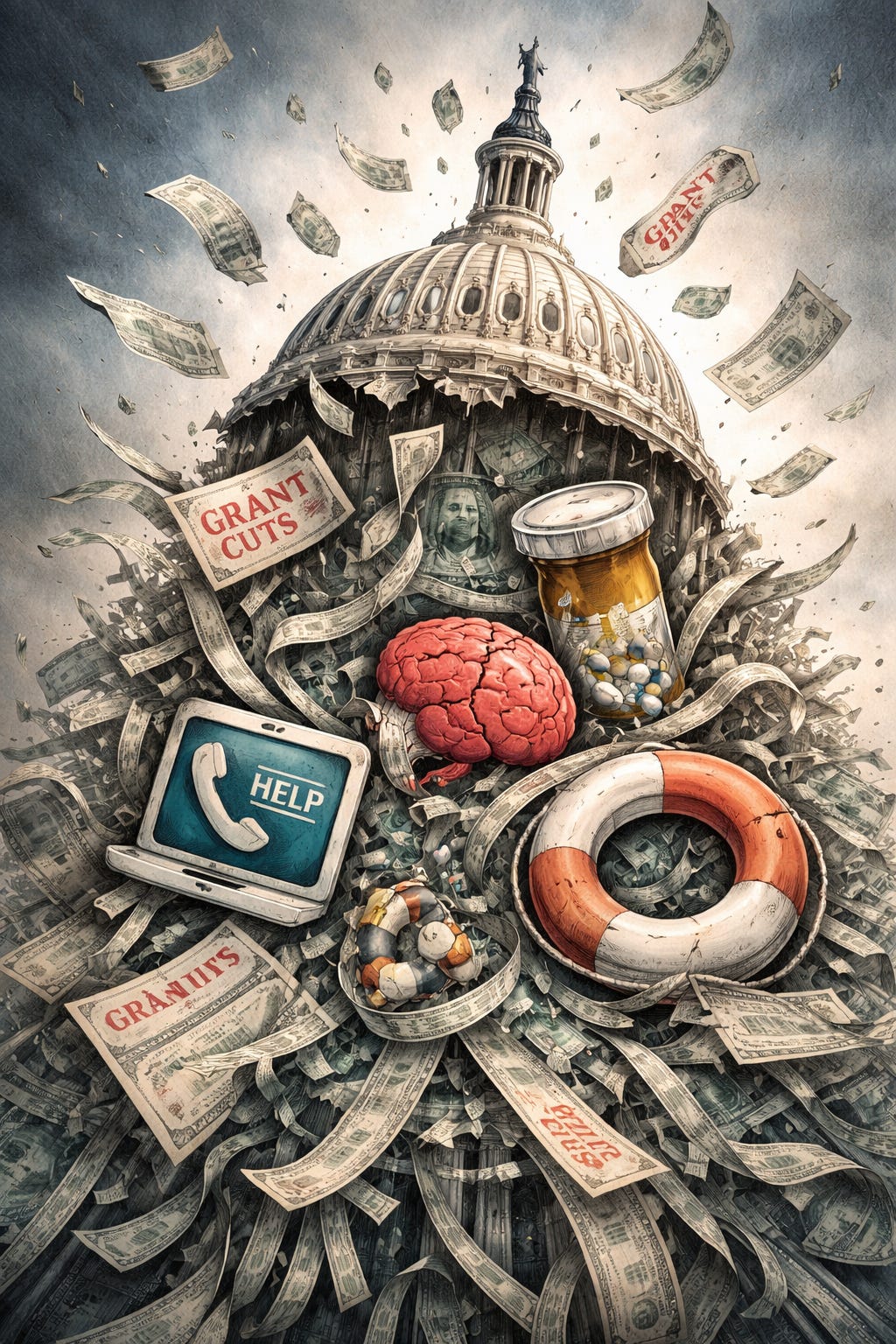
In mid-January 2026, the Department of Health and Human Services, under the Trump administration, abruptly informed hundreds of grant recipients across the country that their funding had been terminated.
The grants in question, administered through the Substance Abuse and Mental Health Services Administration (SAMHSA), totaled nearly $1.9 billion and supported critical public health services, including suicide prevention, opioid treatment, youth mental health care, and programs supporting people experiencing homelessness.
The terminations came without warning or public explanation. Letters were sent to awardees notifying them that their funding had been canceled, effective immediately.
Want to Know Your Rights?
Download a free digital copy of the U.S. Constitution, the same document Trump is trying to bulldoze. Learn exactly what he’s breaking, and how to fight back.
100,000+ strong — and counting.
This winter of our discontent, become a paid subscriber for just $1 a week and help us keep the truth alive.
Join The Coffman Chronicle — $1/Week
The Cut
The grants at the center of this crisis were part of a broad range of SAMHSA-funded initiatives approved by Congress in prior appropriations cycles. The programs affected included Project AWARE, which supports youth mental health services in schools; State Opioid Response grants; suicide prevention hotlines; community-based addiction treatment centers; and programs supporting individuals with co-occurring mental health and housing crises. These grants were not theoretical. They had already been awarded and, in many cases, partially disbursed. Organizations had staffed up, committed resources, and in some cases already delivered services.
On January 12, 2026, SAMHSA began issuing termination letters citing “realignment with agency priorities” as the justification. There was no indication that the grantees had failed to meet their obligations. There was no public notice of policy change. These were unilateral terminations — sudden and unexplained.
The move blindsided nonprofit organizations, state health departments, and local service providers across the country. It also came amid already high instability, as many behavioral health organizations continued to recover from funding gaps left by the previous year’s federal government shutdown. The SAMHSA grants were lifelines, and without them, program closures, staff layoffs, and service disruptions would have followed immediately.
The Backlash
If the administration believed that cutting $1.9 billion in behavioral health grants would go unnoticed, it underestimated the scale and immediacy of the response. Within hours of the cancellation notices being sent, backlash erupted from every corner of the mental health ecosystem.
National organizations, including the National Council for Mental Wellbeing, the American Foundation for Suicide Prevention, and the National Alliance on Mental Illness, issued urgent statements warning of the real-world consequences. Many of the grants supported services that had already been delivered, particularly in rural and underserved communities where federal dollars were often the only stable source of funding.
Elected officials also responded quickly. Representative Rosa DeLauro (D-CT), the ranking member of the House Appropriations Committee, issued a statement condemning the cuts as “reckless and harmful,” calling on the Department of Health and Human Services to immediately reverse course. Senate Democratic Whip Dick Durbin (D-IL) called the move “outrageous and unjustifiable,” and pointed out that the funding in question had been approved on a bipartisan basis. Even some Republican governors whose states rely heavily on federal addiction treatment dollars expressed concern.
Media coverage intensified over the following 24 hours, focusing on the whiplash experienced by frontline providers who were left wondering how to keep their doors open. News outlets interviewed local nonprofits that had already submitted reimbursements to SAMHSA for services provided, only to be told that the funding had been canceled. One Kansas City provider described the situation as “financial betrayal.” Others spoke of having to inform staff of impending layoffs, only to reverse those conversations hours later. It was, as one advocate put it, “a man-made disaster for communities already in crisis.”
The Reversal
Faced with a storm of public and political pressure, the administration backpedaled. On January 13, HHS issued a new statement: the terminations were being rescinded, and all grant funding would proceed as originally awarded. No explanation was given for the reversal beyond vague references to “stakeholder input” and “updated implementation guidance.”
But the damage — operational, emotional, and political — had already taken root. Providers had been forced to consider shutting down programs. Staff morale was shaken. Trust had been fractured. The message was clear: even funding that has already been awarded and approved by Congress is no longer safe from the whims of executive action.
The reversal's speed did not signal strength. It revealed that the administration had miscalculated badly.
This Isn’t Just a Mistake. It’s a Pattern
The SAMHSA funding debacle did not emerge from a vacuum. It followed a now-familiar pattern of executive overreach and selective disruption, one already visible in the administration’s earlier attempt to cancel grant funding for the Institute of Museum and Library Services (IMLS). In 2025, the Trump administration moved to eliminate more than 90 percent of IMLS’s competitive grant portfolio, abruptly pulling support from public libraries, cultural institutions, and educational programming in communities across the country.
Those cuts, like the SAMHSA terminations, were not reductions proposed through congressional appropriations or public budget debate. They were cancellations of already-approved grants. In that case, however, the public response was more subdued. Despite protests from librarians, educators, and museum advocates, the political backlash did not reach the same volume or intensity. It took a coordinated lawsuit from a coalition of state attorneys general and a prolonged court battle to ultimately force the administration to reinstate the funding. By the time the grants were restored, many institutions had already lost staffing, programming, or critical planning time.
The contrast in response is telling. While libraries and museums are vital public institutions, they are often overlooked in national policy debates. They serve millions quietly, often those with the least political capital. For many Americans, the loss of a library or museum grant is not immediately visible, even as the long-term effects are profound. The same cannot be said for mental health and addiction services. These touch every demographic, every geography, and every socioeconomic class. From opioid treatment in rural America to suicide prevention programs in urban school districts, behavioral health care is deeply embedded in every community.
That may be why the administration miscalculated. The attempt to cut SAMHSA grants likely followed the same playbook: identify a federal agency, test the boundaries of executive authority, and see how far those boundaries can be stretched. After the IMLS situation failed to generate sustained outrage, another test appeared plausible. However, this time, the pushback was immediate, broad, and politically costly. Within 24 hours, the administration was forced to reverse itself, a dramatic contrast to the prolonged legal fight over library funding.
The difference in outcome should not be mistaken for restraint. If anything, it shows that the line will continue to be tested until it breaks or until it is enforced.
Why Mental Health and Addiction Cuts Hit Differently
The decision to cut funding for behavioral health services struck a deeper nerve than previous episodes of executive disruption. Mental health and addiction are not niche issues. They are national crises. Every year, tens of thousands of Americans die from drug overdoses, and suicide remains a leading cause of death across multiple age groups. These crises do not discriminate by geography, race, political affiliation, or income level. Unlike some other policy areas, the demand for mental health and addiction services is both urgent and visible.
In recent years, political leaders across the spectrum have increasingly framed mental health as a top priority. It is often invoked in the aftermath of mass shootings, during veteran suicide discussions, and as a response to rising youth anxiety and depression. Yet too often, the political attention fades once the news cycle moves on. The invocation of mental health as a rhetorical shield, particularly in conservative circles, is rarely matched by serious funding commitments.
This dissonance was thrown into stark relief by the SAMHSA episode. At the same time that the administration attempted to cancel billions in funding for behavioral health, it continued to invoke mental health in speeches and press releases as a “top national priority.” However, policy is what happens after the talking points are set aside. When it came time to fund the programs that make a tangible difference — crisis hotlines, recovery programs, school-based mental health staff, community addiction treatment — the administration chose to defund, not defend.
The backlash was not just about money. It was about priorities. When mental health is framed as essential in theory but dismissed in practice, it sends a clear signal that the system is not serious about the crisis it claims to care about. For those on the ground — the providers, clients, families, and advocates — that contradiction is not theoretical. It’s life or death.
That contradiction is further underscored by the Pentagon’s continued failure to release its congressionally mandated annual suicide report, a delay that has drawn criticism from veterans’ groups and lawmakers alike.
See our recent reporting here:

At every level of government, from public health to national defense, mental health is treated as a public relations tool, not a policy priority.
Executive Overreach and the Power of the Purse
The attempt to cancel SAMHSA grants did not just expose a policy failure. It highlighted a deeper constitutional concern, one that has gained urgency in recent years. Under the U.S. Constitution, Congress holds the exclusive authority to appropriate federal funds. The executive branch is responsible for implementing spending in accordance with congressional directives. That separation is not a formality; it is a core mechanism of checks and balances. When the executive branch unilaterally withholds, cancels, or redirects funding that Congress has already allocated, it risks violating that constitutional boundary.
This was not the first time the line had been tested. In the IMLS case, the administration canceled grants that had been fully approved by Congress and already awarded to institutions. That action was challenged in court and ultimately reversed, but only after a prolonged legal battle. While the courts ruled in favor of reinstating the funding, the episode exposed a legal gray area: how far can the executive go in disrupting federal spending before it becomes a violation of law? The ruling forced compliance but did not eliminate the ambiguity. That ambiguity may have emboldened the administration to try again, this time with mental health and addiction funding.
In the case of SAMHSA, the reversal happened so quickly that no legal ruling was issued. However, the constitutional stakes were just as high. These grants were not hypothetical line items in a future budget. They were formal agreements backed by congressional appropriation. Attempting to cancel them, especially without justification, due process, or public explanation, was not just bureaucratic overreach. It was a challenge to the legislative branch’s authority.
Whether framed as negligence, opportunism, or deliberate provocation, the outcome is the same: a blurred line between Congress's and the presidency's powers, and a chilling signal to those who rely on federal support that even the most fundamental guardrails can be bypassed in silence.
The Damage Is Done. Trust Has Eroded
Even with the grants restored, the impact of the attempted cancellation lingers. For many nonprofit organizations and public agencies, the episode confirmed what they had long feared. Federal funding is no longer a guarantee, even after it has been awarded. The damage extends beyond the disruption of specific programs. It has shaken the broader ecosystem of trust that makes public funding work.
Most federal grants, including those administered by SAMHSA, operate on a reimbursement model. Organizations provide services up front, including hiring staff, running programs, distributing resources, and then submit documentation to receive funding. This model depends on a basic assumption that the government will fulfill its end of the agreement. When that assumption is broken, even briefly, the financial risks become untenable for many organizations. Grant cancellations don’t just interrupt services. They jeopardize payroll, force layoffs, and leave providers in debt for work already done.
As a result, some organizations are now rethinking their relationship with federal grantmaking altogether. After the IMLS cuts, many libraries and museums scaled back their participation in future cycles, wary of the legal and financial turmoil they had just experienced. The same pattern is likely to repeat with SAMHSA. Even though applications have reopened, trust has not been repaired. The risk remains, and it may keep otherwise qualified, high-impact organizations from seeking future funding.
This chilling effect could have broader policy implications. If application numbers drop, the administration may use the decline to argue that certain programs are no longer needed, that demand has weakened, or that providers are not engaging. However, that would invert the truth. A drop in applications would not reflect disinterest. It would reflect distrust. Whether or not that outcome is intentional, it is politically useful to those looking to dismantle public infrastructure under the guise of disuse.
Whether by design or dysfunction, the result is the same: fewer organizations willing to work with a government that has shown itself willing to break its promises.
A Familiar Pattern: Inaction and Exploitation
The SAMHSA reversal fits into a larger pattern that has become all too familiar: mental health is politically invoked, but institutionally abandoned. When tragedy strikes, whether it’s a mass shooting, a veteran’s suicide, or a spike in overdose deaths, elected officials are quick to cite mental health as the problem. It becomes a rhetorical fallback, a convenient way to deflect from harder policy conversations about guns, inequality, or the structural causes of despair.
Yet when the cameras turn off, the promises fade. The infrastructure needed to address the crisis, including consistent funding, data transparency, and program stability, is undermined or ignored. The failure to release the Pentagon’s congressionally-mandated suicide report is just one more example. That report, which tracks suicide rates among active-duty service members and is central to shaping prevention policy, remains overdue with no public explanation. Its absence speaks volumes. Even the most visible and politically sympathetic populations, such as military personnel, are not immune to the erosion of accountability around mental health.
The contradiction could not be clearer. Mental health is treated as a public relations concern rather than a public health responsibility. Services are defunded until outrage makes it politically untenable. Transparency is withheld until advocates force it into the light. Meanwhile, those doing the work on the ground are left to navigate uncertainty, instability, and performative governance often without the tools they need to succeed.
What We’re Really Up Against
The attempted cancellation of SAMHSA grants was not an isolated incident. It was a test of institutional boundaries, public attention, and political will. While the funding was ultimately restored, the episode revealed the fragility of systems that millions rely on. Behavioral health providers, already stretched thin by years of underfunding and bureaucratic complexity, were forced to confront an uncomfortable truth that even programs authorized by Congress and already underway can be targeted without warning.
Yet the reversal also proved something else. It showed that coordinated, vocal, and immediate public pressure works. The administration did not reverse course out of principle. It reversed course because the cost of moving forward had become too high. Providers spoke out. Advocacy groups mobilized. Lawmakers demanded answers. As a result, within a day, a decision that would have jeopardized care for thousands was undone.
That should not be necessary, but in this political climate, it may be the only reliable defense. The institutions that protect public health, education, and access to information are increasingly being tested not through legislation, but through quiet administrative decisions designed to evade scrutiny. When resistance is delayed or fragmented, those decisions stand. When it is loud, swift, and unified, they falter.
The SAMHSA episode is not just a story about mental health funding. It is a warning. It reminds us that the stability of public programs now depends as much on political vigilance as on policy design. Further, it forces a choice between accepting the erosion of trust as inevitable and meeting every test with the clarity and volume required to push it back.
Enjoying this kind of reporting?
Subscribe for more coverage on federal policy, public health, and the politics shaping national infrastructure. Your support helps us keep digging, connecting the dots, and holding power to account.
Sources:
White House reverses $2 billion cut to mental health, addiction grants (Roll Call) — January 14, 2026
Trump administration reverses course on $1.9 billion in cuts to addiction and mental health grants (Stat News) — January 14, 2026
Trump administration reverses sudden cuts to grants for mental health and addiction treatment programs (CBS News) — January 15, 2026
White House reverses $2B cut to mental health, substance abuse grants (EMS1) — January 15, 2026
Trump administration reverses itself, restores $2 billion in mental health, substance abuse grants (Montana Free Press) — January 15, 2026
Democrat blasts HHS for creating confusion in cutting, then reinstating SAMHSA grants (AP News) — January 14, 2026
‘It’s constant whiplash’: Kansas City organizations see mental health grants canceled one day and restored the next (The Beacon) — January 16, 2026
Trump Admin. Pulls Student Mental Health Grants, Then Restores Them (Education Week) — January 15, 2026
‘Tremendously thankful’: SCAN restores all 8 programs after they were cut by Trump administration (Laredo Morning Times) — January 15, 2026
SAMHSA cancels, reinstates thousands of behavioral health grants (National Association of Counties) — January 16, 2026
Advocates Mobilize Nationwide as Administration Walks Back SAMHSA Grant Cuts (AJMC) — January 15, 2026
Terrifying. And I still don't understand why the government keeps escalating the situation in the country, even though it backed down in this case.
Another dumb move by the right wing Republicans.