

Who Commits Mass Shootings in the U.S.? The Data, Not the Myths
Forget the myths and scapegoats. The data shows one constant across every definition of mass shootings: men.

Who is overwhelmingly committing mass shootings in the United States?
It’s a question asked after every tragedy — in newsrooms, in legislatures, and at kitchen tables. And it’s a question that often gets answered with more heat than light. Some politicians insist it’s “gangs” driving the numbers. Others point the finger at “mentally ill loners.” Recently, some commentators have gone further, scapegoating LGBTQ+ people with no evidence to back it up.
But the data tells a far clearer story than the myths: mass shooters are overwhelmingly men. The gender signal is so strong across every dataset — federal, academic, or journalistic — that it barely budges when you change definitions. What shifts are other demographic details: race, age, and motive. Those vary depending on how you define “mass shooting” in the first place.
And that’s where this conversation usually breaks down. There is no single U.S. legal definition of a “mass shooting.” Some databases track only public attacks where four or more people are killed. Others count any incident where four or more are killed, whether in a public place, a home, or during a felony. Still others use a broader threshold: four or more shot, whether killed or not. Each of these approaches paints a different picture.
This article cuts through the noise by looking at three of the most widely cited datasets: The Violence Project, the AP/USA Today/Northeastern Mass Killing Database, and the U.S. Secret Service’s Mass Attacks in Public Spaces reports. By walking through them in turn, we can see how the definition of “mass shooting” changes the narrative and where the constants remain.
The constants matter. Because when we ask who overwhelmingly commits mass shootings, the answer doesn’t just shape the headlines. It shapes policy, prevention, and ultimately, whether communities can stop the next one before it happens.
Stay Informed. Stay Loud.
Subscribe to The Coffman Chronicle for no-BS political analysis, action guides, and daily truth bombs you won’t get from corporate media.
Why Definitions Matter
If you’ve ever noticed how different news outlets report wildly different numbers of “mass shootings” in a given year, you’ve run headfirst into the problem of definitions. The truth is, the United States has no single, agreed-upon standard for what counts as a mass shooting. And that definitional gap is more than academic. It changes who appears in the statistics, how trends are interpreted, and even what policies get proposed.
Here’s how the major players draw their lines:
The Violence Project (TVP): Tracks public mass shootings where four or more people are killed in a public place, excluding the shooter. This is the most restrictive definition, focusing on high-profile, headline-making rampages like those in Las Vegas or Uvalde.
AP/USA Today/Northeastern University Mass Killing Database: Counts all mass killings with four or more fatalities, regardless of weapon or setting. That means a domestic familicide in a home, a workplace shooting, or a public rampage all appear here. It’s broader than TVP and captures more private tragedies.
U.S. Secret Service (NTAC): Defines mass attacks as incidents where three or more people are injured or killed in public or semi-public spaces. These include attacks with guns (the majority), but also with knives or vehicles. This approach is prevention-focused, highlighting patterns and warning signs.
Gun Violence Archive (GVA): Uses the broadest lens: four or more people shot, injured, or killed, excluding the shooter. This produces the largest count, often in the hundreds annually, and includes gang disputes, drive-bys, and other incidents that don’t fit the “headline” model of a mass shooting.
Each of these definitions produces a different demographic breakdown. Public mass shootings skew somewhat older and whiter. Broader definitions that include domestic killings or felony-linked shootings pull in a younger, more racially varied set of perpetrators. The common thread, though, is that men dominate every category.
Understanding these definitions is the key to understanding the debate. Without clarity, we’re left with dueling talking points. With clarity, we can see the real patterns and the real opportunities for prevention.
Lens A: Public Mass Shootings (Violence Project)
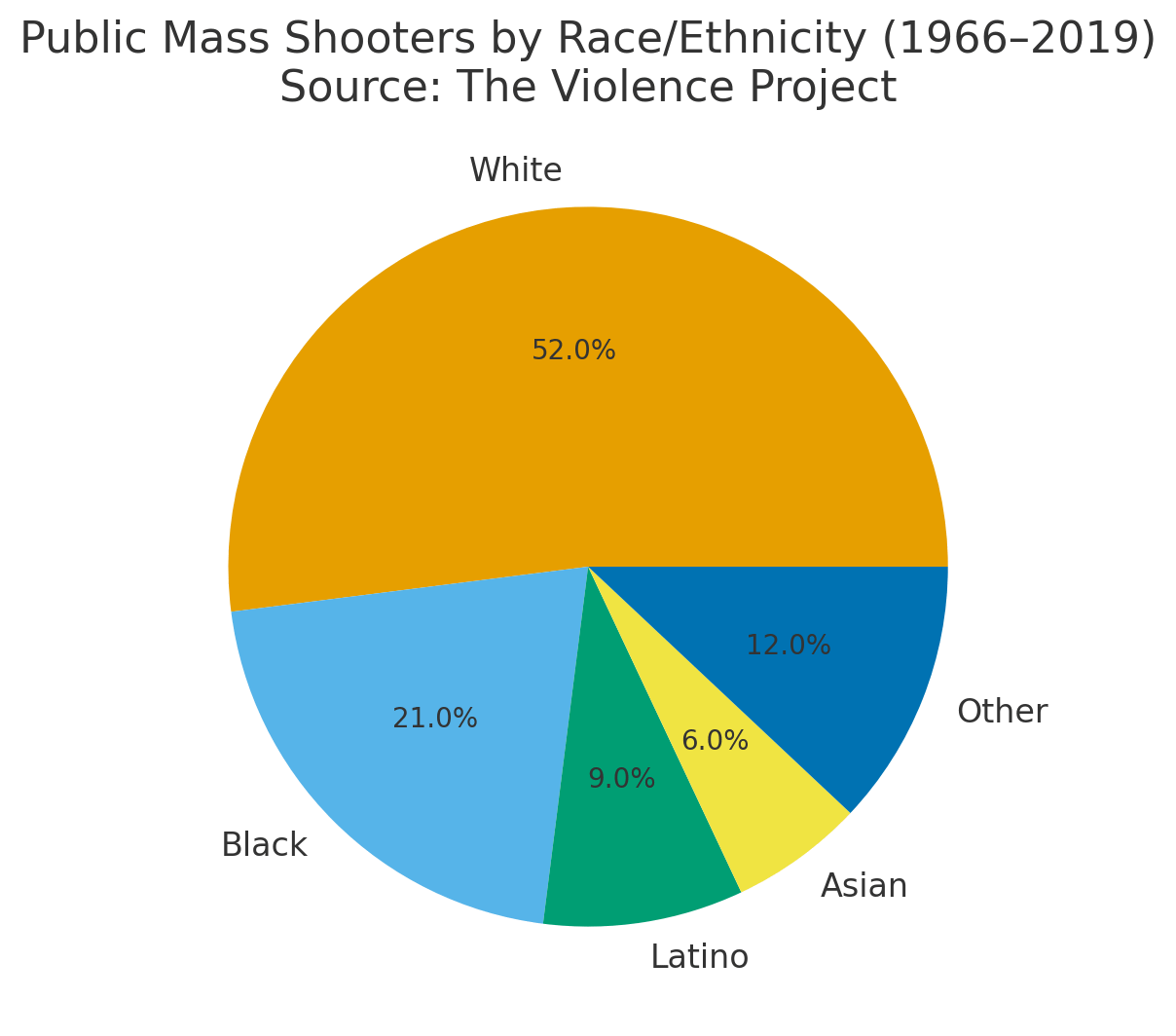
When most Americans picture a “mass shooting,” this is the category they imagine: a gunman in a school, a concert venue, or an office, killing multiple people in a public setting. The Violence Project database is the gold standard for tracking these attacks. It looks at every U.S. public mass shooting from 1966 to 2019 where four or more people were killed in a public place, not including the shooter.
The receipts are clear:
Gender: 97.7% of public mass shooters were male.
Age: The average age is 34, though perpetrators span from teenagers to older men.
Race/Ethnicity:
52% White → the plurality, not a majority.
21% Black
8–9% Latino
6–7% Asian
Small percentages of Middle Eastern, Native American, or other.
Other factors:
65% had a prior criminal record.
58% had a history of violence.
48% leaked their plans in some form beforehand.
These findings cut directly against the idea that mass shootings are evenly spread across demographics or primarily driven by one group other than men. The overwhelming gender imbalance is undeniable. The racial distribution shows White perpetrators as the largest share in this public setting, but not the sole actors, and not a full majority.
This category includes the cases most etched in the national memory: Columbine (1999), Virginia Tech (2007), Sandy Hook (2012), Las Vegas (2017), and Uvalde (2022). These public rampages dominate headlines precisely because they unfold in shared spaces. They also tend to fuel legislative debates, even though they represent a fraction of overall gun deaths.
Takeaway: In public mass shootings, men dominate the perpetrator profile, and White men are the plurality.
Lens B: Mass Killings (AP/USA Today/Northeastern)
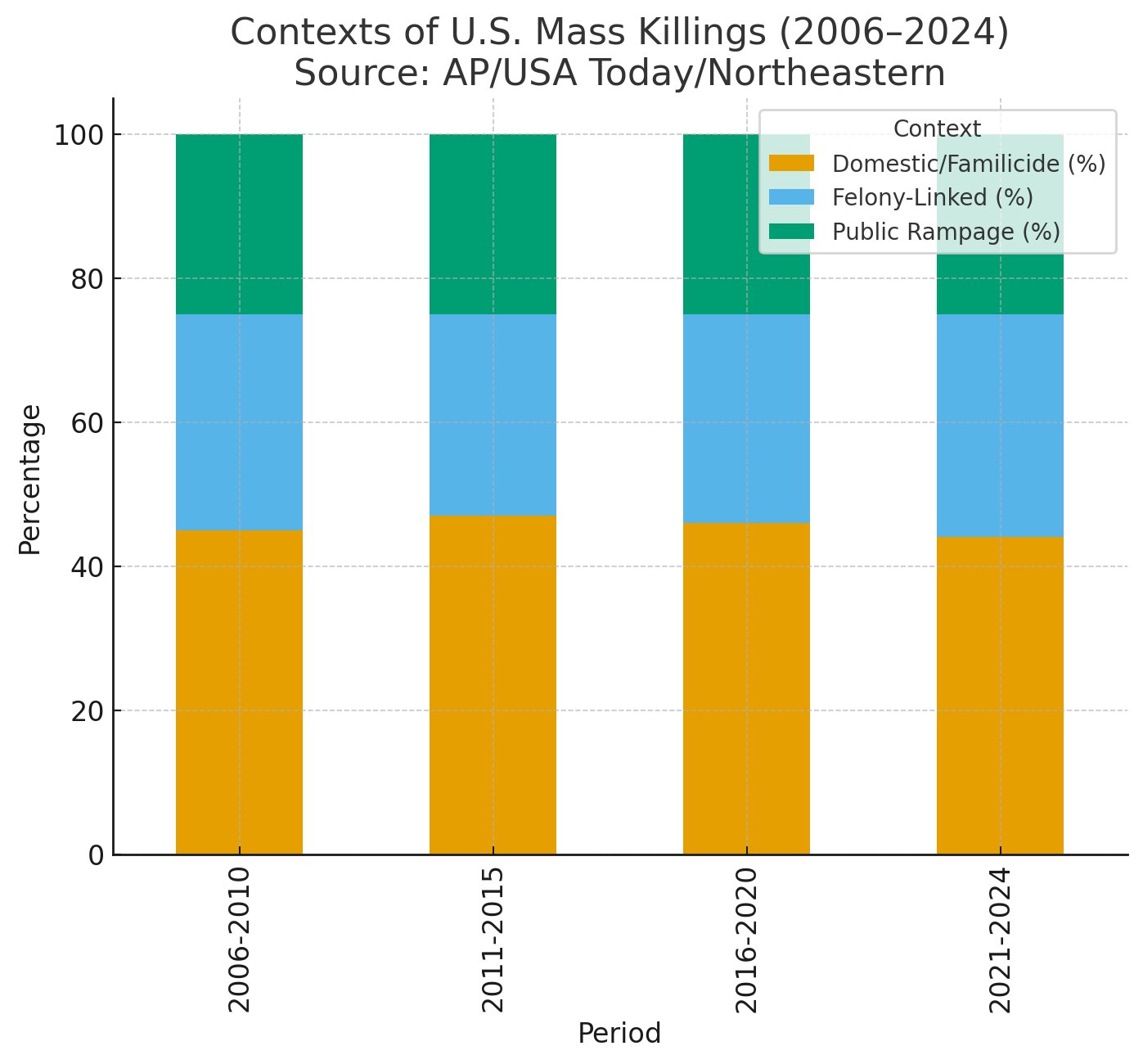
If the Violence Project zooms in tightly on high-profile public attacks, the AP/USA Today/Northeastern University Mass Killing Database widens the frame. It tracks every U.S. mass killing since 2006 where four or more people were killed, regardless of weapon, setting, or motive.
This database shows a different picture because it includes:
Domestic familicides — a father killing his children and partner, often followed by suicide.
Felony-related killings — murders tied to robberies, drug disputes, or other crimes.
Public rampages — still in the mix, but no longer the only type of case.
The receipts here:
Gender: Still overwhelming. ~97% of perpetrators are male.
Age: The median age is ~30–31.
Race/Ethnicity:
White perpetrators remain a large share, but not always the plurality.
Domestic/familicide cases bring in more racial variation, showing higher proportions of Black and Latino perpetrators than the Violence Project’s narrower dataset.
Context: Nearly half of all mass killings are family-related.
Examples:
In 2019, a man in Elkmont, Alabama, shot and killed five family members, including children.
In 2022, a father in Oklahoma killed his wife and three children before turning the gun on himself.
Takeaway: The AP/Northeastern database reinforces the gender constant — almost all perpetrators are men — while showing how race and motive shift once domestic and felony-related cases are included.
Lens C: Mass Attacks in Public Spaces (Secret Service)
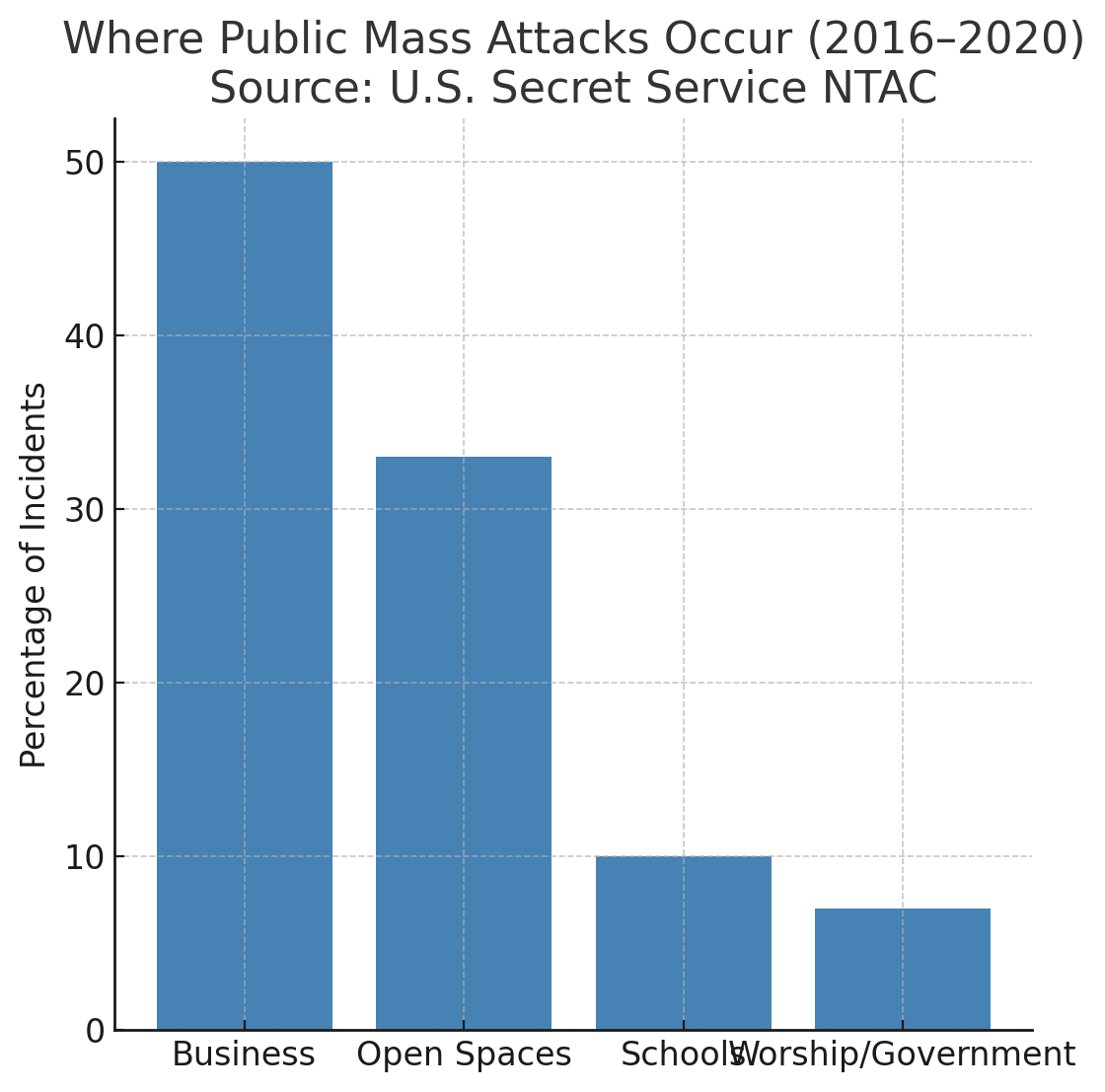
The U.S. Secret Service doesn’t just look backward. It looks for patterns that can stop the next attack. Through its National Threat Assessment Center (NTAC), the agency studied mass attacks in public spaces from 2016 to 2020. Their definition: three or more people injured or killed in public or semi-public spaces, with any weapon. Guns dominate the data, but knives and vehicles appear too.
The receipts:
Gender: 96% of attackers were male.
Age: Average age 34.
Context:
Nearly half at businesses.
One-third in open spaces.
Others at schools, houses of worship, and government sites.
Warning signs:
63% had histories of domestic violence or violent behavior.
Over half experienced major stressors (job loss, eviction, divorce).
Many leaked plans through conversations, writings, or online posts.
Examples:
The 2019 Virginia Beach shooting, in which a city employee killed 12 coworkers.
The 2018 Jacksonville Landing shooting, during a video game tournament.
Takeaway: Whether in schools, workplaces, or public gatherings, the demographic constant remains: almost all perpetrators are men, often in their 20s to 40s.
The Constant: Gender and Age
Pulling the three lenses together:
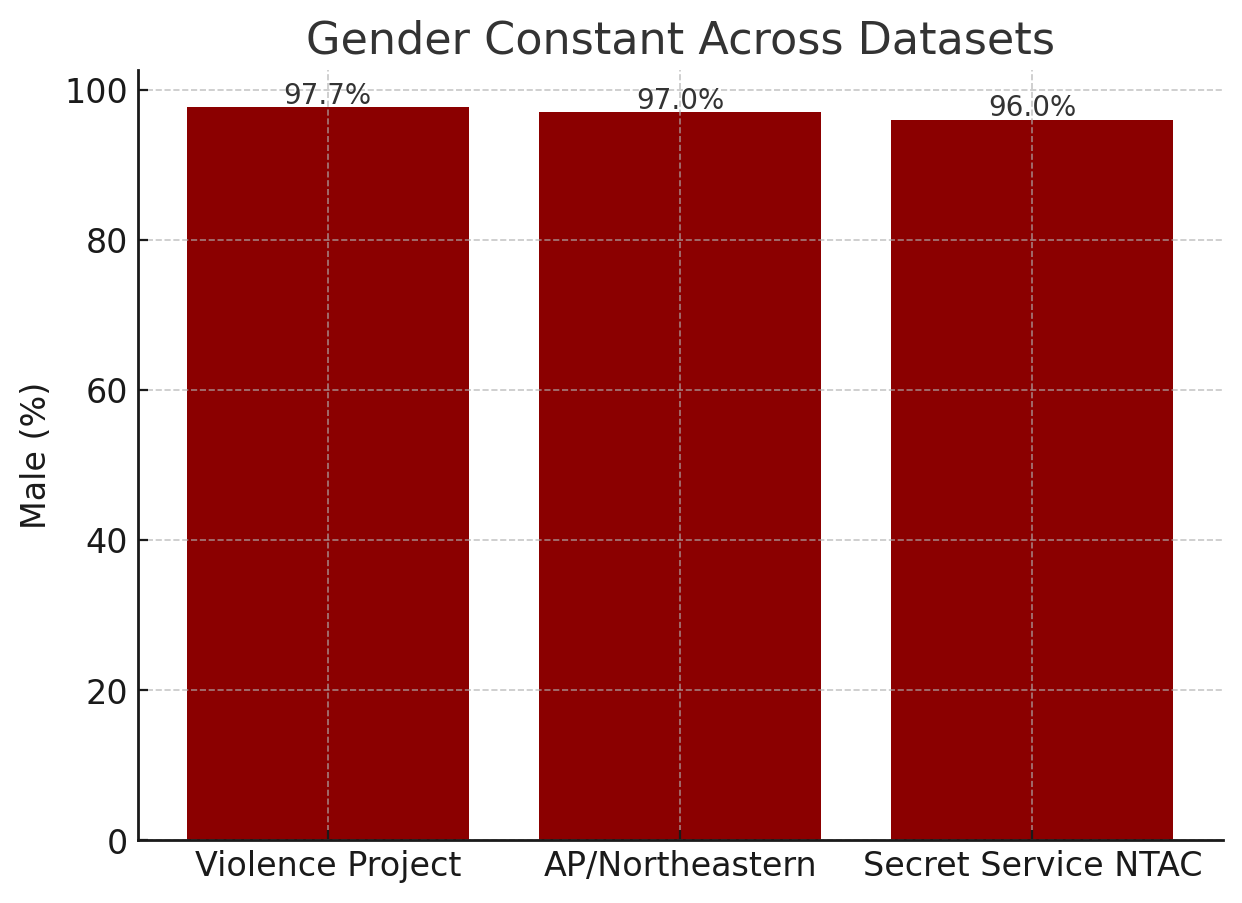
Violence Project: 97.7% male, avg. age 34.
AP/Northeastern: ~97% male, median age ~30–31.
Secret Service: 96% male, avg. age 34.
The demographic constant is unmistakable: the overwhelming majority of mass shooters are men, typically in their late 20s to mid-30s.
Race and ethnicity vary by definition. White perpetrators are the plurality in public mass shootings. In broader definitions, the mix shifts, with no single group always dominant. But gender does not shift.
Takeaway: The honest answer to “who overwhelmingly commits mass shootings?” is simple: men.
Historical Trends: Has the Profile Changed?
Looking back to the 1960s, the core profile of a mass shooter has been stable.
Gender/Age Stability: 1966–2019, Violence Project: 97.7% male, avg. age 34.
Race: White perpetrators consistently the plurality in public rampages, but broader definitions bring more variation.
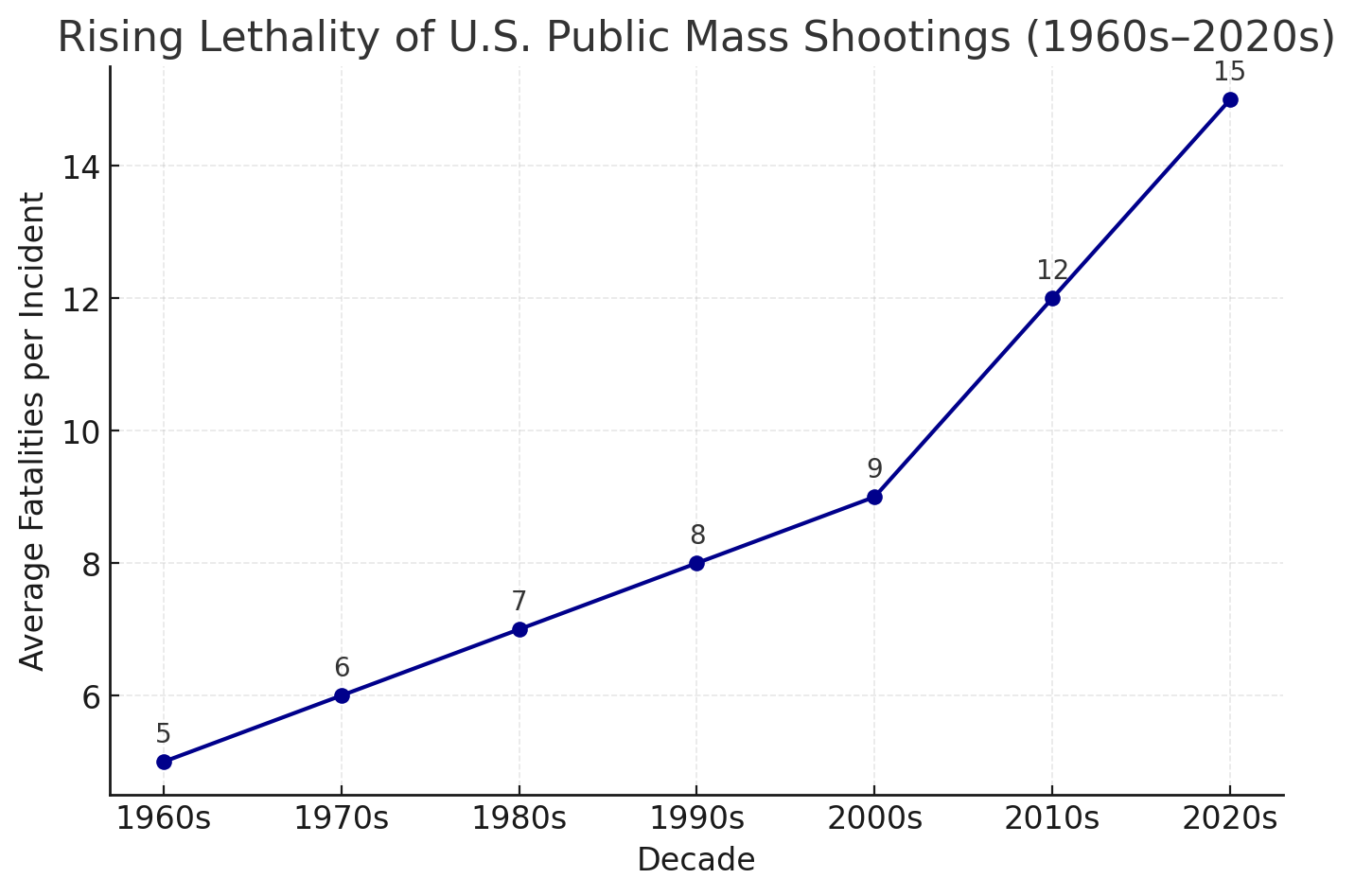
Weapons: Early cases used shotguns and revolvers; today, semiautomatic pistols and AR-15s dominate. This has increased lethality.
Settings:
1980s–1990s: workplace shootings (“going postal”).
1990s–2000s: school shootings (Columbine, Virginia Tech).
2010s–2020s: large public gatherings (Las Vegas, Orlando).
Takeaway: The profile hasn’t changed — male, often young to mid-adult — but the weapons and targets have made attacks deadlier.
Media Narratives: What Gets Amplified
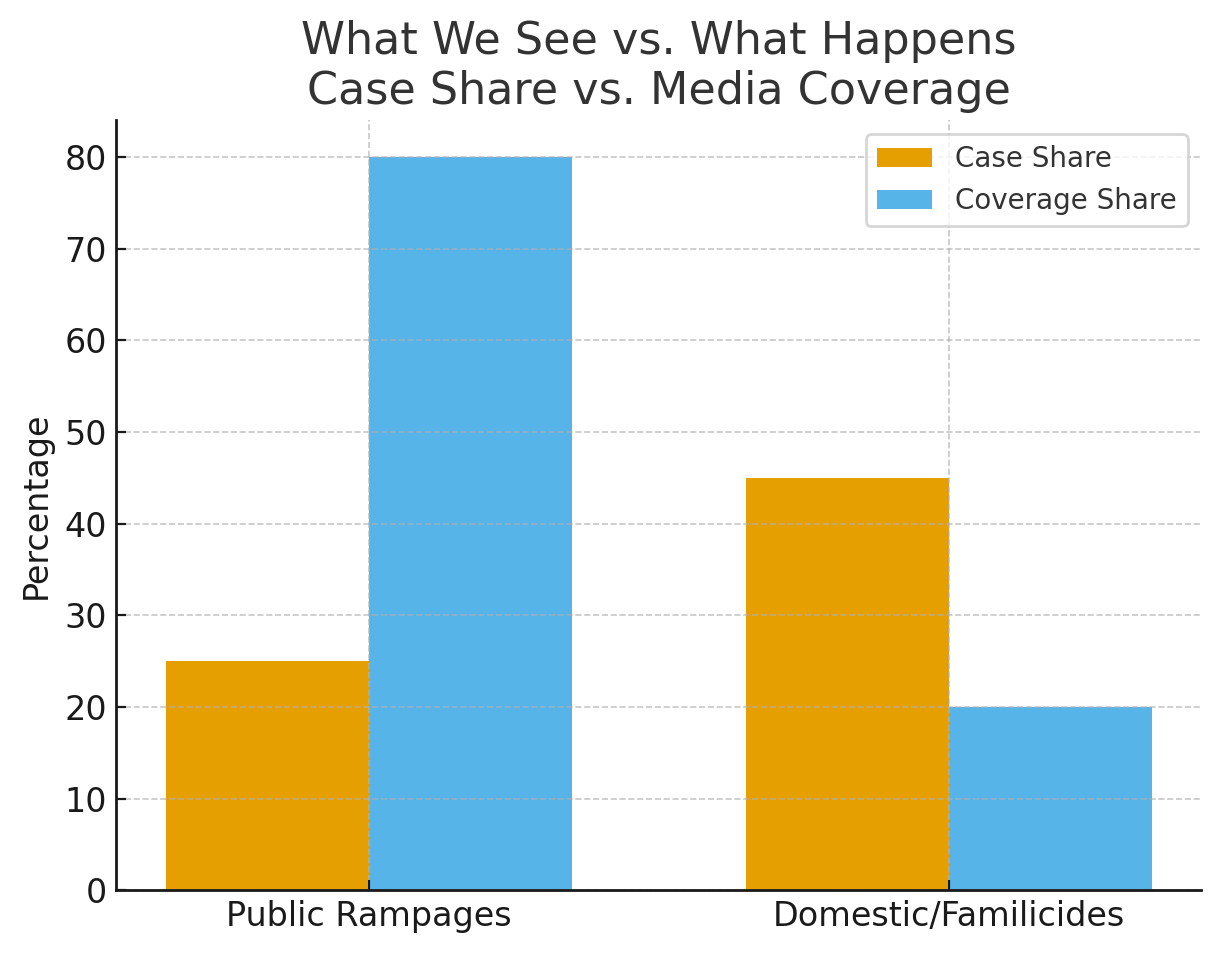
The media skews perception by covering some mass shootings more than others.
Public rampages dominate coverage. Domestic killings, though more common, rarely make national news.
Racial framing:
White shooters: “loner,” “mentally ill.”
Black/Latino shooters: “gang violence” or “crime.”
Trans scapegoating myth:
Reality: Only one trans shooter in the Violence Project dataset since 1966.
Across thousands of GVA cases, trans/LGBTQ+ shooters are statistically negligible.
Takeaway: Media framing exaggerates certain archetypes while erasing others, distorting public understanding.
Two Key Clarifiers
1. Scale:
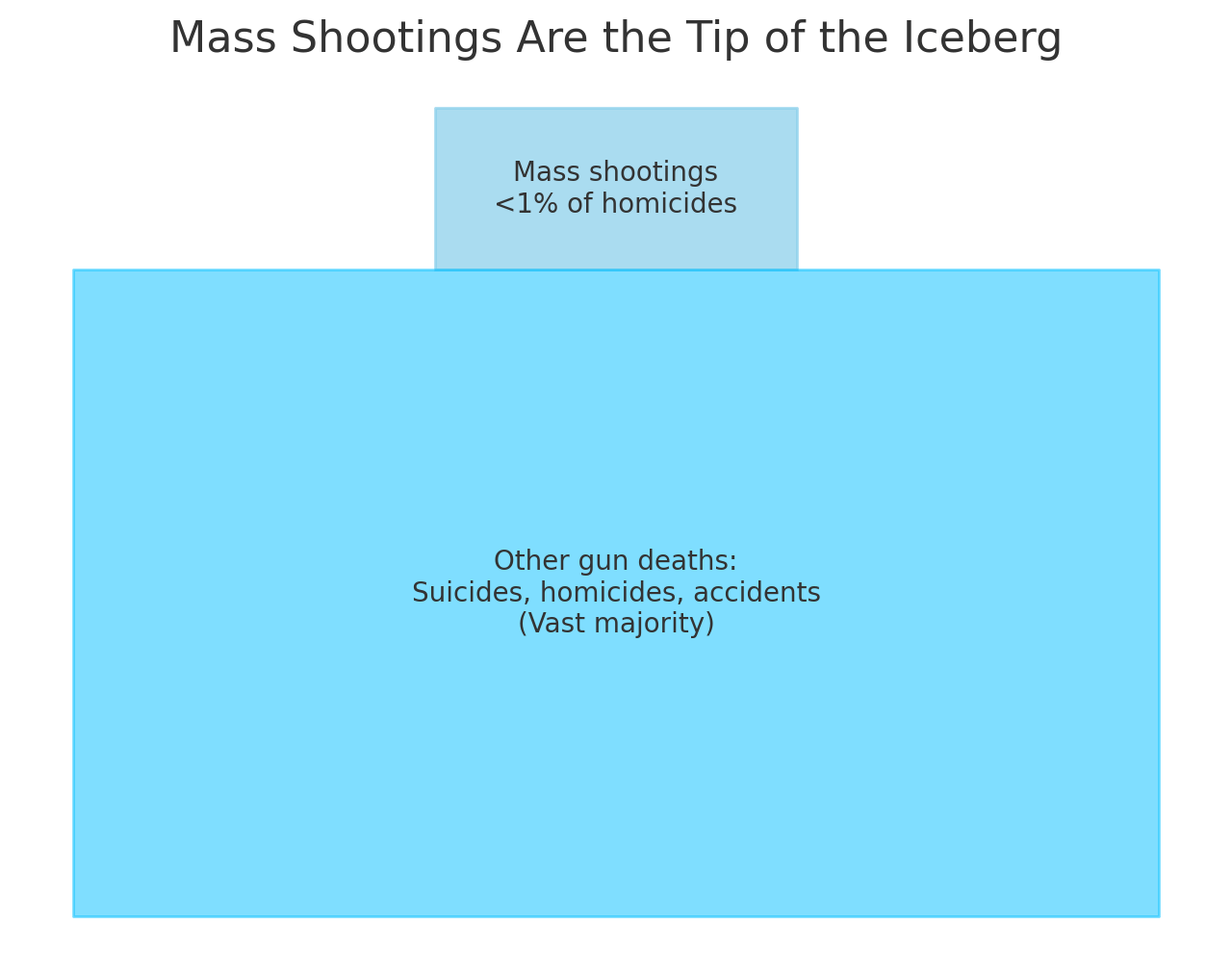
Mass shootings = <1% of homicides, though they dominate headlines.
They’re the visible tip of the iceberg of U.S. gun violence.
2. Prevention:
Warning signs are common.
Violence Project: Nearly half of the participants had leaked plans, and two-thirds had criminal records.
Secret Service: 63% had domestic violence histories; most had recent crises.
Policy tools exist: red flag laws, domestic violence protections, and safe storage requirements.
Takeaway: Mass shootings are rare but not unpredictable. The signals are often there.
Conclusion: Cutting Through the Noise
The myths are loud, but the receipts are louder. When the question is who overwhelmingly commits mass shootings in the United States, the answer is not complicated or partisan. It’s men.
Across datasets, the imbalance is overwhelming, with 96–98% of participants being male, typically in their late 20s to mid-30s. Race varies by definition. In public mass shootings, White perpetrators are the plurality. In broader definitions, the mix shifts. What does not shift is gender.
Here’s the brutal honesty: mass shootings are not random chaos. They are overwhelmingly committed by men who often show warning signs — leaking plans, committing domestic violence, spiraling after crises. Communities see the signals, but systems fail to act.
And here’s the danger: when politicians scapegoat gangs, immigrants, or LGBTQ+ people, they aren’t just wrong. They’re wasting time and dodging the receipts. That waste ensures the next tragedy.
If we anchor the debate where the data leads — on gender, age, and prevention signals — we can cut through the myths. We can stop recycling false claims and start building policies that address what the receipts make plain.
Because every time we ask this question, another community has already paid the price. And the data leaves us no excuse for answering with anything less than the truth.
Stay Informed. Stay Loud.
Subscribe to The Coffman Chronicle for no-BS political analysis, action guides, and daily truth bombs you won’t get from corporate media.
Bibliography:
Peterson, Jillian K., and James A. Densley. The Violence Project Database of Mass Shootings in the United States, 1966–2019. St. Paul, MN: The Violence Project, November 2019.
Northeastern University, Associated Press, and USA TODAY. “Mass Killing Database (2006–present).” Northeastern University School of Criminology & Criminal Justice.
U.S. Department of Justice, National Institute of Justice. “Public Mass Shootings: Database Amasses Details of a Half Century of U.S. Mass Shootings.” February 3, 2022.
U.S. Secret Service, National Threat Assessment Center. Mass Attacks in Public Spaces: 2016–2020 (executive summary and report). Washington, DC, January 2023.
Associated Press. “Database of Mass Killings — What Counts & How Many.” AP News, October 26, 2023.
“Mass shootings in the United States.” Wikipedia.
Notes on Sources
Violence Project Report (2019): This report provides the core demographics—97.7% male, average age ~34, race breakdown (52% White plurality), plus precursors like leakage and prior violence.
AP/Northeastern Mass Killing Database: Covers all incidents with 4+ fatalities since 2006; includes domestic, felony-related, and public shootings.
NIJ Article on Public Mass Shootings: National Institute of Justice coverage of the Violence Project findings, capturing demographics and trends similarly.
AP News Explanation of Definitions: Clarifies what counts as a mass killing vs. mass shooting; offers context for definitions.
Wikipedia Overview: Provides a summary of varying definitions and a breakdown of race/gender patterns across datasets.
Secret Service NTAC Report: The source for gender (96% male), age (~34), settings (businesses, open spaces, etc.), and prevention data (stressors, prior violence).
Well researched and presented.
In other words....no, not horrible black, Latino, gay, Muslim, or transsexual people. Not gangbangers or Don Linguine Fettucine.
Any other questions?