


When Representative Alexandria Ocasio-Cortez and Senator Bernie Sanders introduced legislation to pause new AI and hyperscale data center construction until Congress passes federal safeguards, much of Washington treated it as a stunt. In a narrow sense, that reaction is understandable. The bill is very unlikely to become law in the current political environment.
However, dismissing it misses the larger point.
What Sanders and Ocasio-Cortez are doing is naming a conflict that is already unfolding across the country, and especially in states like Pennsylvania. The debate over data centers is no longer just about technology or economic development in the abstract. It is becoming a much more grounded and uncomfortable question about who bears the costs of the AI economy, and who actually benefits.
This Community Is Powered by You
What started as a small circle has grown into something much bigger, and it’s all because of readers like you.
Every time you forward this email, post it on socials, or bring someone new into the fold, you’re helping build one of the most passionate, independent political communities out there.
Want to keep the momentum going?
Share this newsletter with someone who should be part of this conversation.
Thank you for being here. It means everything.
A Public Already on Edge
The political class may still be catching up, but the public mood is already shifting.
A recent survey from the Pew Research Center found that Americans are more likely to view data centers as harmful than beneficial for the environment, home energy costs, and quality of life in nearby communities. What is especially striking is that skepticism increases with familiarity. People who say they have heard “a lot” about data centers are significantly more likely to see them as a net negative than those who have heard only a little.
Pennsylvania offers an even sharper picture. A February 2026 poll from Quinnipiac University found that 68% of voters in the state would oppose building an AI data center in their own community. That includes a majority of Republicans, along with large majorities of independents and Democrats. In a state defined by its political divisions, such an agreement is unusual. It suggests that this is not a conventional partisan issue.
Not Just a Pennsylvania Story
Pennsylvania may be one of the clearest examples of this tension, but it is not alone.
Across the Midwest and Northeast, similar conflicts are emerging. In Missouri, large public meetings have drawn residents from across the political spectrum to oppose rezoning farmland for data center development. In Illinois, local officials in counties such as Sangamon and Champaign have slowed or paused projects amid intense community pushback. In Ohio, activists have gone so far as to pursue a statewide amendment to restrict massive new data center construction.
We’ve reported on some of these surprising pushbacks here:
Note: Articles roll into the archive over time. Become a paid subscriber for full access to our extensive catalog.


Even the industry has taken notice. Microsoft’s president recently acknowledged that winning and maintaining local trust is now essential, after community opposition contributed to delays and cancellations in multiple regions.
Taken together, these fights point to something larger than isolated local disputes. They suggest a growing pattern of resistance, particularly in rural and small-town communities that are being asked to host the physical infrastructure of the digital economy.
What Communities Are Actually Asking
In Pennsylvania, some of the most visible local battles, including proposals in places like Chester County, have made the concerns remarkably consistent.
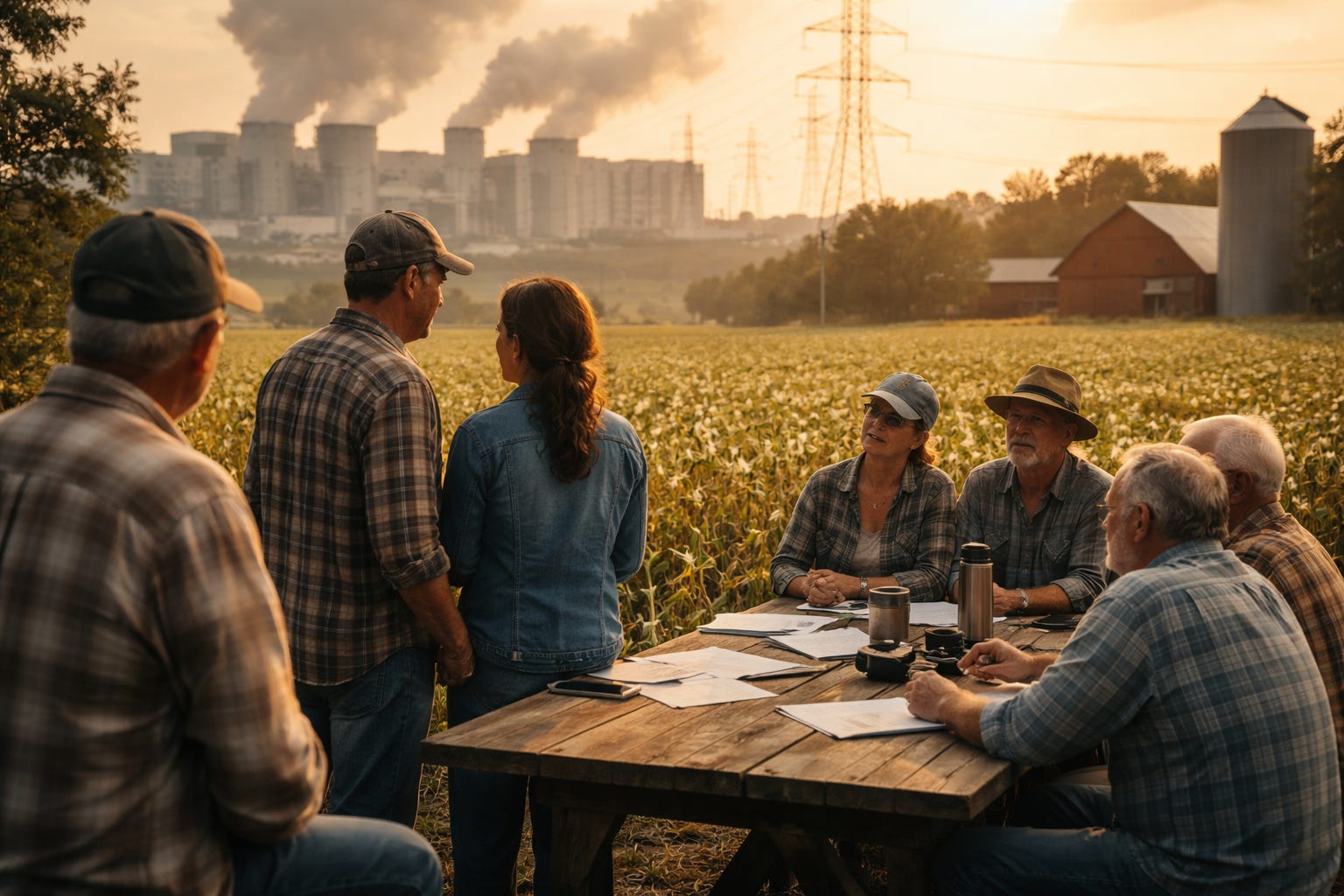
Residents are not primarily debating abstract questions about artificial intelligence. They are asking what these projects will mean for their daily lives. They are asking whether increased electricity demand will translate into higher utility bills, whether local roads and infrastructure can handle the added strain, and whether water use and land disruption will alter the character of their communities.
They are also asking a simpler, more pointed question: what exactly are we getting in return?
The promised benefits, particularly in terms of permanent local employment, often appear modest when compared to the scale of the projects themselves. That gap between visible cost and uncertain benefit is where skepticism tends to grow.
We’ve reported extensively on the impact of AI data centers. See some of that reporting here:
Note: Articles roll into our archive over time. Become a paid subscriber for full access to our extensive catalog.


Kitchen Table Politics, Not Culture War
This is why the politics of this issue do not follow familiar lines.
In many rural communities, the debate over data centers is not ideological. It is practical. It shows up in conversations about electric bills, road conditions, emergency response times, and whether local services are already stretched too thin. It shows up in concerns about whether new development will actually strengthen a community or simply impose new demands on already fragile systems.
In other words, this is kitchen table politics.
It is about whether a project will make life more affordable or more expensive, more stable or more precarious. It is about whether the benefits of economic growth are being shared locally or flowing outward. It is about a question that many communities are increasingly asking with some frustration: why does the system move so quickly when corporate infrastructure is on the table, but so slowly when it comes to the basic infrastructure people rely on every day?
A Backlash Rooted in Experience
The cross-partisan nature of this backlash begins to make sense in that context.
Communities that have spent years dealing with hospital closures, struggling schools, deteriorating infrastructure, and long emergency response times are not approaching these proposals with abstract optimism. They are evaluating them against lived experience.
For many, that experience has created a deep skepticism toward projects that promise broad economic benefits but deliver limited local improvements. When a proposal requires significant local resources, whether land, power, water, or infrastructure capacity, but offers uncertain returns, it can begin to look less like development and more like extraction.
That perception, whether or not it is universally fair, is powerful. Moreover, it helps explain why resistance is emerging in places that are often assumed to be eager for any form of investment.
The Overlooked Common Ground
There is another, quieter lesson in all of this.
Strip away the familiar political labels, and many of the concerns driving this backlash are widely shared. People across different regions and political identities are asking how to keep family farms viable, support local businesses, protect land for future generations, and ensure that communities are not hollowed out by distant economic forces.
In many rural areas, the idea that people should look out for one another is not an abstract political philosophy. It is a lived reality, expressed through volunteer fire departments, community fundraising, and neighbors stepping in during times of need. The language used to describe those values may differ, but the underlying ethic of mutual responsibility is often similar.
That does not erase real political differences, but it does suggest that the starting point for many of these debates is closer than it might appear.
Why This Debate Matters
That is why the Sanders-AOC proposal is worth taking seriously, even if it never passes.
It is not simply a policy proposal. It is an attempt to bring a growing tension into the open. It asks whether the rapid expansion of the AI economy should proceed without stronger safeguards, and whether communities should have more say in how and where that expansion happens.
More fundamentally, it raises a question that extends well beyond data centers. If the country can mobilize land, energy, incentives, and political will for large-scale digital infrastructure, why has it struggled to do the same for the systems that directly sustain communities?
That question is not going away, and increasingly, neither is the willingness of communities to push back when the answer does not feel acceptable.
If America can move mountains for data centers, it can stop pretending it is powerless to build the infrastructure communities actually need.
If you found this useful, subscribe for more reporting and analysis on the political and economic forces shaping everyday life, especially in the places too often ignored in national conversations.
Sources:
Sanders, Ocasio-Cortez push bill to impose AI data center moratorium, Associated Press, March 25, 2026.
A movement to ban data centers gains steam across the U.S., The Washington Post, March 25, 2026.
Bernie Sanders and AOC introduce bill to pause building of new datacenters, The Guardian, March 25, 2026.
Exclusive: Sen. Warner calls AI data center moratorium championed by AOC “idiocy”, Axios, March 25, 2026.
How Americans view data centers’ impact in key areas from the environment to jobs, Pew Research Center, March 12, 2026.
Pennsylvania Release – February 25, 2026, Quinnipiac University Poll, February 25, 2026.
PA House committee advances data center bills, City & State Pennsylvania, March 2, 2026.
East Whiteland residents oppose data center as planners send revised plan back for further review, 6abc / WPVI, March 10, 2026.
A proposal to make an East Whiteland data center 60% bigger sparked heated opposition in Chester County, The Philadelphia Inquirer, March 10, 2026.
Data centers are eyeing the collar counties. They’re drawing pushback from residents across the region, The Philadelphia Inquirer, March 24, 2026.
How some townships fight the data center next door, The Philadelphia Inquirer, March 25, 2026.
Archbald denies 18-building data center campus during special Friday afternoon meeting, WVIA, March 27, 2026.
Data centers: Ransom Twp. denies zoning amendment request after resident’s lawyer points out flaws, WVIA, January 21, 2026.
Residents and elected officials want PA Permit Fast Track Program to slow down when it comes to data centers, WVIA, March 24, 2026.
Protests against AI data centers in Missouri and across the U.S. are scrambling political lines, KCUR / NPR, January 31, 2026.
The Sangamon County Board tables vote on a massive data center, NPR Illinois, March 23, 2026.
Board tables vote on proposed data center near Waverly, Jacksonville Journal-Courier, March 25, 2026.
Proposed amendment to ban huge data centers in Ohio can move to next step, The Statehouse News Bureau / State News, March 26, 2026.
Microsoft president says building data centres requires trust of US communities, Reuters, March 24, 2026.
Don't you mean who pays for the AI bubble just like who paid for the housing bubble during the great recession.
The cost bearing potential of AI data centers must be addressed in terms of whom benefits and how much. There is little benefit to the consumer of AI if they inadvertently pay for it via their utility bills, environmental damage, and job disruption. This sounds like another corporate scam courtesy of the current grifters in our government. Say no to AI data centers pending public community meetings and appropriate legal safe guards which benefit the less powerful consumers over the more powerful corporations. That might begin to get some constructive dialogue going. But, no action until the public is satisfied.