


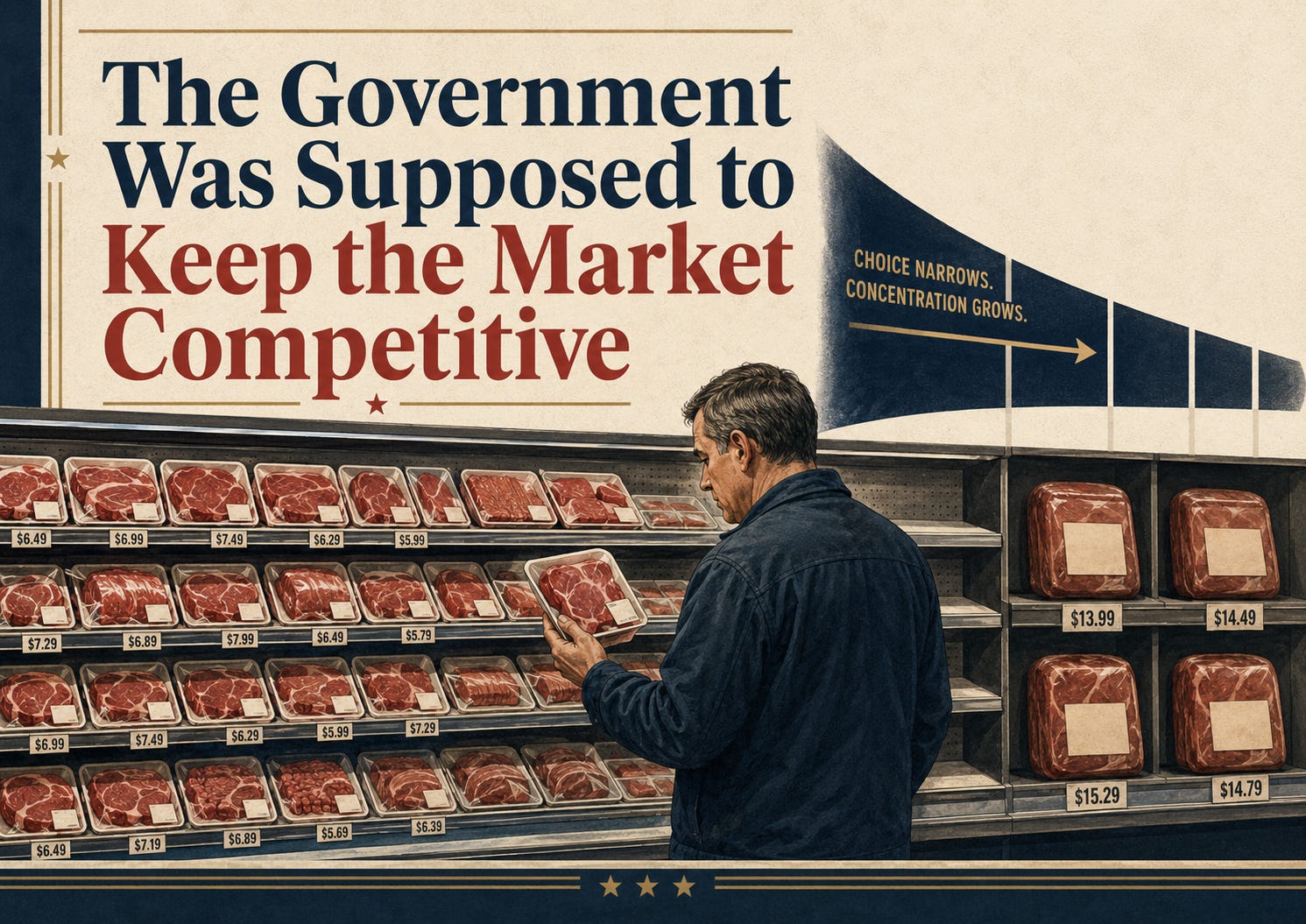
The Market at the Meat Counter
There is a strange moment in the grocery store when a package of hamburger starts to feel like a financial decision. You pick it up, look at the price, put it back, check the smaller package, and do the quiet arithmetic Americans have become very good at doing. Maybe tacos become pasta. Maybe steaks wait another week. Maybe the family pack is cheaper per pound, assuming there is enough money in the account to buy more today in order to save tomorrow.
Hundreds of miles away, a cattle rancher can be doing a different version of the same calculation. Feed costs what it costs. So does fuel. The cattle are ready when they are ready, but when it comes time to sell, the number of enormous processors competing to buy those cattle has become remarkably small.
Those two Americans may never meet. One is trying to get dinner on the table, while the other is trying to keep a ranch profitable. Between them sits an industry that has spent decades becoming increasingly concentrated. Now Washington is paying attention. On Friday, President Donald Trump publicly attacked what he called a “nasty monopoly” in food processing and promised action aimed at giving farmers and ranchers more options.
The concentration problem he identified is real. The more uncomfortable question is how it was allowed to get this far.
This Community Is Powered by You
What started as a small circle has grown into something much bigger, and it’s all because of readers like you.
Every time you forward this email, post it on socials, or bring someone new into the fold, you’re helping build one of the most passionate, independent communities out there.
Want to keep the momentum going?
Share this newsletter with someone who should be part of this conversation.
Thank you for being here. It means everything.
Four Companies, One Very Narrow Marketplace
The number behind that concentration is difficult to ignore. JBS, Cargill, Tyson Foods, and National Beef now account for roughly 85% of the U.S. beef-processing market. In 1980, the four largest processors controlled about 36%.
A concentrated industry is not automatically an illegal one, and market share by itself is not evidence of collusion or price fixing. The Justice Department is investigating whether illegal conduct occurred, but competition does not become irrelevant simply because concentration is legal. A rancher preparing to sell cattle does not negotiate in an abstract national economy. What matters is how many serious buyers are available. Fewer buyers can mean fewer chances to reject a bad offer and find a better one.
Workers face a similar problem when only a handful of large employers dominate their local industry. Families buying beef have their own stake in processors competing aggressively for business.
A market can contain thousands of ranchers, millions of customers, and shelves full of different packages while still becoming remarkably narrow at the point where much of the product must pass. The issue is whether competition still has enough room to work.
Success Is Not the Crime
There is nothing inherently suspicious about a company becoming large. A business can grow because it is efficient, because customers prefer its product, because it innovates faster than its competitors, or because scale allows it to do something smaller firms cannot. Profit is not evidence of wrongdoing, and market share is not a confession.
A government that punished companies simply for succeeding would not protect competition. It would punish it. The problem begins when success hardens into control.
A dominant company should still have to compete for customers, suppliers, and workers. New firms should still have a realistic chance to enter the market. A rancher should not discover that the number of buyers has become so small that bargaining power exists mostly on the other side of the table.
The Square New Deal should defend that boundary. Capitalism depends on the possibility that someone else can build a better product, offer a better price, pay a better wage, or make a better deal. Government should not guarantee any company a permanent place at the top, any more than it should decide who belongs there. Government does not owe corporations protection from competition. It owes the public protection of competition.
The Government Already Had a Job
None of this required Washington to invent a new responsibility. Congress passed the Sherman Antitrust Act in 1890, the Clayton Act in 1914, and created the Federal Trade Commission that same year. In 1976, Congress added premerger review for certain large deals.
The reason was straightforward. Some damage is easier to prevent than repair. Once competitors combine and customers lose alternatives, reconstructing competition can be extraordinarily difficult.
The machinery still exists. On August 26th, the Justice Department announced a record $250 million civil penalty against investment firm KKR to resolve allegations that it repeatedly violated federal premerger-review requirements involving at least 16 transactions. KKR agreed to the settlement without admitting the allegations.
The United States has laws, regulators, prosecutors, and a system designed to examine whether consolidation threatens competition. That makes the concentration in beef processing harder to treat as something that simply happened. Government put itself in this story more than a century ago. The question is how well it did the job.
Why Do We Keep Waiting Until the Market Is Broken?
Markets rarely become concentrated in one dramatic moment. They narrow gradually. One company buys another, a regional processor closes, a competitor sells, a plant disappears. Suppliers adjust to the remaining buyers, workers adjust to the remaining employers, and customers adjust to the remaining choices. Each change can be explained on its own. Taken together over decades, they can produce a market very different from the one government was supposed to preserve.
By the time Washington decides competition has become a serious problem, much of the competitive structure may already be gone. An investigation can uncover misconduct, a lawsuit can stop an illegal practice, and a court can impose remedies, but none of those things automatically recreates the businesses that closed, the capacity that disappeared, or the competitors absorbed years earlier.
Government cannot prevent every merger, save every company, or guarantee that every town keeps every employer, nor should it try. Markets change. Businesses fail. Efficient companies win. Stewardship, however, requires noticing when ordinary market change is steadily removing the competition the system depends on.
If four companies now control most beef processing, Washington should investigate any evidence of illegal conduct. It should also ask a harder question about its own performance. How many warning signs did government see while the market was narrowing? Antitrust policy should not amount to standing beside a burned-down house with a clipboard, carefully documenting that there used to be more rooms.
Trump Has Identified the Problem. Now Test the Remedy.
President Trump deserves credit for putting the concentration problem on the table. His proposed response is to make it easier for farmers and ranchers to process meat outside the handful of companies that dominate the industry, while supporting independent processors and removing regulations the administration considers unnecessary.
There is a reasonable idea underneath that approach. If government rules make it unnecessarily expensive or difficult for smaller processors to enter the market, those rules deserve scrutiny. Regulation can protect the public, but it can also become a barrier established companies can absorb while potential competitors cannot.
The test cannot stop there, however. Meat inspection exists because contaminated food does not become harmless simply because it came from a small business. Ranchers themselves have argued that barriers should be reduced without abandoning inspection standards.
Washington therefore has a harder job than choosing between regulation and deregulation. Remove rules that unnecessarily protect incumbents. Make it possible for smaller processors to compete. Enforce the law when dominant companies engage in illegal conduct. Preserve the protections necessary to keep unsafe meat out of the food supply. The country does not have to choose between four giant processors and a system with no meaningful rules. A government capable of stewardship should be able to protect competition and protect the dinner table at the same time.
A Free Market Requires Somewhere Else to Go
A market is not truly competitive just because government does not set the price. Competition depends on alternatives.
A worker needs another employer. A farmer needs another buyer. A small business needs another supplier. A customer needs another seller. An entrepreneur needs a realistic path into the market. Those alternatives create bargaining power.
Take them away, and the economy may still look private on paper. The contracts are still voluntary. The companies are still privately owned. The worker is still technically free to quit, and the rancher is still technically free to refuse an offer. However, freedom means less when every road leads back to the same handful of companies.
Competition is one way ordinary people protect themselves without needing government to negotiate every transaction on their behalf. The Square New Deal should aim not to guarantee that every business survives or every worker gets the deal he wants, but to preserve enough real competition that saying no still means something. A free market requires somewhere else to go.
The Square New Deal Test for Market Power
The Square New Deal does not need a rule that says every large company should be broken apart. It needs better questions. Can customers realistically choose another seller? Can workers realistically choose another employer? Can suppliers realistically choose another buyer? Can a new competitor enter the market without barriers designed to protect the companies already there?
If those answers begin turning into no, government has a stewardship problem. The cause may be illegal conduct, a merger policy that allowed too much concentration, regulations that established companies can afford but smaller competitors cannot, weak enforcement, or several of those things working together.
The remedy should follow the problem. Sometimes that means prosecution. Sometimes it means blocking a merger. Sometimes it means removing a barrier to entry or writing a better rule. The Square New Deal should not begin with a predetermined punishment and work backward toward a justification. It should begin with the condition of the market itself.
Can ordinary people still choose, bargain, compete and walk away? If they cannot, government has not preserved a free market simply because the companies operating inside it remain privately owned.
Learn more about the Square New Deal here:

The Government Was Supposed to Keep the Market Competitive
The family standing at the meat counter should not need Washington to decide what hamburger costs, and the rancher selling cattle should not need a federal official negotiating the price on his behalf. That is the point of having a competitive market in the first place.
When enough buyers compete for cattle, enough processors compete for business, and enough sellers compete for customers, millions of individual decisions do much of the work government should never try to do itself. Prices move. Businesses rise and fall. Better offers beat worse ones. People retain the ability to walk away.
However, that system depends on competition remaining real. Government was never supposed to guarantee every company success. It was never supposed to freeze the economy in place or protect businesses from rivals that could do the job better. It was supposed to keep the field open.
That means enforcing the law when competition is attacked, questioning consolidation before the alternatives disappear, removing rules that unnecessarily protect incumbents, and preserving the protections the public actually needs.
Government does not owe corporations protection from competition. It owes the public protection of competition.
Support Independent Media-The Coffman Chronicle
If this argument made sense to you, share it with someone who still believes a free market should actually be free.
The Coffman Chronicle is reader-supported. If you can afford to become a paid subscriber, it helps us keep doing this work independently and keep building out the Square New Deal.
If you can’t, keep reading, sharing and bringing other people into the conversation.
Thank you!
Sources
Federal Trade Commission. “The Antitrust Laws.”
Federal Trade Commission. “Mergers.”
MacDonald, James M. “Concentration in U.S. Meatpacking Industry and How It Affects Competition and Cattle Prices.” U.S. Department of Agriculture, Economic Research Service, January 25, 2024.
Douglas, Leah, Tom Polansek, and Susan Heavey. “Trump Vows Legal Order to Break Up ‘Nasty Monopoly’ in Food Processing.” Reuters, August 28, 2026. Updated August 29, 2026.
U.S. Department of Justice. “Deputy Assistant Attorney General Nicole Sarrine Delivers Remarks at R-CALF USA 2026 Annual National Convention.” June 17, 2026.
U.S. Department of Justice. “KKR Agrees to Pay Record $250M Penalty for Serial Violations of Federal Premerger Review Law.” August 26, 2026.
This seems like an excellent analysis, but missing is,”Why is the Trump administration announcing this investigation?” And “Will they follow through? Unfortunately two very real possible answers must be considered. One is the administration got hammered for announcing the beef imports, and so thought up this “investigation” only to calm the waters, and they have no intention of following through with it. The second is that the Trump Family and MAGA sees the threat of an investigation as an opportunity to shake down another industry for campaign contributions and business payoffs
oversite vs giant lobbying firms. Lobbying is winning, the American taxpayer/ consumer is losing. Its the efficiency of the under the table deals, the hidden perks, not the efficiency of a corporation that protects monopolies.