


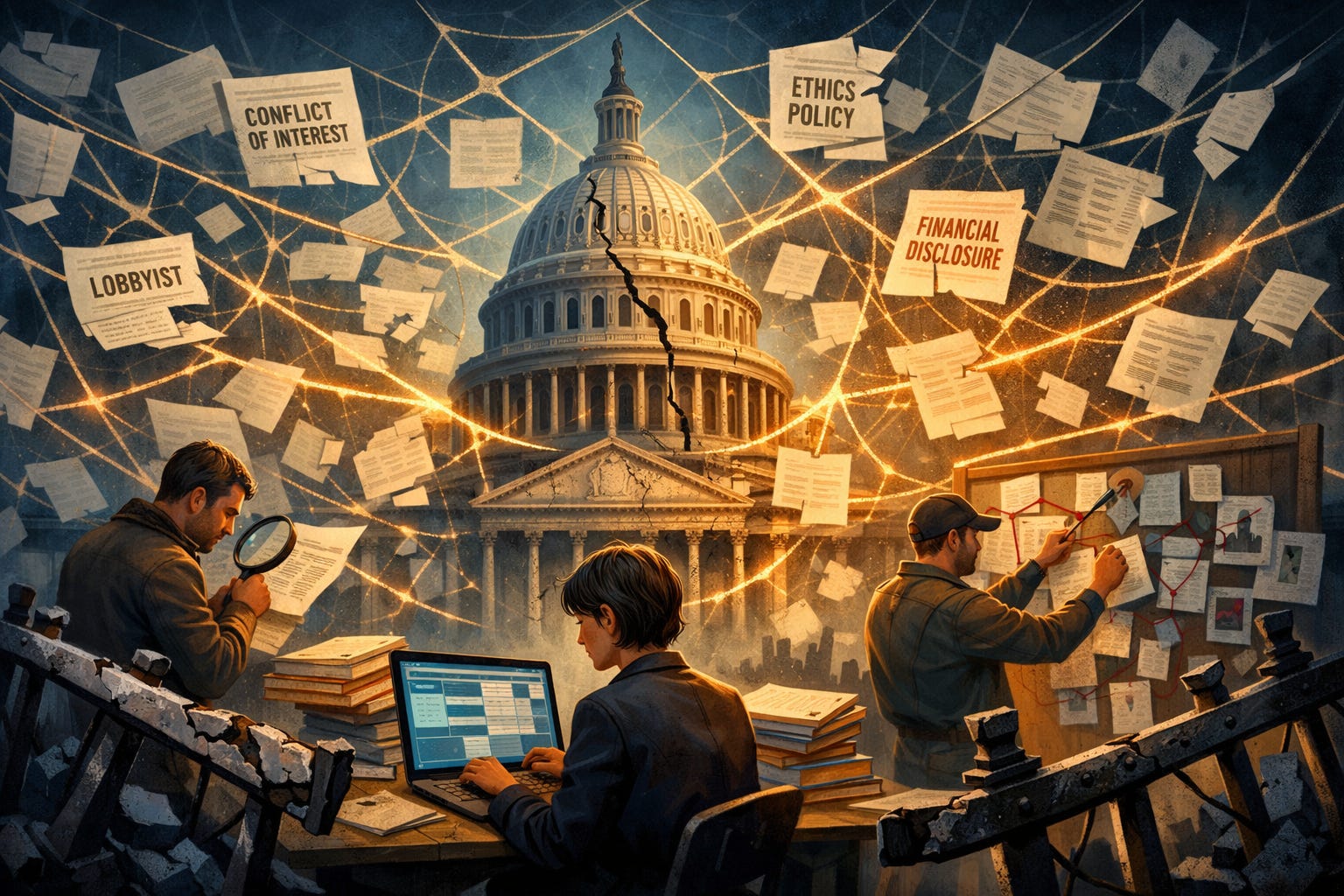
On March 9, 2026, ProPublica published something that, on its face, should not have felt remarkable: a searchable database of financial disclosure records for more than 1,500 Trump administration appointees. The records themselves were not secret. They were, in the formal sense, public. Yet once they were gathered, standardized, and made searchable in one place, they told a much bigger story than any single filing could. ProPublica’s database covers 1,573 appointees, 3,196 documents, and roughly 117,000 reported assets. That scale matters because it turns isolated paperwork into a pattern the public can actually see.
That is where this story begins, not with a single sensational disclosure or an especially shameless official, though there are examples of both. It begins with the uncomfortable realization that a newsroom had to build the ethics database the government should have built long ago. Once ProPublica did, the underlying problem came into focus. The federal ethics system is far more fragmented, reactive, and dependent on norms than many Americans probably assumed.
This matters beyond any one administration. The public is already primed to believe the system is corrupt. When disclosures that are technically public must be stitched together by reporters before anyone can understand them, that does not exactly inspire confidence. It suggests a system that offers transparency on paper while obscuring it in practice, and once readers begin to pull on that thread, they find something even more troubling beneath it.
This Community Is Powered by You
What started as a small circle has grown into something much bigger, and it’s all because of readers like you.
Every time you forward this email, post it on socials, or bring someone new into the fold, you’re helping build one of the most passionate, independent political communities out there.
Want to keep the momentum going?
Share this newsletter with someone who should be part of this conversation.
Thank you for being here. It means everything.
What ProPublica Actually Published
ProPublica’s project is not just a dump of forms. It is a map of financial relationships across a large share of the administration’s political leadership. The database includes information on assets, debts, prior employment, outside income, and ethics agreements for many appointees. ProPublica describes the records as detailing the finances of former lobbyists, industry executives, and at least a dozen officials who declined to identify former clients.
Seen one at a time, those forms might seem dry or technical. Seen together, they reveal recurring themes. ProPublica’s main finding is what it called a “web of financial ties” between Trump officials and the industries they help regulate. That phrase does a lot of work yet is also fairly precise. The reporting is not simply about wealthy people entering government. It is about the density of overlapping ties between private interests and public authority.
Plenty of senior officials have private-sector backgrounds, and not every prior employer or investment creates a conflict. The issue arises when the overlap becomes so close and so common that the public is left wondering where professional experience ends, and private loyalty begins.
The Kinds of Concerns the Reporting Surfaced
One way to understand the ProPublica reporting is to look not just at the names, but at the categories of concern.
In some cases, the issue is direct financial overlap. ProPublica reported in December 2025 that Deputy Attorney General Todd Blanche shut down aspects of crypto enforcement while still holding significant crypto-related investments. According to the reporting, those assets were worth at least about $159,000, and legal experts told ProPublica that Blanche’s actions while still invested in the sector violated both his ethics agreement and federal conflict-of-interest rules. The issue was serious enough that, in January 2026, six senators cited the investigation in accusing Blanche of a “glaring” conflict.
In other cases, the issue is not a stock trade or a single holding, but the persistence of financial relationships after an official enters office. ProPublica’s March 2026 reporting on Deputy Defense Secretary Steve Feinberg found that, although he had divested his stake in Cerberus Capital Management, he continued to rely on the firm for accounting, tax, and health care services. ProPublica further reported that the Defense Department approved an extension that allowed the financial relationship to continue without an end date, even as Cerberus-owned companies had received contracts tied to the Pentagon’s Golden Dome initiative.
Then there is the transparency problem itself. ProPublica reported that at least a dozen officials declined to identify former clients in their disclosures. There are narrow circumstances in which that can be permitted, yet from the standpoint of public trust, the effect is obvious. If the public cannot know who an official recently worked for, it cannot independently assess whether that official is now using power to benefit those clients. At that point, disclosure becomes little more than a technical exercise.
Each of these examples is troubling on its own. Together, they suggest something more serious than a few bad actors slipping through. They suggest a staffing model and an ethics regime that tolerate too much overlap between private interest and public power.
Why These Questions Did Not Fully Surface Earlier
Whenever records like these emerge, people ask a fair question: if the forms were public, why did these concerns not dominate the confirmation process?
The answer is that “public” does not necessarily mean “visible,” and it certainly does not mean “easy to analyze at scale.” ProPublica’s own project underscores this. The records existed, yet they were scattered across agencies, disclosure processes, and file formats until journalists assembled them into one searchable system. The revelation here is not simply that conflicts existed. It is that the underlying transparency infrastructure was too fragmented to make those conflicts legible to ordinary citizens in real time.
There is another reason as well, and it gets to the heart of the ethics system. Federal financial disclosure is not mainly designed to disqualify nominees from office. It is designed to identify conflicts and manage them through recusals, divestitures, and ethics agreements. In other words, the default question is often not, “Should this person hold this office at all?” It is, “What paperwork and restrictions will allow this person to serve?” ProPublica’s database is so powerful precisely because it lets readers see how often that management model is being asked to carry an enormous amount of weight.
The distinction may sound technical, yet it has enormous consequences. A system designed to manage conflicts after selection is very different from one designed to screen out the worst conflicts before power is exercised. The former can produce legal compliance while still leaving the public with the strong impression that something is deeply off.
The Pattern Did Not Begin in 2026
The new reporting is alarming. It is not, however, entirely new.
Trump’s first administration already offered repeated warnings about the revolving door between lobbying, industry, and executive power. In 2019, ProPublica reported that it had identified 281 lobbyists who had worked in the Trump administration, roughly one for every 14 political appointees at that point. That was not a stray anecdote, but rather an indicator of how heavily the administration had staffed itself from the lobbying world.
The first term also produced more concrete examples of why that matters. In 2020, ProPublica reported that Rebeckah Adcock, a former lobbyist for CropLife America, helped former chemical industry colleagues while serving as a senior Agriculture Department official. The reporting described her sharing information and helping former industry contacts navigate agency processes. Again, the concern was not merely that she once worked in the private sector. The concern was that the lines between public duty and former private affiliation appeared far too porous.
This means the current database is not exposing a freak event. Instead, it is showing readers a pattern. Trump 1.0 raised the warning flags. Trump 2.0 is now producing the giant disclosure archive, making the scale of the problem harder to ignore.
The Modest Reform That Existed, and the Larger Failure Behind It
After the first Trump term, the Biden administration did try, in a limited way, to tighten ethics rules for executive appointees. On January 20, 2021, President Biden signed Executive Order 13989, titled Ethics Commitments by Executive Branch Personnel. The order required appointees to sign an ethics pledge imposing additional restrictions, including a two-year ban on participating in matters involving former employers or clients, and added restrictions on recent lobbyists.
These were not sweeping anti-corruption reforms. They did not create the kind of hard front-end barriers many good-governance advocates would prefer. They were, to put it plainly, weak sauce. However, they were a start. They acknowledged that the baseline federal system was not enough and that additional guardrails were warranted.
Then came the predictable problem with relying on executive orders for ethics reform. Executive orders can be undone. They are not laws. On January 20, 2025, Trump rescinded Biden’s ethics order as part of his initial batch of reversals called Initial Rescissions of Harmful Executive Orders and Actions. The Federal Register’s notice of the rescissions specifically lists Executive Order 13989 among the orders revoked.
The rescission also arrived amid other signals that anti-corruption enforcement was losing momentum. Reuters reported in February 2025 that the Justice Department had paused enforcement of the Foreign Corrupt Practices Act, one of the federal government’s primary anti-bribery statutes. That decision alone does not demonstrate opposition to ethics enforcement. However, in combination with the rollback of Biden-era ethics restrictions and other oversight changes, it reinforced the impression that anti-corruption safeguards were being treated as less urgent.
The sequence matters, and not only because the optics are terrible. Trump’s first term was marked by repeated ethics concerns. Biden responded with modest, temporary guardrails, self-imposed on his own administration. Congress then had nearly four years to codify those rules, strengthen them, or, at the very least, treat them as a floor. Predictably, it did not. Trump returned to the office and erased the extra constraints on day one, citing them as harmful, while deprioritizing anti-corruption efforts. Now, ProPublica has published a trove of disclosures showing just how many overlapping concerns exist among Trump appointees. It is hard not to view this as a pattern.
Why This Matters Beyond a Few Scandals
One or two conflicts can be explained away. Perhaps there was a special circumstance here, a sloppy vetting process there, or an official who stretched the rules more than they should have. Washington has always had gray areas, and no ethics system will eliminate them entirely.
Scale changes the meaning of a story.
When a disclosure project covering 1,573 appointees still yields this many examples of industry overlap, questionable timing, ongoing financial relationships, and missing client information, the public stops seeing it as a handful of exceptions. It starts seeing a pattern, and once people believe the pattern is the point, trust erodes very quickly.
This is where the ProPublica reporting connects to the broader public mood. Many Americans already believe institutions are captured by insiders. They already assume that the rules are looser for the powerful than for everyone else. When the government’s answer to obvious overlap is often some combination of disclosure, recusal, and faith that norms will hold, that suspicion only hardens.
That does not mean every appointee in the database is corrupt. It does mean the system is doing a poor job of persuading the public that it takes corruption risk seriously before power is exercised.
What Reasonable Reform Would Look Like
The encouraging part of this story, if there is one, is that the necessary reforms are not exotic. They are not utopian. They are the kind of basic governance rules that well-run institutions in many sectors eventually adopt because repeated experience teaches them where the cracks are.
The first and most obvious reform is transparency that is actually usable. The federal government should maintain a centralized, searchable, machine-readable database of appointee financial disclosures, ethics agreements, recusals, divestiture commitments, and transaction reports. ProPublica has already shown that such a database can be built. The fact that journalists did it first is an indictment of the government’s own transparency design.
The second reform is timing. If disclosure is supposed to help the public and oversight institutions identify problems, then it should be available in a practical, coherent way before officials begin exercising power, not only after they are already in place.
The third reform is clearer front-end rules for conflict-heavy roles. Certain positions should come with cooling-off periods for recent lobbyists and senior industry executives. Regulatory or enforcement roles should require divestiture before the official begins work, not on a flexible timeline that allows them to continue holding the asset while making consequential decisions. The Todd Blanche reporting illustrates exactly why that timing matters.
The fourth reform is a more complete disclosure of prior clients. There may be rare cases in which confidentiality concerns require narrow exceptions. However, as a general rule, high-level public power should not come with secret recent loyalties. If a person cannot disclose enough for the public to evaluate their conflicts, that is not a transparency system working as intended.
Both parties should support such reforms. It ensures stability, integrity, and trust in governance. Instead of cashing in viral moments criticizing the opposing party, each should be preemptively addressing the very real norm erosions, ethical concerns, and integrity issues we are all highlighting.
None of this amounts to a purity test. It amounts to the kind of preventive governance that good institutions, from nonprofits to corporations, routinely adopt because they understand a basic truth: reacting to predictable scandals is a poor substitute for building structures that make those scandals less likely in the first place.
The Real Lesson of the ProPublica Database
ProPublica’s reporting is valuable because it gives readers something more than outrage. It gives them a clear view of how the machinery works and how poorly it is designed for the moment.
A public already convinced that the system is compromised will not be reassured by technical compliance, fragmented disclosures, or promises that ethics agreements are handling things behind the scenes. People want to know whether obvious conflicts are being prevented before officials take power. Right now, too often, the answer appears to be no.
That is why this database matters so much. It is not just a collection of forms. It is evidence of a design failure. The government had the records. It had prior warnings. It even had a modest recent example of stronger guardrails, however limited, and allowed those to remain temporary. Then a newsroom came along, assembled the pieces, and showed the country what the official system had never made easy to see.
The scandal, in the end, is not merely that ProPublica found conflicts. The scandal is that the system still seems to require journalists to make them visible.
If you value journalism that explains the system—not just the scandal—consider subscribing. We believe better understanding leads to better reform.
Sources:
Explore Financial Disclosures From President Trump and 1,500 of His Appointees — ProPublica, March 5, 2026.
Documents Reveal a Web of Financial Ties Between Trump Officials and the Industries They Help Regulate — ProPublica, March 5, 2026.
Top DOJ Official Shut Down Enforcement Against Crypto Companies While Holding Crypto Investments — ProPublica, December 11, 2025.
Update: We Found a “Staggering” 281 Lobbyists Who’ve Worked in the Trump Administration — ProPublica, October 15, 2019.
These Emails Show a Trump Official Helping Her Former Chemical Industry Colleagues — ProPublica, January 14, 2020.
The Government Donald Trump Left Behind — ProPublica, January 27, 2021.
Ethics Commitments by Executive Branch Personnel — Federal Register, January 25, 2021.
Initial Rescissions of Harmful Executive Orders and Actions — Federal Register, January 28, 2025.
The White House’s Financial Disclosures for Top Officials Are Incomplete — NOTUS, March 10, 2026.
Senior Justice Department Ethics Official Resigns Over Sidelining by Trump — Reuters, February 19, 2025.
Trump’s Justice Department Hits the Brakes on Anti-Corruption Enforcement — Reuters, February 12, 2025.
Head of U.S. Whistleblower Office Alleges Trump Improperly Fired Him — Reuters, February 10, 2025.
Congratulations to all who made public this information. My regional newspapers will now read it. I hope they will share it with the public.
Civic-minded Americans for the win, as always - so, can this be used to prove to SCOTUS that Citizens United was a major fuckup and they, by and large, need to be removed from their abused positions?