


In an age where a trip to the store already comes with sticker shock, Americans are now being forced to pay the price for an economic war they didn’t sign up for. President Trump’s sweeping tariffs—impacting over $1.4 trillion in imports—have turned everyday shopping into a battlefield. Retail giants like Walmart, Target, and Home Depot are caught in the crossfire, and the American consumer is taking the hit.
A Tariff Tsunami Hits U.S. Imports
Under Trump’s aggressive trade realignment strategy, import taxes have surged to historic levels. Tariffs on Chinese goods alone reach as high as 145%, touching nearly every sector from electronics to apparel. Mexico and Canada now see 25% tariffs on staples like produce, lumber, and automotive parts. European imports face 20% surcharges, with other nations falling between 10% and 49%.
“Tariffs are taxes, plain and simple. And like most taxes, they ultimately fall on American consumers and businesses.”
— David Dollar, Senior Fellow, Brookings Institution
According to the International Monetary Fund, U.S. tariff rates have reached their highest point since 1909.
Independent News. Just $1/Week.
We just hit 12,000 subscribers—thank you! We’re offering full access to The Coffman Chronicle for just $1 a week ($52/year) to celebrate.
Get exclusive analysis and fearless reporting you won’t find in corporate media.
Support truth. Stay informed.
Retail Giants Raise Red Flags
In April 2025, the CEOs of Walmart, Target, and Home Depot met directly with President Trump to raise concerns. Their warning was clear: empty shelves, delayed shipments, rising prices, and shrinking profit margins. According to internal memos leaked to the press, executives pushed for either partial tariff relief or expedited trade negotiations with China.
Target, which sources over 30% of its private-label merchandise from China, has already seen its stock value plummet by 32% this year. Walmart has barely managed to hold the line by absorbing some of the costs. Home Depot is facing rising expenses from copper piping to power tools.
“This isn’t about luxury goods or foreign cars. This is about diapers, lightbulbs, school supplies, and groceries.”
— Anonymous Walmart executive to Reuters
We’ve been covering the tariff story for several months. See some of our reporting here:


The Hidden Tax on Consumers
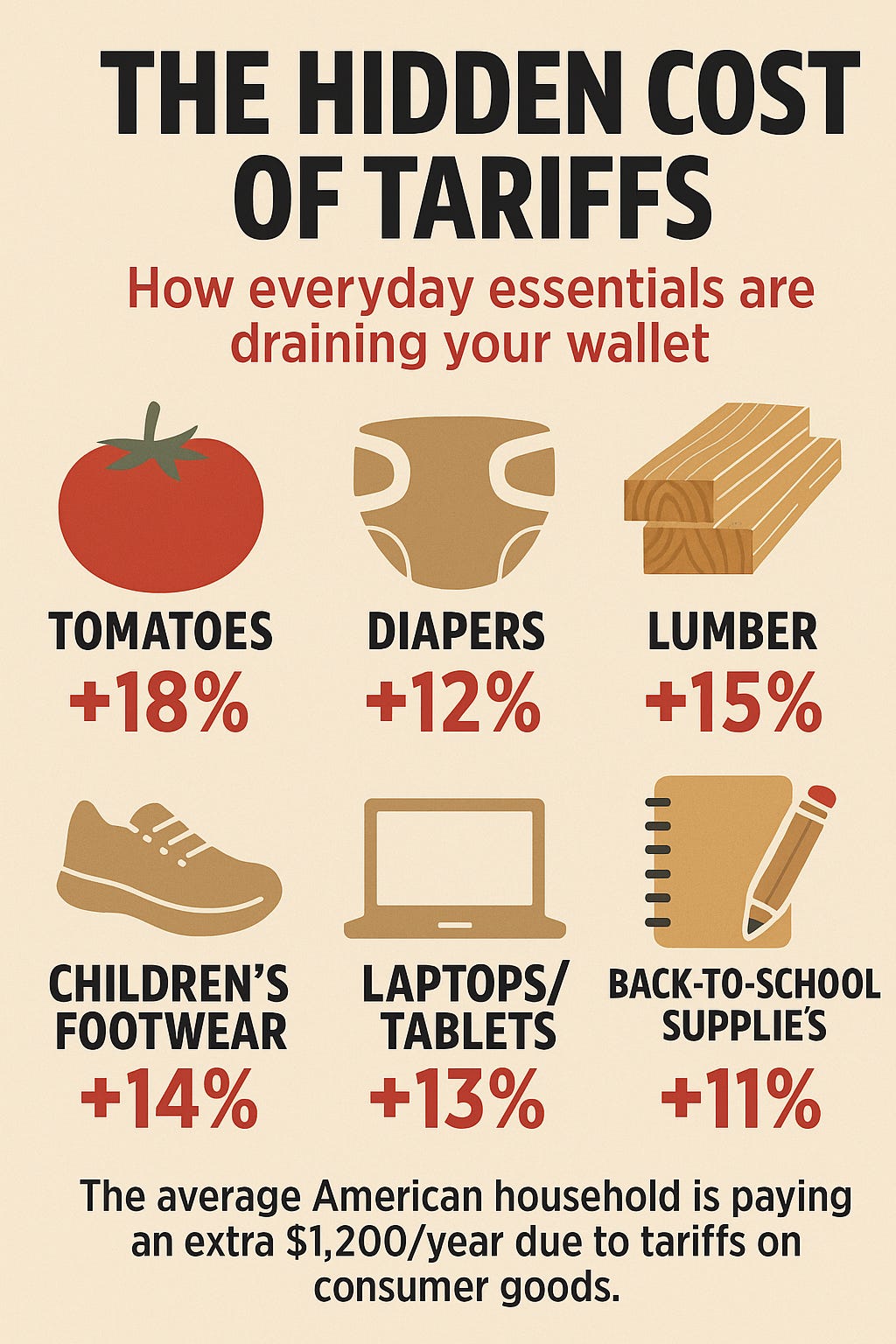
Despite rhetoric about punishing foreign competitors, these tariffs have become a hidden tax on U.S. consumers. As retailers shift costs onto customers, prices are rising across key categories:
Electronics: Laptops, TVs, and smart appliances up 8–14%
Apparel: Children’s clothing and footwear up over 12%
Groceries: Produce from Mexico and Canada more expensive than ever
“The idea that tariffs will bring back supply chains is misguided. Companies don’t pivot production overnight — they pass costs onto consumers.”
— Chad P. Bown, Senior Fellow, Peterson Institute
Just ask Jamie Simmons, a single parent in Ohio:
“The grocery bill that used to be $120 is now $170. I had to put back my kid’s new sneakers last week. We’re not buying luxuries—we’re buying basics, and even that’s becoming a struggle.”
Supply Chains Under Siege
With limited time to adapt, big-box retailers are scrambling to diversify their suppliers. But it’s not as simple as flipping a switch. Many factories in Southeast Asia and Latin America lack the infrastructure or scale to meet demand.
“Tariffs have compounded existing supply chain disruptions, fueling inflation without delivering clear strategic benefits.”
— David Autor, Professor of Economics, MIT
Economic Fallout Spills Over
The IMF recently downgraded global economic growth to 2.8%, naming U.S. tariffs as a significant contributing factor. Meanwhile, the U.S. Chamber of Commerce has warned that prolonged enforcement could lead to job losses across logistics, warehousing, and retail sectors.
Home Depot is already seeing delays and pricing volatility in key construction and renovation supplies. Target’s decline in market value underscores broader investor anxiety about the stability of consumer retail under trade war conditions.
Authoritarian Economics, Disguised as Patriotism
These tariffs were imposed unilaterally without bipartisan consensus or public debate. This mirrors a broader pattern of economic policymaking by executive fiat.
“Trade tensions and tariffs create uncertainty, leading to price volatility and supply chain adjustments that impact both businesses and consumers.”
— JP Morgan Market Insights
The Pattern Repeats
We’ve seen this before. During the Great Depression, the 1930 Smoot-Hawley Tariff Act raised import duties to record highs, triggering retaliatory tariffs from other countries and deepening the global economic crisis. Trump’s current approach is eerily reminiscent—escalating costs, provoking retaliation, and harming the very economy it claims to protect.
Who Really Wins?
Not American workers. Not American families. While the administration touts these tariffs as tools to punish foreign powers, the real result has been inflation, confusion, and instability.
A handful of domestic manufacturers may benefit. But tens of millions of Americans pay more weekly just to keep their households running.
Call to Action
This is about more than trade. It’s about democracy, accountability, and economic justice. Contact your representatives and demand:
Congressional hearings on the impact of these tariffs
Legislation requiring congressional approval for large-scale trade actions
Emergency relief for retailers and consumers being squeezed by inflation
Economic decisions should serve the people, not punish them. We cannot afford to repeat the mistakes of history while ignoring the families being hurt today. If this trade war continues unchecked, it won’t just empty shopping carts; it will empty homes, shelves, and futures.
This isn’t just about trade policies; it’s about whether families can afford their next meal or their children’s school supplies.
We just hit 12,000 subscribers—thank you! We’re offering full access to The Coffman Chronicle for just $1 a week ($52/year) to celebrate.
Get exclusive analysis and fearless reporting you won’t find in corporate media.
Bibliography:
Dollar, David. “Tariffs on China Are No Substitute for a Trade Deal.” Brookings Institution, June 20, 2019.
Bown, Chad P. “Chad Bown on Tariffs, Tracking Trade Wars, and the Future of Global Trade.” Peterson Institute for International Economics, April 2025.
Autor, David. “Clip: The New York Times Biden's China Tariffs Are the Wrong Way to Compete.” MIT News, May 18, 2024.
J.P. Morgan Asset Management. “Tariff Uncertainty and Asset Allocation.” J.P. Morgan, April 2025.
International Monetary Fund. “The Global Economy Enters a New Era.” IMF Blog, April 22, 2025.
U.S. Chamber of Commerce. “‘A Matter of Survival’: Small Businesses Speak Out on Tariffs.” U.S. Chamber of Commerce, March 3, 2025.
Britannica. “Smoot-Hawley Tariff Act.” Encyclopedia Britannica, accessed April 26, 2025.
Business Insider. “The Worst Is Yet to Come: Trump's Tariffs Could Mean Even Higher Prices and Empty Shelves Within Weeks.” Business Insider, April 2025.
Reuters. “US Starts Collecting Trump's 10% Tariff, Smashing Global Trade Norms.” Reuters, April 5, 2025.
Brookings Institution. “Did Trump's Tariffs Benefit American Workers and National Security?” Brookings Institution, September 2019.
It’s not just paying more - in a few days, the last freighter from China will dock in the West Coast. It’s reported the last on the east coast will dock 15th May. Apparently the ports like Seattle are ghost towns.
It’s not just everything will cost more - you will not be able to get things. There may be substitutes … but they won’t be from China, they will have some sort of tariff, they may not be as capable or you may go on a long waiting list.
Good luck
I have another article coming out soon with more information on the economic disaster that's coming. Christmas is going to suck this year. 😞 Thanks for the comment.