


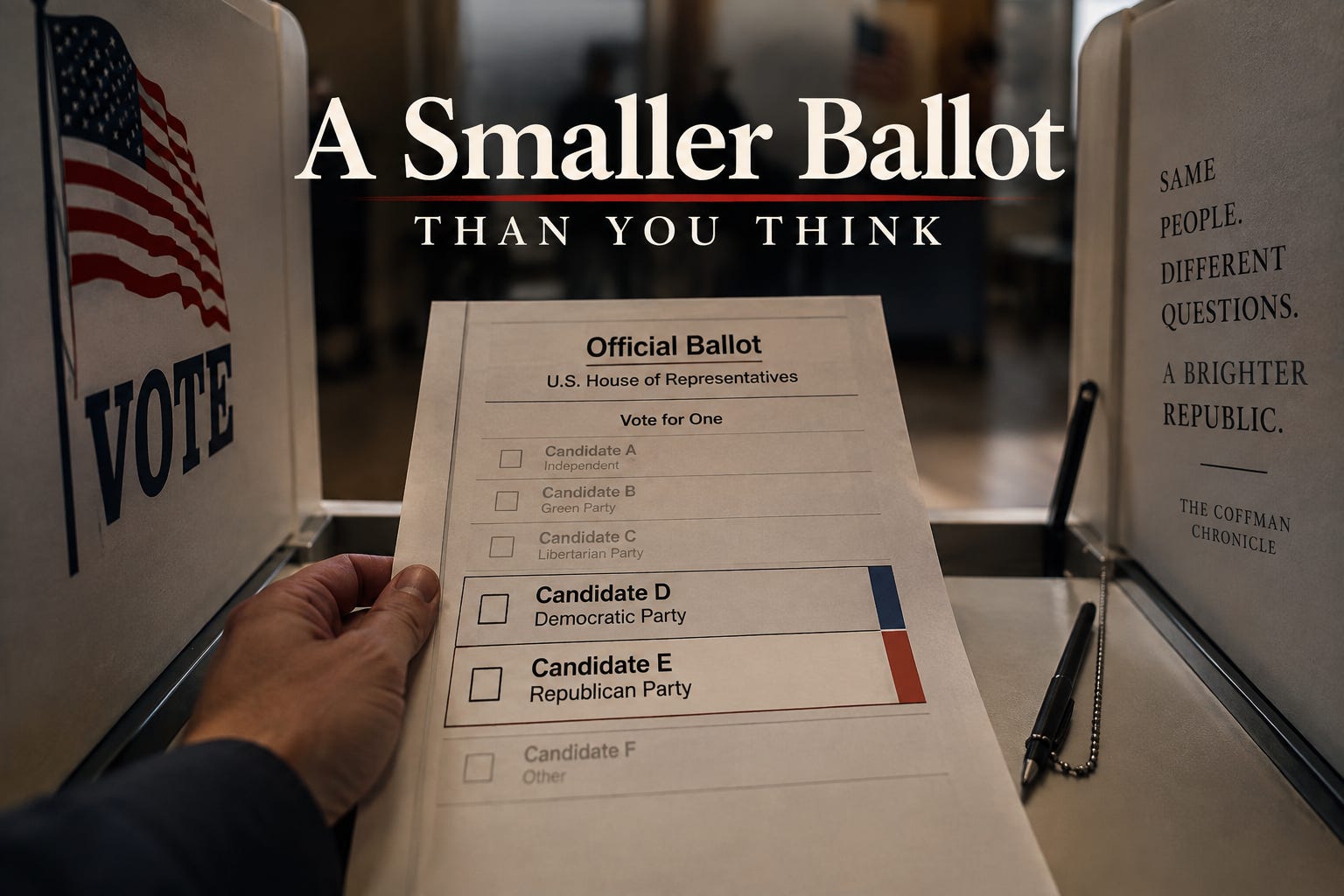
You walk into the voting booth with a lifetime of opinions that do not fit neatly into a box. Maybe you agree with one party on taxes, another on health care, and neither on what government should be doing in your community. Maybe you do not consider yourself a Republican. Maybe you do not consider yourself a Democrat.
Then you look at the ballot. Republican. Democrat. Sometimes there is another name— an independent, a Libertarian, or a Green. Sometimes there is someone outside the two parties that dominate nearly every election-night map in America.
Then another question begins creeping into your head. Can that person actually win? If I vote for them, am I wasting my vote? Will I help elect the candidate I like least?
That is where something strange happens. The question is no longer simply, “Who best represents me?” It becomes, “Which of the choices I have been given can I live with?”
Americans are told constantly that voting is the foundation of representative government. That is true, but there is another question we do not ask nearly enough. When you finally step into that booth, how much choice do you really have?
This Community Is Powered by You
What started as a small circle has grown into something much bigger, and it’s all because of readers like you.
Every time you forward this email, post it on socials, or bring someone new into the fold, you’re helping build one of the most passionate, independent communities out there.
Want to keep the momentum going?
Share this newsletter with someone who should be part of this conversation.
Thank you for being here. It means everything.
The Largest Political Identity in America Is Neither Party
In 2025, a record 45% of American adults told Gallup they considered themselves politically independent. Twenty-seven percent identified as Democrats, and another 27% identified as Republicans.
That number needs an important qualification. “Independent” does not mean politically neutral, centrist, or committed to voting for independent candidates. Many Americans who reject a formal party label still lean Republican or Democrat. Gallup’s number therefore does not describe a 45% third-party voting bloc, but it does describe a country in which nearly half of adults declined to identify first as either Republican or Democrat.
Pew Research Center found another part of the same disconnect: 25% of Americans said neither major party represented the interests of people like them even somewhat well. Among independents and people identifying with other parties, that rose to 39%.
Those Americans do not share one ideology. An independent conservative, a disaffected progressive, a libertarian, a moderate, and someone who simply distrusts political parties may agree on very little.
Perhaps that is the point. American voters are complicated. The machinery that translates their choices into representation is much less so.
You Have Freedom to Choose After the System Narrows the Menu
The Constitution does not say America should have two political parties. Republicans and Democrats did not even exist when it was written. However, the way Americans elect members of the House creates strong pressure toward two-party competition.
Federal law requires states with more than one House member to use single-member districts. The basic structure is one district, one representative, one winner.
The Congressional Research Service has noted that an electoral system in which each House constituency elects only one legislator, and only one candidate can win, encourages two-party competition.
Think about what that means from the voter’s side. Suppose five candidates represent five different combinations of beliefs, and you prefer Candidate C. If nearly everyone believes only Candidates A and B can win, supporting C can begin to feel less like expressing your preference and more like risking the victory of whichever major candidate you oppose most.
Political scientists call that strategic voting. Most voters know it by another name: being realistic. That realism can become self-reinforcing. Candidates outside the two dominant parties struggle to prove they are viable because voters hesitate to support candidates they believe cannot win. Voters hesitate because those candidates have not demonstrated that they can win.
That is not evidence of a secret agreement between Democrats and Republicans. Rather, the rules of the contest create an incentive. On paper, a voter may have three choices. In practice, that voter may believe only two count.
Before Voters Can Choose, Candidates Have to Reach the Ballot
Even before that calculation begins, another filter has already operated. The candidate must first reach the ballot.
The Federal Election Commission (FEC) does not determine ballot access for federal candidates. State law does. That means an independent congressional candidate faces different rules depending on where the race is being run.
The FEC’s 2026 calendar illustrates the variation. The general-election filing deadline for independent candidates was May 4th in Ohio, June 15th in Utah, August 3rd in Pennsylvania, August 25th in Oregon, and August 24th in Wyoming. The FEC cautions that those dates are general reference points because petition rules, declarations, and minor-party procedures can impose additional requirements.
None of that means independent candidates are prohibited from running, or that every state designed its rules to protect the major parties. It means that by the time a voter sees a ballot, much of the political field has already been shaped. Parties have nominated candidates. Independents and minor parties have navigated state requirements. Campaigns have raised money, recruited volunteers, sought attention, and tried to convince voters that they belong in the race.
We often talk about political choice as though it begins when the voter picks up a pen or touches a screen. It actually begins much earlier.
Then Comes the Word “Spoiler”
Suppose the independent candidate makes it through all of that. Their name is on the ballot. Now comes another pressure: the word “spoiler.”
The underlying concern is real. In an election in which only one candidate ultimately wins the seat, a third candidate can receive more votes than the margin separating the top two candidates without winning the election.
Imagine a result in which the Republican receives 48.7%, the Democrat receives 47.9%, and an independent receives 3.4%.
The independent received more votes than the margin separating the two major-party candidates. Someone will almost certainly say the independent cost one of them the election.
Maybe, but whose votes were they? Without evidence about those voters’ second choices, we cannot simply assign them to the losing major-party candidate. Some might have voted Republican. Some might have voted Democratic. Some might have skipped the race entirely. Others may have voted only because the independent gave them an option they actually wanted.
A vote cast for an independent is not automatically a Republican vote or a Democratic vote that wandered away. The vote belongs to the citizen who cast it.
Strategic voting can still be perfectly rational. If a voter’s overriding goal is preventing one candidate from taking office, supporting the strongest opponent may make sense, but deciding that neither major-party candidate has earned your support is also a political judgment.
So when an independent receives 3 percent, 5%, or 10%, perhaps the first question should not always be who that candidate hurt. Another question is available: Why did those voters choose someone else?
This November, We Get to Watch the Question Play Out
This is not an abstract problem waiting for some future election. It is already sitting on ballots this November.
As of September 11th, the Cook Political Report rated 21 U.S. House races as Toss Ups. Three provide especially clear examples of the choice problem. Arizona’s 6th District, Iowa’s 3rd District, and Wisconsin’s 3rd District are all currently rated Toss Ups.
In Arizona’s 6th District, voters will see Democrat JoAnna Mendoza, Republican Juan Ciscomani, Green candidate Gary Swing, and Libertarian Jereme Peters. In Iowa’s 3rd District, Democrat Sarah Trone Garriott and Republican Zach Nunn will share the ballot with Libertarian Jake Heard. In Wisconsin’s 3rd District, Democrat Rebecca Cooke and Republican Derrick Van Orden are running alongside independents Alexander Valiensi Kent and Rustin Levem Provance.
None of that tells us how any of those races will finish. It certainly does not tell us which major-party candidate, if either, would benefit from the absence of the other candidates.
It tells us something more useful for this discussion. In highly competitive races, voters will have additional names available. Some will choose the Republican. Some will choose the Democrat. Some will choose someone else.
If an independent or minor-party total eventually exceeds the margin between the two leading candidates, the temptation will be to call that candidate a spoiler, but the more revealing question may be why enough voters in a closely contested district rejected both major-party choices to make that conversation possible.
More Parties Would Not Automatically Fix the Problem
None of this proves that America would be better governed if every ballot contained six political parties instead of two. More names do not automatically create better choices. A new party can become as rigid as an old one. Candidates can still disappoint voters, and governing coalitions still have to be built somewhere.
Americans themselves are divided about whether they want additional parties. In a November 2025 Pew Research Center survey, 37% of adults said the statement “I often wish there were more political parties to choose from” described their views extremely or very well. Democratic and Democratic-leaning adults were more likely to say so than Republicans and Republican leaners, 46% to 29%.
The question is not whether three parties are inherently better than two. Rather, it is whether the choices available to voters adequately reflect the political diversity of the people making them.
A two-party system can bundle many factions into broad coalitions before Election Day, but that can simplify the final contest. The cost is that citizens whose views do not fit comfortably inside either coalition may confront a choice between joining one, voting for a candidate they think cannot win, or sitting out the race. That tradeoff deserves to be visible.
Representation Is More Than Permission to Vote
Article I does not describe the House of Representatives as a chamber chosen by political parties. It says its members are “chosen every second Year by the People.” Political parties are enormously important institutions, but the people are the constitutional source of the choice.
The Square New Deal begins with the idea that public institutions exist to serve the people who created them, not the other way around. That principle should apply to how we think about political parties, too.
A healthy republic does not require every political belief to produce its own party. It cannot guarantee every voter a candidate who matches every opinion, but voting should involve judgment: examining candidates, weighing competing interests, considering consequences, and deciding who should exercise public power on your behalf.
That judgment changes when the first calculation is whether supporting the person you prefer might help elect the person you oppose. The problem is not that voters sometimes make strategic choices, but why strategic choice has become such a familiar part of American voting that “Who can actually win?” can arrive before “Who represents me?”
Political parties should compete for support, as should candidates. Citizens remain free to decide that none of them has earned it. Representative government is about more than giving people permission to participate. It is about giving their political judgment somewhere meaningful to go.
The Question We Should Be Asking on Election Night
On election night, the map will turn red and blue. Commentators will count seats, and parties will celebrate victories, explain defeats, and begin talking about the next election. Independent and third-party candidates who finish far behind will mostly disappear from the conversation. Their voters should not.
Some Americans will enthusiastically choose Republicans. Some will enthusiastically choose Democrats. Some will choose someone else. Others may select a major-party candidate only because the person they actually preferred seemed unable to win. Those are different political judgments, yet the final map will compress almost all of them into red and blue. That is why the most interesting question about independent candidates this November may not be whether they win seats. It may be what their votes reveal.
A republic cannot guarantee every citizen the candidate they want. It cannot guarantee that every political philosophy becomes a viable party, but a ballot does not end the conversation about political choice.
The Democratic Party does not own voters who oppose Republicans. The Republican Party does not own voters who oppose Democrats. A vote for somebody else does not become the property of either party simply because the final margin is close. Those votes belong to the citizens who cast them.
As such, when the ballots are counted, and we ask who won Congress, another question is worth asking. How many Americans walked into the voting booth wanting something other than the two choices they had been taught to consider realistic?
Representative government is not measured only by whether people are permitted to vote. It is also worth measuring whether they believe their vote has somewhere meaningful to go.
Support Independent Media
If this piece gave you something worth thinking about, share it with someone who does not fit neatly inside a political box.
The Coffman Chronicle is supported by readers who believe representative government should answer to citizens, not parties, donors, or political machinery.
If you can afford to support independent journalism like this, consider becoming a paid subscriber.
If you cannot, keep reading, keep sharing, and keep asking the questions powerful institutions would rather leave unasked.
The republic belongs to the people. Act like it.
Sources
Borelli, Gabriel. “Nearly 4 in 10 Americans Wish They Had Options Beyond the Republican and Democratic Parties.” Pew Research Center, January 15, 2026. Pew Research Center
Brudnick, Ida A. The Congressional Research Service and the American Legislative Process. CRS Report RL33471. Washington, DC: Congressional Research Service, updated April 12, 2011. Congressional Research Service report
Cook Political Report. “2026 CPR House Race Ratings.” September 11, 2026. Cook Political Report House ratings
Federal Election Commission. “2026 Congressional Primary Dates and Candidate Filing Deadlines for Ballot Access.” Data as of May 18, 2026. Federal Election Commission filing-deadline report
Federal Election Commission. “Election Results and Voting Information.” Accessed September 21, 2026. Federal Election Commission
Jones, Jeffrey M. “New High of 45% in U.S. Identify as Political Independents.” Gallup, January 12, 2026. Gallup
Legal Information Institute. “2 U.S. Code § 2c—Number of Congressional Districts; Number of Representatives from Each District.” Cornell Law School. Accessed September 21, 2026. Legal Information Institute
Shepard, Steven, Andy Cerda, Joseph Copeland, Ted Van Green, and Shanay Gracia. “How Well the Republican and Democratic Parties Represent Americans’ Interests.” Pew Research Center, October 30, 2025. Pew Research Center
The Green Papers. “Arizona 2026 General Election.” Accessed September 21, 2026. The Green Papers — Arizona
The Green Papers. “Iowa 2026 General Election.” Accessed September 21, 2026. The Green Papers — Iowa
The Green Papers. “Wisconsin 2026 General Election.” Accessed September 21, 2026. The Green Papers — Wisconsin
U.S. Congress. “Constitution of the United States: Article I.” Constitution Annotated. Accessed September 21, 2026. Constitution Annotated
If you listen to those political ads on TV, you know that some candidates lie. For example, Bruce Blakeman, Nassau County Executive Director, is running for governor. He claims he is going to lower our utility bills, but we all know he is good buddies with The Fapweasel (Trump). He doesn’t really “believe” in climate change, solar panels, and wind turbines. Blakeman obviously has to go along with all of this, so how is he going to lower our energy costs and still stay on The Fapweasel’s good side? (Trump). Too many lies. As a voter, you have to have a good memory and develop your ability to spot a lie. My mom used to say, “a liar has to have a good memory.” We know our president doesn’t!
Yes! In my coastal Virginia district, I have a choice between a Republican who loves Trump and a Democrat who loves Israel. A pox on both their houses.