


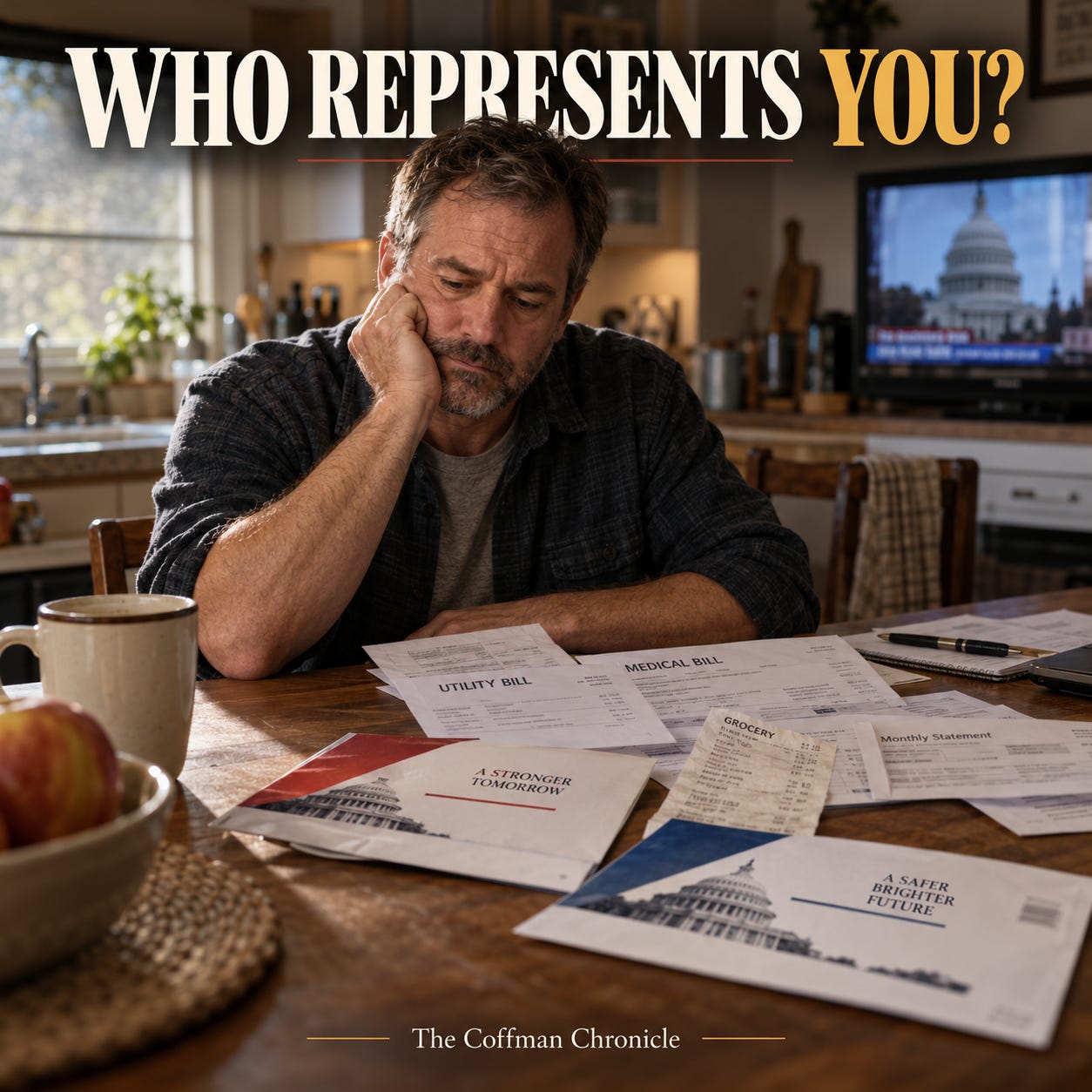
The Voter Who Doesn’t Feel Represented
Another election is approaching, and the bills are already sitting on the kitchen table. Groceries take a larger bite out of the paycheck. The mortgage or rent is due, healthcare is expensive, and whatever was supposed to go into retirement savings has already been spent somewhere else. Meanwhile, Democrats and Republicans are explaining, once again, why the other side is responsible for America’s problems.
Some citizens still believe strongly in the party they support. Others vote reluctantly, choosing the candidate whose policies worry them less. Some have stopped voting because neither party seems to speak for them. Those are different choices, and the parties have different policies, records, and responsibilities, but they lead to the same unsettling question: How can a citizen participate in representative government and still feel unrepresented by the people who win?
An election determines who gets the authority to govern. It does not settle whether voters trust those officials, agree with their agenda, or believe their concerns will be heard. The campaign may end on election night, but citizens still have to live with what comes after.
This Community Is Powered by You
What started as a small circle has grown into something much bigger, and it’s all because of readers like you.
Every time you forward this email, post it on socials, or bring someone new into the fold, you’re helping build one of the most passionate, independent communities out there.
Want to keep the momentum going?
Share this newsletter with someone who should be part of this conversation.
Thank you for being here. It means everything.
The Numbers Say Americans Are Frustrated
This frustration is not confined to the loudest voices on social media. In a Pew Research Center survey conducted in September 2025, 56% of American adults said the Republican Party did not represent their interests well; 58% said the same of the Democratic Party. One in four said neither party represented their interests even somewhat well.
The numbers require care. Those first two groups overlap, and Pew found that most Americans still felt at least somewhat represented by one major party. The survey does not show that the entire country has rejected its political choices. It does show a sizable population that sees no adequate home in either party.
A separate poll published in October 2026 by the Associated Press–NORC Center for Public Affairs Research found that 55% of registered voters thought Republicans could not solve important problems, while 48% said the same about Democrats. On the cost of living, 38% trusted Democrats more, 27% trusted Republicans more, and 27% trusted neither. Results differ by party, but many voters question whether either can deliver the solutions they need.
These surveys measure perceptions, not what officeholders privately believe. They cannot prove a politician doesn't care. They can, however, show that many Americans doubt whether the people asking for their votes understand the problems they face.
Voting Against Someone Is Not the Same as Voting for Someone
Consider the person who enters the voting booth more worried about one candidate winning than excited about the other. That vote is no less legitimate. Preventing a policy you believe would harm your family or community can be a serious, thoughtful reason to participate. However, a ballot cast in opposition does not necessarily signal enthusiasm for everything the winning candidate plans to do.
A Pew Research Center analysis published in October 2026, based on a survey conducted in May and June, illustrates the tension. Among independents who leaned Republican, 56% said a major reason for leaning that way was the belief that Democratic policies were harmful to the country. Among independents who leaned Democratic, 64% said the same about Republican policies. Only 34% of Republican leaners and 27% of Democratic leaners cited the perceived benefits of their preferred party’s policies as a major reason.
Those figures describe why people lean toward a party, not how particular individuals voted in an election. Still, they help explain why a victory isn't a blank check. Some people helped elect a candidate because they supported the agenda; others may have decided the alternative was worse. Their votes count equally, and elected officials must govern within the constitutional system, not just celebrate the size of their majority.
Political Parties Are Not the American People
Political parties are not intruders in American democracy. They recruit candidates, organize campaigns, propose policies, and give voters useful information about competing approaches to government. Running a large representative democracy without political organizations would be difficult. The danger arises when winning for the organization becomes easier to explain than serving the public.
The Constitution establishes Congress, the presidency, and the courts. It does not establish the Republican or Democratic Party as a branch of government. A representative may campaign under a party banner, but everyone in that district is a constituent. Senators represent their states, including people who voted against them, people registered with smaller parties, and people who stayed home.
Parties also help shape the choices offered in November. Primaries and ballot-access rules influence which candidates reach the general election; state law determines who may participate in a primary. Parties have legitimate interests in choosing nominees, while voters have legitimate reasons to ask whether those rules leave them meaningful choices. We do not need to pretend political parties are unnecessary to recognize that a party nomination and a public office carry different obligations.
For non-aligned voters, much of the practical concern arises before November. In some states, they cannot participate in a major party’s closed primary without joining that party. Elsewhere, the rules provide different opportunities. A fair debate about those arrangements can respect parties’ freedom to associate while still asking whether the political process gives citizens a meaningful voice.
Australia Requires Participation. Does That Guarantee Representation?
Australia offers a revealing contrast. Eligible citizens generally must enroll and vote in federal elections. Those who fail to vote without a valid and sufficient reason can face an initial administrative penalty of 20 Australian dollars (A$20), and unresolved cases can reach court. The Australian Electoral Commission reports that 90.7% of enrolled voters turned out for the 2025 House of Representatives election.
Australia also uses preferential voting in federal elections. For its House of Representatives, voters rank every candidate in order of preference. This lets voters express a first choice and then indicate acceptable alternatives, rather than making only one selection. Compulsory participation and preferential voting are separate features of the system; neither, by itself, tells us whether citizens approve of their representatives.
Supporters of compulsory voting see broad participation as a civic responsibility. Critics object to financial penalties for not participating. That debate is worth having, but our question is different. If almost everyone reaches the ballot box, have we necessarily answered whether people are heard after the election? A legal duty to cast a ballot cannot substitute for an elected official’s duty to answer for decisions made in office.
The Kitchen Table Is Where Political Promises Are Tested
At the kitchen table, nobody gets a discount on groceries because their preferred party won, because government cannot control every price or paycheck. Markets, businesses, state policies, world events, and federal decisions all play a part. However, citizens can still examine the choices their government actually made, instead of accepting a campaign’s explanation that every problem belongs to the opposition.
That is not a minor concern. In a Pew survey conducted from September 28 to October 4, 2026, 84% of registered voters said the economy was very important to their congressional vote. Healthcare, housing, energy, and retirement are not abstractions in a television debate. They determine what a household can afford and what it must postpone.
Consider the Social Security Fairness Act. The House passed it 327–75 in November 2024, and the Senate approved it 76–20 in December. Signed into law the following January, it repealed two provisions that reduced Social Security benefits for some people receiving pensions from jobs not covered by the program, including certain teachers, firefighters, and public employees. By July 2025, the Social Security Administration reported sending more than 3.1 million payments totaling $17 billion to eligible beneficiaries, including payments for benefits previously withheld.
For a retired public employee whose benefits had been reduced, that change meant more money coming into the household. However, the legislation also carried a public cost. The Congressional Budget Office estimated it would increase federal deficits by approximately $196 billion from 2024 through 2034. Supporters considered the previous benefit reductions unfair, while critics questioned the cost and consequences for Social Security’s finances.
Here is what accountability looks like in practice. Citizens can examine how their representatives voted, who benefited from the change, what it costs, and why Congress chose that approach. Lawmakers from both parties supported the measure, and members of both parties opposed it. Their individual voting records tell citizens considerably more than the party labels beside their names.
The Constitution Gives Power to Representatives, Not Party Headquarters
That example leads us to Article I of the Constitution. Congress makes federal law, exercises the taxing and spending powers assigned to it, and authorizes the use of public money through the constitutional appropriations process. Congress can also investigate federal administration as part of its legislative and oversight responsibilities. A president may sign or veto legislation and administer laws through the executive branch, but presidential attention does not erase congressional authority.
Party leaders influence committee assignments, agendas, and negotiations. Individual members cannot force every bill to a vote or control an entire chamber's decisions. Yet citizens can still ask which proposals their lawmakers supported, what amendments they offered, how they voted, and what they did when agencies failed to implement a law properly.
The Social Security Fairness Act illustrates why this matters. Congress decided to change the benefit rules. The president signed the legislation, and the Social Security Administration had to carry it out. Each institution had a role, and each can be examined for what it actually did. A voter who knows the difference between those responsibilities is better equipped to judge a campaign promise or a political accusation.
The Square New Deal: Representation Requires Stewardship
The Square New Deal approaches this as a question of stewardship. Government stewardship begins with a simple obligation: Public power must serve public purposes, under rules citizens can understand and challenge. Representatives cannot satisfy every constituent or follow every shifting majority opinion. They can explain their choices, account for public resources, and accept scrutiny of the results.
Citizen stewardship matters just as much, but it should not be reduced to an instruction to vote and stop complaining. People can study a voting record, attend a local meeting, question an agency, organize neighbors, support a candidate, or defend another person’s right to participate. When someone stops voting, we should ask why before calling them irresponsible. Disillusionment, deliberate protest, and practical barriers are not the same problem.
A parent working two jobs, an older adult without reliable transportation, and a citizen with a disability may all care deeply about civic decisions while finding it hard to attend a public meeting or reach a polling place. Institutions should be judged partly by whether ordinary people can use them, not simply by whether participation is available on paper.
Participation is not only a responsibility that government demands from citizens. Government has responsibilities that make participation meaningful: fair opportunities to take part, public information that can be examined, lawful avenues for disagreement, and officials answerable for decisions. None of that requires citizens to surrender their judgment to a political party. The Constitution belongs to the people, including the people who disagree about how it should be used.
Your Vote Belongs to You
After the election, the bills remain on the kitchen table. Some neighbors will be pleased with the result, others relieved that an alternative lost, and others convinced they were offered no satisfactory choice. Whoever wins must govern a community larger than the people who voted for the winner. Public office is not a party’s possession or a license to ignore constituents who voted differently.
Citizens do not need to applaud every law to deserve an explanation. They can ask who benefited, who paid, what alternatives were considered, and how their representatives used the authority entrusted to them. These are not acts of disloyalty. They are the ordinary work of self-government between elections.
Your vote belongs to you. The responsibility of representation belongs to the people elected to serve. Political parties may win elections, but they do not inherit ownership of the republic. That authority remains with the American people, and so does the right to demand an accounting.
Support Independent Media and Help Keep the People at the Center of Government
The Coffman Chronicle looks beyond party labels, follows the decisions made by those in power, and shows how those decisions affect ordinary Americans at the kitchen table. Our job is not to defend Democrats or Republicans. Our job is to follow the facts, ask difficult questions, and remind elected officials that they serve the people, not their political parties.
If this kind of independent journalism matters to you, please share this article and subscribe for free. And if you can afford to support the work, consider becoming a paid subscriber. Your support helps keep The Coffman Chronicle independent and focused on the accountability Americans deserve.
Political parties may compete for power, but the republic belongs to the people.
Sources
AP-NORC Center for Public Affairs Research. “Few Voters See Either the Republican Party or the Democratic Party as Able to Solve Important Problems or Help People Like Them.” October 3, 2026.
Australian Electoral Commission. “Electoral Backgrounder: Compulsory Voting.” Accessed October 19, 2026.
Australian Electoral Commission. “Participation in the 2025 Federal Election.” Accessed October 19, 2026.
Australian Electoral Commission. “Voting in the House of Representatives.” Accessed October 19, 2026.
Congressional Budget Office. H.R. 82, Social Security Fairness Act of 2023. Cost estimate, September 9, 2024.
Kiley, Jocelyn, Steven Shepard, Andrew Daniller, and Hannah Hartig. “Economy Ranks as Top Issue in Midterms for All Voters—but Partisans Differ Over the Importance of Other Issues.” Pew Research Center, October 8, 2026.
National Archives. “The Constitution of the United States: A Transcription.” Accessed October 19, 2026.
National Conference of State Legislatures. “State Primary Election Types.” Accessed October 19, 2026.
Shepard, Steven. “Why Americans Identify as Republicans and Democrats—and Why They Don’t.” Pew Research Center, October 2, 2026.
Shepard, Steven, Andy Cerda, Joseph Copeland, Ted Van Green, and Shanay Gracia. “How Well the Republican and Democratic Parties Represent Americans’ Interests.” Pew Research Center, October 30, 2025.
Social Security Administration. “Celebrating Our Recent Social Security Fairness Act Milestone and What It May Mean for You.” Social Security Matters, July 10, 2025.
U.S. House of Representatives, Office of the Clerk. “Roll Call 456: H.R. 82, Social Security Fairness Act.” 118th Congress, November 12, 2024.
U.S. Senate. “Roll Call Vote 338: H.R. 82, Social Security Fairness Act.” 118th Congress, December 21, 2024.
The Democratic party still represents me very well. I just wish they didn't waffle so much and were more aggressive. I don't quite understand how someone thinks neither party represents them, it should be clear that whichever you agree with most, well, that represents you. It's a bit harsh, but I think those who waffle between the two are wishy-washy. You have strong beliefs and values, don't you? So vote according to them.
I see a clear difference between Democrats and today’s Republicans. The Republicans are no longer “the party of Lincoln,” far from it. I don’t agree with the Democrats on everything, but they don’t lie.