


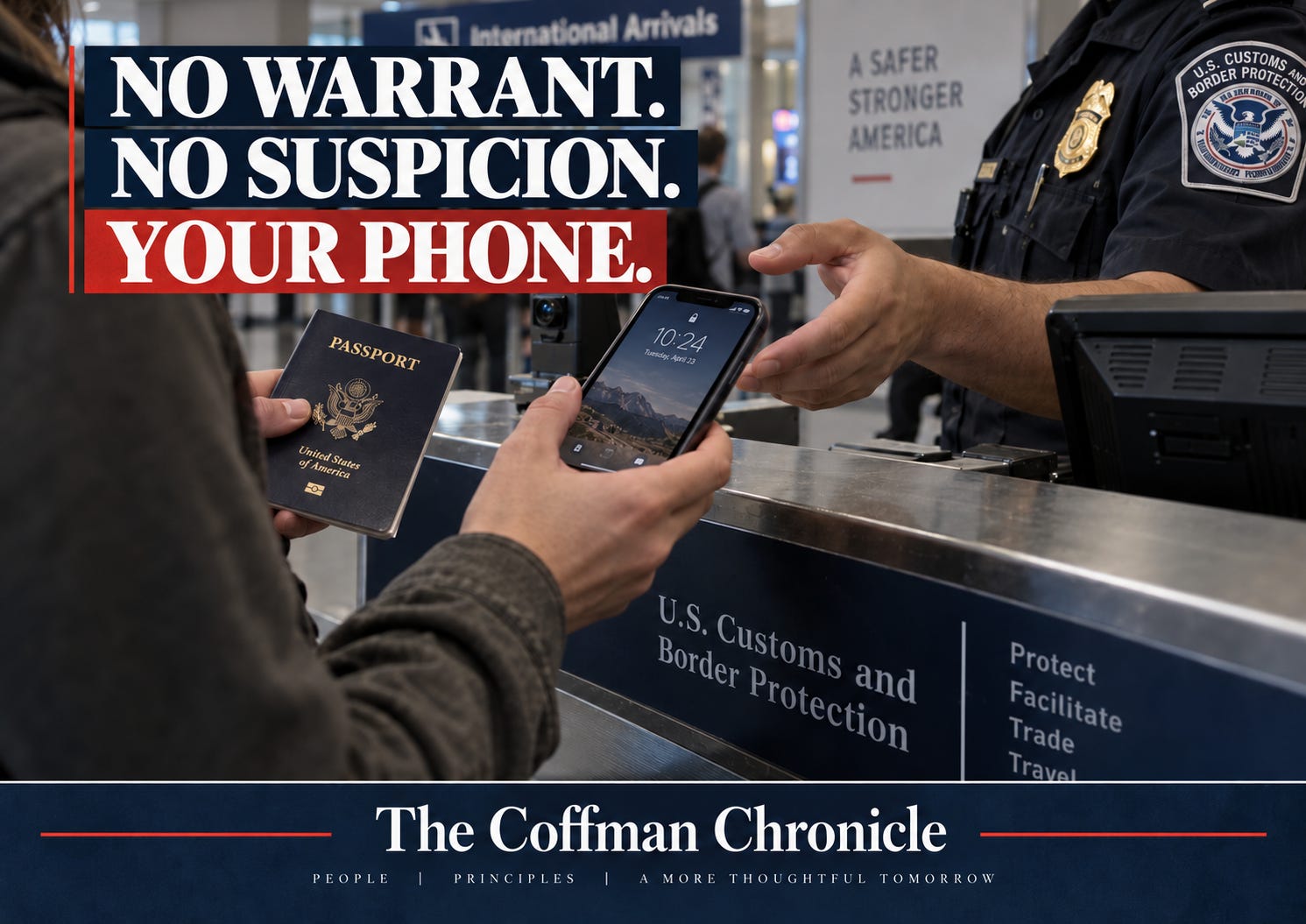
You have been out of the country for a week. Perhaps it was a vacation. Maybe you were visiting family, or your employer sent you somewhere you wouldn't have chosen on your own. Whatever the reason, the trip is over. You have landed back in the United States, stood in the customs line, and handed over the document proving you have every right to come home.
Then a federal officer asks for your phone. You have not been charged with a crime, nor has a judge signed a warrant, and the officer does not necessarily have reasonable suspicion that you have done anything wrong. The little rectangle in your pocket may contain conversations with your spouse, photographs of your children, banking information, medical records, work emails, internet searches, location history, and pieces of your life you may never have shown another human being.
On September 17th, the U.S. Court of Appeals for the Second Circuit ruled in United States v. Alisigwe that the government may manually search a traveler’s cellphone at the international border without a warrant, probable cause, or individualized suspicion. The decision directly governs federal courts in New York, Connecticut, and Vermont. The Second Circuit also noted that other federal appeals courts considering comparable manual searches have reached similar conclusions.
That may sound like a narrow legal dispute about customs officers, airports, and one criminal defendant, but it becomes much more personal when the phone in question could be yours.
This Community Is Powered by You
What started as a small circle has grown into something much bigger, and it’s all because of readers like you.
Every time you forward this email, post it on socials, or bring someone new into the fold, you’re helping build one of the most passionate, independent communities out there.
Want to keep the momentum going?
Share this newsletter with someone who should be part of this conversation.
Thank you for being here. It means everything.
This Power Did Not Begin With Donald Trump
The timing makes Donald Trump part of this story. The ruling arrived during his current term, so his administration is the one presently exercising the authority the court upheld. However, it would be inaccurate to pretend he invented it.
The first cellphone search at the center of Alisigwe took place in February 2019, during Trump’s first term. The second occurred more than two years later, during the Biden administration. The policy history goes back even further. In 2009, during the Obama administration, the Department of Homeland Security issued directives governing border searches of laptops and other electronic media.
The rules and technology have changed, but the underlying border-search authority has survived Republican and Democratic administrations. Government power outlives presidential politics. An authority tolerated when someone you trust occupies the White House can pass directly to someone you distrust.
Before deciding whether this particular power goes too far, however, there is a more basic question: Why does the government have so much search authority at the border in the first place?
Why Government Has More Power at the Border
The international border has always been different. The Supreme Court has long recognized what is known as the border-search exception. The principle rests on a straightforward idea: a sovereign nation must be able to control who and what enters its territory. That means customs officers do not need a warrant every time they open a suitcase. Routine searches of people and property entering the United States have traditionally received considerably more constitutional latitude than searches conducted inside the country.
That authority has a practical basis. A border officer who needed a warrant before inspecting every suspicious suitcase would not have a workable border-security system. Contraband moves. People move. Decisions often must be made while the traveler and the property are standing directly in front of the officer.
Protecting the nation’s borders is legitimate government work. The easiest argument here is also the weakest: government should keep its hands off everything belonging to an American citizen unless it first convinces a judge. That has never been the constitutional rule at the border.
The Second Circuit relied on that history in Alisigwe. Under its precedents, routine searches of a traveler’s property at the border do not require individualized suspicion. The court concluded that a manually searched cellphone falls within that rule because, legally, the phone is property.
On paper, the reasoning is simple. People cross the border with belongings the government has traditionally been allowed to inspect. A cellphone is one of them. Then technology changed what “belongings” could mean.
Then Technology Changed the Meaning of Belongings
A suitcase can hold a great deal, but eventually you reach the bottom. A cellphone is different. It may contain years of photographs, thousands of private messages, financial information, medical records, work documents, internet searches, location history, and notes never intended for anyone else.
Current U.S. Customs and Border Protection policy does place an important limit on the search. Officers are supposed to disable network connections and may not use the device to access information stored only remotely. However, whatever is resident on the phone can still amount to an enormous archive of a person’s life.
Judge Eunice Lee focused on the gap between treating a phone as a physical object and confronting what a search of that object can actually expose. She agreed that the government did not need a warrant or probable cause in this case, but she rejected the majority’s broader conclusion that a cellphone search should be treated as another routine border search requiring no individualized suspicion. She warned that such a rule could expose an international traveler’s medical records, finances, personal messages, browsing habits, location information, and other private material simply because the traveler returned to the United States.
That is the problem with applying an old legal category to a new kind of possession. The border-search exception developed around trunks, bags, papers, packages, and other physical things. They could reveal private information, but they had natural limits on how much of a person’s life they could contain.
A smartphone has almost no comparable boundary. Judge Lee noted that one of the Second Circuit precedents underlying the majority’s reasoning was decided in 2006, before the first iPhone was released. The physical-property rules courts inherited were built in a world that looked very different from the one now passing through an airport checkpoint.
That does not automatically make the old rule unconstitutional, but it should make us ask whether calling a phone “property” actually answers the question.
There’s one more issue. A traveler selects the items in their suitcase, but you do not control who sends you something on your phone. Your suitcase remains closed, perhaps even locked, as you travel, but your phone keeps receiving texts, social media shares, emails, and other data you haven't necessarily endorsed.
The Supreme Court Has Already Said Phones Are Different
In 2014, the Supreme Court confronted a different version of the same technological problem. Police arrested David Riley in California and seized a cellphone from his pocket. Officers searched the phone without first obtaining a warrant and found information later used against him. Police have traditionally been allowed to search a person and objects immediately associated with that person after a lawful arrest, but a cellphone complicated that analogy.
In Riley v. California, the Supreme Court held that police generally must obtain a warrant before searching the phone’s digital contents. The Court emphasized that modern cellphones can hold immense quantities of personal information and can reveal far more than the physical objects traditionally carried in a pocket.
Riley did not involve the international border, and the border-search exception rests on a different constitutional foundation. The Second Circuit therefore rejected the argument that Riley automatically requires a warrant or reasonable suspicion before a manual border search of a cellphone.
Legally, those circumstances are different, but the phone has not changed. The device that can reveal an extraordinary portion of someone’s private life after an arrest does not suddenly become less revealing when its owner walks through customs.
The Kitchen-Table Test
Imagine sitting at your kitchen table with your phone in front of you, then unlocking it and handing it to a government agent you have never met. You have not been arrested, a judge has not signed a warrant, and the government has not explained what it thinks you did. You crossed an international border.
Would that feel like handing over a suitcase, or like handing over a piece of your private life? Ordinary people do not experience their phones as legal categories. They experience them as the place where their children text, their doctors send messages, their banks send alerts, their photographs accumulate, and years of ordinary life quietly collect.
The government may have good reasons to inspect a traveler’s belongings, but the more intimate the thing being searched becomes, the more important it is to ask what the government is trying to find and what limits should accompany that power.
That does not mean every cellphone search at the border is abusive, but it does mean we should stop pretending the intrusion is trivial.
Government Still Has a Legitimate Problem to Solve
There is another reason this case should not be reduced to a simple privacy slogan. Chinwendu Alisigwe was not randomly selected from a customs line with no investigative history. Federal investigators were already investigating fraudulent identification documents tied to him. The court’s opinion says Alisigwe used fraudulent passports and identification documents to open bank accounts in real people's names.
When officers searched his phone at John F. Kennedy International Airport in 2019, they found images containing other people’s names, birthdates, Social Security numbers, bank information, and addresses. More than two years later, another manual search uncovered a WhatsApp message connected to one of the identities he had stolen.
The district court concluded that officers had reasonable suspicion on both occasions. On appeal, Alisigwe did not challenge that finding. Instead, he argued that the searches required a warrant and probable cause. The Second Circuit went further than the district court, holding that because these manual cellphone searches were routine searches of property at the border, the government did not need reasonable suspicion at all.
The difference between having reasonable suspicion and being legally required to have it is the heart of this case. The evidence found on Alisigwe’s phone illustrates why law enforcement wants access to digital devices at the border. Phones can contain evidence of serious crimes, but constitutional rules are rarely written only for easy cases. A rule that permits a search when investigators have strong reasons to suspect criminal activity also governs the traveler for whom they have no particular reason to suspect anything.
The government may have had good reasons to search Alisigwe’s phone. The Second Circuit’s ruling says it did not need them. Those are not the same proposition.
Constitutional Permission Is Not the Same as Good Stewardship
Courts decide whether government has crossed a constitutional boundary. That is essential work, but it is not the same thing as deciding whether government should exercise every bit of power that remains on the lawful side of that boundary. That is where stewardship begins.
If a court says the Constitution allows a manual cellphone search at the border without reasonable suspicion, that establishes what the Fourth Amendment permits under that court’s reading of the law. It does not require Congress to authorize the broadest possible use of that power, agencies to treat every lawful intrusion as wise, or citizens to stop asking whether the rules are proportionate to the government’s purpose.
Sufficient government differs from maximum government. Sufficient government has enough authority to stop contraband, investigate serious crimes, protect the border, and enforce the law. Maximum government takes every inch of authority courts are willing to tolerate and treats that permission as the end of the discussion.
The Square New Deal begins from a different premise: public power should be strong enough to do the public’s work and disciplined enough to remember who that power belongs to. If reasonable suspicion would still allow officers to search phones when facts point toward criminal activity, asking whether suspicion should be required is not an argument against border enforcement. It is an argument about proportionality.
The Constitution sets boundaries. Stewardship asks what government does inside them.
Congress Writes the Rule
If this power is going to exist, Congress should not leave its practical boundaries entirely to court decisions and agency policy.
U.S. Customs and Border Protection, or CBP, already distinguishes between a “basic” manual search and an “advanced” search using external equipment to review, copy, or analyze a device’s contents. Under current CBP policy, officers may conduct a basic search without suspicion. An advanced search generally requires reasonable suspicion of a violation of law enforced or administered by CBP, or a national-security concern, as well as senior-manager approval. CBP’s own two-tier system shows that the government already recognizes that not every cellphone search carries the same level of intrusion.
Congress can decide whether those protections are sufficient. It can debate whether manual searches should require reasonable suspicion and can establish statutory rules for privileged communications, retention, information sharing, notice to travelers, and public reporting. Those are legislative questions involving security, privacy, law enforcement, technology, and constitutional liberty. That is exactly why they belong in the people’s branch.
Congress need not wait for the Supreme Court to declare a practice unconstitutional before writing stronger statutory safeguards, nor should an issue this important depend indefinitely on executive policies a future administration can revise. A durable republic does not govern every new technology by stretching an old rule until a court finally tells it to stop. Congress is supposed to see the new problem, debate the competing interests, and write the rule.
The question is not whether border agents should have meaningful authority to search electronic devices, but rather what showing of cause the government should have to make before opening a device that can reveal far more about a person than any suitcase ever could.
Never Design Power Around the President You Trust
Power exercised under one president can be inherited by another. An agency policy can outlast an administration. A court precedent may govern travelers years after the original political fight has faded.
The question is not simply whether you trust one administration to search a cellphone at the border, but whether you would be comfortable giving the same authority to a president you deeply distrust. If the answer changes depending on whose name appears on the Oval Office door, then the problem may not be the president. It may be the power.
That is the discipline a constitutional republic demands from citizens as well as government. We should not demand restraints only when our political opponents control the machinery of the state and forget those restraints when people we support take their place.
Government needs enough authority to protect the border and investigate serious crime. Americans also need enough privacy to live ordinary lives without treating every exercise of government power as unlimited merely because a court has declared some portion of it lawful.
Those responsibilities can exist together. The answer is not powerless government. It is sufficient government governed by durable rules—rules written carefully enough to protect the country, strong enough to protect the citizen, and permanent enough not to depend on which president happens to be standing behind them.
The next time an American returns home from another country, there may be a passport in one hand and a cellphone in the other. One tells the government who you are. The other may tell the government almost everything else. A phone may fit in your pocket. We should stop pretending that makes it a suitcase.
Support Independent Media
If you believe government power should be strong enough to protect the country and limited enough to protect the citizen, share this piece with someone who still thinks constitutional questions only matter when the other side is in charge.
The Coffman Chronicle is supported by readers, not political parties, corporations, or campaigns. If you can afford to support independent writing that puts the Constitution, the working class, and the people’s branch ahead of partisan loyalty, please consider becoming a paid subscriber.
And if a paid subscription is not in the budget, keep reading, keep sharing, and keep asking the harder question: Not who has the power but what rules come with it?
Sources:
United States Court of Appeals for the Second Circuit. United States v. Alisigwe, No. 24-960. Decided September 17, 2026. https://ww3.ca2.uscourts.gov/decisions/OPN/24-960_complete_opn.pdf.
Supreme Court of the United States. Riley v. California, 573 U.S. 373 (2014). https://www.supremecourt.gov/opinions/boundvolumes/573BV.pdf.
U.S. Customs and Border Protection. “Border Search of Electronic Devices at Ports of Entry.” Accessed September 21, 2026. https://www.cbp.gov/travel/cbp-search-authority/border-search-electronic-devices.
U.S. Department of Homeland Security. “Secretary Napolitano Announces New Directives on Border Searches of Electronic Media.” August 27, 2009. https://www.dhs.gov/archive/news/2009/08/27/new-directives-border-searches-electronic-media.
It's a very interesting post. It accommodates competing interests: privacy, and the legitimate prerogative of government.
One curiosity that occurred to me, especially regarding things like banking-related records, is that some things require passwords. Does any part of the government have a legitimate theory as to whether mobile phone holders are required to reveal passwords?